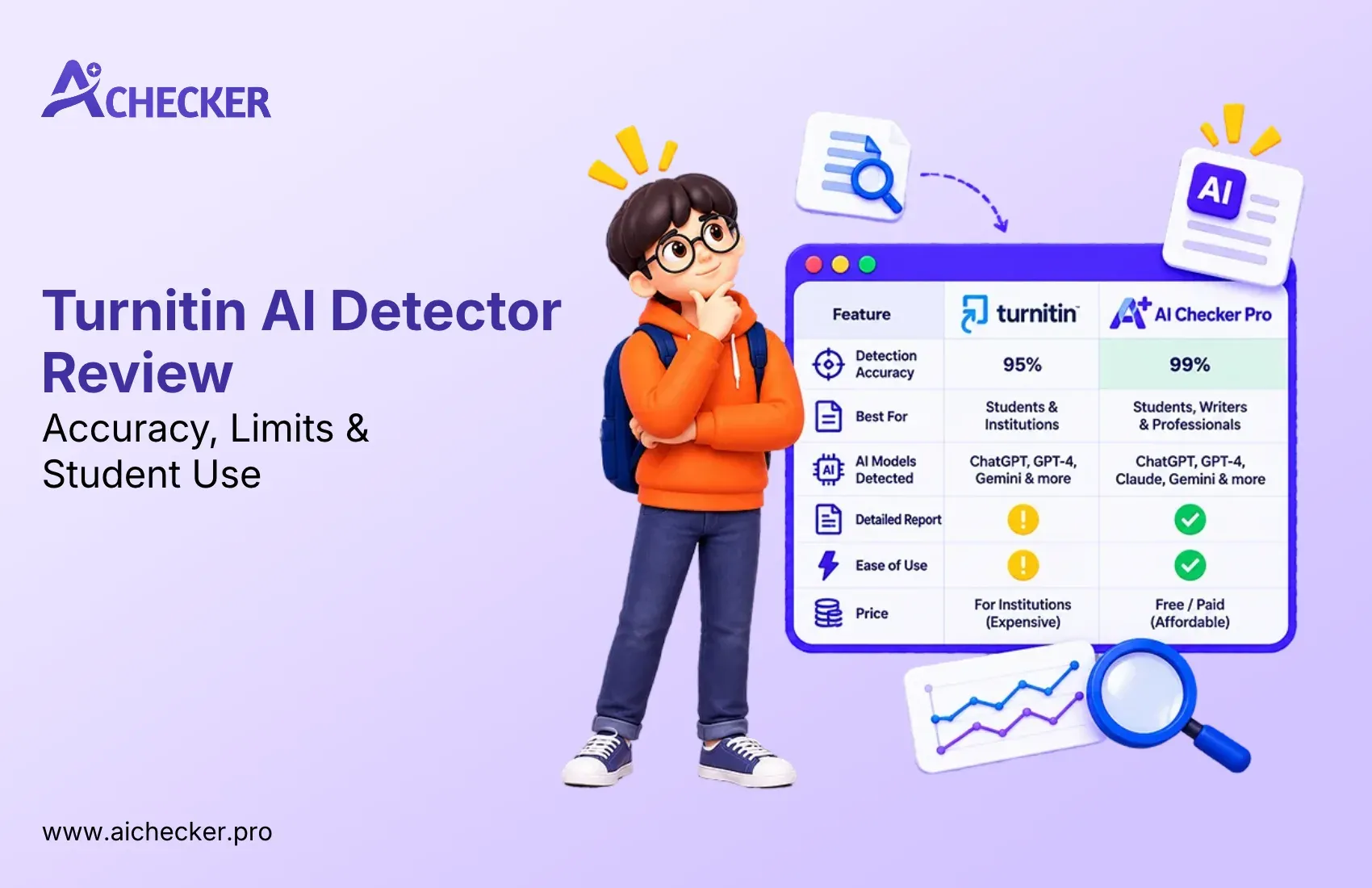
Turnitin AI Detector Review: Accuracy, Limits & Student Use
TABLE OF CONTENTS
Key Highlights
What Is the Turnitin AI Detector?
How Accurate Is Turnitin AI Detector in 2026?
Is Turnitin AI Detector Reliable in 2026?
What Does Turnitin AI Detection Percentage Mean?
ChatGPT, Claude and Gemini: What Can Turnitin Catch?
Turnitin AI Detector False Positives: Can Turnitin Falsely Detect AI Writing?
What Are the Limitations of Turnitin AI Detection?
Turnitin Plagiarism Checker vs AI Detector
Turnitin AI Detection for Students and Teachers
Turnitin AI Detector Free and Alternatives
How AI Checker Pro Fits In
What I Would Do Before You Submit or Grade
Conclusion
FAQs
Get an AI summary of this post on:


If you are a student, a teacher, or a blogger, this Turnitin AI detector review is for you. I have tested many essays and blog posts on detectors, and the single largest issue is rarely the tool.
It is how people read the score. Here is the short answer: Turnitin's AI detector estimates how much of a submitted document resembles text from a language model. It is a helpful signal, but it is not proof, and it is not 100% accurate.
In this guide, I will show you how it works, how accurate it is in 2026, what the percentage means, and what to do if you get unfairly flagged. I will explain it simply.
Key Highlights
- No AI detector is 100% accurate, and that includes Turnitin.
- Scores under 20% show an asterisk instead of a number, because Turnitin's own testing found more false flags in that range.
- The percentage shows how much of the text looked AI-written. It does not show the chance that a student cheated.
- Formal writing and non native English writing carry a higher risk of being flagged by mistake.
- Paraphrased and humanized AI text is harder to catch than raw ChatGPT output, even after Turnitin's 2025 and 2026 updates.
- In most school setups, students cannot open the AI report unless their instructor shares it.
The main takeaway from this Turnitin AI detector review: check your draft yourself before you submit, so nothing surprises you.
What Is the Turnitin AI Detector?
Turnitin was initially designed as a plagiarism checker for thousands of US higher education institutions and secondary education schools. The tool gained an additional feature in 2023, as the company released an AI writing indicator. Thus, the reports generated by the software include both similarity and artificial intelligence scores.
The detector is referred to as Turnitin AI detector, Turnitin AI checker, or Turnitin AI detection tool, depending on the marketing section.
However, the software is embedded as a component in the educational establishments' submission system, meaning that it is not available for standalone use on a third-party website.
Get Lifetime Access with 60% OFF
Stop paying monthly subscriptions. Enjoy unlimited AI detection and humanizer access forever with future updates included.
- One-time payment
- Unlimited access forever
- All future updates included
Turnitin breaks the document into overlapping parts consisting of several sentences, and for each sentence, it calculates the probability of it being generated by a language model.
Then, it considers typical patterns of language models, such as highly consistent word choice and improbable regularity in sentence structure. Lastly, it counts these sentences and reports the ratio as the percentage of text generated by a language model.
A few facts help you read the result:
- It needs roughly 300 words of normal prose before it will run.
- It works best on long essays, not on lists, code, or short answers.
- It was built mainly for English writing.
- It spots patterns. It cannot see who typed the words or how they were produced.
That last point is the core idea behind Turnitin AI writing detection. It is pattern matching, not evidence.
How Accurate Is Turnitin AI Detector in 2026?
Turnitin claims their detector has a less than 1% false positive rate at the document level. However it's only for documents with over 20% AI content.
For this Turnitin AI detector review, I ran a batch of student style essays last month, a mix of fully human written, raw ChatGPT output, and edited AI drafts, the results were all over the place as you might expect. Raw AI text was flagged most of the time, but lightly edited AI text was a coin flip, and a couple of very formal human essays got attention they didn't deserve.
It matches up with what I've seen in my testing with Turnitin AI detector accuracy across tools. Turnitin updated their model in February 2026, and added detection for humanizer tools in August 2025.
They've made improvements, but there's still reason to be skeptical about these claimed accuracy rates. Vendors will always report numbers that make them look good, and OpenAI turned off its own AI classifier in 2023, after finding it wasn't accurate enough.
Is Turnitin AI Detector Reliable in 2026?
Turnitin claims their detector has a less than 1% false positive rate at the document level. However, it's only for documents with over 20% AI content.
For this Turnitin AI detector review, I ran a batch of student-style essays last month, a mix of fully human written, raw ChatGPT output, and edited AI drafts; the results were all over the place as you might expect. Raw AI text was flagged most of the time, but lightly edited AI text was a coin flip, and a couple of very formal human essays got attention they didn't deserve.
They've made improvements, but there's still reason to be skeptical about these claimed accuracy rates. Vendors will always report numbers that make them look good, and OpenAI turned off its own AI classifier in 2023, after finding it wasn't accurate enough.
What Does Turnitin AI Detection Percentage Mean?
Firstly, I detected the ChatGPT blog content through AI Checker Pro. I again Humanize content through AI checker Pro then checked the result from Turnitin.
Now, I check this Humanized content to Turnitin AI Detector.
Now I'll give real-time data & Insight,
AI detection: 1%
Humanized content: 93%
Here is how the Turnitin AI detection score usually looks:
- Asterisk (*%): Turnitin saw some signals, but the estimate fell under 20%, so it hides the number.
- 0%: No sentences were flagged as likely AI.
- 20% and above: A real number appears, and highlighted sentences show up for the instructor.
- Very high scores: These get the most attention, but even a score of 90% is still an estimate.
The plain text explanation of what Turnitin AI percentage means is that 40% of qualifying sentences were machine-written.
Someone still needs to review the paper and interpret the results. Many instructors review the Turnitin AI detection results before even reading the essay, so a poor score can be damaging before any discussion even occurs.
ChatGPT, Claude and Gemini: What Can Turnitin Catch?
Turnitin does not care about what tools you're using. It looks at your writing's characteristics. That's why the brand doesn't matter; it's about the percentage of text that is raw model and how much you change it.
Does Turnitin Detect ChatGPT?
Yes, it often does when the text is raw or lightly edited. This is why many people search for a Turnitin ChatGPT detector. ChatGPT style writing is smooth, balanced, and predictable, and that is exactly what the model was trained to catch.
Can Turnitin Detect Claude AI?
It can flag Claude output too, especially long unedited answers. Claude tends to write in a slightly different rhythm than ChatGPT, but it is still model written prose with recognizable patterns.
Can Turnitin Detect Gemini AI?
The same logic applies. Gemini text can be flagged when it is submitted with little change. Turnitin has not published a public accuracy table for each model, so anyone who gives you exact catch rates for Claude versus Gemini is guessing.
Can Turnitin Detect AI Generated Essays?
Yes, a fully AI generated essay is the easiest case. Where it gets messy is mixed work, like a human outline, an AI draft, and a heavy rewrite. The more you personally shape the argument, examples, and wording, the less the writing looks like a model's default output.
Does Turnitin Detect AI Paraphrasing?
Partly. Detection accuracy decreases for paraphrased or humanized AI text compared to raw AI text, for all major detectors.
Simple synonym substitutions are no longer foolproof, since Turnitin has added paraphrasing detection in 2024 and bypassers detection in 2025. At the same time, a text that has been substantially reworded and contains personal detail is significantly harder to classify.
Detection and rewriting are in a perpetual arms race, with each side getting better at its craft all the time. If your educational institution allows AI assistance, your safest option is to use AI for ideation and structure, and complete the final writing on your own.
If you wish to edit a draft you have already written, an AI checker pro can highlight the sentences that appear to be generated by AI so that you can rewrite them in your own words.
Turnitin AI Detector False Positives: Can Turnitin Falsely Detect AI Writing?
Yes, and this is the part feared by students. Human language can be flagged as AI, and Turnitin have admitted there were false positives. Research that went viral in 2023 suggested that a number of detectors were more likely to flag writing in non native English. As a result a number of prestigious universities have either turned off, or limited, their use of AI detection.
Writing styles that raise the risk include:
- Formal academic prose with very regular sentences
- Five paragraph essays and lab report templates
- Non native English writing with simple, careful phrasing
- Heavy use of grammar tools that smooth everything out
- Short introductions and conclusions, which Turnitin itself said had higher false flag rates
Picture a sophomore at a state university who writes a clean, careful reflection paper in her second language. It reads smooth because she worked hard to make it correct. That is exactly the kind of paper that can trigger a flag, and I have seen similar cases play out.
How do you lower your risk of Turnitin AI detector false positives?
- Write in Google Docs so you have a full version history.
- Add specific details only you would know, such as class discussions, local examples, or personal experience.
- Vary your sentence length on purpose.
- Do not run every sentence through a grammar rewriter.
- Check your draft before you submit it, so you can fix flagged sentences
What Are the Limitations of Turnitin AI Detection?
If you only remember one section of this Turnitin AI detector review, make it this one. These are the real limits:
- Length: Short answers and small samples are unreliable or not scored at all.
- Language: It is built mainly for English prose.
- Mixed writing: It struggles to separate human edits from AI drafts.
- No source: Unlike plagiarism matching, it cannot point to the original text.
- Moving target: Each model update can change scores on the same essay.
- Humanized text: Edited, paraphrased, or humanized writing is harder to judge.
These Turnitin AI detector limitations are the reason many schools tell teachers to treat the report as one piece of evidence among several.
Turnitin Plagiarism Checker vs AI Detector
These two features answer different questions, and mixing them up causes a lot of panic.
- The plagiarism side compares your text against a large database of sources and shows matches.
- The AI side looks at writing style and predicts if a model produced it.
You can have 0% similarity and still get a high AI score. You can also have a high similarity score and 0% AI. Seeing the Turnitin plagiarism checker vs AI detector difference clearly will save you a lot of stress.
Turnitin AI Detection for Students and Teachers
Can Students Check Turnitin AI Detection Score?
Usually not. Depending on the school, policies may vary, but in most cases, only the instructor can open an AI report. This is why students are so concerned about Turnitin AI detection for students. The best option is to ask the instructor about their policy and do your own scan before submitting.
Turnitin AI Detector for Teachers
For teachers, the Turnitin AI detector for teachers works best as a starting point. If a paper gets a high score, here is what I would do:
- Read the paper yourself before judging the number.
- Compare it with the student's in class writing.
- Ask the student to talk through their process and show drafts.
- Never base a penalty on the score alone.
Turnitin AI Detector Free and Alternatives
Many students ask about a Turnitin AI detector free option. The honest answer is, that Turnitin is licensed by schools, so you only can get to it through your school. There is no public free version.
That is why there is growing interest in Turnitin AI detector alternatives, and Any Turnitin AI detection review that doesn't mention the alternatives is considered incomplete.
Here is how the main options compare:
| Tool | Accuracy Notes | Free Tier | Humanizer Included | Best For |
|---|---|---|---|---|
| Turnitin | Strong on raw AI text, weaker on edited text | No, school license only | No | Schools and universities |
| GPTZero | Popular with educators, results vary on edited text | Limited free plan | No | Teachers and students |
| Originality.ai | Built with publishers in mind, no tool is perfect | Paid, credit based | No | SEO teams and agencies |
| AI Checker Pro | Sentence level detection | Check the pricing page for current plans | Yes | Students, bloggers, and businesses |
No detector in this table is 100% accurate, so I always suggest using more than one signal
How AI Checker Pro Fits In
Tools like AI Checker Pro can help to detect AI content accurately and show you exactly which sentences are AI-generated, instead of giving you one number that represents a percentage of AI content.
Instead of rewriting the content manually, most users turn to AI Checker Pro to eliminate all traces of AI from their content. AI Checker Pro has an AI humanizer, supports ChatGPT, GPT -4, GPT -5, Gemini, Claude, and has been used by 100K+ users.
I have personally witnessed bloggers clean their content using AI Checker Pro and then post it with confidence, knowing that all traces of AI have been completely removed from their content. The process for students is just as simple.
What I Would Do Before You Submit or Grade
The biggest lesson from this Turnitin AI detector review is simple: protect yourself early. Here is what actually works in 2026:
- Keep your notes, outlines, and drafts.
- Read your paper out loud and fix any sentence that sounds like a template.
- Check your work before the deadline, not after.
- Follow your school's AI policy, because rules differ from class to class.
- If you are flagged, stay calm and bring your drafts and version history.
Have you ever had a paper flagged that you wrote yourself? You are not alone, and it is more common than most people think.
Conclusion
All things considered, this Turnitin AI detector review boils down to one key point: the score is a suggestion and nothing more. While it does a decent job at detecting blatant cases of AI-generated text, you can't ignore the possibility of false positives, paraphrased content, and combined drafts, which means Turnitin is only somewhat reliable.
If you are a student, make sure to keep your drafts and ask to review your work before handing it in. If you are a professor, have a heart-to-heart chat with the student before pressing the evil button. And if you are looking for another tool to double-check your results, give AI Checker Pro a shot!
FAQs
How accurate is Turnitin AI detector?
Does Turnitin detect ChatGPT?
Can Turnitin detect Claude AI?
Can Turnitin detect Gemini AI?
Can Turnitin falsely detect AI writing?
What does Turnitin AI detection percentage mean?
Can students check Turnitin AI detection score?
Is Turnitin AI detector reliable in 2026?
Does Turnitin detect AI paraphrasing?
Is there a free Turnitin AI detector?

Harshil Barvaliya
SEO Executive & Content Writer at AI Checker Pro
I’m Harshil Barvaliya, an SEO Executive and Content Writer at AI Checker Pro. I focus on improving the website’s search engine visibility through effective SEO strategies, including keyword research, on-page and off-page optimization, and content development.Get Started Free
Create a free account for advanced AI detection and scan history.
Trusted by thousands worldwide.
Recent Blog's
Discover how AI-powered content creation can elevate your website's reach and engage your audience like never before. Explore the real impact of AI on crafting content that connects.