False Positives Explained: Why AI Checker Pro Might Flag Human Writing as AI
TABLE OF CONTENTS
What Is a False Positive in AI Detection?
Why Do AI Detectors Flag Human Writing as AI?
How Common Are AI Detector False Positives?
Real-World Examples of False Positives
How AI Checker Pro Approaches Detection Accuracy
How to Reduce AI Detector False Positives Before You Submit
What to Do If Your Writing Was Falsely Flagged
AI Detector Accuracy: Understanding Confidence Scores
Best Practices for Using AI Detection Tools Responsibly
Conclusion
FAQs
Get an AI summary of this post on:





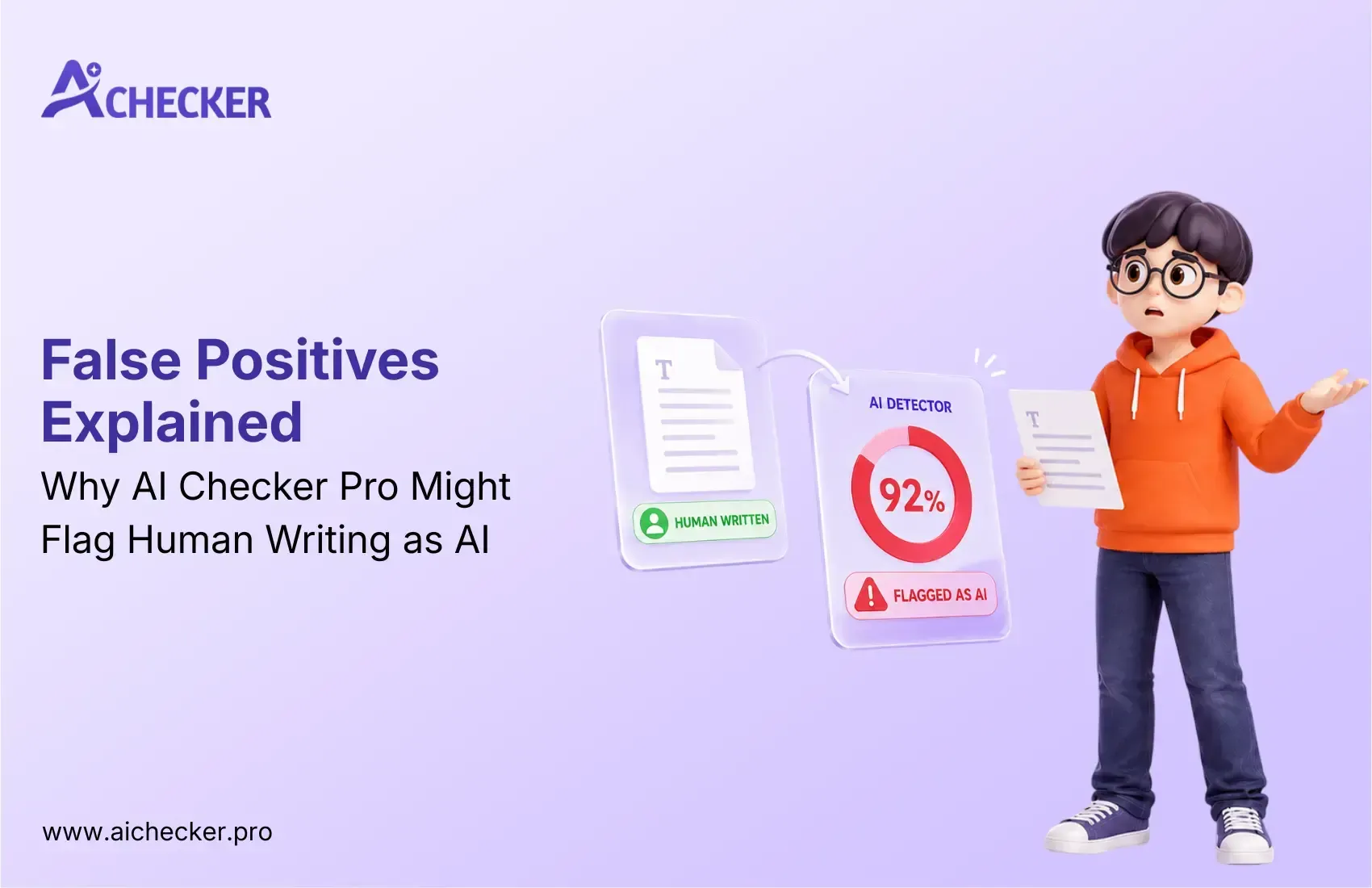
You have written every word yourself, run it through AI Checker Pro, and gotten a high percentage nevertheless. What is a false positive, exactly, and how common is it?
AI detection programs sometimes make false positives, which means that they classify human-written text as AI-generated. A false positive could be caused by a checker using a formal tone or similar patterns to other large language models.
Every AI detecting program, including AI Checker Pro, is not 100% accurate, and knowing what happens is essential to prevent false positives from happening.
This is an in-depth article on why false positives occur, how common they are, and what students, editors, and writers do about them.
What Is a False Positive in AI Detection?
A false positive in AI detection occurs when an AI detection tool registers human language as "likely AI-generated" despite the piece never being touched by an AI.
A false positive is much worse than a false negative, which is when an AI-generated text is not flagged by a detector. While both are errors in detection, false positives can damage one's credibility in the literary world and turn away potential clients.
AI detectors cannot detect intent, so they scan texts for patterns most commonly found in text generated by AI and register how likely it is for that text to be AI-generated. Therefore, any statement made about the accuracy of AI detectors is a probabilistic statement.
Why Do AI Detectors Flag Human Writing as AI?
Most AI detector issues stem from the way they're trained on foundational models. These programs evaluate text patterns against those produced by AI, and there are several writing styles that overlap with those characteristics.
1. Predictable or Formal Sentence Structure
AI models tend to write in balanced, grammatically clean sentences. So do many trained writers, technical authors, and non-native English speakers who learned formal grammar rules. That overlap alone can trigger detection algorithms.
2. Repetitive Phrasing and Structure
Academic writing, business reports, and SEO content often reuse transition words and consistent paragraph structures. Detectors read this uniformity as a possible AI signal, even when it's simply a disciplined writing style.
3. Short Text Length
Most detectors, including AI Checker Pro, Originality.ai, Grammarly's AI detector, and Winston AI, recommend a minimum word count before scanning, often around 100-300 words. Shorter samples don't give the model enough pattern data, which increases the chance of a false positive AI detection result.
4. Heavy Use of Grammar or Paraphrasing Tools
Grammar checkers, sentence rewriters, and style tools sometimes smooth out natural irregularities in your writing. Ironically, this can make human text look more "polished" and therefore more machine-like to a detector.
5. Non-Native English Writing Patterns
Multiple independent studies have found that detectors disproportionately flag text from non-native English speakers, since simplified sentence construction can resemble the more uniform output of language models. A few tips to avoid AI detection in writing can help reduce this risk.
6. Templated or Formulaic Content
Cover letters, product descriptions, and structured reports often follow near-identical formats across many writers, a habit shared across the field rather than any one AI detector for content writers or individual's style, and that repetition can push AI detection scores higher.
How Common Are AI Detector False Positives?
No detector is unimpeachable. Even the best tools, developed independently by academic researchers looking to establish AI detector accuracy benchmarks, have a history of yielding false positives on human-written material, especially technical writing, ESL work, and short content.
This is why responsible AI detection services provide a probability score rather than a binary "AI or human" result, because businesses should use these tools as one part of their review process, not the only part.
Here's a simplified way to think about detection error types:
| Error Type | What It Means | Risk Level |
|---|---|---|
| False Positive | Human text flagged as AI | High; can damage trust or grades |
| False Negative | AI text passes as human | Moderate; content still needs quality review |
| Uncertain/Mixed Score | Text sits near the 40-60% range | Requires manual review, not automatic judgment |

Get Lifetime Access with 60% OFF
Stop paying monthly subscriptions. Enjoy unlimited AI detection and humanizer access forever with future updates included.
- One-time payment
- Unlimited access forever
- All future updates included
Real-World Examples of False Positives
A university student submits a personal statement written entirely by hand. Because it follows a structured five-paragraph format common in academic writing, it scores 60% "likely AI." Running that kind of draft through an AI detector for essays before submission can catch this early.
A non-native English blogger writes clear, grammatically correct product copy. The simplified sentence patterns trigger a moderate AI detection score.
A technical writer documents an API using consistent terminology and short, repetitive sentences, standard practice in technical writing, and receives an inflated AI probability score.
None of these cases involve AI-generated content. They involve writing styles that statistically resemble it.
How AI Checker Pro Approaches Detection Accuracy
AI detector reliability increases as a tool does more than simply provide a percentage. Sentence-level analysis, rather than an overarching score, provides more context for writers and evaluators to understand how AI content detectors work and arrive at more accurate conclusions.
A useful AI detection workflow generally includes:
- Scanning the full text for an overall AI probability score.
- Reviewing sentence-level highlights to see which sections were flagged and why.
- Cross-checking flagged sections against the writer's known style or drafting history.
- Treating any single scan as one signal, not a final verdict.
Writers who want to demonstrate originality can also review their writing history or drafts before submitting work, which helps explain flagged sections that a detector alone can't account for.
How to Reduce AI Detector False Positives Before You Submit
You can't eliminate detection risk, but there are ways to reduce AI detector false positives before you submit:
- Vary your sentence length. Mix short and long sentences instead of uniform structure.
- Add specific, personal details. Concrete examples and lived experience are harder for detectors to associate with AI patterns.
- Avoid over-editing with AI-powered grammar tools right before a final scan, since heavy smoothing can reduce natural variation.
- Write in multiple sittings. Natural drafting, revision, and self-editing create irregularities that align with typical human writing behavior.
- Keep text length above the tool's recommended minimum, usually at least 100-300 words, for a more reliable score.
What to Do If Your Writing Was Falsely Flagged
If you're a student or professional facing a false positive accusation:
- Don't panic or immediately rewrite everything. A single score isn't proof of AI use.
- Request the sentence-level report, not just the overall percentage, and review which parts were flagged.
- Provide supporting evidence: draft history, outline notes, or version history from Google Docs or Word.
- Ask for a second scan using a different AI detector, since detection scores vary by model and training data.
- Explain your writing background if relevant: for example, ESL status or a technical writing style, since these are known triggers for AI detection errors.
AI Detector Accuracy: Understanding Confidence Scores
An AI detection limitations reality check: no percentage score means "guilty" or "innocent." A 70% AI score means the model found writing patterns 70% common to known AI writing, not that 70% of the text is AI-generated. Understanding how accurate AI content checkers really are helps put any single score into perspective.
Treat AI detector output the way you'd treat a spam filter: useful, generally accurate, but wrong often enough that a human still needs to make the final call, especially in academic or employment settings.
Best Practices for Using AI Detection Tools Responsibly
AI detection software is most effective when it's used as part of a broader content verification process instead of a standalone decision-making system. Whether you're a student, educator, editor, or business, following responsible practices helps reduce misunderstandings and improves the accuracy of your reviews.
For Students
If you're submitting academic work, keep your research notes, outlines, and document version history. These files provide evidence of your writing process if your work is ever questioned. Running your draft through an AI detector for students before class can help you spot flagged sections early. Avoid making excessive AI-assisted edits immediately before submission, as this can unintentionally increase detection scores.
For Content Writers and Marketers
Professional writers should focus on producing authentic content with unique insights rather than writing solely to satisfy AI content checkers. Including personal experiences, original research, industry examples, and expert opinions naturally makes content more distinctive while improving overall quality.
Before publishing, use AI detection as a quality-checking tool rather than a pass-or-fail test. If certain sections receive unusually high scores, review them for repetitive wording or overly predictable sentence patterns instead of rewriting the entire article.
For Educators
AI detectors should support academic integrity, not replace professional judgment. When a paper receives a high AI probability score, review the student's previous assignments, writing style, and available draft history before reaching any conclusions. A good AI detector guide for teachers can help set fair, consistent review policies for the whole class.
Providing students with an opportunity to explain their work or submit supporting evidence creates a fairer evaluation process and reduces the impact of false positives.
For Businesses
Organizations using AI detection for businesses in hiring, compliance, or content verification should establish clear review policies. Rather than rejecting content based on a single percentage, combine AI detection reports with plagiarism checks, editorial review, and manual assessment.
This layered approach improves decision-making while minimizing the risk of incorrectly labeling genuine human work as AI-generated.
Ultimately, AI detection works best when paired with human expertise. The technology continues to improve, but it remains a probabilistic system that identifies patterns, not intent or authorship. Using it responsibly ensures more accurate evaluations and helps maintain confidence in both human and AI-assisted writing.
Conclusion
False positives are an integral part of AI detection technology. AI Checker Pro cannot distinguish between texts written by humans and generated by artificial intelligence with a high level of accuracy. Various types of formal writing, technical documentation, short samples, texts in non-native English, and other elements can affect the result and statistical probability.
Therefore, the best option is to view the detection score as a helpful indication and analyze the whole paper instead of relying solely on one result.
A comprehensive evaluation of sentence structure, drafts, and other factors will help determine if anything needs to be improved. Also, if you use AI Checker Pro to detect AI content before submitting your work, it would be easier to identify potential issues and improve the text.
FAQs
1. Why does AI Checker Pro flag human writing as AI?
2. What is a false positive in AI detection?
3. How accurate is AI Checker Pro?
4. Can grammar checkers cause false positives?
5. Does short text length affect AI detection scores?
6. Why do non-native English writers get flagged more often?
7. What should I do if my writing is falsely flagged as AI?
8. Can technical writing trigger AI detection false positives?
9. How can I reduce AI detector false positives before submitting?
10. What does a 70% AI score actually mean?

Harshil Barvaliya
SEO Executive & Content Writer at AI Checker Pro
I’m Harshil Barvaliya, an SEO Executive and Content Writer at AI Checker Pro. I focus on improving the website’s search engine visibility through effective SEO strategies, including keyword research, on-page and off-page optimization, and content development.Get Started Free
Create a free account for advanced AI detection and scan history.
Trusted by thousands worldwide.
Recent Blog's
Discover how AI-powered content creation can elevate your website's reach and engage your audience like never before. Explore the real impact of AI on crafting content that connects.