Why AI Detection Is Becoming a Major Problem in Education, SEO, and Publishing
TABLE OF CONTENTS
What Is AI Detection and How Does It Work?
Why AI Detection Became Important So Quickly
The Biggest Problems With AI Detection Today
AI Detection Problems in Education, SEO, and Publishing
AI Humanizers vs AI Detectors: The New AI Arms Race
The Future of AI Detection Technology
Conclusion
FAQs
Get an AI summary of this post on:





AI detection has gone from a niche thing to a mainstream kind of crisis in just a few years, and honestly, it didn't feel gradual. Schools are using AI checkers to flag student essays, while publishers are now rejecting whole pieces of work based on AI content detector numbers.
At the same time, SEO pros are second-guessing every single line they write. Yet the very tools that were supposed to "fix it" are turning into a new puzzle, and maybe a bigger one too. This article sorta unpacks exactly why AI detection is getting worse as a serious issue, and what that means for writers, teachers, and content creators right now.
What Is AI Detection and How Does It Work?
AI detection is basically trying to figure out whether some writing came from an artificial intelligence system, not from a human. An AI detector looks at a bunch of little patterns in how the text shows up, like the sentence layout, how predictable the words feel, and whether the style stays consistent all the way through. Then it gives a probability score, like how likely it is that the content is machine-generated.
In simple terms, an AI text detector looks for patterns that humans rarely use, but language models repeat often.
What AI Detectors Analyze
AI detection tools rely on a few core signals:
- Perplexity: How unpredictable the word choices are. Human writing tends to be more varied; AI writing is often more predictable.
- Burstiness: Humans mix short and long sentences. AI tends to use uniform sentence lengths.
- Repetitive phrasing: AI models often reuse the same transitions and sentence starters.
- Statistical likelihood: An AI writing detector compares text against models trained on known AI outputs to calculate a detection probability.
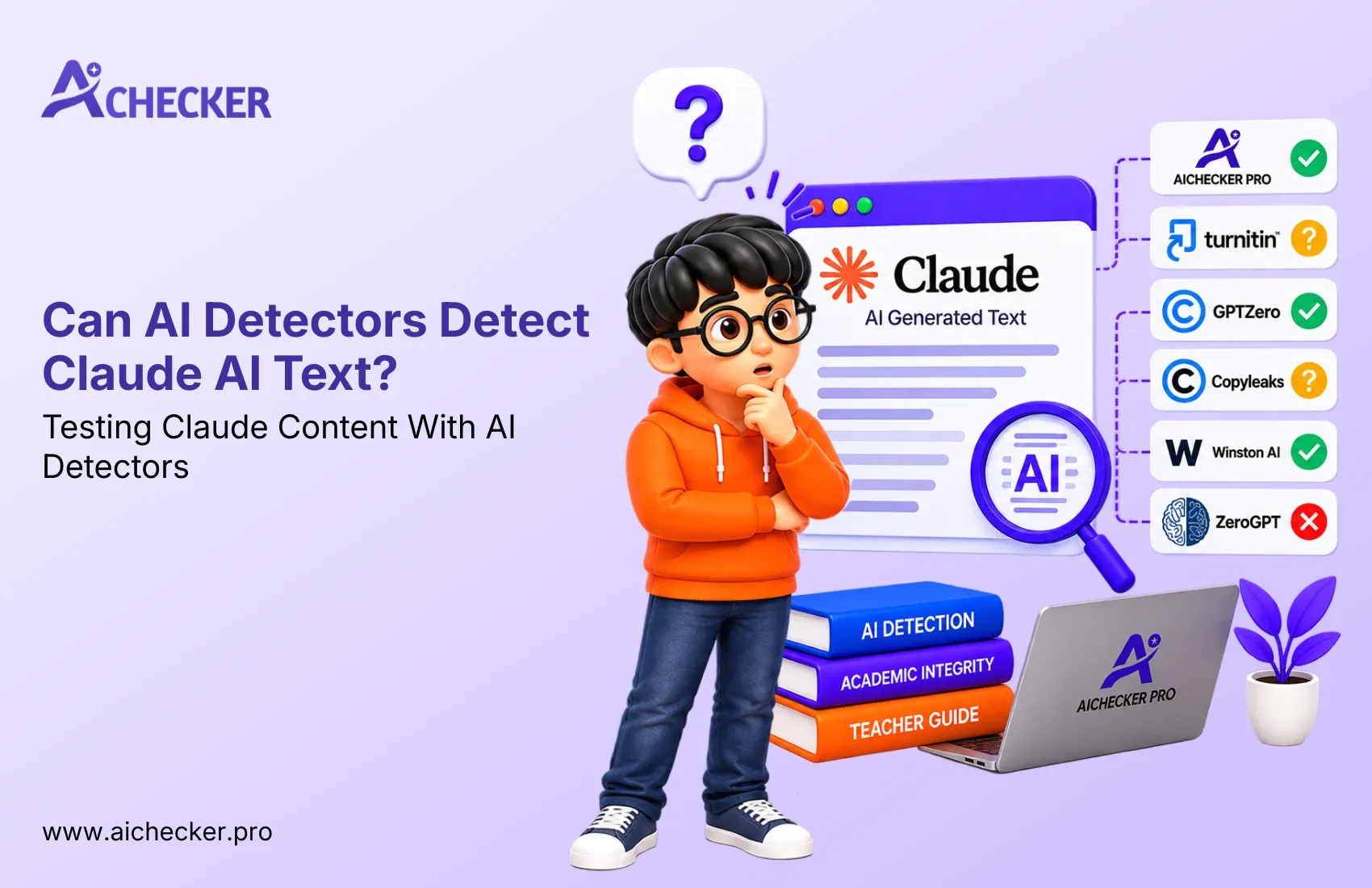
Tools like GPTZero, Turnitin AI, Originality.ai, Winston AI, Copyleaks, and ZeroGPT use little variations of these same approaches. The real part is that each tool has its own sort of algorithm, which is one of the reasons the same piece of text can end up with wildly different scores between platforms.
Common AI Detection Tools
| Tool | Primary Use |
|---|---|
| GPTZero | Education, academia |
| Turnitin AI | University assignment checking |
| Originality.ai | SEO and publishing |
| Winston AI | Business and editorial |
| ZeroGPT | General free AI checking |
| Copyleaks | Plagiarism and AI combined |
Why AI Detection Became Important So Quickly
When ChatGPT launched in late 2022, it kind of changed everything. Within a few months, students started handing in AI-made essays. At the same time, content farms were flooding the web with AI-produced articles, and publishers began getting manuscripts that looked too tidy, like suspiciously clean wording.
So institutions felt they had to answer. The quickest thing on hand was AI checker tools, and they rolled them out fast, usually without really taking the time to understand what those tools can actually do, and where they quietly fail.
Of course, educators wanted ways to steer AI use in the classroom, and a detection system sounded like the most immediate option, the intuitive one, and honestly the easiest to implement if you just wanted academic integrity to stay intact.
And yeah, the need for a reliable ChatGPT detector was absolutely there. But the tools that were built to satisfy that need turned out to be pretty far from reliable, even if the marketing sounded confident.
The Biggest Problems With AI Detection Today
False Positives
False positives are kind of the most damaging issue with AI detection today. A false positive happens when an AI checker flags content that was actually written by a human as if it were AI-generated.
Research shows that non-native English texts end up being flagged as AI-generated at twice the rate of native English texts, even when the writing was manually verified as completely human-written. And yeah, this issue disproportionately affects international students, multilingual learners, plus students with learning disabilities.
Detection Accuracy Issues
No AI detection tool on the market right now can really guarantee accuracy, you know. Detection scores are, in a sense, probabilistic, not definitive. So if something gets an 85% "AI-generated" label, it does not mean the text was actually produced by an AI.
It just means the system spotted patterns that look like AI writing, but those patterns can also show up in plain, clean human work.
When students get hit with false accusations, they often go through deep psychological distress, plus higher anxiety and a reduced sense of trust toward schools. Commercial automated AI-text detectors do not offer statistical guarantees for false positive rates either.
Ethical Concerns
A lot of those detection tools want you to submit student work into outside databases, which might bump into privacy rules and also the university's privacy policy. And if that happens, false accusations of academic dishonesty could really wreck the rapport between faculty and students, and it can mess up learning in a bad way, long-term.
There is also a kind of fairness issue. When a free AI detector flags a student just because they wrote in straightforward, simple English, it's not actually improving accuracy. It's basically punishing clarity, not deception or anything like that.
AI Detection Problems in Education, SEO, and Publishing
Education
The adoption of an AI detector for essays in schools and universities has been fast, but honestly, the outcomes are pretty troubling.
The core issue looks like this: an AI-generated text detector can't really tell the difference between a student who used AI and a student who simply writes in a tidy, well-organized style. And so both can end up with similar scores on a ChatGPT checker. If you punish both equally, it isn't fair, and it doesn't work well either.
Also, the adoption of AI in academia has kicked off this kind of arms race, where students use these tools, and then faculty try to spot them. A lot of researchers say this whole back and forth is unproductive, and it needs to stop. They suggest institutions should rethink how assignments are made, instead of leaning on detection software for educators that feels flawed.
Key issues in education:
- Students with writing disabilities or learning differences face higher false-positive rates
- Non-native English speakers are flagged disproportionately
- Institutional policies are inconsistent and often based on unreliable tools
- Excessive reliance on AI detection fosters a culture of suspicion rather than support
SEO Industry
In the SEO world there's a different but still very serious problem. Content professionals often use writing tools to scale production, and publishers and website owners then run the text through an AI content detector before it even goes live. If the score is high, the content gets rejected, even if it's been carefully edited and honestly is useful.
Google's top priority is helpful, original content, no matter who wrote it. The search engine algorithms don't "ban" AI content in any direct way.
So you get this false problem. SEO teams spend hours running content through an AI generator checker, when the real focus should be way simpler, like checking whether the content genuinely helps the reader, not just passing some score.
Publishing
In the publishing industry, both traditional and digital publishers are using AI-generated checker tools to screen submissions. It's kind of confusing at times because the same tools also seem to be overly strict. Lately there's been this new wave of rejections, and not all of them make sense, some seem to aim at legit human writers.
What happens next is a chilling effect. Writers start altering their natural voice, not because of quality issues, but to avoid triggering a detection algorithm. And that feels like a real cultural and creative cost, even if the reasoning is "for quality control" on paper.
AI Humanizers vs AI Detectors: The New AI Arms Race
As AI detection tools spread out, there was this parallel market that kind of showed up to counter them. You'd see tools sold as AI humanizer platforms, where the whole point is to rewrite AI-generated content so it can sneak past those detection checks.
Now these text humanizer tools, also called AI to human text converter or AI text converter platforms sometimes, tend to rely on natural language processing. They nudge sentence patterns around, swap syntax, and add little stylistic irregularities that detectors often link with actual human writing.
And yeah, paraphrasing tools are everywhere now. Some are even tailored just to bypass detection algorithms. Even small tweaks in how you write, like mixing up sentence lengths or tossing in rhetorical questions, can reduce how sensitive most detectors are, by a lot.
The result is a direct technological arms race:
- A new AI detector tool is released
- Humanizer AI and AI text humanizer platforms update their algorithms to bypass it
- The detector updates to catch the new patterns
- The cycle repeats
This is not sustainable. The side that benefits from bypassing detection will always have a bit more motivation to come up with new ideas than the side trying to catch them, and that imbalance tends to stick around.
Every tool that claims to "convert" AI to human, or to make AI text look like human text, like one of those "detection defeat" converters, is basically showing that the detection system is already not fully working. It's like they're admitting it without saying it.
So in practice: no AI detector free tool, or paid one, should ever be used as the sole reason for judgment in a high-stakes situation. These tools are more like warning signs than proof. Indicators, not proof.
The Future of AI Detection Technology
The current generation of AI content detector tools feels like it is only a transitional phase. Here's kind of where the tech is going next, in practice:
Watermarking: Some AI providers are embedding invisible signals directly into generated text. Those marks are usually hard to strip out, and they don't really depend on pattern analysis. But they only do their job if the text hasn't been meaningfully edited after it was produced. Once people start changing things a lot, the signal can get less dependable.
Behavioral Detection: Future systems might pivot from what was written to how it was written. Stuff like keystroke logging, writing time analysis, plus revision history can act as stronger clues about authorship. And it may reduce the bias issues that come with text-only analysis.
Multimodal Evidence: When you combine text analysis with metadata, submission context, and behavioral information, detection can get more reliable, and it can also become more fair compared to today's approaches.
Institutional Policy Over Tool Reliance: Honestly, the most practical change is probably cultural more than technical. Instead of depending on a free AI detector to "police" every single submission, institutions are shifting toward transparency expectations, process-based assessment, and more in-person evaluation formats. You can read more about this shift in this AI detection tools guide for educators.
So the future of AI detection is not about a perfect instrument that catches every AI sentence. It's more like a smarter arrangement that zooms in on what matters most: whether the work shows real understanding, genuine creativity, and meaningful effort.
Conclusion
AI detection was supposed to help guard academic integrity, content quality, and publishing standards. But in real life, it kind of did the opposite. It has brought in brand new problems like false accusations, creative censorship, and this weird arms race between AI humanizer tools and AI checker platforms. No clean winner, honestly, it just keeps going. So the answer isn't, like, a better AI text detector or something.
What we really need is a more honest conversation about where AI actually fits into writing, learning, and publishing. Yes, tools can help support that conversation, but they cannot replace it. Not at all.
If you are a writer, educator, or content professional dealing with these issues, then aim for quality, transparency, and real usefulness instead of chasing some perfect detection score.
FAQs
1. What is an AI detector and how does it work?
2. Is any AI checker free to use?
3. Can an AI text detector give wrong results?
4. Which is the best AI detection tool available today?
5. How does an AI humanizer help bypass AI detection?
6. Can I convert AI text to human text for free?
7. Does Google penalize AI-generated content in SEO?
8. Why are students being falsely flagged by AI detectors for essays?
9. What is the difference between AI detection and plagiarism detection?
10. Is there a way to remove AI signals from text without using a humanizer tool?

Harshil Barvaliya
SEO Executive & Content Writer at AI Checker Pro
I’m Harshil Barvaliya, an SEO Executive and Content Writer at AI Checker Pro. I focus on improving the website’s search engine visibility through effective SEO strategies, including keyword research, on-page and off-page optimization, and content development.Get Started Free
Create a free account for advanced AI detection and scan history.
Trusted by thousands worldwide.
Recent Blog's
Discover how AI-powered content creation can elevate your website's reach and engage your audience like never before. Explore the real impact of AI on crafting content that connects.