What Every Educator Must Know About AI Detection Tools in 2026
TABLE OF CONTENTS
Why AI Detection Matters More Than Ever in 2026
The Core Problem: Why Most People Get AI Detection Wrong
How AI Detection Tools Actually Work
Top AI Detection Tools Worth Using in 2026
AI Detector for Essays: What Educators Need to Know
Common Mistakes People Make With AI Checkers
Pro Tips for Getting the Most Out of AI Detection
Future Trends in AI Detection
Conclusion
FAQs
Get an AI summary of this post on:





The current moment shows widespread accessibility to AI-generated content. The content is now being utilized by students. The content is now being utilized by writers. The content is now being utilized by professionals who sometimes use it without their knowledge.
If you work in education, marketing, or content management and need to check whether something was created by a person, you must have searched for an AI detection tool through Google at least one time during this week.
The problem exists because different AI detection tools show different levels of detection performance. Some tools offer free testing, but they fail to deliver accurate results. Some products provide correct results, yet they charge high fees. Some products make false claims about their capabilities.
The guide provides a straightforward path to understanding information. The tutorial shows you how to use AI detection systems. The tutorial shows you which tools are beneficial to your work. The tutorial shows you which mistakes experienced users make that lead to their failure.
Why AI Detection Matters More Than Ever in 2026
Online platforms now experience an overwhelming increase in AI-generated text content. According to multiple industry reports, a significant share of blog posts, academic submissions, and marketing copy now contain AI-written content.
The system creates an unfair situation for teachers. The system produces a quality problem that SEO teams must address. The system creates a trust issue that brands must resolve.
A reliable AI content detector has become essential because people need it. People have moved beyond curiosity because they want to understand everything.
Here's what's at stake:
- Academic institutions want to ensure students are actually learning, not just prompting
- Content teams need to maintain brand voice and originality
- SEO managers know that low-quality AI content can hurt rankings
- Publishers and editors want to protect their credibility
Whether you're evaluating an essay or a blog draft, you need tools that give you real answers, not just a percentage that means nothing.
The Core Problem: Why Most People Get AI Detection Wrong
Here is something which most guides will not explain to you because AI detection functions through probabilistic methods, which do not provide complete certainty.
No tool, including the best available tools, can establish complete proof that an AI system generated a specific text. The tools operate to examine writing patterns that show higher statistical occurrence in AI-generated content compared to human writing.
Things like:
- Perplexity: how predictable the word choices are
- Burstiness: how much the sentence length and complexity vary
- Semantic patterns: how ideas flow from one sentence to the next
People write their content using two different types of sentence structures, which create a writing style that contains more abrupt shifts between short and long sentences. AI writing produces text that maintains a constant flow without any variations in its pace.
The best AI text detectors use a combination of these signals. The worst ones rely on just one.
Most educators make this mistake because they believe that students who create their own content through extensive editing of AI text or who write together with AI as their co-writer will activate detection tools. The detection tool does not fail because the whole method has a fundamental restriction. You can learn more about how AI content detectors work to better understand these limits.
You need to learn this information so that you can use these tools in a responsible way.
How AI Detection Tools Actually Work
Let's break down the mechanics without getting too technical.
Perplexity Scoring
ChatGPT and other AI models use training data to forecast which word will follow next in their generated output. The generated text from these systems produces results that demonstrate extremely high predictability according to their "perplexity" measurement. A ChatGPT detector essentially asks: "Is this text too predictable to be human?"
Burstiness Analysis
Humans write with rhythm, sometimes long, sometimes short, sometimes fragments. AI generates text that maintains uniform flow through its entire writing process. The free AI detection tool identifies burstiness patterns through its examination of this specific signature variation.
Classifier Models
The advanced detection methods use their own machine learning models to identify AI-generated text, which they developed specifically for that purpose. AI Checker Pro utilizes its multi-signal classifiers to evaluate text by measuring three different aspects, which include perplexity, burstiness, and semantic coherence.
Watermarking (Emerging)
Some AI providers are beginning to embed invisible watermarks into AI outputs. The technology currently exists in its preliminary stage, but it will likely become widely used within the upcoming years because it provides better detection capabilities.
Top AI Detection Tools Worth Using in 2026
There are dozens of options. Here's an honest breakdown of the most used ones:
| Tool | Free Tier | Best For | Accuracy |
|---|---|---|---|
| AI Checker Pro | Yes | Educators, marketers, teams | High |
| GPTZero | Yes (limited) | Academic use | Good |
| Copyleaks AI Detector | Yes (limited) | Enterprise and education | Good |
| Originality ai | No | SEO teams | High |
| Winston AI | Limited | Content agencies | Good |
| Sapling | Yes | Quick checks | Moderate |
If you want a side-by-side breakdown, this comparison of free vs paid AI checker tools covers the key differences in detail.
AI Checker Pro
The AI Checker Pro tool functions as an all-purpose solution that allows users to examine student essays, blog drafts, and marketing content. The system can identify text produced by ChatGPT, Claude, and Gemini, and other major language models. The interface delivers fast results through its clean design while providing users with a section-by-section performance assessment instead of delivering only a total score.
The sentence-level highlighting feature enables educators to see which sections of a document activated the artificial intelligence detection system. The system provides more valuable information through multiple detection points which show 60 percent of text as artificial intelligence-generated compared to using a single AI detection score without any explanation.
AI Detector for Essays: What Educators Need to Know
If you are an educator, here is what you should know about using an AI detector for essays and education:
Don't Use It as the Sole Evidence
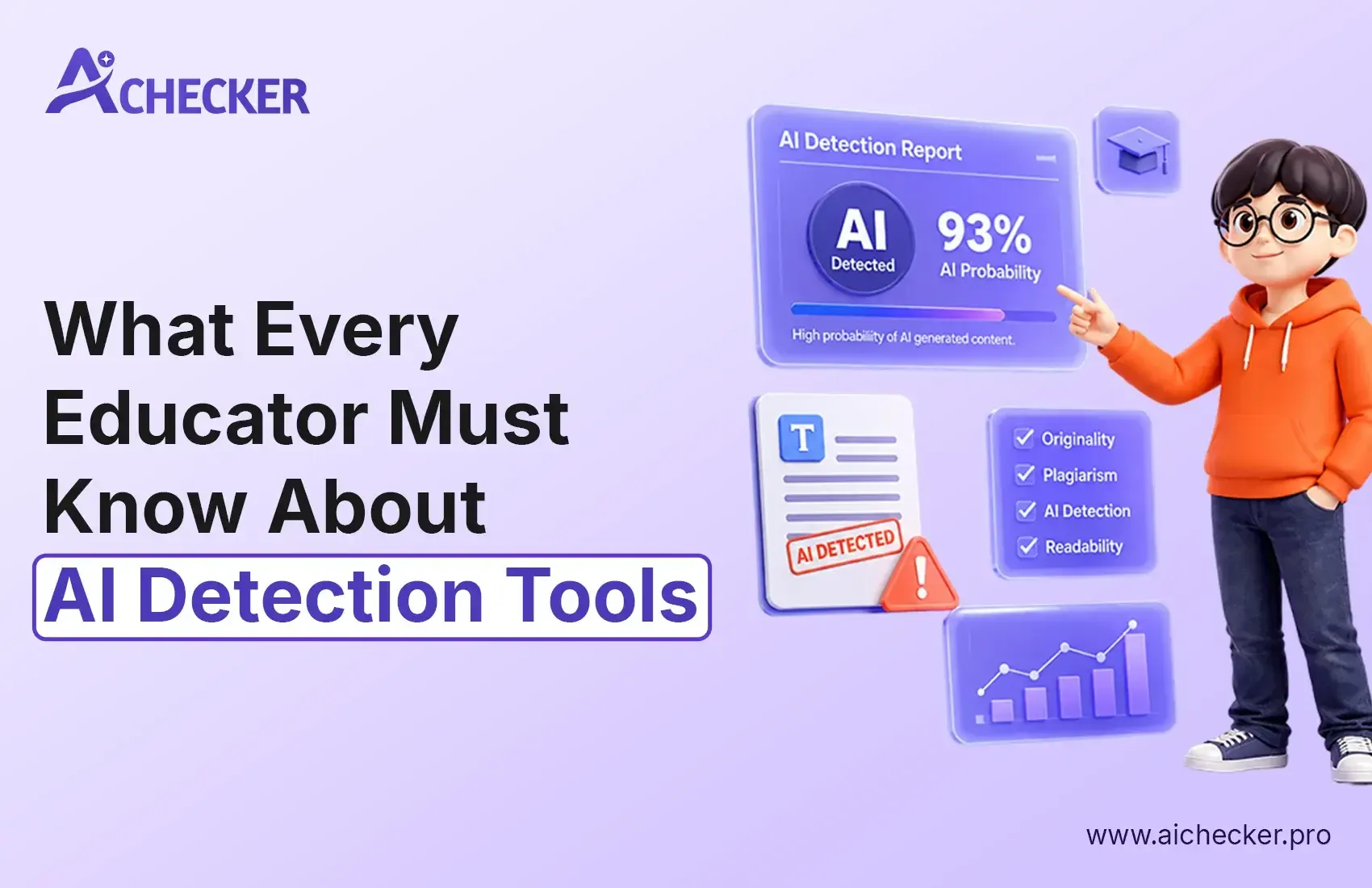
Your decision-making process should use AI detection scores as guidance, but they should not become your primary decision-making tool. The AI-generated writing score of 85% indicates that the student used AI to produce their work, but it does not prove that they committed academic dishonesty. You still need to consider:
- Does this match the student's writing style from past work?
- Did they submit drafts showing their process?
- Is this topic one they clearly know well?
Use detection as a starting point for a conversation, not a verdict.
Run Multiple Tools
No single AI checker achieves complete accuracy. The most trustworthy results emerge when you run the same document through two or three tools and analyze their results. The three systems show strong detection when they all identify the same content as suspicious. You should take precautions when results show divided outcomes between two options.
Set Clear Policies First
This is the most underrated step. It is important for educators, before they select or even rely on any AI detection tool, to have clear written policies on:
- What counts as permitted AI use (e.g., grammar checking vs. drafting)
- What the consequences of detected AI use are
- How disputes will be handled
Detection without policy creates more problems than it solves. A solid teacher's guide to AI detection can help you build that policy foundation before you start using any tool.
Common Mistakes People Make With AI Checkers
Even experienced users get these wrong:
1. Trusting a single score blindly A number like "72% AI" sounds precise, but it isn't. It's a probability estimate. Treat it that way.
2. Testing short texts Most AI text checker tools struggle with texts under 200 to 300 words. The sample size is too small for meaningful pattern analysis. Always test longer documents for better accuracy.
3. Ignoring false positives Highly technical writing, academic writing, and writing by non-native English speakers can sometimes trigger AI flags because their writing is also structured and uniform. This is a known limitation. You can read more about AI detector accuracy and what affects it.
4. Not updating their tool AI models evolve constantly. A tool trained on ChatGPT 3.5 outputs may not detect GPT-4o or Claude outputs as well. Check whether your AI generator detector is regularly updated for new models.
5. Using free tools for high-stakes decisions Free tiers are great for casual checking. For academic integrity cases or publishing decisions, invest in a more robust paid tool with better accuracy and audit trails.
Pro Tips for Getting the Most Out of AI Detection
Advanced users perform their actual tasks as follows.
Begin by establishing writing standards for your authors. After your content team members complete their work, gather their unedited writing samples. The baseline style provides a reference point which you can use to check their work.
Detection needs to function within an integrated operational system. The system needs to integrate AI detection with three other components, which include plagiarism detection, readability assessment, and editorial evaluation. A single indication does not provide complete information about a situation.
You need to examine their work for paraphrasing, which needs to be checked. Students and writers create content through AI generation which they subsequently rewrite in their own words. Tools that only check for direct AI output will miss this. The system requires tools that identify content that has been partially created through AI assistance. Using an AI humanizer alongside detection tools gives you a fuller picture of how content may have been modified.
You need to record every step of your procedure. You should record every detail about AI detection results through the documentation of tools used, scores obtained, and extra information. This system protects both you and the individual who undergoes assessment.
Future Trends in AI Detection
The field is evolving fast. Here's where things are heading:
Behavioral Biometrics
Some platforms are testing writing detection through analysis of three specific writing elements, which include typing speed, pause patterns, and revision behavior, to determine whether a text was written by a human. This process requires more effort to replicate than it takes to produce the completed work.
AI Watermarking Standards
Several governments and AI laboratories currently advocate for the establishment of standardized watermarking practices that should apply to all AI-generated content. The upcoming trend of widespread adoption will lead to a new method of detection that uses embedded tags instead of analyzing patterns.
Real-Time Detection in Writing Tools
AI detection will become a standard feature within all LMS platforms, word processing tools, and content management systems. The system will perform detection during content creation instead of conducting a check after users submit their work. The role of AI in protecting academic integrity is expected to grow significantly as these tools become embedded into everyday platforms.
Multimodal Detection
Current detectors exist with their main focus on detecting text content. The field of AI-generated media now includes growing numbers of images, audio, and video content. The practice of multimodal detection will establish itself as the standard method for authenticating content integrity by examining all content types simultaneously.
Better Explainability
The present assessment tools produce a numerical score for you. The upcoming assessment tools will explain the reasons behind your score by identifying the exact text sections and describing patterns and all the revealed indicators that led to your score. The process enables organizations to make better decisions because it provides clearer evidence that supports their decision-making process.
Conclusion
AI detectors function as beneficial tools for detection, but they do not provide absolute proof of truth.
The best approach in 2026 is to use them as one part of a broader strategy combining detection tools, clear policies, human judgment, and ongoing education. Educators need to establish their policy first before they begin implementing their educational tools. Content managers should incorporate detection systems into their editorial processes, yet they must not rely on detection as their ultimate decision-making tool. Developers who create AI-integrated products must recognize that their users will face evaluation through these tools.
The goal of research through creative and academic work does not require complete control over AI technologies. The goal is to ensure transparency, maintain quality, and protect the value of genuine human effort.
FAQs
1. What is an AI detector and how does it work?
2. Is there a good free AI detector I can use right now?
3. Can a ChatGPT detector catch all AI-written text?
4. How accurate are free AI checker tools compared to paid ones?
5. What does it mean to humanize AI text?
6. Which AI writing detector is best for checking student essays?
7. Can I convert AI text to human text without detection?
8. Why does my original writing sometimes get flagged by an AI content detector?
9. How do I use an AI generator checker the right way?
10. What is the future of AI detection tools?

Harshil Barvaliya
SEO Executive & Content Writer at AI Checker Pro
I’m Harshil Barvaliya, an SEO Executive and Content Writer at AI Checker Pro. I focus on improving the website’s search engine visibility through effective SEO strategies, including keyword research, on-page and off-page optimization, and content development.Get Started Free
Create a free account for advanced AI detection and scan history.
Trusted by thousands worldwide.
Recent Blog's
Discover how AI-powered content creation can elevate your website's reach and engage your audience like never before. Explore the real impact of AI on crafting content that connects.