
Looking for the Best AI Detector? Try AI Checker Pro (Full Review)
TABLE OF CONTENTS
Who Actually Needs an AI Detector in 2026?
The Core Problem With AI Content
What Is AI Checker Pro?
How the Detection Works
The AI Humanizer: What Sets It Apart
AI Checker Pro vs. Other Tools
Practical Tips for Students
Practical Tips for Bloggers and SEO Writers
Is the Accuracy Good Enough to Trust?
Conclusion
FAQs
Get an AI summary of this post on:





Finding a good AI detection suite that meets your requirements hasn't been easy. This is also the case for millions of students, bloggers, and businesses, too.
By 2026, humans will be required to generate content resembling that of human sources with the assistance of AI outputs. The tools to detect AI-generated text have greatly improved.
This review will provide an in-depth look at AI Checker Pro's feature set, how it performs against competitors, and its overall value as an AI detection tool.
Based upon my experiences with many different AI detection products over the last year, the majority of them do not provide accurate results, meaning AI detection tools simply give you a percentage score with no further details.
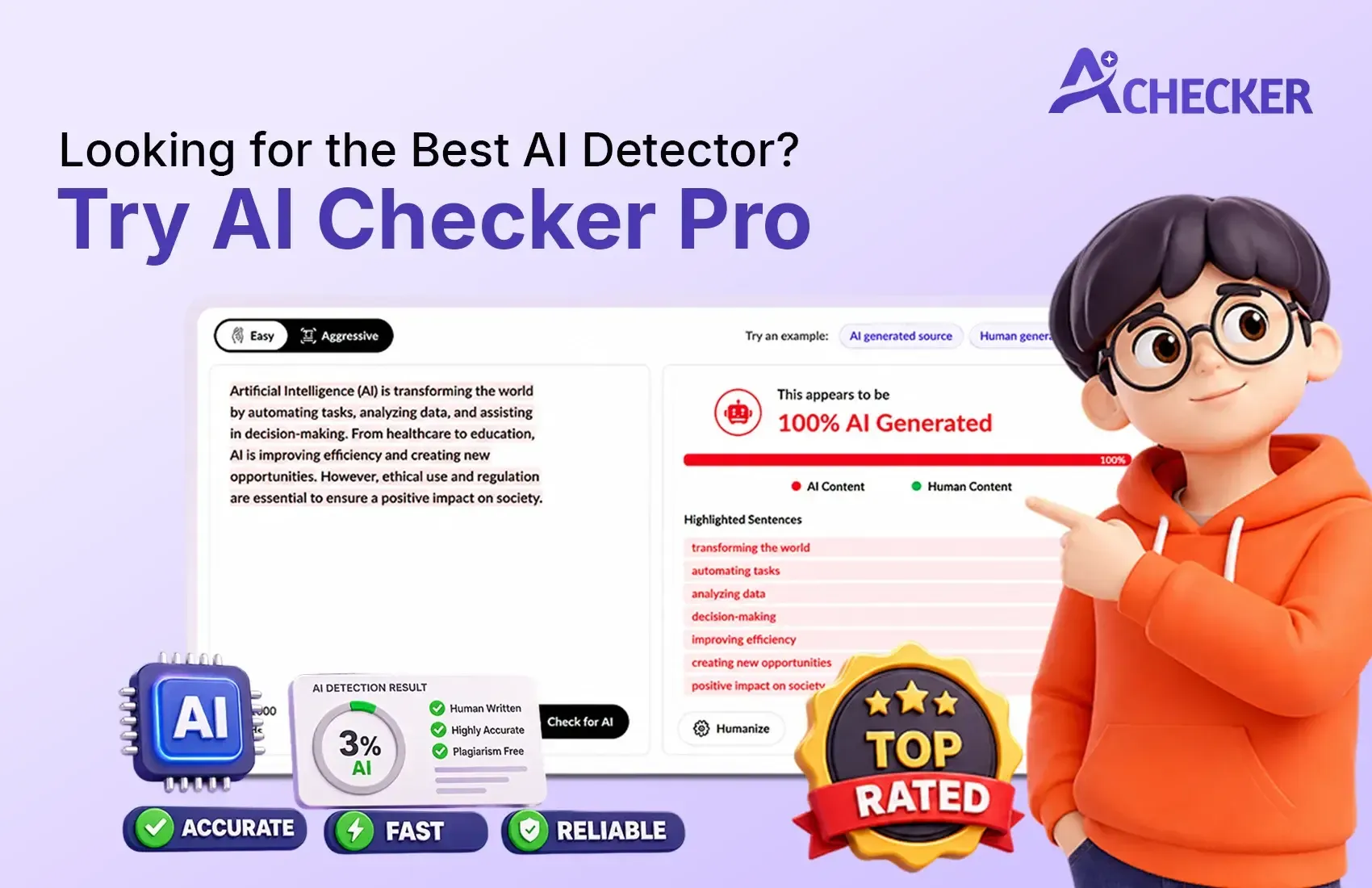
AI Checker Pro features a much different approach to determining whether text was generated by AI or not. AI Checker Pro is able to identify specific lines of text that contain indications of AI-generated content, and has access to a humanisation tool that allows users to correct any issues straight away, instead of having to switch back and forth between multiple products.
Who Actually Needs an AI Detector in 2026?
The tool will demonstrate its functions after I describe its target audience because the answer to this question will likely determine who its actual users are.
The most visible group of people that needs this tool consists of students. The use of ChatGPT to help create your essay makes your situation unsafe when your professor uses Turnitin or GPTZero to assess your work. The writing will show AI detection patterns because you used AI tools only to create your outline and brainstorm ideas. If you're wondering how colleges detect AI in essays, this is exactly the kind of pattern-matching that gets students flagged.
The academic staff requires this tool because professors need it to assess student work. The process requires excessive time because an evaluator must read 30 papers to estimate which ones contain AI-written content. A good detector gives you evidence you can actually act on.
Bloggers and content writers need it for a completely different reason. Google has developed strong capabilities to recognize content that lacks authentic human experience. Your articles will lose search engine ranking because they contain mostly unedited AI content.
The Core Problem With AI Content
Let me explain this in a simple way. AI models such as ChatGPT, GPT-4, GPT-5, Gemini, and Claude create writing that follows specific patterns that readers can recognize. They tend to use formal transitions together with balanced sentence structures and a specific type of writing that creates smooth flow that human writers do not produce in their natural writing style. The systems that detect patterns operate by searching for the specific patterns that they have been programmed to identify.
The problem goes beyond getting caught. Here is what actually happens in 2026 when you publish raw AI content on your blog:
- Google's Helpful Content system flags it as low-quality
- Readers bounce quickly because the writing feels flat
- Your dwell time drops, which hurts your ranking
- Competitors with more natural-sounding content outrank you
That is why the need for a solid AI text humanizer has gone from optional to essential for anyone serious about content.
What Is AI Checker Pro?
The online service AI Checker Pro provides solutions that address both aspects of the challenge. The first step of the process determines which sections of your material were probably created by artificial intelligence. The second step of the process transforms those sections into text that appears as though an actual person composed the material.
The tool works with content generated by all major AI models, including ChatGPT, GPT-4, GPT-5, Gemini, and Claude. Each model uses its own distinct writing pattern because different models exhibit different writing patterns, and the single-model detector system can only recognize one writing style. Understanding how AI detectors work helps explain why multi-model support matters so much here.
The platform has more than 100,000 active users, and its user base continues to expand because the platform delivers dependable results to its customers. The users of AI Checker Pro now use the tool to transform complete documents into polished content within a few minutes instead of doing manual rewriting work.
How the Detection Works
AI detectors primarily assess documents as their main operational method. The system processes all information to produce a single measurement, which fails to indicate the specific location of the issue.
AI Checker Pro operates through its ability to analyze individual sentences. The system needs you to paste your text before it can conduct a sentence-based assessment of your content. The system highlights flagged sentences to show you the exact locations where AI patterns occur. This method proves more effective because it allows you to assess 1,500-word articles that contain only 300-word problems.
Here is the basic workflow:
- Paste your content into the editor
- Run the detection scan
- Review the sentence-by-sentence breakdown
- Use the built-in humanizer to rewrite flagged sections
- Re-scan to confirm your score has improved before publishing or submitting
The whole process takes a few minutes for a standard blog post or essay.
The AI Humanizer: What Sets It Apart
The detection function operates successfully, yet you need an actual solution to your problem. The built-in humanizer feature exists to solve this problem, which acts as the primary reason why users return to this software.
The existing text humanizer tools currently available in the market only create artificial content through two methods: they produce unnecessary words or they alter the sequence of sentences. A smart detector will still catch that.
Real humanization requires something deeper: changing sentence structure, varying rhythm, adjusting tone, and replacing predictable phrasing with something that sounds like it came from an actual person with an opinion. You can read more about why authenticity always wins with humanized AI content and how this approach differs from basic paraphrasing.
Here is what a strong AI text humanizer actually does:
- Rewrites at the sentence level, not just swapping synonyms
- Preserves the original meaning while changing the structure
- Adjusts tone to match the context, whether academic, conversational, or professional
- Handles content from multiple AI models, not just one
- Produces output that passes multiple detectors, not just the one you tested it on
AI Checker Pro's humanize AI text engine covers all of these. I have personally seen bloggers clean their content using AI Checker Pro and cut their detection score from 85 percent down to under 10 percent in a single pass. The results of that process remain difficult to dispute.
AI Checker Pro vs. Other Tools
I will assess three systems, which include GPTZero, Originality.ai, and Turnitin, through my honest assessment.
The academic community widely uses GPTZero because it can accurately detect basic content, but it lacks any guidance to help users proceed. Your content received a flag, but you received no information about what steps to take next.
The agencies which need multiple detection methods should select Originality.ai as their main solution. The software system functions best when multiple users operate it together but it becomes costly for individuals who want to use it independently. The platform does not provide a humanizer feature.
Turnitin stands as the most dreaded tool that students need to use for their academic work. The system checks documents for both plagiarism and artificial intelligence writing patterns. The system serves universities throughout the United States while it detects increasing amounts of ChatGPT-generated content. Students have no power over their professor's choice of tools but they can ensure their content is ready for submission.
AI Checker Pro promotes itself as a complete package that handles all detection needs. The system provides both detection capabilities and an AI-to-human conversion tool at an accessible price for individual users, students, and small teams. The software provides efficient time-saving benefits through its sentence analysis, which enables users to create effective results instead of low-quality rewrites.
Practical Tips for Students
The advice I would give my friend applies to college students in the US who fear their work might receive academic dishonesty flags.
First, use AI as a starting point, not a final answer. The tool will assist you in creating an initial outline and a rough draft, but you must examine each paragraph to determine if the words truly express your knowledge.
Second, run your draft through a detector before you submit it. AI Checker Pro provides accurate AI content detection which identifies the specific parts that require further development. Pairing this habit with strategies to avoid AI detection in college papers gives you the strongest possible approach before submission.
Third, read your paper out loud after editing. You should rewrite any section that sounds excessively smooth or formal, or that fails to match your normal way of speaking. Human writing contains a distinct personality. The writing style establishes authentic human expression through its natural flow and actual viewpoints.
Fourth, pay attention to your introduction and conclusion. The sections show the most visible AI writing patterns because these parts contain content that professors examine during their reading process.
Practical Tips for Bloggers and SEO Writers
Bloggers encounter challenges that differ from each other but maintain equal importance. The following is my advice to you.
Publish your AI-generated content only after you complete detection tests for the entire draft. High AI scores create content problems, which Google will use to reduce content value, whereas clean scores do not ensure good website rankings. Understanding whether Google penalizes AI content is essential before hitting publish on any AI-assisted piece.
Use the humanize text process as part of your editing pass, not as a replacement for it. The humanizer gets you most of the way there, but you should still read through and add your own examples, opinions, and context. Google provides rewards for that specific content.
Your humanization work should target the sections that have the greatest SEO impact. Your title, your introduction, your H2 headings, and your conclusion are where tone and authenticity matter most.
You must use AI Checker Pro for every client document that you create at scale. A single article that gets flagged on a client's website can rapidly destroy trust. The system achieves protection through its completely organized workflow process.
Is the Accuracy Good Enough to Trust?
The fair question requires assessment of all AI detection methods, which lack complete accuracy. No AI detection system achieves absolute accuracy because it generates false positive results, which identify human writing as machine-generated. To better understand these limitations, it helps to look at how accurate AI content checkers really are before drawing any conclusions.
AI Checker Pro establishes itself as a superior tool that maintains constant updates for upcoming AI systems and advanced writing methods. GPT-5 distinctly produces text compared to GPT-3, which results in detection systems using outdated data to overlook present-day writing styles. Your accuracy will remain intact when you maintain your knowledge about current developments.
Students, bloggers, and content teams can use the tool because its accuracy provides sufficient value for their needs. The system should serve your editing process because it provides information that you should not consider as your ultimate solution.
Conclusion
AI Checker Pro provides more than basic scoring because it helps users solve their problems. The system provides precise detection results because it uses sentence-level detection methods, and the humanize AI engine enables users to complete their work without needing to do manual content creation.
The tool provides essential functions that fulfill the requirements of students who want to improve their essays, bloggers who want to maintain their search ranking, and businesses that require content that sounds natural for their operations.
The software has become one of the most effective solutions in 2026 because it has more than 100,000 users and works with all major AI systems.
FAQs
1. What is AI Checker Pro and how does it work as an AI detector?
2. Is AI Checker Pro really free to use as an AI checker?
3. How is AI Checker Pro different from other AI detection tools?
4. Can AI Checker Pro help students pass Turnitin AI detection?
5. What does the AI humanizer inside AI Checker Pro actually do?
6. Does AI Checker Pro work with content made by ChatGPT, Gemini, and Claude?
7. Why do bloggers need an AI humanizer tool for SEO in 2026?
8. How accurate is AI Checker Pro compared to other free AI detectors?
9. Can teachers and professors use AI Checker Pro to check student work?
10. How do I humanize AI text quickly before submitting or publishing it?

Harshil Barvaliya
SEO Executive & Content Writer at AI Checker Pro
I’m Harshil Barvaliya, an SEO Executive and Content Writer at AI Checker Pro. I focus on improving the website’s search engine visibility through effective SEO strategies, including keyword research, on-page and off-page optimization, and content development.Get Started Free
Create a free account for advanced AI detection and scan history.
Trusted by thousands worldwide.
Recent Blog's
Discover how AI-powered content creation can elevate your website's reach and engage your audience like never before. Explore the real impact of AI on crafting content that connects.