Does Google Detect AI-Generated Content in 2026?
TABLE OF CONTENTS
Key Highlights
Does Google Detect AI Content? The Direct Answer
How Does Google Detect AI-Written Content?
Does Google Penalize AI Content? Policies You Should Know
Does AI Content Rank on Google? What Works in 2026
Does Google Care If Content Is Written by AI?
Why Detectors Matter for SEO
What Happens When AI Content Violates Google's Spam Policies?
A practical 2026 checklist
Conclusion
FAQs
Get an AI summary of this post on:


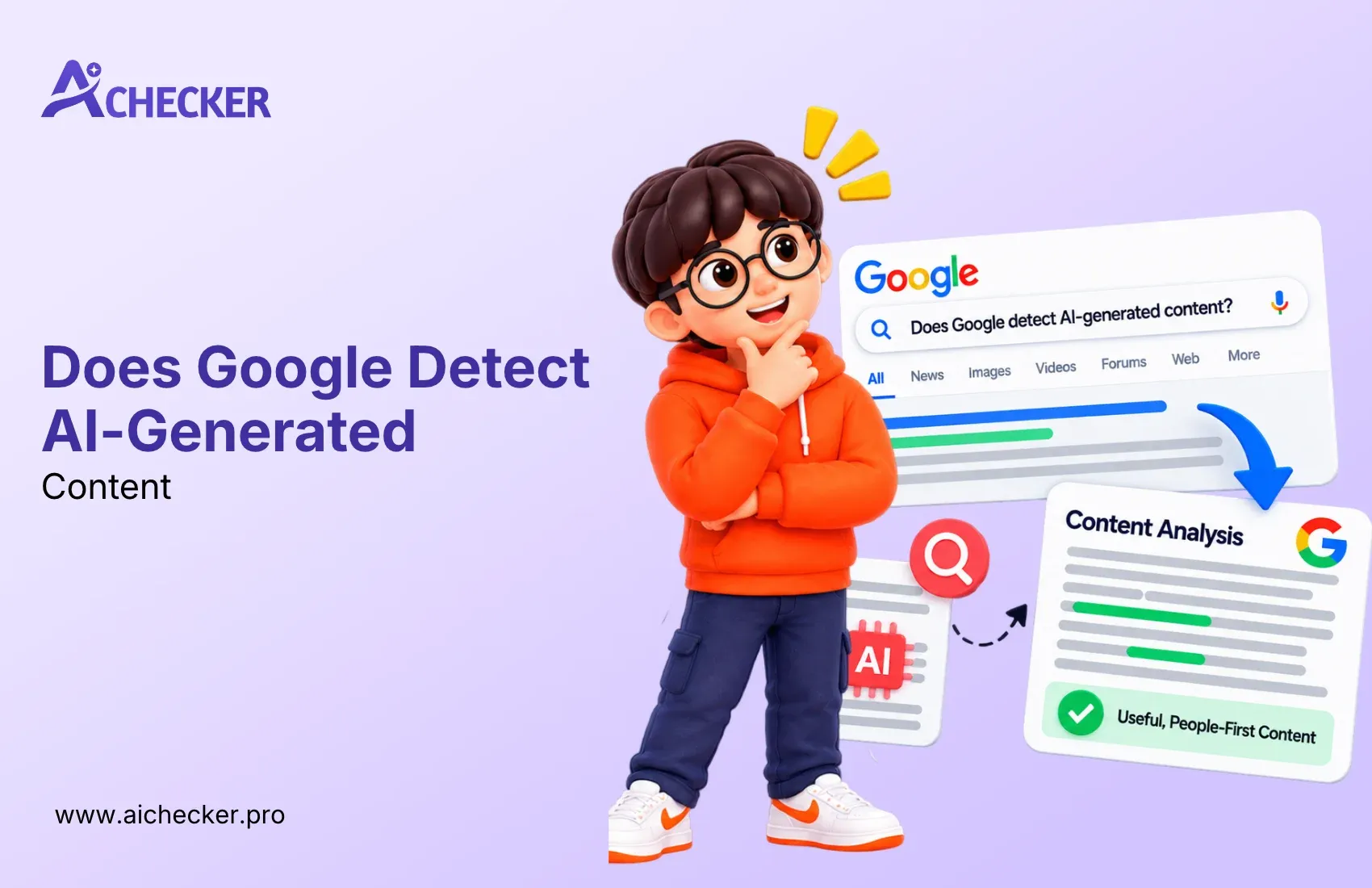
Does Google actually detect AI content and penalize websites for using it? This is a common concern for content writers and website owners, especially as AI writing tools become part of everyday content creation.
On the other hand, publishing large volumes of generic, low-value content just to gain rankings can put your website at risk. In this guide, we’ll look at Google’s guidelines, how AI content affects SEO, and what you can do to protect your rankings in 2026.
Key Highlights
- Google focuses on helpful, reliable content rather than whether AI was used to create it. AI-assisted articles can perform well when they provide accurate information, original insights, and genuine value to readers.
- The real risk is spam, not AI. Content made mainly to manipulate rankings breaks Google's spam rules.
- Google is much better at spotting low-value patterns than at naming the tool behind the text.
- Human editing, original examples, and real experience raise your chances of ranking.
- No AI detector is 100% accurate, and false positives happen, even on fully human writing.
- Running your draft through a detector and a humanizer before publishing is a smart safety step, whatever the answer to whether Google detects AI content turns out to be.
Does Google Detect AI Content? The Direct Answer
Let’s break this down in simple terms. When people ask whether Google can detect AI content, they are usually asking two different questions: Can Google identify text written by AI, and will using AI hurt their search rankings?
Google has not publicly confirmed that it automatically labels AI-written pages and lowers their rankings for that reason alone. In fact, its guidance has made it clear since 2023 that helpful, reliable content can rank regardless of how it is produced. The real problem starts when websites use automation mainly to manipulate search rankings or publish large amounts of low-quality content.
When I evaluate content performance, I look at its usefulness, originality, accuracy, and search intent. That is the difference worth understanding: Google's main concern is not simply which tool you use, but the value your content provides to readers.
What Google has officially said
Here is the part most bloggers miss. Google's public guidance focuses on the quality of the page, not the writing method. In plain terms:
- Using AI to help create useful content is not against the rules.
- Using AI to publish huge volumes of pages with no real value is a problem.
Google wants content that shows experience, expertise, and trust. If you want the full picture of the Google AI content policy, the short version is simple. Quality and intent matter more than the tool.
So, does Google detect ChatGPT content specifically?
This is a very common worry, so let me be direct. Does Google detect ChatGPT content? Google has not said it hunts for ChatGPT by name. It can still notice patterns that raw AI text tends to share, like generic phrasing, repeated structure, and a lack of original insight. Those patterns look like low effort content, and low effort content performs badly.

Get Lifetime Access with 60% OFF
Stop paying monthly subscriptions. Enjoy unlimited AI detection and humanizer access forever with future updates included.
- One-time payment
- Unlimited access forever
- All future updates included
How Does Google Detect AI-Written Content?
Here is where it gets practical. When people ask how Google detects AI-written content, they usually imagine one magic detector. In my experience, it is more like a stack of quality signals working together.
Google's ranking systems look at things such as:
- Originality: Does the page add something new, or does it repeat what ten other pages already say?
- Depth: Does it answer the full question, or just skim the surface?
- User behavior: Do people stay, click around, or bounce straight back to search results?
- Scale patterns: Did a site suddenly publish hundreds of near-identical pages?
- Trust signals: Is there a real author, real sources, and real experience behind the page?
Notice something important. None of these signals say "this was written by AI." They say "this page is not helpful." The key takeaway is that content quality matters more than the writing tool. Focus on accuracy, originality, relevance, and usefulness instead of trying to predict whether a page will be identified as AI-generated.
Detection vs evaluation
There is an important difference between detecting AI content and evaluating its quality. Detection means identifying whether text was created by AI, while evaluation means checking whether it is useful, accurate, and relevant to the reader. When it comes to search rankings, Google focuses on the value a page provides rather than simply how it was written.
This is how Google Search handles AI-assisted content in practice. A page needs to answer the reader’s question, provide reliable information, and offer something useful. Simply using AI does not make content low quality, just as writing everything manually does not guarantee good content.
Google has also explored watermarking technology for content generated by its own AI tools, but that is separate from how its search systems evaluate web pages.
So, how does Google evaluate AI-generated content? The practical approach is to focus on helpful information, originality, accuracy, and user needs. Write for people first, use AI as a supporting tool, and make sure every page offers genuine value.
Does Google Penalize AI Content? Policies You Should Know
Once you understand whether Google can detect AI content, the next question is what really matters for SEO: Does Google penalize AI content?
The short answer is no, not simply because AI was used to create it. Google’s focus is on whether content follows its spam policies and provides genuine value to readers. A well-researched, useful article can perform well even when AI helps with drafting or editing. However, content created at scale mainly to manipulate search rankings can violate Google’s spam policies, especially when it offers little original value.
Google's spam rules
Google's spam policies address scaled content abuse, which includes producing large amounts of unoriginal content primarily to manipulate search rankings. This policy applies whether the content is created by AI, humans, or a combination of both.
The helpful content approach
Google's Google helpful content guidelines ask you to put people first. Before you hit publish, ask yourself:
- Would a reader feel they learned something useful?
- Does this page show real, first hand experience?
- Would I be comfortable putting my name on it?
If the answer is yes, you are in a good place. These ideas also sit inside the broader Google AI generated content guidelines, which keep returning to one theme: serve the reader.
Does Google penalize AI generated articles?
AI-assisted articles can perform well in Google Search when they provide useful information, original insights, and accurate answers. Editing alone does not guarantee better rankings; the final content must meet readers' needs and provide genuine value.
So does Google penalize AI-generated articles? Usually not directly. They just fail to earn the trust that ranking needs, much like Google detects AI content questions itself, where the answer is about quality.
If you want the official side, is AI-generated content allowed on Google? Yes, as long as it is helpful and not made to game search results.
Does AI Content Rank on Google? What Works in 2026
If you are using AI to write blog posts, the big question is whether those articles can actually rank on Google. The answer is yes. AI-assisted content can rank well, but using an AI tool does not guarantee good results.
From my experience as a technical content writer, the real difference comes down to what you add after the first draft. Content needs accurate information, original insights, practical examples, and a clear answer to the reader’s question. Simply copying an AI response and publishing it without proper editing is unlikely to give readers much value.
So, can AI-generated content rank on Google? Absolutely. The stronger approach is to use AI to speed up research and drafting, then apply human judgment to make the content genuinely useful.
How Experience and Trust Affect AI Content
Google’s quality guidelines use the E-E-A-T framework: Experience, Expertise, Authoritativeness, and Trustworthiness. These principles are especially relevant when creating AI-assisted content.
One common weakness in AI drafts is the lack of first-hand experience. An AI tool can explain how a product works, but it cannot personally test that product on your behalf. You can add value by including your own observations, screenshots, test results, original data, or lessons from real projects.
For example, if you are writing about an AI writing tool, explain what you tested, what worked, and where the tool fell short. These details make the article more useful and give readers a reason to trust your advice. Never invent personal experiences or test results just to make an article sound authentic.
Does Google Rank Human-Written Content Higher?
Google does not automatically give content a ranking advantage simply because a human wrote it. The same principle applies to AI-assisted content: the writing method alone does not determine search performance.
Can Google Detect AI Content After Human Editing?
This is where many students and bloggers get nervous. Once a human edits, does Google detect AI content becomes a much smaller worry. Can Google detect AI content after human editing?
Human editing can improve AI-assisted content by adding original insights, correcting errors, and making explanations more relevant to readers. However, editing does not guarantee that an AI detector will classify the text as human-written. Detector results should be treated cautiously rather than as definitive proof of authorship.
Here is something I have seen again and again. Detection accuracy drops a lot on paraphrased or humanized AI text compared to raw AI text. That is true for Turnitin, GPTZero, Originality.ai, and Copyleaks. It is also why no AI detector is 100% accurate.
What about false positives?
This part matters, especially if you are a student. Part of the confusion around whether Google detects AI content comes from detector errors. Human written text can get flagged as AI, particularly formal writing, academic writing, and writing by non native English speakers. I have seen a genuine college essay flagged simply because it was very polished and predictable.
To lower that risk:
- Add personal examples and specific details only you would know.
- Vary your sentence length. Mix short and long.
- Check your draft sentence by sentence before you submit or publish.
Can Google tell if content is written by ChatGPT?
Here is the other long tail question people type all the time. Can Google tell if content is written by ChatGPT? Google may notice the low quality patterns that come with lazy AI use, but it does not need to name ChatGPT to rank your page lower. A weak page is a weak page.
However, human editing can improve an article by adding original thinking, relevant examples, a natural tone, and better answers to readers’ questions. These improvements can make the content more helpful and competitive in search results.
That is why I would focus less on whether an article was written by a person or an AI tool and more on what the final version offers. Review the facts, remove repetitive sections, fill information gaps, and make sure the article matches the search intent. These are more useful steps than trying to make every sentence appear human-written.
Does Google Care If Content Is Written by AI?
Google's published guidance focuses on content quality and its intended purpose, not on banning AI-generated content. Using AI to research, outline, draft, or improve an article is not automatically a problem.
The risk comes when websites use automation primarily to manipulate rankings or publish large amounts of unoriginal, low-value content. Such practices may violate Google’s spam policies, regardless of whether the content was generated by AI or written manually.
For SEO in 2026, the practical goal is simple: create content that answers the reader’s question accurately and provides genuine value beyond generic information. Use AI where it saves time, apply your own expertise where it matters, and review the final article before publishing.
Why Detectors Matter for SEO
Reviewing content before publishing helps identify unclear wording, factual errors, and repetitive passages. AI detection tools can provide an additional review signal, but their scores do not establish whether content is original or predict how Google will rank it.
AI Checker Pro provides sentence-level AI detection results to help writers identify passages for closer review. Use these results alongside fact-checking, editorial judgment, and original examples rather than treating them as a guarantee of content quality or search performance.
This Detector can support this review process by providing sentence-level AI detection results. It helps writers identify specific lines for closer inspection instead of reviewing the entire article blindly. The tool supports content associated with ChatGPT, GPT-4, GPT-5, Gemini, and Claude. Use its results as a guide, then check the facts, improve the wording, and add relevant examples or original insights.
My simple testing scenario
I wanted to see if Google's AI detection claims held up, so last month I ran a batch of about twenty blog drafts through several detectors. Ten were raw ChatGPT output and ten were AI drafts I edited by hand. The raw drafts were flagged fast by almost every tool. The edited drafts got mixed results, and two tools disagreed with each other on the same paragraph. That is a good reminder to treat any score as a signal, not a verdict.
How the popular tools compare
| Tool | Accuracy (general) | Free Tier | Humanizer Included | Best For |
|---|---|---|---|---|
| AI Checker Pro | Sentence-level detection, strong on raw text | Yes, with paid plans for more | Yes | Bloggers, students, agencies |
| Turnitin | Strong on raw text, weaker on edited text | No, institutions only | No | Universities and teachers |
| GPTZero | Good on raw text, can misflag formal writing | Yes, limited | No | Teachers and quick checks |
| Originality.ai | Popular with publishers, mixed on edited text | Paid credits | No | SEO teams and publishers |
Remember, every tool in this table has limits, and none of them can fully answer whether Google detects AI content for you. Pick based on your workflow and always review flagged lines yourself.
You can use an AI detection tool to review your draft and identify sentences that may need closer attention. Always check the wording, facts, and context before making changes.
What Happens When AI Content Violates Google's Spam Policies?
Publishing thin or unoriginal content primarily to manipulate search rankings can violate Google's spam policies. Depending on the violation, a website may experience lower visibility or a manual action. However, using AI to create content does not automatically trigger a penalty. The key issue is whether the content provides genuine value and follows Google's policies.
A practical 2026 checklist
If " Does Google detect AI content keeps you worried, here is what actually works in 2026:
- Start with a real outline. Plan the questions your reader has before you prompt any AI.
- Use AI for drafts, not final copy. Treat it like a fast first draft from an intern.
- Add experience. Include your own examples, tests, and numbers you can stand behind.
- Review the draft: Check facts, clarity, repetition, and relevance to the reader's question.
- Use detection tools carefully: Treat their results as prompts for further review, not proof of AI authorship. If you use a humanizer, review the rewritten text for accuracy and meaning.
- Publish with clear authorship: Include an accurate author byline, relevant credentials, and reliable sources where appropriate.
If you need an additional review step, AI Checker Pro can help you identify sentences that may need closer attention. Review every suggested change before publishing.
Conclusion
So, does Google detect AI content? Google focuses on helpful, reliable content and does not automatically penalize a page simply because AI was used to create it. However, producing large amounts of unoriginal content primarily to manipulate search rankings can violate Google's spam policies.
Use AI to support research and drafting, then verify the facts, add original insights, and edit the article for your audience. AI detection tools can support your review process, but their results are not a guarantee of how Google will evaluate your page.
Ultimately, focus on publishing content that answers readers' questions accurately and provides value beyond generic information.
FAQs
Does Google detect AI content?
Can Google detect AI generated content?
Does Google penalize AI content?
Can Google tell if content is written by ChatGPT?
Is AI generated content allowed on Google?
Does AI content rank on Google?
Can Google detect AI content after human editing?
How does Google detect AI written content?
Does Google use AI detectors for SEO?
What happens if Google detects AI content?

Harshil Barvaliya
SEO Executive & Content Writer at AI Checker Pro
I’m Harshil Barvaliya, an SEO Executive and Content Writer at AI Checker Pro. I focus on improving the website’s search engine visibility through effective SEO strategies, including keyword research, on-page and off-page optimization, and content development.Get Started Free
Create a free account for advanced AI detection and scan history.
Trusted by thousands worldwide.
Recent Blog's
Discover how AI-powered content creation can elevate your website's reach and engage your audience like never before. Explore the real impact of AI on crafting content that connects.