How to Use AI for SEO Without Losing the Human Touch
TABLE OF CONTENTS
Understanding AI-Generated Content
The Complete AI SEO Framework
Essential AI Tools for Modern SEO Success
Optimizing for Both Google & AI Search Engines (GEO)
Maintaining Natural Tone, Readability & E-E-A-T
Real-World Success: Case Study of AI+SEO in Action
Measuring Success: KPIs for AI-Powered SEO
Common Pitfalls to Avoid
Where AI SEO is Heading in 2026
Conclusion
FAQs
Get an AI summary of this post on:






Initially, I was quite worried about the utilization of AI in SEO. The main concerns were Google penalties, unappealing writing, and the loss of all previous work. Anyway, after months of experimentation and modification, I learned a very significant lesson: the human element is not replaced but rather enhanced by AI. We are seeing an extreme transformation in the entire cycle of content creation, optimization, and ranking. AI can efficiently reduce the time taken for certain tasks, but it is unwise to depend solely on automation. The current narrative will unfold the way in which you can bring AI to your SEO process, keep a prominent personal voice, achieve the desired ranking, and perceive new concepts like Generative Engine Optimization (GEO).
Understanding AI-Generated Content
It is a common experience to read an article and then immediately think, “This was definitely AI”. I experienced that also, and it never went well. A human writer scatters words, and the reader feels like they are having a conversation; on the other hand, a machine-written piece of work is an unwelcome feeling of non-human interaction; it is flat and dull. However, Google does not eliminate generative AI content SEO; it just enforces a penalty on writing that is not helpful and is just a reproduction of what has already been published. AI-generated content can certainly rank; I have been able to help dozens of AI-assisted articles achieve high positions with my ranking skills.
The Complete AI SEO Framework
Before the installation of any AI tool, a plan is necessary. I got this realization the hard way after two months of content creation, which resulted in nothing. Afterward, determine SEO tasks that can be automated and those that should still be human-controlled. In my personal experience, AI took over; it was good at identifying keywords, developing content outlines, writing meta descriptions, and discovering content gaps. The balance between efficiency and quality is not an easy task. I have seen authors who write 50 AI articles a day, and guess what? None of them gets ranked. On the other hand, I publish 3-4 articles per week with the help of AI, and they actually get traffic because I spend time editing, personalizing, and making the quality up to the standard.
Step-by-Step: Integrating AI into Your SEO Strategy
I will guide you on how I integrate AI into my search engine optimization workflow, one stage at a time.
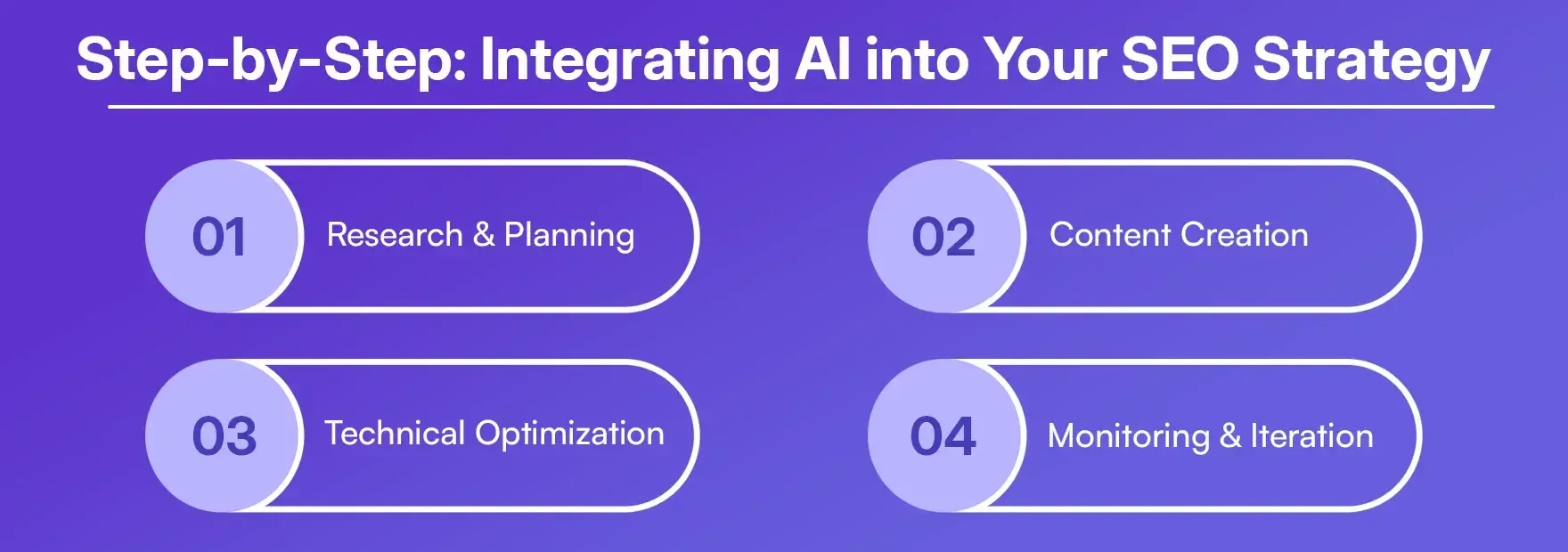
Phase 1: Research & Planning This is the area where AI really stands out. For keyword research, I depend on Semrush and Ahrefs with their AI-assisted features. Just by entering a topic, I get hundreds of keyword suggestions, along with search volumes and difficulty scores, in a matter of minutes.
Phase 2: Content Creation What I do is this: First, I let AI create a full outline from my keyword analysis that is the most detailed. Next, I have the AI prepare the first draft. But, this is very important, I look at that draft as raw clay. I give it a new shape, incorporate my tone, put in my personal examples, and rewrite parts that sound standard.
Phase 3: Technical Optimization AI is a wonderful tool for handling technical SEO tasks. One of its main applications in my SEO work is creating schema markup, writing optimized meta descriptions, and even determining the best spots for internal links. All these activities are boring, but AI is really fast and precise when it comes to dealing with them.
Phase 4: Monitoring & Iteration After the articles have been published, I utilize Google Search Console and analytics to monitor their performance. In cases where articles do not perform well, I rely on AI to provide suggestions for enhancements that are grounded in what is currently being ranked.
Essential AI Tools for Modern SEO Success
Let me share the tools that have been proven to work from my testing.
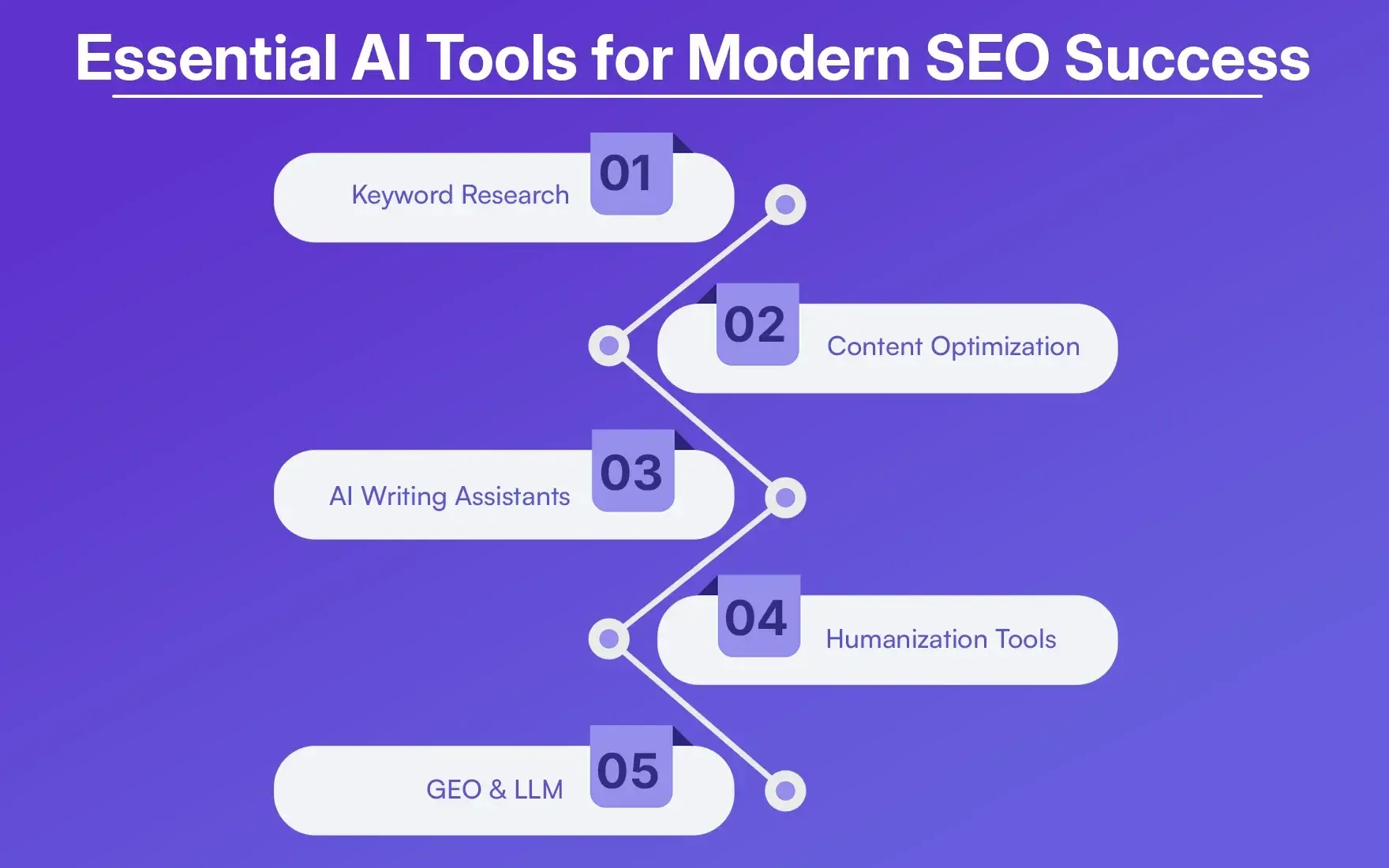
Keyword Research: Semrush and Ahrefs have both developed super amazing AI features. AI is utilized by Semrush's Keyword Magic Tool for topic-based keyword grouping; meanwhile, Ahrefs' Keywords Explorer estimates ranking difficulty through AI-powered models.
Content Optimization: The major players in this case are Surfer SEO, Clearscope, and Frase. While Surfer SEO provides a content score and specifies the necessary inclusions, Clearscope emphasizes semantic relevance. On the other hand, Frase integrates research with optimization. In my experience, I interchangeably use Surfer and Frase based on the type of project.
AI Writing Assistants: My daily drivers are ChatGPT, Claude, and Jasper.ai. ChatGPT is awesome for coming up with ideas and making quick drafts. Claude is the best for detailed, subtle, and lengthy content. Jasper has beginner-friendly built-in SEO templates that can be very helpful.
Humanization Tools: Here is the point where numerous individuals encounter problems. When your AI-generated content is very robotic in nature or gets identified by an AI content detector, you will require a humanization layer. I have discovered that manual editing is a good practice, but when I am pressed for time, Bypass AI has been a great help.
GEO & LLM: The generative AI content SEO and tracking tools that allow you to know how your content shows up in AI search engines like ChatGPT are the ones like Search Atlas, Frase, and NEURONwri, which are becoming the key players. It is a less familiar area to navigate, but one that is impressively on the rise.
Here’s a brief comparison: For keyword research, go for Semrush or Ahrefs. For content optimization, choose Surfer or Frase. For writing, opt for ChatGPT or Claude. For humanization, either edit manually or use Bypass AI when required. For GEO tracking, the Frase or Search Atlas should be your first choice.
Optimizing for Both Google & AI Search Engines (GEO)
The majority of SEO manuals dealing with the content aspect hardly cover the following point: ranking on Google is no longer the only requirement for your content.
This process is referred to as Generative Engine Optimization (GEO), and it is the future of AI visibility SEO.
Here’s the way I optimize for the traditional and AI search engines together: Firstly, make extensive use of schema markup and structured data. This kind of data is much loved by AI engines, as it is easier for them to parse and comprehend. Use the FAQ schema, the article schema, and the how-to schema wherever appropriate.
Secondly, provide answers to questions directly and clearly. Fluff should not cover your answers. AI engines give priority to content that does not take too long to get to the core but still conveys everything.
Third, make a resource of your content that will be a reference, and not least. AI engines prefer to refer to a resource that is authoritative and extensive rather than to a thin and superficial article.
Fourth, use simple, easy-to-understand headings and subheadings that correspond to natural language queries. Users are conversationally asking AI engines, so the headings should be like that.
The merging of traditional SEO and GEO requires that you think in terms of Google’s results page ranking AND being cited by AI engines. The positive side of it is that most of the same principles apply: produce content that is helpful, accurate, and well-structured.
Maintaining Natural Tone, Readability & E-E-A-T
Most users have difficulties at this point when it comes to AI SEO tactics, and to be honest, this is the most critical part of the whole article.
Using conversational language patterns means writing as you talk. Read your content aloud. If it sounds like a textbook, rewrite it. If it sounds like something you'd say to a friend over coffee, you're on the right track.
Let's address the issue of passing AI detection and remaining true to oneself: It is a fact that if your main goal is to produce content that is really useful to others and contains personal insights, the question of AI detection becomes insignificant.
I have used the Bypass AI humanizer on projects for clients who specifically needed content that would not set off AI detectors, and its performance has been good in keeping up the quality, and at the same time dealing with the concerns.
AI should speed up your content creation process, but not take over your unique voice and expertise.
Real-World Success: Case Study of AI+SEO in Action
Let me share a genuine case that clearly demonstrates how AI content optimization can work if done correctly.
About three months ago, I cooperated with a small online shop that offered outdoor equipment. Their website was only getting about 2,000 organic visitors a month, and they were unable to go past that limit. The Problem: To be in the same league with the big brands, they required more content, but their two-person content team could not handle it anymore. The quality of their output was deteriorating as the times were cutting and their rankings were showing it.
Incorporating the input of their team (who really use outdoor gear) for personal testing insights, comparisons of real products, and honest recommendations. To optimize technically, we applied AI for the generation of schema markup, building of internal linking structure, and optimization of the meta descriptions. This probably saved 15-20 hours monthly of work in tedious tasks.
The Results: As per the four months, their organic traffic for the most difficult key phrases was frequently within the top 5 positions. The rate of converting visitors into buyers increased because the content was more informative and genuine.
Measuring Success: KPIs for AI-Powered SEO
The measurement is necessary for improvement. I shall guide you through the important metrics for AI SEO strategies.
Basic metrics are still your base. Keep an eye on your keyword positions through Google Search Console and Semrush-like tools. Check the monthly increase of organic traffic.
The edge of AI-specific metrics is discovered, and content performance is undergoing to be tracked. Frequently, the performance of your content in the Google featured snippets and AI Overviews is to be monitored. You can occasionally track LLM citations by searching for your topics in ChatGPT or Claude and seeing if your content is referred to.
To track both SEO and GEO performance, I am applying a mixed-method approach. For traditional SEO tracking, Google Search Console and Semrush are responsible for the job. As for GEO, I check AI engine results manually and do weekly searches using tools like Frase's GEO tracker that are just starting to emerge.
Setting realistic expectations is very important. Don't think that it is success will come overnight. In my experience, AI-assisted content usually needs 2-3 months to get to its peak rankings, just like traditional content. The only difference is that you can produce a larger volume of it without compromising quality.
Common Pitfalls to Avoid
I have managed to make every possible mistake on AI SEO, and now, as a part of this research, I am going to display instances of mistakes for researchers and save them from redundant trouble.
Depending heavily on Artificial Intelligence without any human supervision is the most significant error I encounter. AI is capable of generating text; however, it is not able to check the accuracy of the facts, provide the necessary subtlety, or ensure that the audience's needs are actually met with the content.
AI technologies come with the threat of duplicate content. In case AI is efficient in content creation concerning the same topic as that of the thousands of others, there is a possibility that the same viewpoint and wording will be used. What is the remedy? Provide us with unique insights, examples, and viewpoints that can be shown only by you.
AI writing is not brand-consistent unless you provide it with clear guidelines. The voice of your content should be similar to yours, not that of a generic AI. Make a style guide and use it as a reference in your AI prompts.
It is very easy to disregard the importance of technical SEO basics when one is engrossed in AI-generated content. Make sure you keep an eye on site speed, mobile-friendly sites, good URL structures, and internal linking. Some of this can be done by AI, but the proper application is still in your hands.
Where AI SEO is Heading in 2026
According to my observations and experiments, the AI visibility SEO is going to have a significant transformation. It will be mandatory to optimize for voice search since a greater number of people will be depending on voice assistants which in turn will need the content to be prepared in a manner of answering the questions asked conversationally.
The trend of hyper-personalization is becoming very popular, and through AI, content variations are being made for different audience segments. The blending of SEO, GEO, and content marketing means that these channels have to be treated together now and not as separate ones as they used to be.
As AI agents are gradually changing the search behavior, it is a must that your content is very authoritative to the extent that the AI engines will trust it and cite it. The continual improvement of AI in comprehending the user intent and context will elevate the quality standards, thus making only the very helpful content stand out.
Conclusion
We are going to summarize with precise moves that can be taken. AN AI SEO strategy that works is the one that leverages AI in the areas of Research, Drafting, and Optimization, but at the same time, it retains human skill and authenticity at the center. In the coming month, decide on your AI tools, shape your workflow, make articles with the help of AI, and improve your method.
In the center of this workflow, solutions like BypassAI can be a big support when it comes to enhancing the human side of the content. Give priority to fast wins such as studying competitors, refreshing old content, and improving meta descriptions. The aim is straightforward: to merge the effectiveness of AI with the real human touch that produces the content that gets ranked and sells.
FAQs
1. Can AI-generated content rank on Google?
2. What is the biggest mistake when using AI for SEO?
3. Which AI tools are best for keyword research?
4. How much should I edit AI-generated content?
5. What is GEO in SEO?
6. How long does AI-assisted content take to rank?
7. Should I use AI for technical SEO tasks?
8. How do I make AI content sound more human?
9. Can I trust all the information that AI writes?
10. How many AI articles should I publish per week?

Megan Haris
Content writer at @Aichecker
I am a content writer at AI Checker, where I craft engaging, SEO-optimized content to enhance brand visibility and educate users about our AI-driven solutions. My role involves creating clear, impactful messaging across digital platforms to drive engagement and support company growth.Get Started Free
Create a free account for advanced AI detection and scan history.
Trusted by thousands worldwide.
Recent Blog's
Discover how AI-powered content creation can elevate your website's reach and engage your audience like never before. Explore the real impact of AI on crafting content that connects.