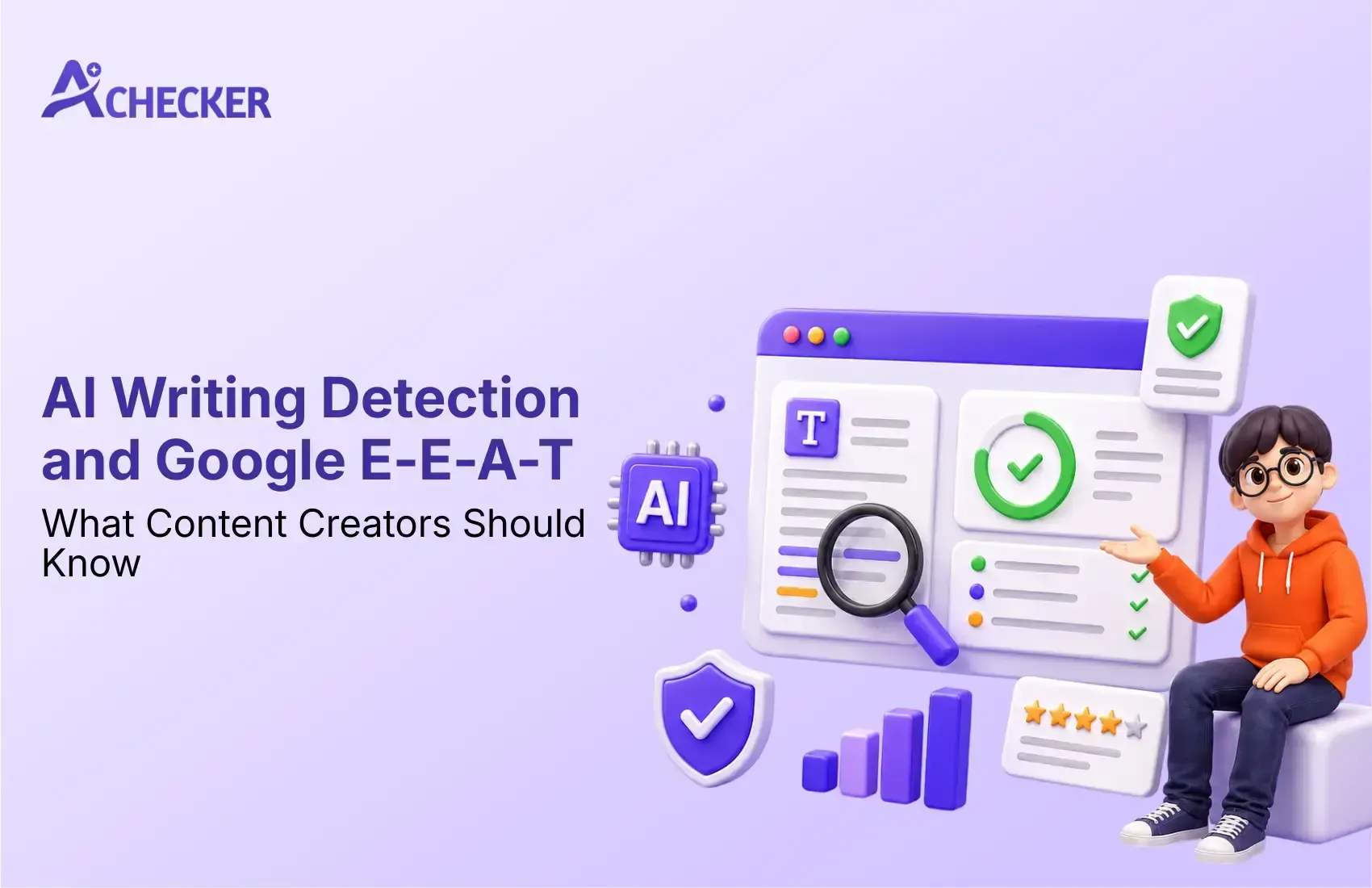
AI Writing Detection and Google E-E-A-T: What Content Creators Should Know
TABLE OF CONTENTS
Does Google Detect AI Content?
What Is Google E-E-A-T, and Why Does It Matter for AI Content?
How Google Evaluates AI Content: The Real Criteria
AI Content Detection Tools for Writers: What They Actually Do
Human-Written Content vs. AI-Generated Content: What Actually Ranks
How to Detect AI-Generated Content: A Practical Workflow
Improve Content Credibility With E-E-A-T: Practical Steps
Conclusion
FAQs
Get an AI summary of this post on:





Google doesn't ban AI-generated content. Google bans lazy content, and right now, a lot of that is created with AI.
This makes all the difference, which most content creators are not yet aware of. How search engines evaluate AI-generated content doesn't decide whether your page is high-quality or not. Whether your content reflects well on your E-E-A-T (Experience, Expertise, Authority, and Trustworthiness) does.
This leaves content teams in 2030 in an amazing position. On the one hand, they know that AI tools help create content faster. On the other hand, they also know that Google's Search Quality Rater Guidelines explicitly instruct raters to assign the lowest possible rating to "content auto-generated with little or no human input" and "content with little originality or added value."
So, the real question is not whether you can publish AI-written content on Google. The real question is: Is my content showing sufficient expertise, or is it sufficiently presenting information compiled from other sources? A good AI detector for content writers can help you figure out exactly where your drafts stand before you hit publish.
This article will explore how AI content detection works, Google's and Bing's guidelines for evaluating AI-generated content, and what publishing teams should do to ensure their content succeeds in search results.
Does Google Detect AI Content?
Yes, but not in the way many people expect.
Google has found that patterns in text produced by AI can sometimes be identified, like repetitive sentence structures, generic language, a lack of precise detail, and an overall lack of real-world grounding.
However, these patterns are not what result in a devaluation of the content's quality; rather, it's the actual quality of the work itself that matters most.
Here's the key distinction Google has made publicly:
- AI-assisted content that's fact-checked, edited, and enriched with real expertise is treated the same as human-written content.
- Auto-generated, unedited content produced purely to fill pages and target keywords falls under Google's "scaled content abuse" policy, regardless of whether a human or an AI wrote it.
So basically, Google's spam policies were made to spot a behavior pattern (mass producing stuff with no extra value), not really a single tool. Like, both human-written spam and AI-generated spam get checked using the same benchmark. If you want a clearer read on where you stand, this guide on whether Google penalizes AI content breaks it down further.
What Is Google E-E-A-T, and Why Does It Matter for AI Content?
E-E-A-T actually stands for Experience, Expertise, Authoritativeness, and Trustworthiness. It's basically the framework Google's human quality raters use to decide if content deserves to rank, and somehow it's baked into the algorithms that run the core updates, you know.
| E-E-A-T Element | What It Measures | Where AI Content Often Falls Short |
|---|---|---|
| Experience | Firsthand involvement with the topic | AI can't have used a product, run a test, or lived through an event |
| Expertise | Depth of knowledge and accuracy | AI often produces surface-level, generalized claims |
| Authoritativeness | Recognition as a credible source by others | AI-generated pages rarely build genuine citations or backlinks on their own |
| Trustworthiness | Accuracy, transparency, and safety of the content | Unedited AI text can include factual errors or unverified claims |
Experience is the one area where artificial intelligence typically falters, and it has relied upon heavily since its adoption. A product testimonial, a personal screenshot, a case study, or an article with an author's credentials serve as proof of experience that no language model can generate convincingly.
This is why E-E-A-T and AI content are inextricably linked in SEO discussions. If an AI-generated article lacks experience, it underperforms in comparison to human-made articles. That's also why so many teams now focus on why authenticity always wins with AI content instead of chasing volume alone.
How Google Evaluates AI Content: The Real Criteria
Google's guidance, refined through its Helpful Content system and folded into core updates, checks content against a handful of steady questions that kinda stay the same each time:
- Does the content demonstrate first-hand knowledge or experience?
- Would you feel comfortable trusting this content for a topic that impacts your health, finances, or safety (YMYL)?
- Does the content provide substantial value compared to other pages already ranking?
- Was the content created primarily to help people, or primarily to attract search traffic?
- Are claims accurate, sourced, and verifiable?
Notice none of these questions ask "was this written by AI?" They ask whether the output is useful. That's the practical takeaway for anyone weighing AI-generated content and SEO risk: the tool isn't the liability, the shortcut is. If you want the full picture, this breakdown of the Google spam update and AI content SEO covers what changed and why it matters.
Signals That Increase Risk
- Bulk-published pages with near-identical structure and thin differentiation
- Generic claims with no data, examples, or named sources
- No visible author, credentials, or editorial oversight
- Content that mirrors top-ranking competitors almost word-for-word in structure
These are the same red flags covered in this rundown of common AI detection problems that content teams run into.
Signals That Reduce Risk
- Clear author bylines with relevant credentials
- Original examples, screenshots, or data specific to your business
- Fact-checked statistics with cited sources
- Editorial review before publishing (not just spell-check)
If you're comparing tools to help enforce these standards, this comparison of the best AI content detectors is a solid place to start.
AI Content Detection Tools for Writers: What They Actually Do
AI detection tools for writers look at your text and try to spot statistical patterns that are kind of common in language model output, like predictable word choices, low sentence-level variability ("burstiness," which is a metric), and even a certain steady flow or phrasing rhythm.
They're useful for three practical purposes:
- Editorial quality control: flagging drafts that read too generically before publishing
- Client and agency transparency: confirming what percentage of a deliverable was AI-assisted vs. human-edited
- Publisher compliance: some platforms and marketplaces now require content-origin disclosure
What they're not good for: proving definitively whether a human or a model wrote a particular sentence. Detection scores are probabilistic, not forensic, more like a hint than a verdict. False positives do happen, especially when there are non-native English writers involved, or when the writing is kinda formulaic and technical. For a closer look at how AI content detectors actually work, it helps to understand the mechanics before trusting any single score.
For businesses using AI content verification platforms, it's best to treat those scores as one editorial signal, not an ultimate conclusion, and then pair automated checks with human review for anything customer-facing; otherwise you risk trusting a number that may be misleading a bit.

Get Lifetime Access with 60% OFF
Stop paying monthly subscriptions. Enjoy unlimited AI detection and humanizer access forever with future updates included.
- One-time payment
- Unlimited access forever
- All future updates included
Human-Written Content vs. AI-Generated Content: What Actually Ranks
The honest answer: neither wins by default. What ranks is the content that best satisfies search intent with the most credible, specific, and well-supported answer.
A useful mental model for editorial teams:
| Factor | Pure AI Output | AI-Assisted + Human Edited | Pure Human Written |
|---|---|---|---|
| Production speed | Fastest | Fast | Slowest |
| Factual accuracy (unverified) | Variable | High (fact-checked) | Depends on writer |
| Experience signals | Weak | Strong, if editor adds real examples | Strong |
| E-E-A-T alignment | Often weak | Can be strong | Strong |
| Scalability | High | Moderate | Low |
The middle column is where most competitive content teams now sort of operate, sort of like the "work lane" that really matters. AI does the drafting, research synthesis, and the basic structure. The humans, on the other hand, bring that lived experience; they double-check claims, and they apply the kind of discernment that AI just can't quite emulate.
Meanwhile, human editors add the lived-in experience, verify claims, and apply judgment in ways AI just can not replicate, or well, it rarely can, anyway. This side-by-side look at AI vs human content for SEO digs deeper into how each approach performs in real rankings.
That hybrid approach is also the most practical way to produce genuinely authentic content with AI tools without running into quality concerns. Like, the AI can speed up production, but there is still a person who owns the accuracy and the originality too.
How to Detect AI-Generated Content: A Practical Workflow
If you manage a content team, publication, or client accounts, here's a workable process:
- Run drafts through an AI content detection tool before publishing, as a QC checkpoint rather than a gatekeeper.
- Cross-check flagged sections against source material to confirm accuracy, not just origin.
- Require a named editor to review every piece for factual claims, statistics, and specific examples.
- Add original elements: screenshots, data from your own testing, quotes from real practitioners that no detector or competitor can replicate.
- Document your editorial process internally, especially for YMYL topics, in case you need to demonstrate compliance later.
Teams that are evaluating AI content detection tools for this kind of workflow should really place the priority on accuracy and transparency, like how the score is actually made, not just on those shiny marketing claims of "99% accuracy." Also look at integration options, such as API access, bulk scanning, browser extensions, and so on, because no detector manages to deliver that kind of consistency across different content types. This roundup of the best free AI detector tools is a good starting point if you're still weighing your options.
Improve Content Credibility With E-E-A-T: Practical Steps
- Add a real author bio with credentials relevant to the topic, not a generic "content team" byline.
- Cite primary sources, studies, official documentation, and original data instead of paraphrasing other blog posts.
- Update content regularly and note the last-reviewed date, especially for topics tied to policy or product changes.
- Show your work. If you tested a claim, say how. If you're citing a statistic, link to where it came from.
- Match depth to intent. A comparison query needs a comparison table. A how-to query needs sequential steps. Padding doesn't help E-E-A-T; precision does.
If your drafts still read a little stiff after editing, running them through an AI humanizer can smooth out the phrasing while you keep the facts and structure intact. And if you want to understand the bigger payoff, this piece on the benefits of AI content detection tools lays out why the extra step is worth it.
None of this requires abandoning AI tools. It requires treating AI as a drafting assistant, not a publishing pipeline.
Conclusion
The discussion about detecting writing generated by artificial intelligence tends to miss the point. Google has long rewarded quality and effort over "natural" human production and penalized organizations for not thinking beyond the writing tool.
Content teams that use AI as a time-saving but supportive layer rather than a complete replacement of their own work will find their rankings benefit the most from such an approach.
Those who rely on sheer volume of AI-generated articles without fact-checking and human editing will see the costs of Google's crusade against content mills.
Before posting an AI-generated article, run it through an AI content detection scanner as one element of a broader quality control regimen that should also include fact-checking and human proofreading. You can run that check anytime with AI Checker Pro.
FAQs
1. Does Google penalize AI-generated content?
2. What does E-E-A-T stand for?
3. Can AI detection tools accurately tell if content was written by AI?
4. Is AI-assisted content bad for SEO?
5. How does Google check content quality?
6. What is scaled content abuse?
7. Do I need to disclose that content was written with AI?
8. What is the best way to use AI for content writing without hurting rankings?
9. Why does experience matter in E-E-A-T?
10. Can AI content rank on Google's first page?

Harshil Barvaliya
SEO Executive & Content Writer at AI Checker Pro
I’m Harshil Barvaliya, an SEO Executive and Content Writer at AI Checker Pro. I focus on improving the website’s search engine visibility through effective SEO strategies, including keyword research, on-page and off-page optimization, and content development.Get Started Free
Create a free account for advanced AI detection and scan history.
Trusted by thousands worldwide.
Recent Blog's
Discover how AI-powered content creation can elevate your website's reach and engage your audience like never before. Explore the real impact of AI on crafting content that connects.