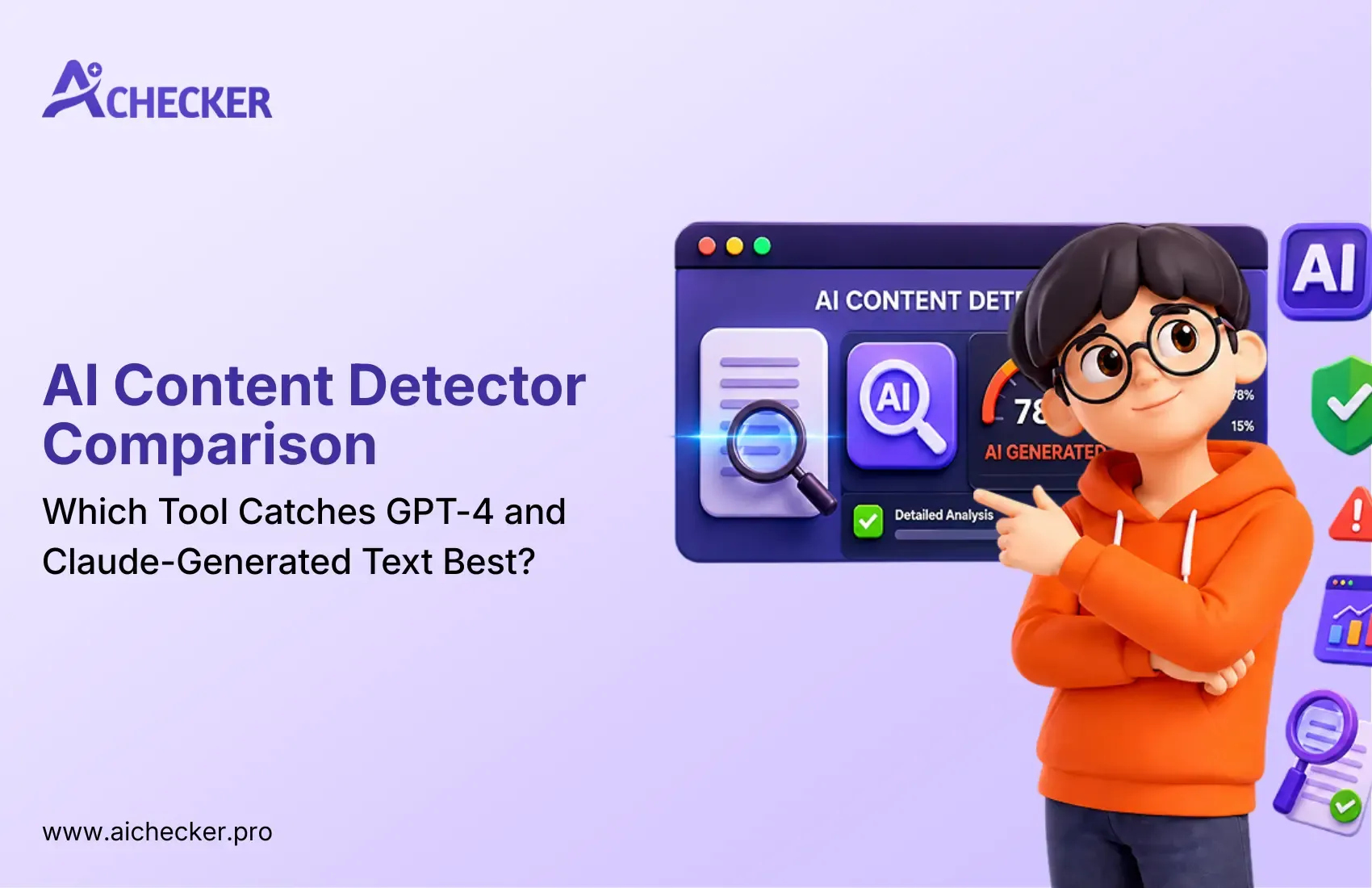
AI Content Detector Comparison: W hich Tool Catches GPT-4 and Claude-Generated Text Best?
TABLE OF CONTENTS
Why AI Detection Is Harder in 2026
How We Tested These AI Content Detectors
Best AI Content Detectors Compared
Which Tool Detects GPT-4 and Claude Text Best?
Are AI Content Detectors Actually Reliable?
How to Reduce AI Detection Scores Naturally
Conclusion
Get an AI summary of this post on:



If you're trying to find the best AI content detector, you probably ended up here for a reason, in the right place, and all that. With GPT-4 and Claude turning out more human-like writing, detecting AI-generated text has become one of the hard tasks in 2026, like actually hard. You can check out this deeper breakdown of common AI detection problems worth knowing about before diving into the comparison.
This AI content detector comparison sort of breaks down the top tools; it also looks at how accurate they are in real life, and then it tells you straight up which one edges out the rest for your situation. Whether you're an educator, a publisher, or you're making content yourself, this guide gives you clear, honest answers.
Why AI Detection Is Harder in 2026
AI detection is honestly not what it was before. Like, two years ago, most AI generated content had these pretty obvious patterns, you could spot them fast. Now, though, it seems like that whole thing has kind of switched over completely, and no one can really rely on the old tells anymore.
GPT-4 and Claude Writing Patterns
GPT-4 and Claude now make text that feels kinda like it was written by a person, the rhythm is similar, sentence shapes are varied and even the vocabulary seems a bit more lived-in. Because of that, the top-tier detectors kinda run into serious trouble, especially when those advanced models output something really inventive or humanized in that way.
Both models have gotten particularly good at avoiding the two main signal detectors that rely on:
- Perplexity: How predictable word choices are. AI text tends to be more predictable than human writing.
- Burstiness: Variation in sentence length. Humans naturally mix long and short sentences; AI tends to be more uniform.
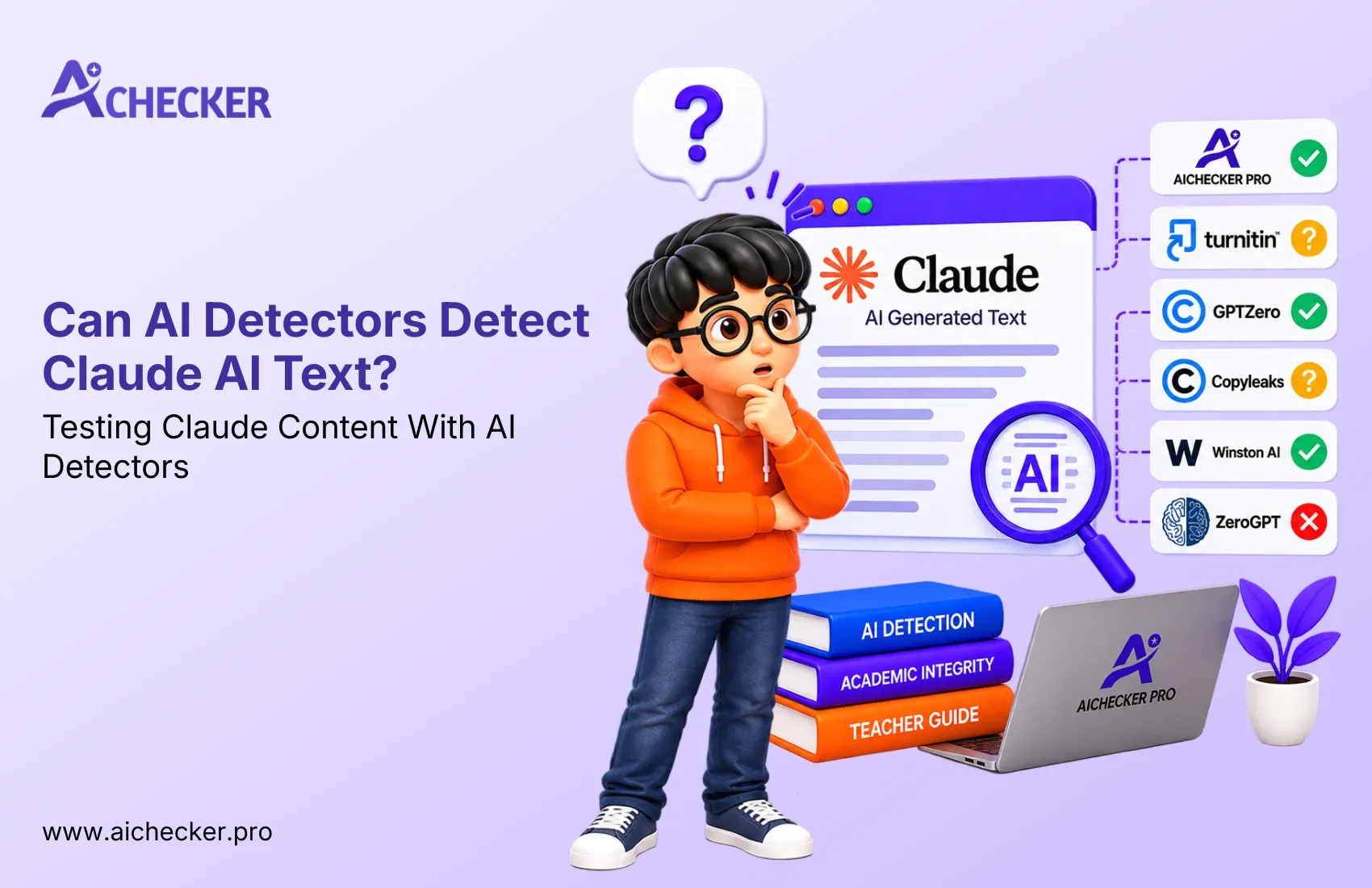
Claude, in particular, manages to make prose that feels really natural. Independent checks show that if a tool hits about 98% accuracy on GPT-3.5 text, it can fall to something like 70% accuracy when it's fed Claude 3.5 output. That's a pretty big gap, and most comparison articles just kind of gloss over it. If you want to understand how accurate AI content checkers really are, that's worth a separate read.
False Positives and Humanized Content
False positives are a growing problem across pretty much every tool in this category. Lately, modern humanizer tools like Quillbot, Humanizer Pro, and Undetectable.ai can push a top detector's accuracy from 92% down to 55-65% on the exact same text, which is kinda wild.
So the real-world detection gap ends up being way wider than what those headline numbers imply. And also, well-written, structured human text gets marked as AI pretty often too. That happens especially in cases with non-native English speakers, and even more with formal academic writers. There's a solid overview of why AI detectors flag human writing by mistake if you want to dig into that side of things.
How We Tested These AI Content Detectors
For this AI content detector comparison, each tool was evaluated using a standardized set of content samples including:
- Raw, unmodified GPT-4 output
- Raw, unmodified Claude-generated text
- Human-written blog articles
- Humanized or lightly edited AI content
- Mixed human and AI content
The key metrics tracked were:
- True positive rate (correctly flagging AI text)
- False positive rate (incorrectly flagging human text as AI)
- Accuracy on Claude-specific output
- Accuracy on GPT-4 AI detector performance
- Ease of use and pricing
Best AI Content Detectors Compared
AIChecker.pro
AIChecker.pro is, like, one of the strongest free AI content detector tools you can use right now. It was built from the ground up specifically for detection accuracy, not really as an add-on to some paraphrasing or writing tool.
Key strengths:
- Accuracy: AIChecker.pro delivers 99% or higher accuracy in real-world tests on content from ChatGPT, GPT-4, Claude, Gemini, and other major AI tools.
- Sentence-level highlighting: It shows you exactly which sentences are flagged and explains the reasoning behind each flag.
- Completely free: No signup required. No credit card. No hidden limits on basic use.
- Multi-model detection: Covers ChatGPT, GPT-4o, Claude, Gemini, Llama, Mistral, and more in a single check.
Best for: Students, bloggers, and content creators who need reliable free detection without a paywall.
Weakness: Like all tools, accuracy drops when content has been heavily processed through a humanizer tool before submission.
GPTZero
GPTZero is honestly pretty well known as being one of the most clear, and academically trusted detectors out there on the market, or something like that. You can read a full GPTZero AI detector review to see how it holds up in detail.
- Achieves 92.4% detection with a 0.24% false positive rate, making it the best balance of accuracy and low false positives among major tools.
- Provides sentence-level highlighting, which is especially useful for educators explaining a flagged submission to a student.
- The free tier allows up to 10,000 words per month. Premium plans start at $12.99 per month.
Best for: Teachers, professors, and academic institutions that need trustworthy, explainable results.
Weakness: Detection rate drops significantly when content has been run through humanizer tools before submission.
Originality.ai
Originality.ai is kinda the go-to tool for content marketers and SEO publishers. It blends AI detection with plagiarism checks in one workflow, so it feels seamless. There's also a detailed Originality.ai vs AIChecker.pro comparison if you want to see how the two stack up directly.
- Achieves approximately 94% detection accuracy with a 2-3% false positive rate.
- Particularly strong at detecting GPT-4 and Claude-generated content, making it one of the best Claude AI text detector options for professional teams.
- Pricing is approximately $0.01 per 100 words on a pay-per-scan model.
Best for: Content agencies, SEO teams, and digital publishers who need reliable detection at scale.
Weakness: No meaningful free tier. Costs can add up quickly for high-volume users or individual writers on a budget.
ZeroGPT
ZeroGPT is among the most popular and pretty accessible free AI detectors, with millions of users worldwide, honestly it's a bit known everywhere.
- Performs very well on raw, unedited AI output. Pure GPT-4 and GPT-5 outputs are reliably caught at near 100%.
- Free to use with no account required.
- Covers ChatGPT, GPT-4, GPT-5, Gemini, Claude, DeepSeek, and Llama.
Best for: Quick, casual checks of clearly AI-generated content where you need a fast answer.
Weakness: False positive rates reach 15-20% in some independent studies, particularly for non-native English speakers or short texts under 300 words. Accuracy also drops significantly on hybrid or paraphrased content. See this ZeroGPT review for a closer look at where it falls short.
Copyleaks
Copyleaks started out as a plagiarism detection tool and then kinda expanded into AI detection too. It now feels like one of the most feature-rich platforms in this comparison, even though, honestly, it still does the basic stuff well.
- High accuracy for detecting unedited AI text from ChatGPT, Claude, and Gemini.
- Supports 30+ languages, making it one of the strongest options for international publishers and multilingual academic institutions.
- Combines AI detection and plagiarism detection in a single platform.
- Uses a proprietary system called AI Logic, which cross-references submitted text against known AI-generated text patterns from models like GPT-4, Claude, and Llama.
Best for: International teams and institutions that need multilingual support and combined plagiarism plus AI detection.
Weakness: Performs well on pure AI text but struggles noticeably with humanized or paraphrased content. Advanced humanizer tools can bypass Copyleaks detection at higher rates than AIChecker.pro or Originality.ai. This AIChecker vs Copyleaks breakdown covers that gap in more detail.
Which Tool Detects GPT-4 and Claude Text Best?
So, here's this sort of clear side-by-side breakdown based on some testing results, I mean, you can see it that way.
| Tool | GPT-4 Detection | Claude Detection | False Positive Rate | Free Tier |
|---|---|---|---|---|
| AIChecker.pro | 99%+ | 99%+ | Low | Yes, no signup |
| Originality.ai | 94% | 94% | 2-3% | No |
| GPTZero | 92.4% | Strong | 0.24% | Yes, 10K words/month |
| Winston AI | 96% | Strong | 3-4% | Limited |
| ZeroGPT | Near 100% (raw) | Moderate | 15-20% | Yes |
| Copyleaks | 99% (unedited) | High (unedited) | Low (unedited) | Limited |
For raw, unmodified GPT-4 and Claude output, AIChecker.pro, Originality.ai, and Copyleaks all land at the top tier. But when there's edited or partially humanized content, AIChecker.pro and Originality.ai keep better consistency across different formats.
If you are specifically evaluating Claude AI text detector accuracy, Originality.ai and AIChecker.pro are the two strongest performers in 2026. For a broader look at how the best AI detector tools compare overall, that article goes even deeper into the field.
Are AI Content Detectors Actually Reliable?
To be honest, they can be useful tools, but they are not perfect ones, really.
No AI content detector is 100 percent infallible. You should treat these kinds of tools like warning signs, for extra looking, instead of a final, absolute verdict about whether some text was written by a human or a machine.
The key limitations every user should understand:
- Humanized content defeats most tools. All major detectors drop 15-35% accuracy on content processed through humanizer tools before submission.
- Short texts are less reliable. Anything under 300 words gives detectors less signal to analyze accurately.
- Non-native English speakers face unfair flagging. Formal, structured writing is consistently misidentified as AI across multiple platforms.
- Newer AI models are harder to catch. Independent studies show that even leading tools catch significantly lower percentages of output from the newest AI model versions compared to older ones.
Use these tools as a starting point for review, not as a final verdict. Pair them with editorial judgment and, in academic contexts, writing process evidence. This guide on how AI detectors work accurately explains the technical side of those limitations pretty clearly.
How to Reduce AI Detection Scores Naturally
If your content is being incorrectly flagged as AI, here are genuine writing improvements that reduce detection scores without using bypass tools. For a deeper dive, check out this full guide on how to humanize AI text naturally:
- Vary your sentence lengths. Mix short punchy sentences with longer ones. AI tends to keep sentence lengths uniform throughout a piece.
- Use first-person perspective. Phrases like "In my experience" or "I have noticed" add a clear human signal to your writing.
- Add specific examples. Real examples and personal references are hard for AI to replicate generically.
- Break predictable patterns. Avoid starting every paragraph with a transition word like "Furthermore" or "Additionally."
- Include natural imperfections. Real human writing occasionally uses colloquial phrases and informal transitions that AI avoids.
- Use the active voice more. AI writing tends to lean heavily on passive constructions, which detectors flag as a signal.
- Edit structurally, not just cosmetically. Reorder sentences, cut unnecessary ones, and rebuild paragraphs around your own logic rather than just swapping words.
These steps improve overall writing quality on their own, not just detection scores. If you want a tool that helps convert AI-sounding content into something that reads more naturally, the AI humanizer at AIChecker.pro is worth trying out.
Conclusion
In the AI content detector comparison of 2026, it looks like no single tool truly wins in every situation, really. When you're after the best AI content detector that can balance accuracy along with free access, and also that easy-to-use feel, AIChecker.pro tends to lead, with 99%+ accuracy, and no signup requirement.
For SEO content teams, Originality.ai remains a professional standard, still. For educators, GPTZero offers a pretty solid mix of transparency and low false positives, in most cases. Use these tools like rough guides, and then pair them with an editorial review, because a single detection score shouldn't be treated as the final answer, ever.
1. What is the best free AI detector tool in 2026?
2. Can an AI checker detect ChatGPT-generated text accurately?
3. How does an AI text detector actually work?
4. Why is my human-written content getting flagged by an AI writing detector?
5. Is there any truly free AI detection tool with no word limit?
6. Can AI humanizer tools really bypass AI detectors?
7. Which AI detector is best for checking student essays?
8. What is the difference between an AI detector and a plagiarism checker?
9. How can I humanize AI text so it passes an AI checker?
10. Does AI content detection work on Claude-generated text?

Harshil Barvaliya
SEO Executive & Content Writer at AI Checker Pro
I’m Harshil Barvaliya, an SEO Executive and Content Writer at AI Checker Pro. I focus on improving the website’s search engine visibility through effective SEO strategies, including keyword research, on-page and off-page optimization, and content development.Get Started Free
Create a free account for advanced AI detection and scan history.
Trusted by thousands worldwide.
Recent Blog's
Discover how AI-powered content creation can elevate your website's reach and engage your audience like never before. Explore the real impact of AI on crafting content that connects.