Google Spam Update 2026: Impact on AI Content & SEO
TABLE OF CONTENTS
What Is the Google Spam Update 2026?
The Real Impact of the Google Spam Update on AI Content
How Google Detects AI Content
Is AI Content Allowed by Google in 2026?
SEO Impact After the Google Algorithm Update 2026
How to Avoid the AI Content Penalty in 2026
How AIchecker Pro Helps You Stay Safe
Best SEO Practices for AI Content in 2026
Conclusion
Get an AI summary of this post on:





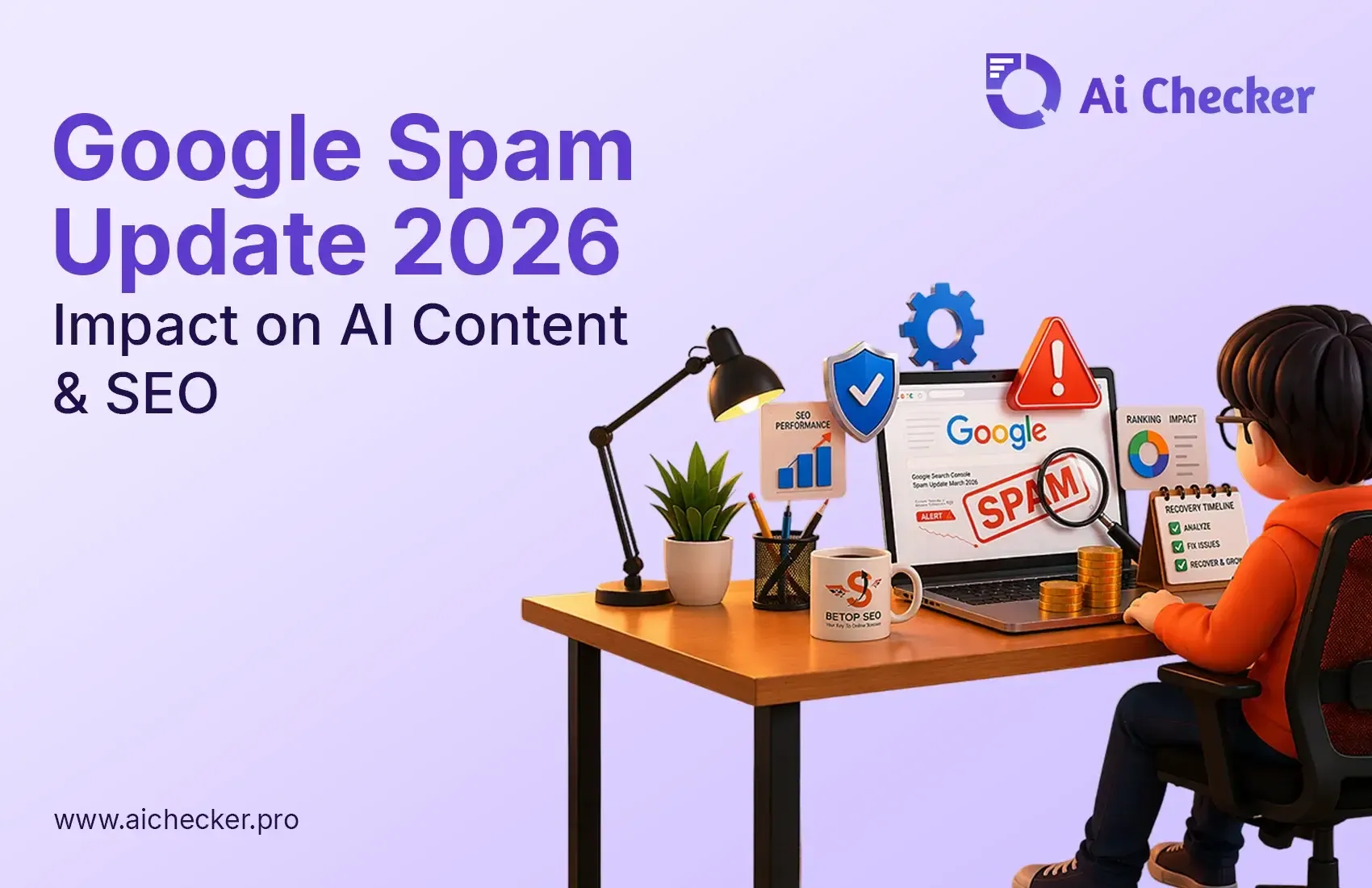
The Google Spam Update 2026 has introduced major search result changes that affect websites using unedited AI-generated material as their main content source. The SEO community is understandably shaken. Many website owners are watching their visitor numbers drop without knowing why. The good news? Once you understand what Google is actually targeting, the problem becomes much easier to fix. If you want a deeper look at how this update connects to broader ranking signals, this guide on AI vs human content for SEO is a helpful starting point.
This guide explains how the Google Spam Update 2026 impacts your content strategy, how AI Content SEO has developed since then, and what you can do to protect your rankings or recover from previous losses. Let's get into it.
What Is the Google Spam Update 2026?
Google has always worked to improve its search results. The Google Spam Update 2026 pushes that goal further than any previous attempt. The update targets content that exists solely as low-quality material produced in bulk through automated content creation software.
Google wants its search results to feel like recommendations from a knowledgeable friend, not a list of pages stuffed with irrelevant information. The Google algorithm update 2026 is a direct continuation of the helpful content system Google has been building since 2022.
What exactly is in the crosshairs? The detection system flags content that contains only surface-level information with no real substance, uses excessive keywords, produces useless AI-written output, and displays "site reputation abuse," which allows low-quality content to appear under trusted domains for ranking purposes.
Google's core message is simple: your content needs to provide real benefits for actual people if you want it to rank. That standard has always existed, but this update enforces it more strictly than any version before it.
The Real Impact of the Google Spam Update on AI Content
This is where things get difficult for content creators who rely too heavily on automation.
The AI Content Google Update did not ban AI writing. But it drew a very clear line between AI-generated content that has been thoughtfully reviewed, edited, and improved by a human, and raw AI output published straight onto a page without any changes. Google treats these two things very differently.
Real examples confirm this. Sites that published multiple AI-generated articles each week without making any meaningful edits saw major traffic drops within weeks of the update rolling out. Some experienced organic traffic reductions between 40 and 60 percent. Meanwhile, sites that used AI for drafting but added genuine human input and editing either held their rankings steady or improved.
The risk comes from how Google detects AI-generated content. Google's systems have become capable of identifying unedited AI output through typical patterns like overly smooth sentence flow, predictable structure, and the absence of personal style or real-world detail.
When those signals are present in published content, the result is an AI content penalty. Once a site receives that penalty, recovery takes significant time and effort.
How Google Detects AI Content
Google does not rely on a single detection method. Instead, it uses a combination of signals to assess content quality and authenticity. These include writing pattern analysis, repetitive phrasing checks, evaluation of first-hand experience, and E-E-A-T scoring, which stands for Experience, Expertise, Authoritativeness, and Trustworthiness.
Originality signals and content classifiers also play a role. Pages that resemble typical AI-generated text, lacking specific context, individual character, or real understanding, receive low quality scores.
What Google is looking for is content that feels generic: writing that lacks real human experience, follows repetitive language patterns, and shows no original thinking or genuine expertise. This is also why understanding how AI detection tools work can be useful, since the signals Google uses overlap significantly with what third-party AI content detectors flag.
Pattern recognition is what trips most people up. The structure and rhythm of unedited AI text can reveal its origins even if you never mention AI anywhere on the page.
Is AI Content Allowed by Google in 2026?
Let's clear something up, because this myth keeps spreading. Google does allow AI content in 2026. According to its official policy, Google permits AI-generated content when it provides useful, accurate information and has been assessed by a human before publication. The update does not target artificial intelligence itself. It targets spam and laziness.
The idea that "all AI content is banned" is simply not true. Penalties apply to AI-generated content that exists purely for algorithmic purposes rather than to genuinely serve readers. Google defines helpful content as content that demonstrates real knowledge, answers real questions, and satisfies the reader beyond what a keyword-stuffed machine output can offer.
You can use ChatGPT or Gemini for content creation. But the output needs real substance behind it. Your personal understanding needs to come through. The content requires fact-checking. The text needs to flow naturally. The writing should reflect your voice. Understanding whether Google penalizes AI content and what specifically triggers those penalties is key to staying on the right side of this update.
SEO Impact After the Google Algorithm Update 2026
If your site has seen a traffic decline recently, the update is likely the reason.
The Google algorithm update 2026 triggered ranking drops for sites showing a few specific patterns: over-reliance on AI-generated text with no human editing, thin pages that only touched the surface of a topic without real depth, and what Google calls "duplicate-pattern content," which refers to pages that are structurally and tonally identical to each other because they were created from the same AI prompt template.
Traffic loss happens when Google marks these pages as unhelpful, leading to decreased rankings and removal from featured positions. The AI content penalty can hit a single page or, in severe cases, affect the overall authority of your entire domain.
Recovery takes time. Depending on how extensively a site was flagged and how quickly genuine improvements are made, the process can take anywhere from three weeks to three months.
SEO for AI content going forward means treating AI as a starting point, never a finish line.
How to Avoid the AI Content Penalty in 2026
Good news: this is very fixable. Here is a practical, step-by-step approach that works.
Step 1: Check before you publish. Run all AI-generated content through a reliable AI detection tool before it goes live. The AI probability score gives you a clear benchmark to work toward.
Step 2: Humanize your AI text. This goes beyond just making it sound human. It needs to deliver genuine value. Share a personal opinion. Use a real-world example. Reframe a paragraph in your own voice. If you want practical guidance, this resource on how to humanize AI content covers the process in detail.
Step 3: Strengthen your E-E-A-T signals. Add a detailed author bio. Cite credible sources. Where possible, include first-hand experience or original observations. Google rewards content that proves it comes from someone who actually knows the subject.
Step 4: Use an AI humanizer to rewrite flagged content. If your AI to human text conversion is not landing naturally, a good AI humanizer can help you rewrite flagged sentences into something that reads more authentically.
Step 5: Add original data and real examples. Quotes from industry experts, original statistics, and case studies from your own experience are the kinds of additions that both humanize text and signal genuine quality to Google. No AI can fabricate a real interview or your own firsthand story.
How AIchecker Pro Helps You Stay Safe
Manually checking every sentence that AI systems produce takes a lot of time, even for experienced writers who understand the patterns Google classifiers use. That is the core problem. What you need is a reliable tool that does the essential work before your content goes live.
This is where AI checker genuinely earns its place in your workflow.
AIchecker Pro works differently from the standard detection tools you may have used before. Instead of delivering a simple "AI or human" judgment, it provides a detailed detection score that evaluates each section of your article separately. It shows you exactly which sentences are creating high-risk flags, so you know where to focus your editing time. That level of detail changes everything.
The built-in AI humanizer feature goes a step further. It detects problem areas and provides instant suggestions to help you correct them. The process of converting AI content into something that reads naturally becomes much faster without losing your core message or key information.
AIchecker Pro is built for bloggers, SEO writers, and agencies who create AI-assisted content and need a straightforward way to verify quality before publishing. It supports content from ChatGPT, Gemini, and other widely used tools, making it a flexible solution for any workflow.
Run your content through AIchecker Pro before it goes live. The time it saves and the penalties it prevents make it worth every bit of the investment.
Best SEO Practices for AI Content in 2026
The SEO landscape for AI content is going through a fundamental shift, and adopting the right habits now will put you ahead going forward.
Google evaluates content based on genuine usefulness to readers, and its ability to identify low-quality material improves every year. AI is an excellent drafting tool, but it should never be your final output on its own.
Edit every piece of AI content, verify its accuracy, and customize it before publishing. Treat AI as a partner in the writing process while keeping full control over the quality and substance. If you need a quick starting point, an AI humanize free online tool can help you address flagged sections with minimal effort.
Structured data helps Google better understand your page content. Internal links that connect to relevant supporting content add context and authority. Author information should be visible and trustworthy. These elements combine to create the kind of strong quality signals that search engines reward.
If you are specifically working on avoiding Google penalties by humanizing AI content, building these habits into your standard publishing workflow is the most reliable long-term approach.
Conclusion
The Google Spam Update 2026 is not an anti-AI system. It is an anti-spam and anti-laziness system. Google permits AI-based content creation, but it rejects content that exists purely to increase word count with no benefit to the reader.
The websites that succeed going forward will use AI intelligently as a foundation, then complete the work by adding human understanding, original perspective, and genuine expertise. AI Content SEO in 2026 means using AI in a way that serves your readers, not just your publishing schedule.
Verify your content. Add human elements. Make sure your E-E-A-T signals are clear and provable. Run every article through an AI detection system before it goes live.
You can start protecting your content right now by using AI checker for free, so that every piece you publish has the best possible chance of ranking without penalty risk.
1. What is the Google Spam Update 2026 and how does it work?
2. Does Google penalize AI-generated content in 2026?
3. How does Google detect AI-written content?
4. What is the AI content penalty and how serious is it?
5. How long does it take to recover from a Google spam penalty?
6. What type of AI content is safe to publish after the 2026 update?
7. How can I avoid the AI content penalty in 2026?
8. What does E-E-A-T mean and why does it matter for AI content SEO?
9. Can I use ChatGPT or Gemini for SEO content in 2026?
10. What is the best way to humanize AI content for Google in 2026?

Harshil Barvaliya
SEO Executive & Content Writer at AI Checker Pro
I’m Harshil Barvaliya, an SEO Executive and Content Writer at AI Checker Pro. I focus on improving the website’s search engine visibility through effective SEO strategies, including keyword research, on-page and off-page optimization, and content development.Get Started Free
Create a free account for advanced AI detection and scan history.
Trusted by thousands worldwide.
Recent Blog's
Discover how AI-powered content creation can elevate your website's reach and engage your audience like never before. Explore the real impact of AI on crafting content that connects.