Falsely Accused of Using AI? What Students Should Do Next
TABLE OF CONTENTS
Why Honest Students Get Flagged by AI Detectors
Can AI Detectors Falsely Accuse Students?
What to Do If Falsely Accused of Using AI: Your First 24 Hours
How to Prove You Did Not Use AI: Evidence That Works
How to Dispute an AI Detection Result Step by Step
What to Do If Turnitin Flags Your Essay as AI
What If My Professor Says I Used AI?
How Popular AI Detectors Compare
How to Reduce Your Risk Before You Submit
Conclusion
FAQs
Get an AI summary of this post on:




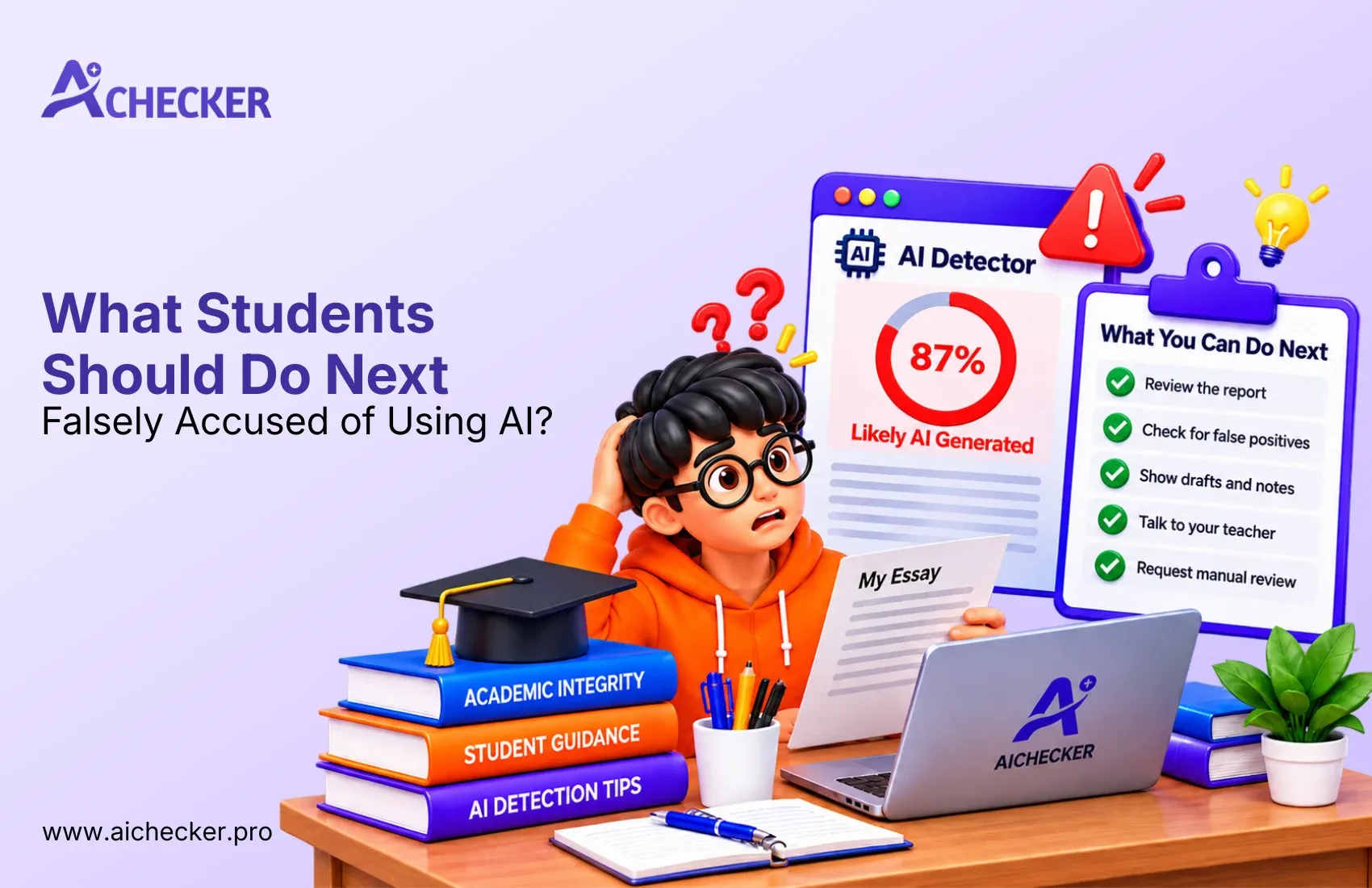
Getting falsely accused of using AI is one of the worst things that could happen to a student in the year 2026.
You wrote the essay yourself, and now some poor professor is just pointing to a number on a screen. It's not fun for anyone, and I know because it has happened to innocent students like myself more than once.
If you get falsely accused of using an AI tool, then you should remain calm, save all your drafts and versions, ask to see the detector results, and to request a formal review. No one detector is 100% accurate, and a number on a screen is not always an answer.
Evidence of your own process is the best way to combat false claims.
Key Highlight
- An AI detector false positive is a statistical guess, not proof that you cheated
- No detector is 100% accurate, and formal or non native English writing gets flagged more often
- Your best defense is a paper trail of drafts, notes, and version history
- Stay calm, ask for the report in writing, and use your school's appeal steps
- If you are falsely accused of using AI, answer with evidence and not emotion
Why Honest Students Get Flagged by AI Detectors
AI detectors do not read your essay the way a professor does. They look for statistical patterns, like how predictable your word choices are and how even your sentence lengths feel. If your writing is clean, formal, and consistent, a detector can read that as machine like.
That is why an AI detector false positive happens so often with strong, careful writers. I have run batches of old essays through several tools, including some written years before ChatGPT existed, and a few of them still came back with a high AI score. It surprised me the first time, and it is the main reason I never trust a single number.
Here are the writers most likely to get falsely flagged as AI:
- Students who write in a very formal, textbook style
- English as a second language writers who stick to simple, safe sentence patterns
- People who write short, factual pieces like lab reports and summaries
- Anyone who edits with grammar tools until the text feels too smooth
So if human writing detected as AI sounds familiar, you are not alone. Plenty of students ask Why is my human-written essay flagged as AI, and the honest answer is that the tool is making a guess based on patterns. It is not proving anything. Being falsely accused of using AI usually starts with one of these quirks. If you are falsely accused of using AI, knowing why the tool misfired is half the battle.
Can AI Detectors Falsely Accuse Students?
Short answer: Yes, and you can be falsely accused of using it as well, which is why it's important to know why. Can AI detectors falsely accuse students? Of course, and in fact do in classrooms across the country every semester.
Students falsely accused of using AI are far more common than most professors know or would admit. Each tool, including Turnitin, GPTZero, Originality.ai, and Copyleaks, states in some way that the results are a suggestion.
Here is what is widely known about AI detector accuracy:
- No AI detector is 100% accurate, and the companies behind them say so themselves
- Formal writing and non native English writing carry a higher risk of being misread
- Accuracy drops a lot when AI text has been paraphrased or edited by hand
- Different tools often give different scores for the same essay
Paste the same paragraph into three different programs, and you could get three completely different answers. Many major universities have reduced their reliance on one detection tool for this exact reason.
Due to the false positives of AI detection, many schools now inform instructors that a score on its own should not be enough to give a student a penalty.
When a low score gets escalated into a formal complaint, you end up with an AI detector false accusation that can haunt a student for months.
Should one percent determine your grade if the tool can make mistakes? Most academic policies would argue otherwise, and students who are falsely accused can rely on this argument to build a defense around.

Get Lifetime Access with 60% OFF
Stop paying monthly subscriptions. Enjoy unlimited AI detection and humanizer access forever with future updates included.
- One-time payment
- Unlimited access forever
- All future updates included
What to Do If Falsely Accused of Using AI: Your First 24 Hours
How you react in the first day can shape the whole case, so here is the order I would follow. Anyone falsely accused of using AI should start here.
Step 1. Do not delete anything. Keep every draft, note, and browser history item exactly as it is.
Step 2. Do not confess to something you did not do just to end the stress.
Step 3. Ask, politely and in writing, to see the detector report and the exact passages that were flagged.
Step 4. Download the full version history of your document right away.
Step 5. Write a timeline of how you worked on the essay while it is still fresh in your mind.
Tone is everything when crafting your response. A passive-aggressive email that suggests you would like to understand the user's issue and tell them about your drafting process will help you avoid a confrontation better than a furious message.
If your initial reaction to an AI detecting your use of ChatGPT is to defend yourself, always remember that a tool has guessed, not seen actual writing.
Many students wrongly accused the use of using ChatGPT tend to rush and prove their innocence immediately. Instead, take a deep breath and compile evidence to the contrary.
Finally, the best response to a false accusation of using an AI to generate text is to be thorough and polite. There is nothing wrong with asking someone to explain their concerns and intentions before responding in kind.
How to Prove You Did Not Use AI: Evidence That Works
You cannot prove a negative directly, but you can show your process, and process is exactly what a detector can never see. If you want to prove an essay is not AI-generated, you need a paper trail. A student falsely accused of using AI who brings drafts to the meeting is in a much stronger spot than one who brings only words. Learning how to prove you did not use AI comes down to showing how the work grew.
What evidence proves I wrote my essay?
The strongest AI detection evidence in your favor usually looks like this:
- Version history from Google Docs or Microsoft Word showing the essay growing over hours or days
- Early outlines, handwritten notes, and brainstorm pages
- Research sources, highlighted PDFs, and saved library searches
- Earlier writing samples from the same class that match your style
- Messages with classmates, tutors, or writing center staff about the draft
That list represents the evidence that proves I wrote my essay in most real cases. Version history is the main one.
An actual essay is written in a process, where texts were edited, deleted, and rewritten. One that's pasted from AI tends to be in much bigger chunks all at once.
When a professor views a document written across multiple sittings, their view of it can often change rapidly. In my experience, showing a falsely accused student version history tends to have the accusation dropped quickly.
Be Ready to Talk Through Your Essay
If your professor asks you to come in, offer to walk them through your work. Tell them what you intended with your thesis, why you chose the sources you did, what you cut, etc.
When you write something yourself, you can talk through what you wrote about with ease. Some instructors ask for a brief in-person writing sample, and that's totally understandable.
This is how you can prove to them that the work is human-written: show your process, show your style evolution, and show that you understand what you're writing about.
How to Dispute an AI Detection Result Step by Step
Once your evidence is ready, move to the formal side. When you are falsely accused of using AI, the paperwork is where cases are won. Knowing how to dispute an AI detection result can feel confusing, but most schools follow a similar path:
- Read your syllabus and the academic integrity section of the student handbook.
- Request the evidence in writing, including the detector name, the score, and the flagged text.
- Submit a written response with your timeline and documents.
- Ask for a meeting with the instructor first, then the department chair if needed.
- Move to the academic integrity office or ombudsperson if the matter stays unresolved.
Many students ask whether you can appeal an AI cheating accusation. Yes, nearly every college has an appeals process, and you usually have the right to present your side before a penalty becomes final. An AI detector appeal works best when it is short, factual, and attached to documents. Write one clear page and add your proof.
When you are falsely accused of using AI and dispute AI detection results, point out these facts politely:
- The tool maker itself says no detector is fully accurate
- The report shows a probability, not a confirmed fact
- Your version history shows how the work was created
If it has come to a formal accusation of an academic integrity violation, then perhaps you can contact your school's student advocate or legal aid office and ask them to take up the case. They will know the appropriate procedure.
I am not a lawyer, so please take what I say with a grain of salt. Students who are accused of using AI are generally given some leeway during the hearing.
What to Do If Turnitin Flags Your Essay as AI
Turnitin is probably the thing most students are scared of, so let me address this one head-on. If a student is wrongly accused of using AI on Turnitin, they should request in writing that the school administration confirm the policy. A report from Turnitin containing problematic sections of an essay should serve as the starting point for a dialogue, not the end of it. The company itself warns that the essay's "AI detection score should not be used as the sole criterion for taking disciplinary action."
Here is what to do if Turnitin flags your essay as AI:
- Ask which sections were highlighted and what the score range was
- Compare those sections with your drafts
- Check whether the flagged parts are quotes, definitions, or standard phrases
- Remind your instructor that the tool can be wrong, especially on short or formal text
When I tested some of the last month's essays for this article, the flagged sentences were often the best-written paragraphs, the ones the writer had edited most. Good writing sometimes got flagged more.
If your AI detector flagged my essay, is the thought in your head: see if the flagged lines are your cleanest by far.
Also keep in mind that accused of using AI in college cases are rarely decided by a score alone at schools with sound policies. Evidence and process come first, and being falsely accused of using AI is something they have seen before.
What If My Professor Says I Used AI?
This is the conversation students dread. People often ask what if my professor says I used AI, and the answer starts with staying respectful. When a professor accused me of using AI is the story I hear from readers, it usually began with a short email or a comment on a graded paper.
Here is how to handle it if you are falsely accused of using AI:
- Stay calm, even if you feel hurt
- Ask what specific concern led to the accusation
- Offer to share drafts and walk through your work
- Avoid blaming the professor, since many are under pressure to catch AI misuse
If the teacher thinks I used AI because my writing looks better than normal, explain why it was helped by tutoring, practice, and/or the writing center. That is a perfectly reasonable response.
An accusation of AI plagiarism may feel like a personal attack, but it's actually a policy decision for many instructors.
If you are accused of using an AI generator, don't panic, but do escalate the issue in writing. Many accusations of AI writing are dropped simply because the student shows the instructor their drafts and the professor realizes the student did it themselves.
How Popular AI Detectors Compare
Not every tool operates the same, and the differences can be very telling in a dispute. Here's a quick overview of general differences from public knowledge and personal testing, and you can find a deeper AI content detector comparison on our blog.
These differences are relevant to the situation where one is falsely accused of using AI and needs to explain how a score came to be.
| Tool | Accuracy | Free Tier | Humanizer Included | Best For |
|---|---|---|---|---|
| AI Checker Pro | Sentence-level detection; results vary like any tool | See the Pricing page | Yes | Students, bloggers, and agencies who want to check and fix text |
| Turnitin | Widely used in schools, not perfect | No, access comes through schools | No | Institution-based checking |
| GPTZero | Popular with teachers, can misread formal writing | Limited free plan | No | Educators and quick checks |
| Originality.ai | Strong for web publishers, not fully accurate | Paid credits | No | Publishers and SEO teams |
Accuracy is difficult to assess since using one or another tool does not guarantee that the results will be 100% accurate, and they may vary depending on the text's length and style.
Therefore, I suggest asking your own paper for help and using different plagiarism checkers to ensure that nothing suspicious is in your paper. In this way, a professional tool like AI Checker Pro will help you identify suspicious sentences.
How to Reduce Your Risk Before You Submit
The best defense is preventing it in the first place. Prevention is the easiest way to avoid being falsely accused of using AI.
If you've ever been falsely accused of using AI before, then you know how much easier it would have been to have a clean paper trail. Here's what I suggest to students in 2026, and these are actually effective habits to keep:
- Write in Google Docs or Word with version history turned on
- Keep your outlines and notes in the same folder
- Run your final draft through a checker before you submit it
- Rework stiff or generic sentences by adding your own examples, like a class discussion or a campus event
- Add personal details, specific course references, and your own voice
Tools such as AI Checker Pro can help detect AI content accurately with sentence-level results that work with text from ChatGPT, GPT -4, GPT 5, Gemini, and Claude.
Easy to use and trusted by 100K+ users, if a few honest sentences sound robotic, the AI humanizer can help you smooth those out in your voice.
I've seen bloggers clean up their content this way instead of redoing everything by hand.
One important note: use any tool to protect work you really wrote. Submitting AI text as your own breaks most academic integrity rules, and no checker changes that.
Read your school's AI policy, because some classes allow AI for brainstorming and some do not.
Conclusion
Being accused of using AI when you are not is not a good position to be in, but it is not a dead end either. There are things you can do to help yourself, like knowing that no detector is perfect, having a writing history to prove your point, having a timeline to prove your point, and responding appropriately and professionally in writing.
Proof can turn what seems to be a hopeless situation full of accusations around using AI into one that can be remedied. You must do one or more of the following things: show your process, ask for a fair hearing, or take your case through your school's appeal process.
What does your writing process look like right now, and what could you do to prove it promptly the next time around? You should start documenting your version history today.
FAQs
What should I do if I am falsely accused of using AI?
Can AI detectors falsely accuse students?
How do I prove I did not use AI?
Why is my human written essay flagged as AI?
What if my professor says I used AI?
How do I dispute an AI detection result?
What should I do if Turnitin flags my essay as AI?
Can you appeal an AI cheating accusation?
How accurate are AI detectors?
What evidence proves I wrote my essay?

Harshil Barvaliya
SEO Executive & Content Writer at AI Checker Pro
I’m Harshil Barvaliya, an SEO Executive and Content Writer at AI Checker Pro. I focus on improving the website’s search engine visibility through effective SEO strategies, including keyword research, on-page and off-page optimization, and content development.Get Started Free
Create a free account for advanced AI detection and scan history.
Trusted by thousands worldwide.
Recent Blog's
Discover how AI-powered content creation can elevate your website's reach and engage your audience like never before. Explore the real impact of AI on crafting content that connects.