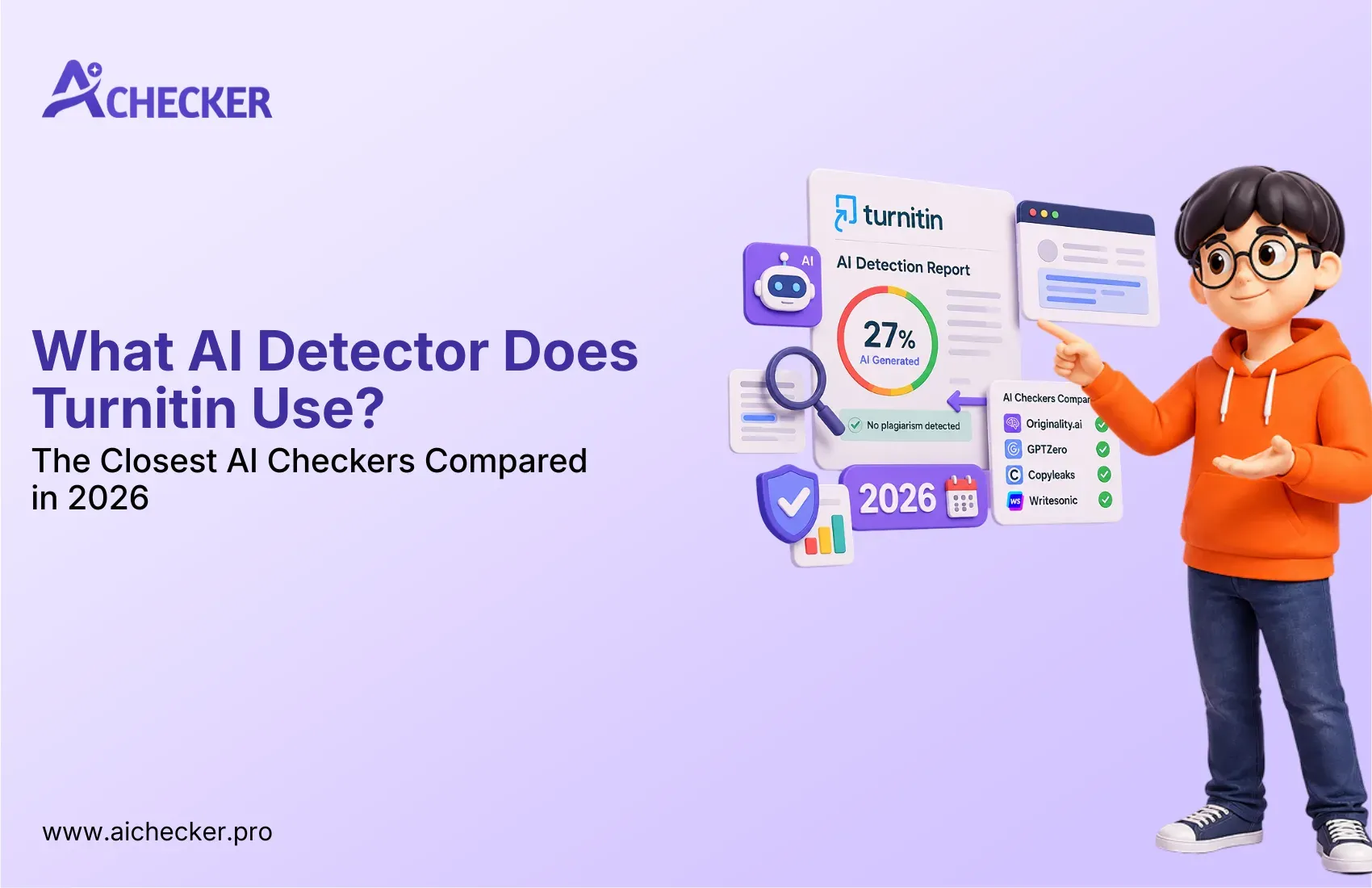
What AI Detector Does Turnitin Use? The Closest AI Checkers Compared in 2026
TABLE OF CONTENTS
What AI Detector Does Turnitin Use?
Does Turnitin Use a Third-Party AI Detector?
How to Use Turnitin AI Checker for Best Efficiency
The Two Layers of Turnitin's AI Writing Report
How Turnitin AI Checker Detects AI Writing
What Grammarly AI Detector Is Closest to Turnitin
How the Turnitin AI Checker Works in Canvas (LMS Integration)
How to Use the Turnitin AI Checker (For Students and Educators)
Can Students Access the Turnitin AI Checker Directly?
The Closest Free AI Detectors to Turnitin (2026 Comparison)
aichecker.pro vs Turnitin: How Close Are the Results?
Originality.ai and Copyleaks: Best for Educators
Why Free AI Detectors Sometimes Disagree With Turnitin
Is Grammarly's AI Detector as Accurate as Turnitin?
Turnitin AI Checker Community: What Discord and Reddit Say
Conclusion
Get an AI summary of this post on:


Turnitin AI checker for students does not utilize any third-party AI detection tool. Instead, Turnitin relies entirely on its proprietary AI detection tool, based on transformer AI, designed in-house and trained only on academic writing datasets. No external or publicly available tool, not GPTZero, not Originality.ai, nor Copyleaks, underlies Turnitin's detection algorithm.
This fact is crucial for those looking for a free Turnitin AI detector to be able to accurately predict what Turnitin will highlight. Because the model behind Turnitin works on academic writings only, the behavior of the algorithm is different.
What AI Detector Does Turnitin Use?
Turnitin uses no third-party detector at all. Turnitin relies on its own custom-made technology for AI detection. The common belief that Turnitin relies on the services of either GPTZero or Originality.ai is wrong and makes students falsely compare the performance of both tools.
In April 2023, Turnitin released its AI detection feature, becoming one of the first large-scale implementations of AI detection for academic purposes. Since then, multiple iterations of the system have made it more accurate and balanced.
One of the notable changes in policies happened in July 2024 when Turnitin decided to mask AI percentage scores from 1% to 19%. Instead, they are now shown as asterisks (∗). Turnitin implemented such a policy to prevent false positive anxiety in authors whose native language is not English and in students who employ various forms of grammar-editing software.
The classifier used by Turnitin is based on transformer architecture, which belongs to the family of neural networks behind GPT-4 and other popular models employed by Google and others.
Does Turnitin Use a Third-Party AI Detector?
Turnitin uses no third-party detector at all. Turnitin relies on its own custom-made technology for AI detection. Understanding how AI detection works is essential before comparing Turnitin to any other tool.
How to Use Turnitin AI Checker for Best Efficiency
Turnitin's system analyzes texts on a per-sentence basis. The probability that the same sequence of words would be written by the language model is estimated for each sentence separately.
The total of probabilities for all sentences is then taken as the final result, giving the total percentage of artificial intelligence shown in the AI Writing Report.
The model was trained on samples of academic writing, including essays, dissertations, research papers, and literature reviews. This gives the system sensitivity to texts written in such a style.
The following signals are the primary inputs to Turnitin's detection model:
- Perplexity score: measures how statistically predictable each sentence is to a language model; low perplexity strongly indicates AI authorship
- Burstiness: measures variation in sentence length and structural complexity; AI-generated text consistently scores low on burstiness due to its uniform output patterns
- Syntax predictability: identifies repeated structural patterns characteristic of outputs from ChatGPT, Claude, Gemini, and similar systems
- Transitional phrasing frequency: flags high-frequency use of phrases statistically over-represented in AI-generated academic writing
- Sentence-level probability distribution: evaluates whether the distribution of predictability scores across a document matches human or AI writing patterns
The Two Layers of Turnitin's AI Writing Report
Turnitin's AI Writing Report is not a single-layer check. It operates on two distinct detection layers:
- AI-generated text detection: identifies full sentences and paragraphs that a generative AI model, such as GPT-4, most likely produced directly
- AI paraphrasing and bypasser detection: identifies text that originated as AI-generated content and was subsequently paraphrased, either manually or using tools such as QuillBot, in an attempt to disguise its origin
The second layer is what makes Turnitin stand out from most of the free online tools that detect plagiarism using algorithms that are similar to Turnitin. Since Turnitin is comprised of two layers, paraphrased AI work, which might be hard to detect through the use of a basic detection system, can be detected by Turnitin. This is something students should consider whenever using another free online service as a substitute for Turnitin.
How Turnitin AI Checker Detects AI Writing
Turnitin's AI scanner uses probabilistic modeling as opposed to key term matching or database scanning. This is entirely different from plagiarism checking software and requires a unique perspective on what constitutes an offense. If you want to understand how AI detectors work in detail, the underlying methodology matters more than most people realize.
Detection signals in plain terms:
- Sentence-level probability modelling: Large language models generate text by selecting the most statistically probable next word at each step. Turnitin's model identifies documents where sentences consistently follow this pattern of maximum-probability word selection, a pattern that is rare in authentic human writing.
- Low perplexity: When a language model finds text easy to predict, the text scores low on perplexity. Turnitin treats sustained low perplexity across multiple sentences as a strong indicator of AI authorship.
- Low burstiness: Human writers naturally vary sentence length, rhythm, and structural complexity. AI outputs tend to maintain consistent paragraph length, similar sentence structures, and uniform complexity throughout a document. Turnitin's model measures this variation and flags documents with abnormally low burstiness.
- Characteristic phrasing patterns: AI systems trained on similar data generate similar linguistic habits. Phrases such as "It is important to note," "Furthermore," "In conclusion," and "It is worth mentioning" appear at statistically elevated rates in AI-generated academic writing. Turnitin's model has learned to weight these frequencies.
- Structural uniformity: AI-generated essays tend to maintain consistent paragraph length, similar argument development patterns across sections, and predictable introduction-body-conclusion structures. Turnitin's model evaluates document-level structural patterns in addition to sentence-level signals.
It should also be noted that according to Turnitin, the false positive rate of human-written documents is about 1% for texts scored over 20%. Nevertheless, some sentences or paragraphs of otherwise human documents may also be marked, especially those containing language that is inherently formal in nature, like methods, abstracts, and literature reviews.
What Grammarly AI Detector Is Closest to Turnitin
One of the common problems found among students is that essays corrected by Grammarly get high AI similarity scores on Turnitin. There are reasons for this; however, one must understand that Grammarly is not producing any AI text. There is a scientific explanation behind it.
The grammar correction system of Grammarly tries to take the written sentence towards a more grammatically perfect sentence construction. As a result, the syntax becomes simpler, the punctuation changes are corrected, and the phraseology becomes standardized. After thorough Grammarly corrections, an essay written by a person can become statistically close to being AI text. You can read a detailed breakdown in this Grammarly AI detector accuracy comparison.
How the Turnitin AI Checker Works in Canvas (LMS Integration)
The Turnitin AI detector embedded in Canvas works based on Turnitin's default integration into Learning Management Systems (LMS). This process happens when the teacher creates a Turnitin-enabled Canvas assignment with the AI detection feature turned on at the institutional level; Turnitin will analyze all the eligible submissions using its unique model.
An AI Writing Report is produced simultaneously with a Similarity Report in the same document viewer in Turnitin. Access to the report can be done from both the Canvas SpeedGrader and Turnitin assignment inbox. The same integration infrastructure works for Moodle, Blackboard, among other LMS platforms that utilize Turnitin's API-based connection.
How to Use the Turnitin AI Checker (For Students and Educators)
Knowing how to use the Turnitin AI checker depends entirely on your role. The process and access level differ significantly between instructors and students.
Submission requirements for AI report generation:
- Document must contain between 320 and 29,999 words
- Text must be submitted in English (AI paraphrasing detection is English-language only)
- The institution must have Turnitin's AI detection feature enabled as part of their license
- The assignment must be configured by the instructor to allow AI detection
Documents submitted outside these parameters will not generate an AI Writing Report, regardless of content.
AI Detector in Turnitin Within Canvas: Step-by-Step
Below is the procedure that should be followed by tutors when using the AI detection tool within Turnitin in Canvas:
- Log in to Canvas and navigate to the specific course and assignment.
- Access the assignment within the SpeedGrader feature or use the Turnitin assignment inbox to access the submission.
- Choose the student submission you want to analyze.
- Within the document viewer, click on the AI Writing Report tab, found next to the Similarity Report tab.
- Clicking on the tab will allow you to see the overall percentage score of AI detection. The sentence highlighting indicates the sentences the model has flagged as highly likely AI-generated.
- Scores shown as ∗ are results between 1 and 19%, hidden according to Turnitin's latest policy update as of July 2024.
- Analyze the result while keeping the entire document in mind. According to Turnitin, the AI report should be considered as part of an academic integrity investigation process, not the sole determinant.
Can Students Access the Turnitin AI Checker Directly?
In the usual institutional setting, students are unable to see their own Turnitin AI Writing Report. The report can be seen only by faculty members, teaching assistants, and institutional administrators. There is some flexibility within some institutions where instructors may choose to share reports with students, although this is done on a case-by-case basis.
The inability to check their own AI writing score is what drives students to seek out free AI detector tools for students. Since students cannot see their own AI score prior to submitting their paper, there must be a free program using similar detection methods to give an estimated score.
The solution to this problem is straightforward. Use the best AI checker for Turnitin, and one of the closest approximations available to Turnitin is aichecker.pro.
The Closest Free AI Detectors to Turnitin (2026 Comparison)
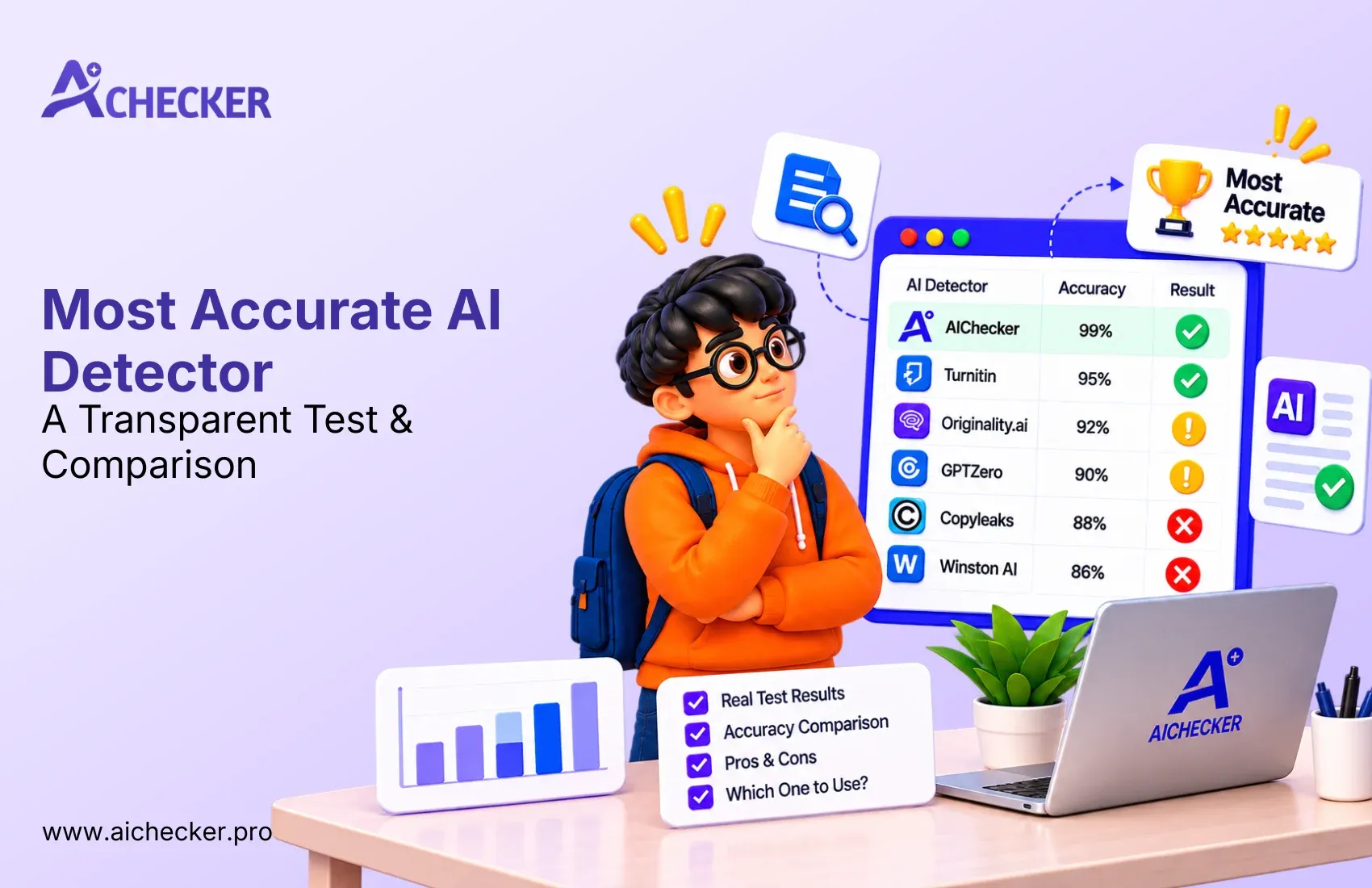
Because students do not have direct access to Turnitin, choosing an appropriate AI detector similar to Turnitin becomes imperative. The comparison below covers five different detectors with respect to their compatibility with Turnitin in terms of methodology, having a free option, being student-friendly, and allowing submissions without database access.
| Tool | Free Tier | No Database Submission | Student Friendly | Detection Signals Similar to Turnitin | Accuracy Rating |
|---|---|---|---|---|---|
| aichecker.pro | Yes | Yes | Yes | High | Average |
| GPTZero | Limited | Yes | Yes | Moderate to High | Good |
| Originality.ai | Paid | Yes | Primarily educators | High | Best |
| Copyleaks | Limited | Yes | Partial | Moderate | Good |
| Winston AI | Limited | Yes | Partial | Moderate | Best |
For students requiring a no-cost, no-signup solution, AI checker Pro is the most accessible and methodologically aligned free tool available in 2026.
aichecker.pro vs Turnitin: How Close Are the Results?
Out of all the freely accessible AI detectors comparable to Turnitin, AI checker Pro comes highly recommended by students prior to submitting content. It evaluates text based on the perplexity score, burstiness, and probability models of sentences, the very same features used by Turnitin's algorithmic model.
Pros for student users include the absence of the need to create an account, not storing any submissions in a database, receiving results instantly, and free usage without a limit on the word count. It is specifically useful for students who wish to determine their AI detection risk prior to submitting via institutional Turnitin.
Despite the inability of AI checker Pro to duplicate Turnitin's academically trained corpus, which is proprietary, its results tend to correlate with those of Turnitin in most cases. It is the best AI detector for pre-submission checks for Turnitin in 2026 for non-institutional students. You can read a full AI Checker Pro review for a deeper breakdown of how it performs.
Originality.ai and Copyleaks: Best for Educators
Originality.ai is the most commercially viable tool that resembles the Turnitin detection system. It provides sentence-level probability scoring and multiple version scanning, as well as the ability to collaborate in teams. It is highly recommended for editorial and academic agencies looking for institutional-grade detectors besides Turnitin. You can explore a full Originality.ai review to understand how it compares in practice.
Copyleaks is a platform that integrates the functionality of AI detection with traditional plagiarism detection and offers integration with learning management systems similar to Turnitin. The AI detection capabilities provided by this system generate accurate results, but not as precise at the sentence level as Originality.ai.
Neither of these two tools can be considered a free Turnitin AI checker for students since both operate using paid subscriptions. Nevertheless, if one is looking for a good institutional-grade AI checker to validate Turnitin results, either Originality.ai or Copyleaks could be considered valid solutions.
Why Free AI Detectors Sometimes Disagree With Turnitin
A student can put the same text through three different AI detectors and get three distinct scores. There is nothing strange in this phenomenon, and here is why.
Turnitin's AI detector uses a model specifically trained on academic texts. Free tools train their models using internet texts. The academic corpus used by Turnitin allows its model to focus more on particular elements in formal essays, research articles, and literature reviews than a model trained on a wider range of internet text. Understanding common AI detection problems can help you interpret these differences more accurately.
Furthermore, the bypass-detection algorithm in Turnitin recognizes paraphrased content produced by an AI tool that manages to slip through all other detectors. The correct approach is to check your work with multiple online detection services, including the one that most resembles Turnitin in functionality.
Is Grammarly's AI Detector as Accurate as Turnitin?
No, not even close, especially when it comes to maintaining academic integrity. The AI detector is a free add-on within Grammarly Premium. The main function of Grammarly is its ability to detect grammatical errors and improve the quality of your writing. While the AI detector is a supplementary aspect of Grammarly, it was created based on the same model as the rest of the program.
For a head-to-head breakdown, this AI Checker Pro vs Grammarly AI comparison is worth reading before drawing conclusions.
The three fundamental differences between Grammarly and Turnitin AI detection are:
- Training data: Turnitin is trained on academic writing datasets; Grammarly is trained on general writing for grammar and style correction
- Detection purpose: Turnitin is built to identify AI authorship in academic submissions; Grammarly's AI detection is an informational feature, not an enforcement tool
- Sensitivity calibration: Turnitin's model is specifically sensitive to the phrasing patterns and structural uniformity of AI-generated academic essays; Grammarly's model is not calibrated for this use case
Grammarly's AI detection should not be used as a proxy for Turnitin results. For any student or educator seeking an AI detector similar to Turnitin in terms of academic accuracy and enforcement sensitivity, Grammarly falls significantly short. Tools such as AI checker Pro, GPTZero, and Originality.ai are meaningfully more aligned with how Turnitin evaluates AI-generated academic content.
Turnitin AI Checker Community: What Discord and Reddit Say
Turnitin AI checker communities on Discord and Reddit have become active sources of real-world data on Turnitin AI checker outcomes, supplementing Turnitin's official documentation with ground-level experience.
Several consistent patterns emerge from these community discussions:
- Non-native English speakers experience disproportionately high AI score levels. Writing with perfect grammar, clear structure, and a lack of idioms is statistically identical to text generated by an algorithm, and may be flagged by AI detectors even if the text is completely human-written.
- The usage of Grammarly-edited essays is often flagged. Students using this program, especially on essays of fewer than 1,000 words, often receive unexpectedly high AI score levels that do not match the reality of their writing.
- Literature reviews in thesis papers and the Methodology section have much higher detection rates than other types of content. Both of those sections have a structurally repetitive character, which makes them more likely to be flagged.
The AI Checker Discord community recommends checking every text before submission with at least two different AI detection tools, including the best AI detector for Turnitin that can be used for free. Students who want to understand how to avoid common AI checker mistakes before submitting will find this especially useful.
AI checker Pro has been highly recommended as the best free alternative to Turnitin AI Checker for students who prefer anonymity and instant results without creating an account or uploading texts on the website.
However, a critical point on academic integrity needs to be stated here: conducting a self-check using an AI detection tool before submitting assignments does not constitute a breach of institutional policy on academic integrity. Self-checking your writing through an AI detection tool, just like running it through spell checks and plagiarism checks before submission, can help you identify errors in the document.
Conclusion
Which AI detector does Turnitin use? Turnitin uses a proprietary system based on transformer models trained on academic datasets, without relying on any external tools.
What AI detector comes closest to Turnitin? AI checker Pro offers students the closest equivalent for pre-submission free checks in 2026. It relies on perplexity, burstiness, and sentence probability modeling, the three main factors used in Turnitin's algorithm, without the need for an account or data storage.
For educators looking for institutional detection tools apart from Turnitin, the best two alternatives are Originality.ai and Copyleaks. No freely available tool will provide results identical to Turnitin's proprietary academic model, but these options come closest in both methodology and reliability.
1. What AI detector does Turnitin use?
2. How does the Turnitin AI checker work?
3. How do students use the Turnitin AI checker?
4. Which free AI detector is closest to Turnitin?
5. How do you use the AI detector in Turnitin within Canvas?
6. Is Grammarly AI detector as accurate as Turnitin?
7. What AI detector is most similar to Turnitin for educators?
8. Why do free AI detectors sometimes give different scores than Turnitin?
9. Does Turnitin detect AI text that has been paraphrased?
10. What is the word limit for Turnitin AI detection to work?

Harshil Barvaliya
SEO Executive & Content Writer at AI Checker Pro
I’m Harshil Barvaliya, an SEO Executive and Content Writer at AI Checker Pro. I focus on improving the website’s search engine visibility through effective SEO strategies, including keyword research, on-page and off-page optimization, and content development.Get Started Free
Create a free account for advanced AI detection and scan history.
Trusted by thousands worldwide.
Recent Blog's
Discover how AI-powered content creation can elevate your website's reach and engage your audience like never before. Explore the real impact of AI on crafting content that connects.