The Evolution of AI Checkers: From GPT Detection to Writing Pattern Analysis
TABLE OF CONTENTS
The Early Days of AI Detection
Why Traditional AI Checkers Started Failing
The Shift Toward Writing Pattern Analysis
How Modern AI Detection Systems Work in 2026
The Biggest Challenges Facing AI Detection Today
The Future of AI Checkers
Conclusion
FAQs
Get an AI summary of this post on:





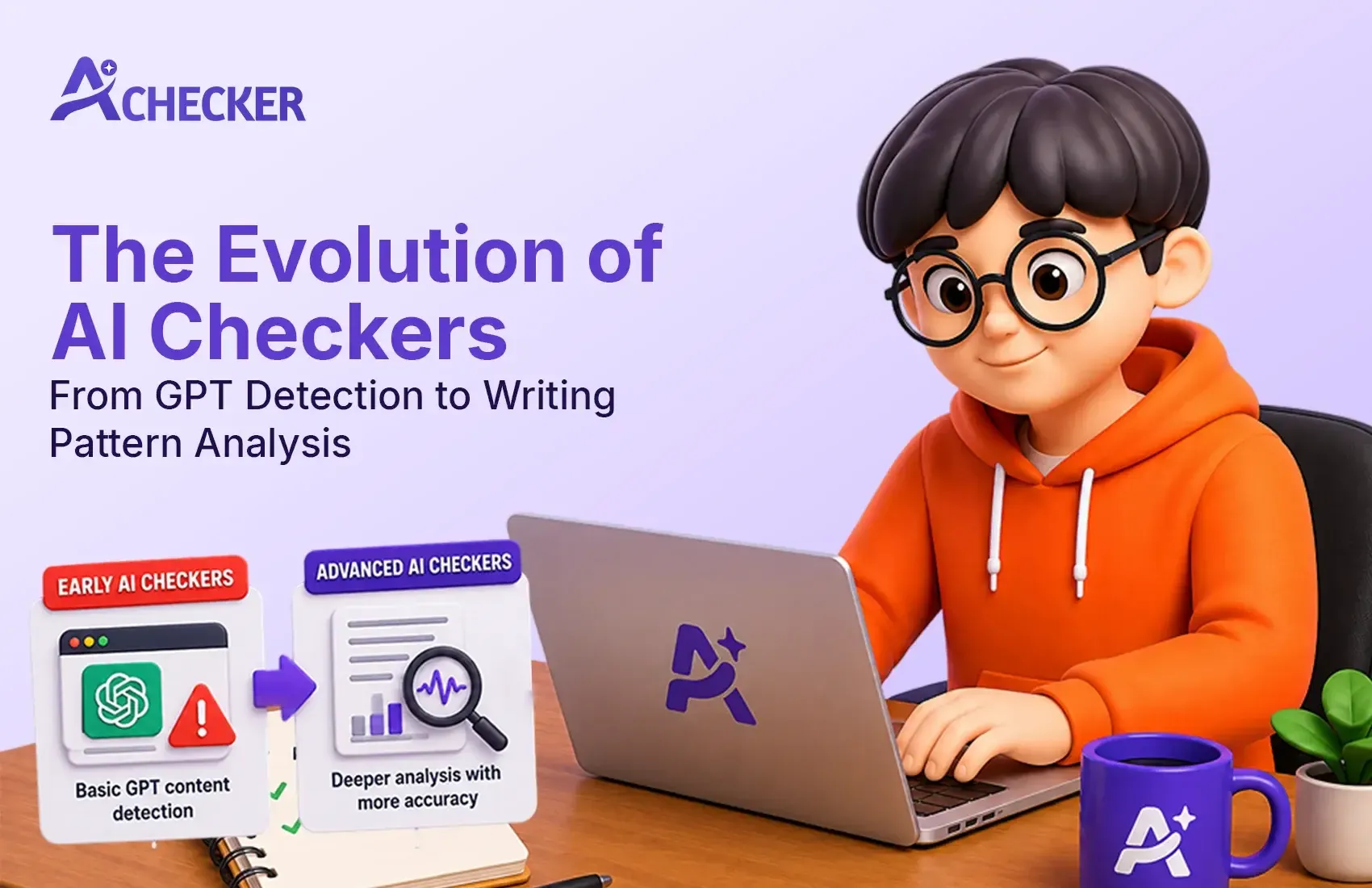
AI checkers have changed a bit dramatically since the first tools showed up in late 2022. What began as a kind of simple rule-based scanner has become more advanced systems, using behavioral analysis, hybrid approaches, and deep linguistic profiling, more or less.
If you write content, run a website, or work in education, then understanding how AI detection has evolved is useful so you can stay informed. Tools like AIChecker.pro are made to keep up with this fast-moving field, honestly.
In this article, we trace the whole journey from basic GPT scanning toward advanced writing pattern analysis, so you can see what shifted over time.
The Early Days of AI Detection
How Early AI Detectors Worked
Early AI detectors were kinda basic probabilistic tools, I mean t, they tended to circle back to one main question: how predictable is this text?
When ChatGPT launched in November 2022, the first generation of AI checker tools popped up within months. Those tools looked at two principal signals:
- Perplexity: How surprising or unpredictable each word choice is
- Burstiness: How much sentence length and structure vary throughout the text
AI-generated text tends to end up scoring low on both of those things, honestly. It feels smooth, consistent, and kind of predictable. Meanwhile, human writing usually looks more irregular, like there are sudden long sentences, little fragments here and there, or unexpected word selection that doesn't really "fit" the pattern.
Tools such as GPTZero and the first versions of Originality.ai sort of leaned on those two signs as their main detection engine.
Why GPT-Style Writing Was Easy to Detect
Early GPT models (GPT-3, GPT-3.5) had clear fingerprints:
- Repetitive transition phrases like "moreover," "in conclusion," and "it is important to note."
- Perfectly balanced paragraphs of equal length
- Overly neutral, formal tone with no emotional variation
- Near-zero use of contractions or colloquial language
These patterns were consistent enough that even basic AI text detectors could flag GPT-3.5 output with fairly good confidence, because detection was kinda straight forward due to the writing style being so uniform, like really uniform. It felt the same throughout the whole piece.
Why Traditional AI Checkers Started Failing
The Rise of Natural-Sounding AI Content
GPT-4 kind of changed everything. Like when OpenAI released it back in early 2023, the detection tools that were made for GPT-3.5 started having trouble almost right away, and it was messy.
There's a study that showed detectors were still pretty solid on GPT-3.5 text, but then kind of fell apart on GPT-4 output. Not only did they miss passages that were AI-made, but they also started flagging normal human writing as if it were generated. In other words, GPT-4 could do this human-like burstiness and weirdly natural unpredictability, well enough to get around the older tools.
OpenAI itself also put out a classifier in early 2023 and later quietly shut it down because the accuracy wasn't great. That alone felt like a big hint that the whole old detection approach had a limited lifespan.
Problems with False Positives
False positives became a serious concern fast. Research shows:
- Between 10% and 28% of genuine human-written content gets incorrectly flagged as AI-generated by some tools
- Non-native English speakers are disproportionately flagged, since their writing can appear more uniform and less varied
- Black students were found to be more likely to face false accusations in academic settings
A 2023 landmark study that appeared in the International Journal for Educational Integrity basically concluded that the AI detection problems people faced with those tools meant they were "neither accurate nor reliable." Since then, it has been cited more than 200 times, or so the summaries say.
The core issue is this: just using perplexity and burstiness, by themselves, wasn't enough to sort out a non-native speaker writing carefully from a language model generating smoothly, somehow. The tools needed a more grounded method, a deeper angle.
The Shift Toward Writing Pattern Analysis
What Is Writing Pattern Analysis?
Pattern analysis for writing kind of goes past just plain perplexity scores. It really looks at the whole structure of how the text was pieced together, not only that, and it tries to find signals that are trickier to fake or mimic. In other words, it's less about the surface and more about the internal phrasing setup, as if the text has tells you can't easily hide.
Definition: Writing pattern analysis is a method used by modern AI writing detectors to assess vocabulary choices, sentence rhythm, stylistic consistency, tonal shifts, and structural logic across an entire document. Rather than measuring a single score, it builds a linguistic profile of the text.
Instead of asking "Is this word predictable?", pattern analysis asks:
- Does the writer's tone shift naturally throughout the text?
- Are there signs of genuine hesitation, personal opinion, or lived experience?
- Does the argument build organically, or does it follow a template structure?
How Modern AI Checkers Analyze Content
Today's free AI checker tools and paid platforms combine multiple layers of analysis:
- Statistical pattern matching - Comparing vocabulary and syntax against known AI output profiles
- Semantic consistency checking - Identifying whether ideas connect in a human-like or machine-like way
- Stylistic fingerprinting - Detecting the uniform, overpolished rhythm common to large language models
- Contextual coherence analysis - Checking whether transitions feel natural or algorithmically generated
This multi-layer kind of approach makes today's free AI detection tools a lot more sophisticated than what their 2022 predecessors did, honestly.
How Modern AI Detection Systems Work in 2026
Hybrid Detection Models
The most capable AI detection tool platforms in 2026 use hybrid models. These combine:
- Feature-based detection: Rule-driven analysis of specific linguistic markers like repetitive transitions, sentence uniformity, and lexical density
- Model-based detection: Machine learning classifiers trained on large datasets of both human and AI-generated text, capable of detecting subtle patterns that rules alone would miss
Tools like Copyleaks, GPTZero, and Sapling have kind of moved toward hybrid architectures. People say they can get accuracy rates like 97% to 99% on those controlled datasets, but in real life, it is not that clean. Performance can vary a lot based on how long the text is, the subject matter, and also if the content has been reworked or edited.
The ChatGPT detector category in particular has had to evolve pretty fast, because GPT-4 and GPT-5 are generating output that feels far more human-like than anything GPT-3.5 could pull off. Also, the whole thing about it tends to shift quickly.
Contextual and Behavioral Analysis
Beyond text analysis, newer systems are starting to look at behavioral signals:
- Writing session metadata: Platforms integrated into word processors or browsers can track whether a document was typed over time or pasted all at once
- Edit history patterns: Human writers revise, backtrack, and rephrase. AI output is typically generated in one pass with minimal editing.
- Prompt signature detection: Some tools are trained to recognize structural patterns specific to how prompts are processed by different AI models
Google's SynthID watermarking technology, published in Nature and released in October 2024, goes even further by embedding invisible markers right into AI-generated content, which later can be checked or verified again.
SynthID kind of represents a fundamental shift in how detection can work, moving away from only inference, and toward verification.
The Biggest Challenges Facing AI Detection Today
False Positives and Ethical Concerns
False positives are still the biggest problem. Right now, most detectors seem to get it right about 7 out of 10 times when things are real in the world, which is pretty far from that 99% accuracy they claim in controlled benchmarks. It's like they look good in one room, then in the wild, they kinda stumble, and you end up with more wrong flags than expected.
The ethical stakes are real:
- A student wrongly accused of using AI can face serious academic penalties
- A content writer falsely flagged loses credibility with clients
- Non-native speakers continue to face higher false positive rates than native speakers
No AI generator detector should be used as the only basis for punishment or rejection. Responsible platforms say this pretty clearly in their documentation, so it should not be treated as the final word. You can read more about how accurate AI content checkers really are before relying on any single result.
Human-Edited AI Content
The trickiest challenge for any AI-generated text detector is when the content kinda starts as AI output, but then a human does real editing. Like, not just a quick swap here and there, but enough that the whole thing feels "lived in" by a person.
If somebody drafts it with AI, then rewrites maybe 40% of the text, adds personal stories and little examples, and tunes the tone, then it lands in that grey zone. Pattern analysis gets all mixed up. And the statistical models that were trained on clean AI on one side versus human datasets on the other, just struggle, because the input becomes a hybrid, kinda blended and messy in a good way.
That's also why tools like AI humanizer converters got popular. They add variation to the AI text to bring the detection score down. And now the detection community is basically in a back-and-forth arms race: humanization tools keep evolving to slip past detectors, while detectors keep updating to catch them.
The Future of AI Checkers
The direction of AI detection in the next few years is clear:
- Watermarking at the model level will become standard, with major AI providers embedding verifiable signatures into output
- Behavioral biometrics will supplement text analysis, using typing cadence and editing patterns to verify authorship
- Cross-document profiling will allow platforms to compare a suspicious document against a user's known writing history
- AI-assisted detection will use AI models to catch other AI models, in a meta-level arms race that mirrors cybersecurity
The role of the AI text detector will shift from binary flagging to a kind of nuanced assessment. Not just "this is AI," but future tools will quietly say things like, "this section shows low human variance, this section looks heavily edited, and this paragraph matches GPT-5 structural patterns." It's more about degrees and signals, less about yes or no.
For now, the most effective approach is not to rely on any single tool. Using multiple AI checkers together, combined with human review, provides the most reliable assessment. Platforms like AIChecker.pro are designed with this multi-signal philosophy in mind.
Conclusion
The story of AI checkers is kind of a story about constant adaptation, you know. What started as simple perplexity scoring has kinda turned into multi-layer systems that look at writing patterns, little behavioral cues, and the underlying structural logic, all at once.
As AI models keep improving, the AI detection tools have to move along with them, too. No single AI checker, or free AI checker tool for that matter, is really perfect right now, so leaning on just one feels like a small but costly mistake. The most responsible path usually mixes several signals, some human judgment, and a transparent read on what the results are actually saying.
For writers, educators, and businesses trying to navigate all this, AIChecker.pro can be a dependable starting point for understanding and verifying content authenticity.
FAQs
1. What is an AI detector and how does it work?
2. Is there a reliable free AI checker I can use right now?
3. How accurate is AI detection in 2026?
4. Can a ChatGPT detector tell if GPT-4 or GPT-5 wrote something?
5. Why do AI checkers wrongly flag human writing?
6. What does an AI text detector actually look for in writing?
7. What is humanize AI and why do people use it?
8. Does editing AI content fool an AI humanizer detector?
9. What is the difference between a free AI detector and a paid one?
10. How can I humanize text to pass AI detection?

Harshil Barvaliya
SEO Executive & Content Writer at AI Checker Pro
I’m Harshil Barvaliya, an SEO Executive and Content Writer at AI Checker Pro. I focus on improving the website’s search engine visibility through effective SEO strategies, including keyword research, on-page and off-page optimization, and content development.Get Started Free
Create a free account for advanced AI detection and scan history.
Trusted by thousands worldwide.
Recent Blog's
Discover how AI-powered content creation can elevate your website's reach and engage your audience like never before. Explore the real impact of AI on crafting content that connects.