Best Free AI Detector Tools in 2026: Features, Limits & Accuracy Compared
TABLE OF CONTENTS
Quick Answer
Best Free AI Detector Tools at a Glance
How We Compared the Best Free AI Detectors
Free AI Detector Sign-Up Requirements and Word Limits
Best Free AI Detector Tools Reviewed
Which Free AI Detector Is Most Accurate?
Can Free AI Detectors Detect ChatGPT, Claude, and Gemini?
Why Do AI Detectors Produce False Positives?
Best Free AI Detector by Use Case
Can AI Detectors Detect Humanized or Edited AI Text?
Conclusion
FAQs
Get an AI summary of this post on:


This article compares the free plans of seven AI detectors: AI Checker Pro, GPTZero, QuillBot's AI Detector, Scribbr's AI Detector, ZeroGPT, Copyleaks, and Originality.ai. It looks at sign-up requirements, free word or character limits, and what accuracy evidence actually exists for each tool. No original laboratory test was run for this comparison; every accuracy figure below is labeled by source so you can judge how much weight to give it.
Disclosure: AI Checker Pro publishes this comparison and is also included as one of the tools. Every tool is evaluated using the same comparison criteria. No tool is automatically ranked first because of ownership.
Quick Answer
There is no single free AI detector that current evidence supports calling the most accurate overall. Accuracy claims come from different test sets and can't be compared directly. What can be compared reliably is free access, and that points to different tools depending on what you need.
| Need | Recommended Option | Why |
|---|---|---|
| Best no-sign-up option | QuillBot AI Detector, Scribbr AI Detector, ZeroGPT, or AI Checker Pro | All four allow a basic scan without creating an account |
| Best for higher free volume | GPTZero | 10,000 words a month, confirmed on GPTZero's own site, the largest recurring free allowance here |
| Best for combined AI and plagiarism checks | Copyleaks | Free AI checker plus a plagiarism layer, though full features need a paid plan |
| Best for editing-resistant detection | Originality.ai | Independent academic testing shows strong performance on paraphrased text, but this is a one-time trial, not an ongoing free plan |
AI detector scores should be treated as signals, not proof of authorship.
Check Your Text in Seconds
Run your writing through AI Checker Pro's detector for ChatGPT, Claude, and Gemini text before you publish or submit it.
- No sign-up required
- Covers ChatGPT, Claude, and Gemini
- Free credits included
Best Free AI Detector Tools at a Glance
Free-tier terms in this category change often. The table below reflects information available as of publication, checked against each provider's own site where possible.
| Tool | Free Access | Free Limit | Sign-Up | Accuracy Evidence | Main Strength | Main Limitation | Best For |
|---|---|---|---|---|---|---|---|
| AI Checker Pro | Free plan | 500 free credits, appears word-based | No | No comparable independent result | Combines detection with a rewriting tool | No published third-party accuracy data | Users who want detection and rewriting together |
| GPTZero | Free plan | 10,000 words/month | Not for a single scan; an account unlocks the monthly allowance | Independent benchmark (RAID): 95.7% detection at a 1% false-positive rate | Largest confirmed recurring free allowance | Account needed for full allowance | Educators, regular monthly users |
| QuillBot AI Detector | Free plan | 1,200 words/scan | No | Vendor claim, citing the RAID benchmark | No signup for a scan | Daily scan cap conflicts across QuillBot's own sources | Fast one-off checks |
| Scribbr AI Detector | Free plan | 1,200 words/check, unlimited checks | No | Self-published test (Scribbr, 2026): 78% | No signup, no cap on number of checks | Small per-check word limit | Repeated short checks |
| ZeroGPT | Free plan | Around 15,000 characters/scan | No | Vendor claim: 98%; independent reviews report a wide, inconsistent range | High per-scan limit, no signup | Accuracy inconsistent across independent reviews | Fast no-account spot checks |
| Copyleaks | Free plan (limited) | Not consistently published across sources | Not required for a first check per most sources | Vendor claim: 99.1%; independent benchmarks report roughly 77% to 96% | Combines AI detection with plagiarism checking | Free tier is limited; full features need a paid plan | Teams needing plagiarism checking too |
| Originality.ai | Trial | 50 signup credits, one-time (1 credit is roughly 100 words) | Yes | Vendor claim: 99%; independent benchmark (RAID, Oct 2025): 96.7% on paraphrased text | Strong on paraphrased or edited AI text | No ongoing free plan, only a one-time trial | Agencies checking outsourced or edited content |
Vendor claims and independent benchmarks measure different things and are not directly comparable, even when both are described as "accuracy."
Get Lifetime Access with 60% OFF
Stop paying monthly subscriptions. Enjoy unlimited AI detection and humanizer access forever with future updates included.
- One-time payment
- Unlimited access forever
- All future updates included
How We Compared the Best Free AI Detectors
This article is a product comparison, not an original laboratory benchmark. Each tool was reviewed against the same criteria:
- Free access (ongoing free plan versus a one-time trial)
- Word or character limits
- Sign-up requirements
- Supported models
- Available accuracy evidence
- Reporting detail (score only versus sentence-level highlighting)
- Main limitations
- Best-fit use case
What the accuracy numbers mean. A vendor claim is a number a provider publishes about its own product, usually from an internal test. An independent benchmark is a study run by a separate research group or academic team, such as the RAID benchmark. A self-published test is a provider testing its own tool and reporting the result, which sits between the two. Percentages from different methodologies should not be compared as if they measured the same thing.
Free AI Detector Sign-Up Requirements and Word Limits
Four tools in this comparison work without creating an account: QuillBot, Scribbr, ZeroGPT, and AI Checker Pro. GPTZero and Originality.ai both require a free account or signup to use their allowance.
| Tool | Account Required? | Free Limit | Reset / Usage Model |
|---|---|---|---|
| AI Checker Pro | No | 500 credits | Fixed allotment shown on the tool; reset cycle not published |
| GPTZero | Not for a single scan; yes for the tracked monthly allowance | 10,000 words/month | Resets monthly |
| QuillBot AI Detector | No | 1,200 words/scan | Per-scan cap; daily scan cap conflicts across QuillBot's own published sources |
| Scribbr AI Detector | No | 1,200 words/check | Unlimited number of checks, no reset needed |
| ZeroGPT | No | Around 15,000 characters/scan | Unlimited scans per day, per current third-party reviews |
| Copyleaks | Not required for a first check, per most sources | Limited, not consistently published | Confirm the live limit before relying on a specific number |
| Originality.ai | Yes | 50 credits, one-time | Does not renew; a paid plan is required after the trial credits are used |
Best option for no sign-up: QuillBot, Scribbr, ZeroGPT, and AI Checker Pro all support a basic scan without an account.
Highest verified free allowance: GPTZero's 10,000 words a month is the largest confirmed recurring free allowance in this group.
Important limitation: Originality.ai's free access is a one-time trial rather than an ongoing plan, and Copyleaks' exact free-tier limit is not consistently published, so it should be checked on the live tool before you rely on a number.
Best Free AI Detector Tools Reviewed
AI Checker Pro
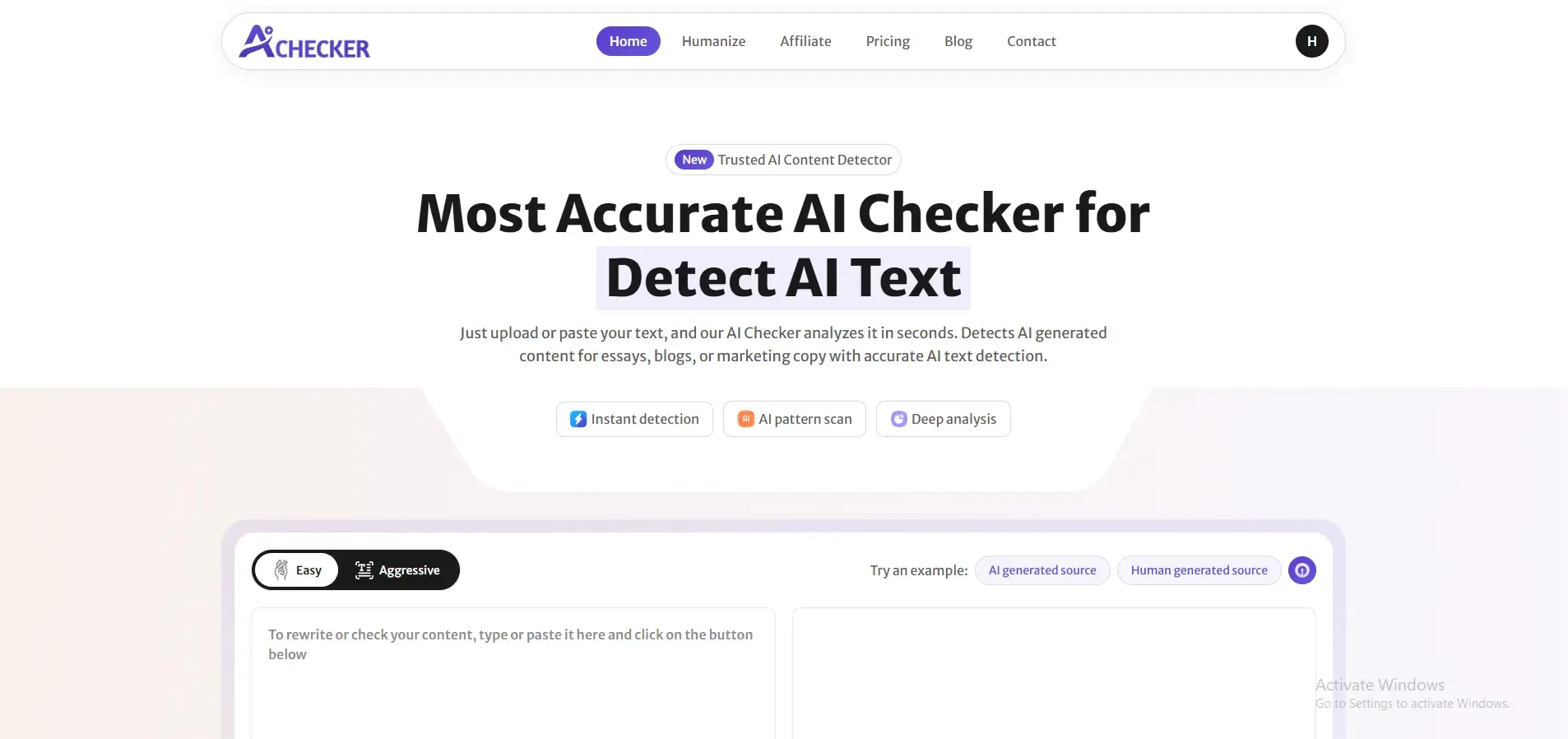
AI Checker Pro is a detection and rewriting tool for text that may have come from ChatGPT, Claude, or Gemini. It runs a scan with no signup and no credit card, and pairs the detection score with a paraphrasing and humanizing tool in the same workflow.
Quick facts
- Free limit: 500 free credits, which line up with a 500-word scan based on the tool's own interface
- Sign-up: No
- Model coverage: ChatGPT, Claude, Gemini
- Accuracy evidence: No comparable independent result published
- Best for: Users who want detection and rewriting in one place
What we like
- No account needed for a basic scan
- "AI Logic" breakdown shows flagged phrases, not just a score
- Detection and rewriting live in the same tool
Limitations
- No independently published accuracy or false-positive rate
- Credit-to-word ratio is inferred from the interface, not stated in writing
Best for: Someone who wants a single free tool that both flags and helps rewrite AI-flagged text.
Verdict: A practical no-signup option for combined detection and rewriting, but choose it for convenience, not for a verified accuracy number, since none currently exists. Read the full AI Checker Pro review or try the detector.
GPTZero
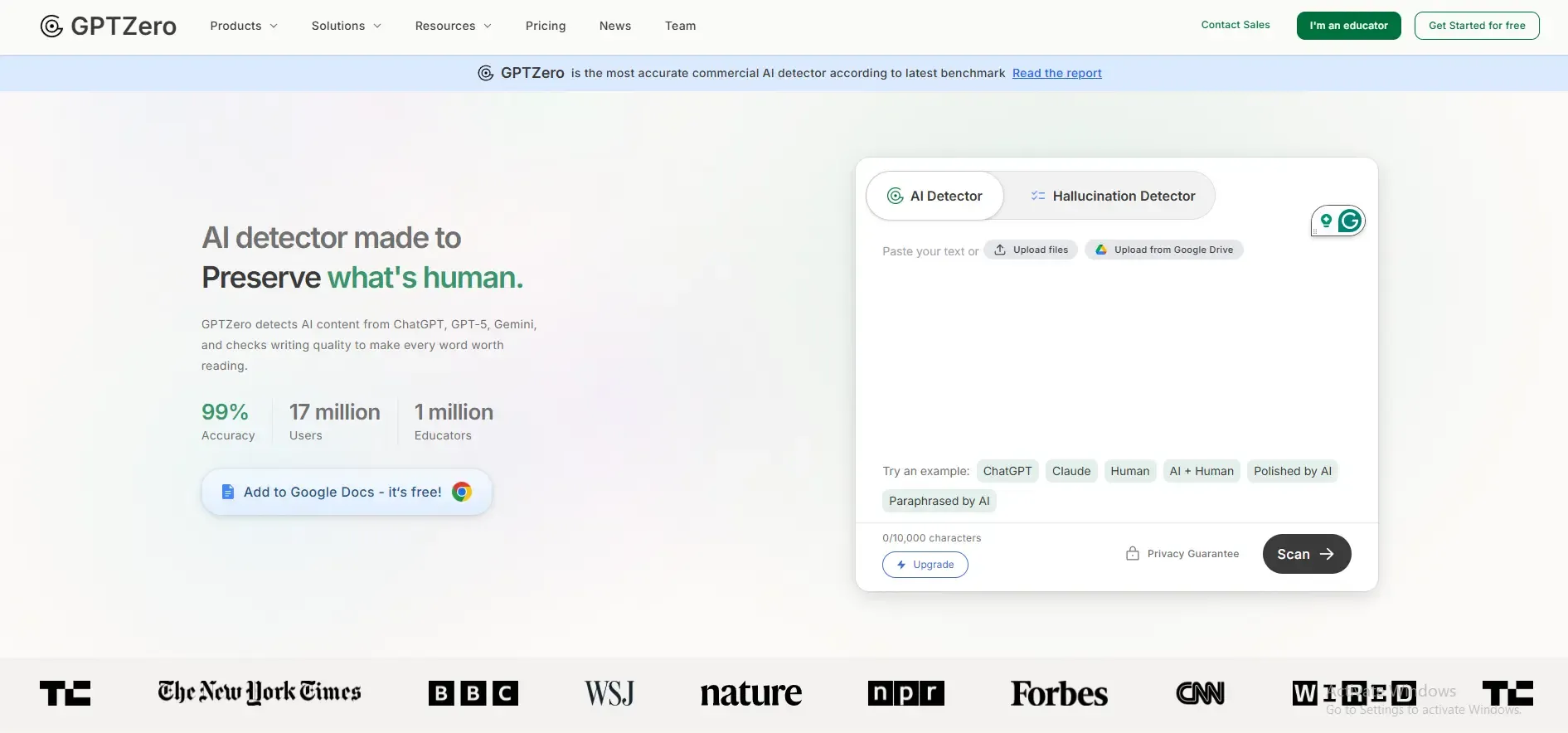
GPTZero is a long-running detector widely used in education. Its own site confirms a free plan of 10,000 words a month with no credit card, and a one-off scan works from the homepage without an account.
Quick facts
- Free limit: 10,000 words/month
- Sign-up: Not for a single scan; needed to use the tracked monthly allowance
- Model coverage: GPT models, Claude, Gemini, Llama
- Accuracy evidence: Independent benchmark (RAID): 95.7% detection at a 1% false-positive rate
- Best for: Educators and regular monthly users
What we like
- Largest confirmed recurring free word allowance in this comparison
- Sentence-level highlighting, not just an overall score
- Backed by an independent academic benchmark, not only a vendor claim
Limitations
- Full monthly allowance requires a free account
- Independent reviews report lower accuracy on heavily paraphrased or edited text
Best for: Teachers or writers who need a recurring monthly allowance rather than a single check.
Verdict: The strongest combination of verified free volume and independent accuracy evidence in this group, though the account requirement is a real step some users want to skip. See our full GPTZero AI detector review for more detail.
QuillBot AI Detector
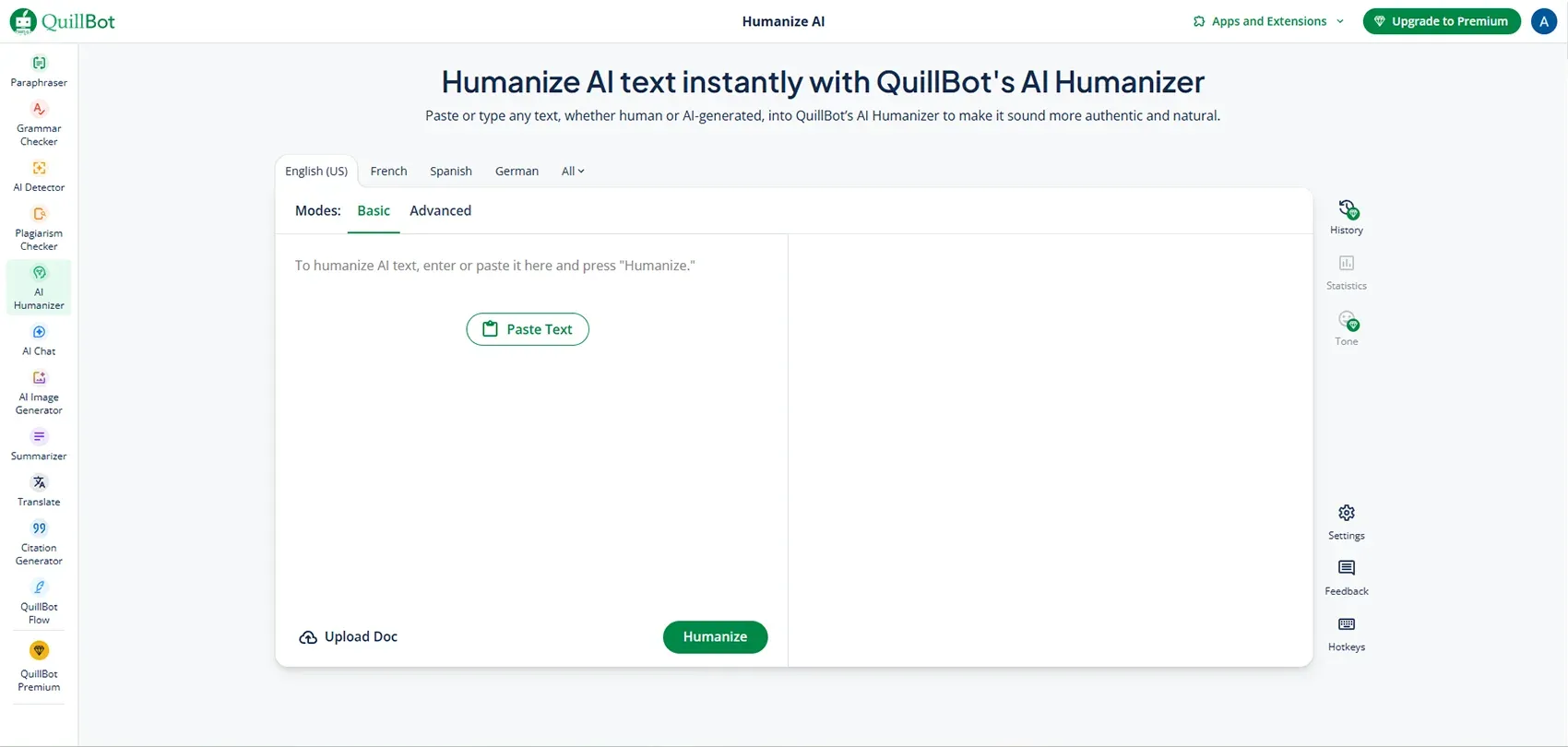
QuillBot's AI Detector sits inside its paraphrasing and grammar platform. It requires no signup and, per QuillBot's own published information, allows checks of up to 1,200 words per scan.
Quick facts
- Free limit: 1,200 words per scan
- Sign-up: No
- Model coverage: GPT-family models primarily; QuillBot also states coverage of Gemini and Claude
- Accuracy evidence: Vendor claim, citing the RAID benchmark, roughly 99% on that specific dataset
- Best for: Fast, no-account checks
What we like
- No account required at all
- Returns a result in seconds
- Works inside a platform many writers already use
Limitations
- Does not highlight the specific sentences behind the score
- QuillBot's published sources currently show different daily limits, so users should confirm the live limit before relying on a specific number
Best for: A quick check on a short passage without creating an account.
Verdict: Convenient for short, occasional checks; the 1,200-word cap and unclear daily scan limit make it a weaker fit for scanning full documents. Read the full QuillBot AI detector review here.
Scribbr AI Detector
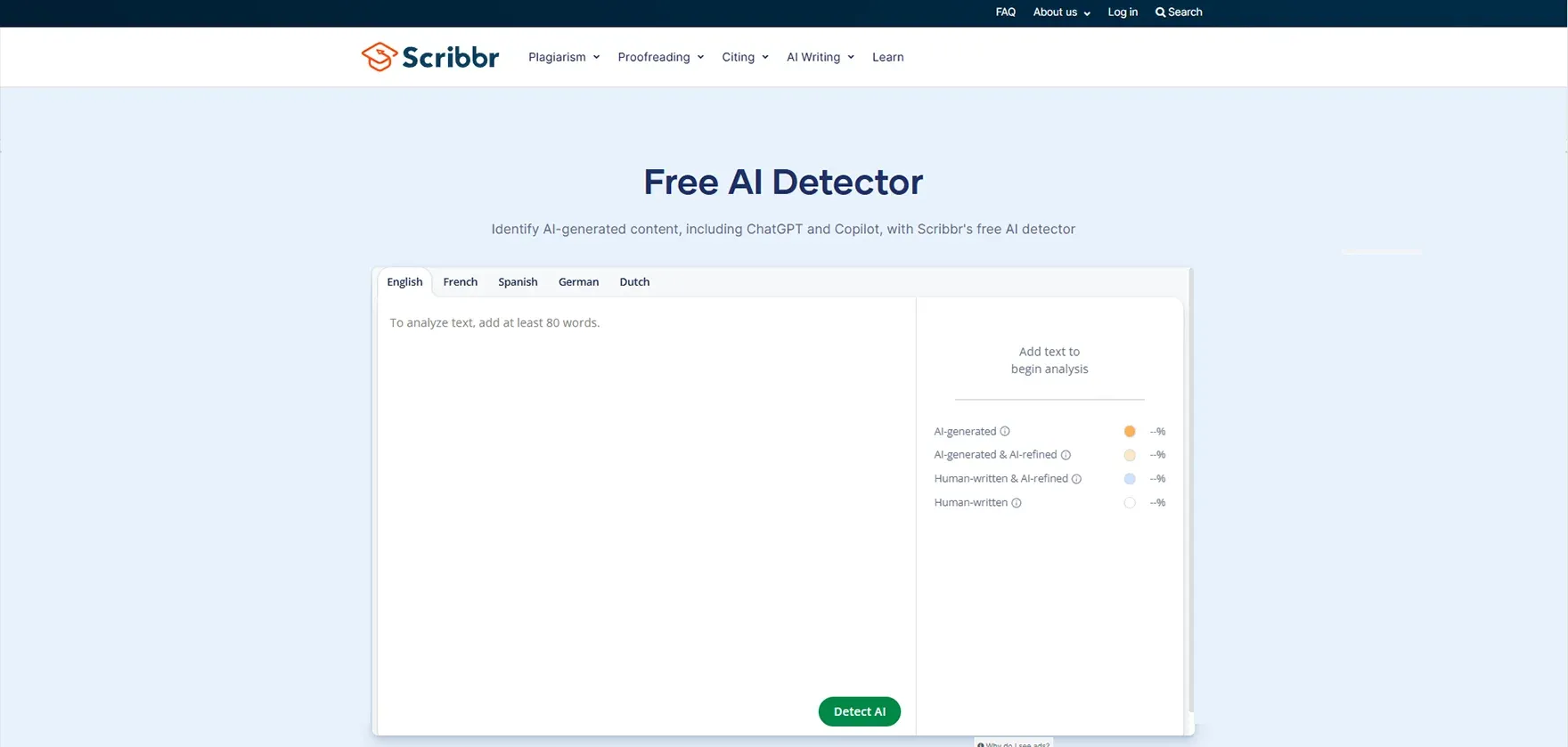
Scribbr, an academic writing and editing service, offers a free AI detector with no signup and no limit on the number of checks, though each check is capped at 1,200 words.
Quick facts
- Free limit: 1,200 words per check, unlimited number of checks
- Model coverage: ChatGPT and other major models
- Accuracy evidence: Self-published test (Scribbr, 2026): 78% on Scribbr's own sample
- Best for: Repeated short checks without an account
What we like
- No account and no cap on the number of checks
- Clean, fast interface
- Useful for checking one section at a time
Limitations
- 78% figure is Scribbr testing its own product, not an independent third party
- 1,200-word cap means long documents need to be split into sections
Best for: Students or writers running repeated quick checks on short sections.
Verdict: A solid no-account option for short passages; treat the 78% figure as a self-reported result rather than an independent score. Our Scribbr AI detector review covers this in more depth.
ZeroGPT
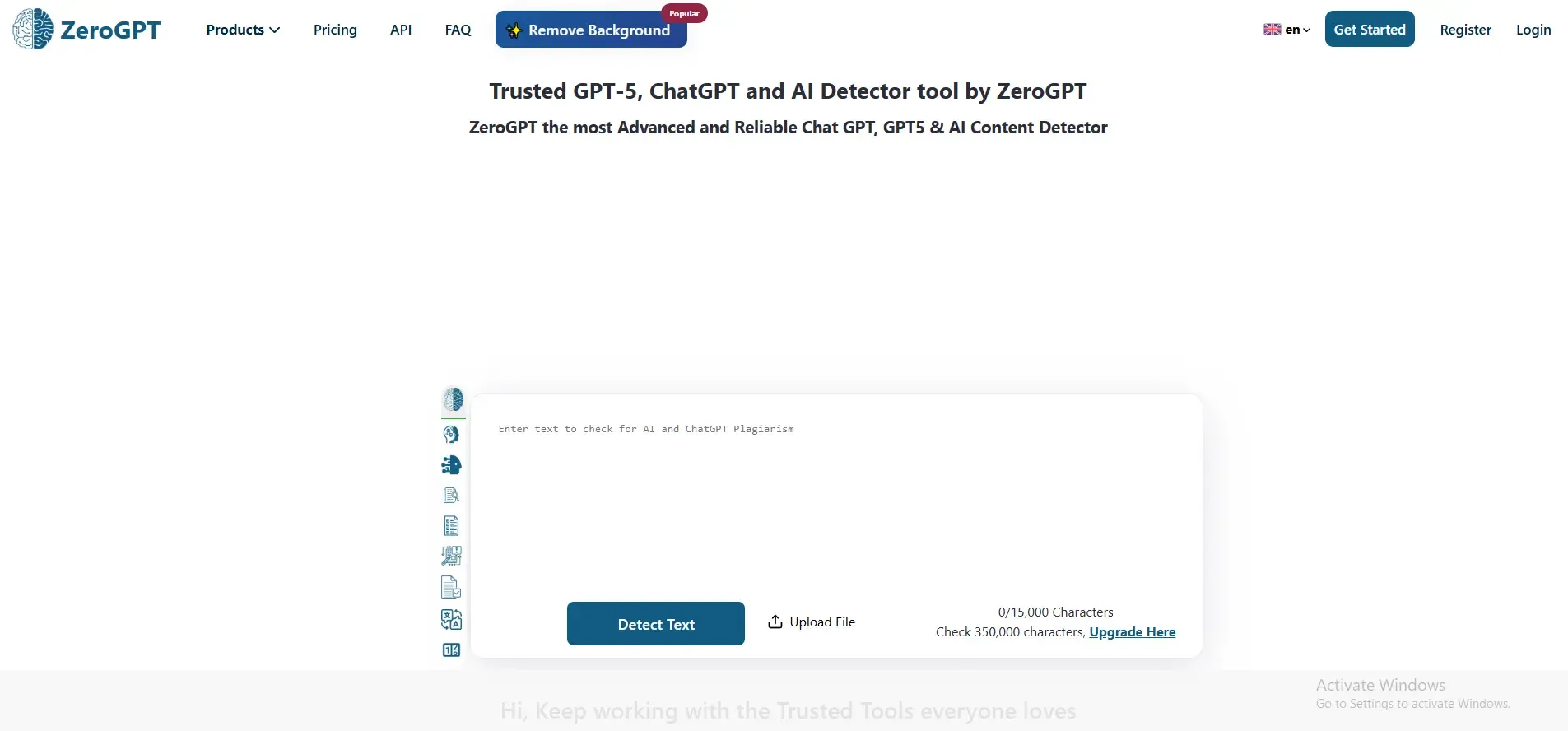
ZeroGPT, at zerogpt.com, is one of the most widely used free, no-signup detectors. Similarly named sites exist and are not the same service, so confirm you're on the official domain before relying on any published limit.
Quick facts
- Free limit: Around 15,000 characters per scan, consistent across several current third-party reviews
- Sign-up: No
- Model coverage: ChatGPT, GPT-4, Gemini, Claude
- Accuracy evidence: Vendor claim: 98%; independent evaluations report a wide, inconsistent range, often well below that figure
- Best for: Fast, no-account spot checks
What we like
- No signup, high per-scan character limit
- Unlimited number of scans per day, per current reviews
- Fast turnaround
Limitations
- Independent accuracy results vary considerably by source and test sample
- Reports of higher false-positive rates on formal or non-native English writing
Best for: A quick, no-account check where speed matters more than a verified accuracy figure.
Verdict: Useful for fast spot checks; the gap between the vendor's 98% claim and independent results is wide enough to treat any single score with caution. See our full review of ZeroGPT for the breakdown.
Copyleaks
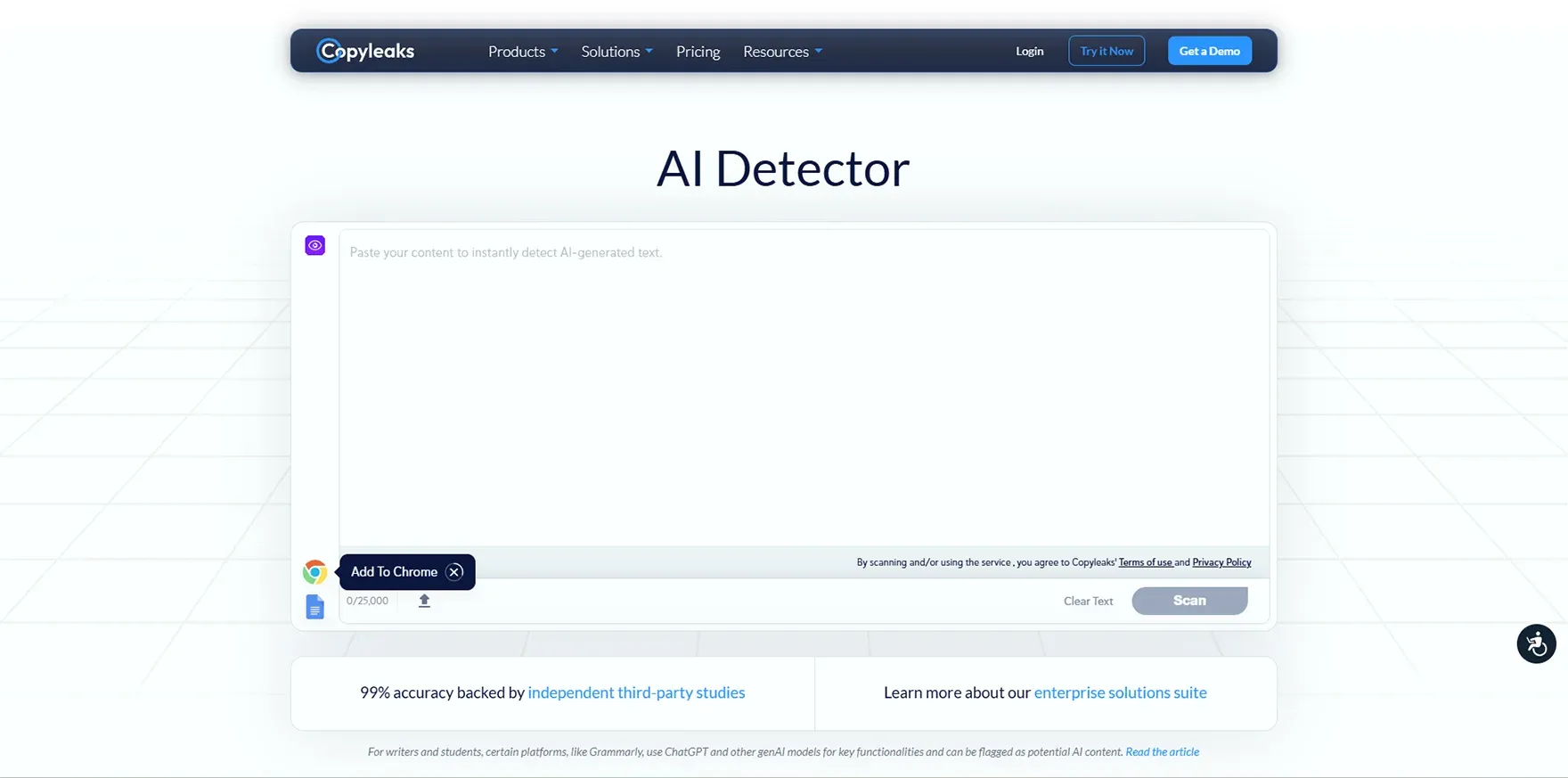
Copyleaks combines AI detection with plagiarism checking and supports over 30 languages. It offers a limited free AI checker alongside paid Personal and Pro plans built for teams and institutions.
Quick facts
- Free limit: Not consistently published across sources; confirm on the live tool
- Sign-up: Not required for a first check, per most current sources
- Model coverage: ChatGPT, Gemini, Claude, and other major models
- Accuracy evidence: Vendor claim: 99.1%; independent benchmarks report roughly 77% to 96% depending on methodology
- Best for: Teams that need AI detection and plagiarism checking together
What we like
- AI detection and plagiarism checking in one platform
- Sentence-level highlighting
- Supports over 30 languages
Limitations
- Free tier is limited, and the exact figure varies by source
- Full feature set requires a paid Personal or Pro plan
Best for: Agencies or schools that want AI detection and plagiarism checking in a single tool.
Verdict: A capable professional-grade tool with a genuinely limited free entry point; check the current free-tier terms directly before assuming a specific word count. Our Copyleaks AI detector review has the full breakdown.
Originality.ai
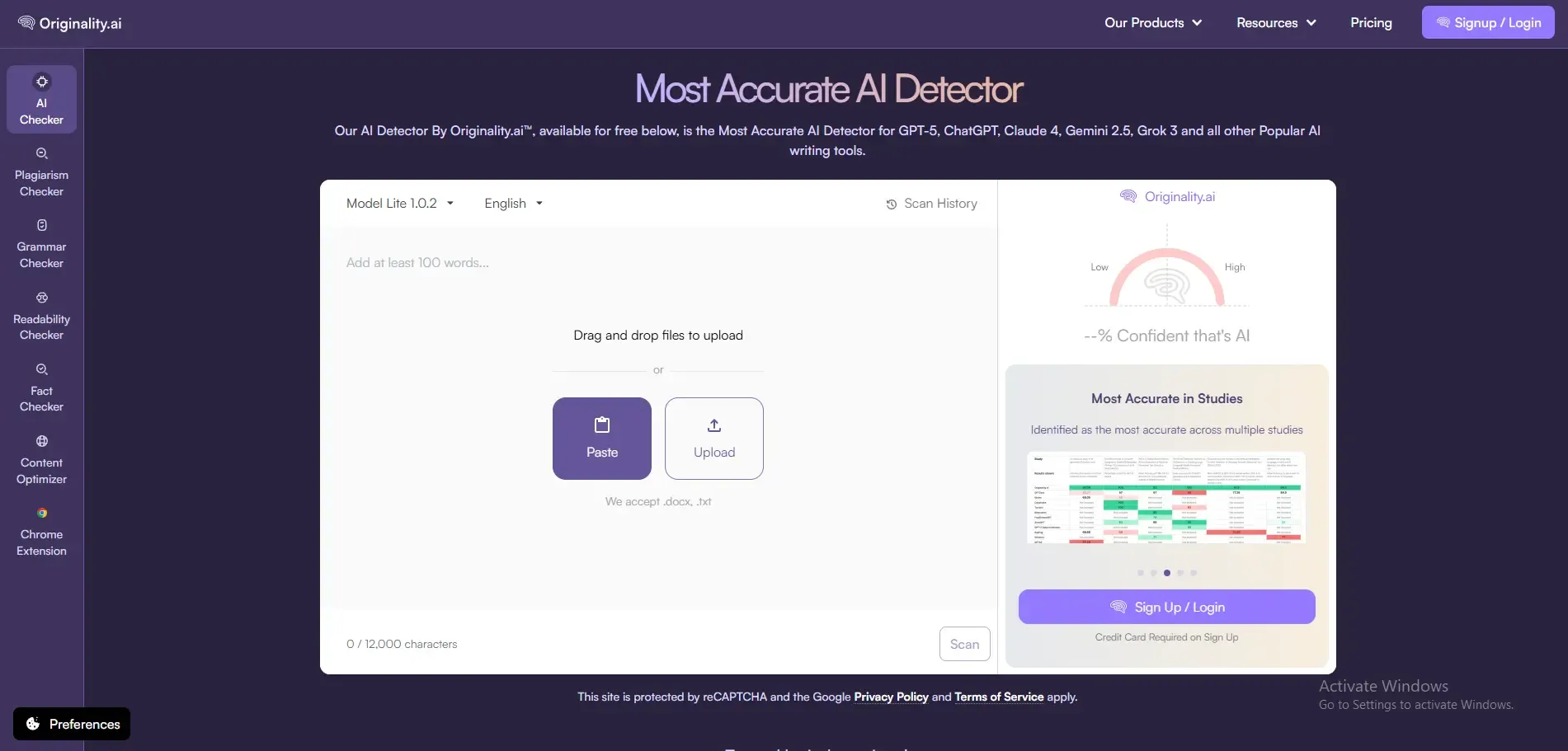
Originality.ai does not offer an ongoing free plan. New accounts get 50 signup credits (roughly one credit per 100 words) as a one-time trial, after which continued use requires a paid plan.
Quick facts
- Free limit: 50 signup credits, one-time, no recurring renewal
- Sign-up: Yes
- Model coverage: ChatGPT, Claude, Gemini, and other major models
- Accuracy evidence: Vendor claim: 99%; independent benchmark (RAID, October 2025, published at ACL): 96.7% on paraphrased content
- Best for: Agencies checking outsourced or heavily edited content
What we like
- Strong independent benchmark result specifically on paraphrased or edited AI text
- Combines AI detection with plagiarism checking
- Built for bulk content workflows
Limitations
- No ongoing free plan, only a one-time trial credit
- Some independent tests report notably lower accuracy on newer models than the vendor's headline figure
Best for: Content teams checking freelance or edited submissions who can move to a paid plan after the trial.
Verdict: The independent paraphrase-detection result is genuinely strong, but this is a trial, not a free plan, so budget for a paid tier if you need ongoing use. Read the complete Originality.ai review for more.
Which Free AI Detector Is Most Accurate?
There is no defensible universal winner based only on currently published accuracy percentages. The numbers above cannot be compared directly for several reasons:
- Different datasets: each vendor or reviewer scores a tool against its own set of sample texts, not a shared one.
- Different AI models: some tests use GPT-4 era text, others use GPT-5, Claude, or Gemini, and results shift by model.
- Different false-positive thresholds: a detector tuned to catch more AI text usually flags more human text too, and not every test applies the same cutoff.
- Edited versus unedited AI text: raw AI output is easier to catch than paraphrased or humanized text, and not every test distinguishes between the two.
- Vendor tests versus independent benchmarks: a provider's own marketing number and a third-party academic benchmark measure different things, even when both are labeled "accuracy."
The more reliable approach is to match a tool's free-plan terms and sign-up requirement to what you need, then treat its score as one input rather than a verdict. For a closer look at how the field stacks up, see our guide on which AI detectors are accurate.
Can Free AI Detectors Detect ChatGPT, Claude, and Gemini?
Most free detectors claim coverage of ChatGPT, Claude, and Gemini, but reliable, directly comparable accuracy data across all three models is not publicly available for every tool in this comparison, so a model-by-model table isn't included here. The general, well-documented pattern is that detectors trained mainly on ChatGPT-style output have historically performed less consistently on Claude and Gemini text, whose sentence rhythm and predictability differ. One documented data point: an independent 2026 test found Originality.ai detected only 31.7% of GPT-5 output compared to GPTZero's 100% in the same test, which shows model-specific performance can vary sharply between tools, though this single comparison should not be generalized to every model or every tool listed here. For more on how detectors handle each model, see our explainer on AI detectors for ChatGPT, Claude, and Gemini.
Why Do AI Detectors Produce False Positives?
False positives happen when human writing contains patterns a detector associates with AI-generated text. Common causes include:
- Highly predictable wording
- Formal or repetitive writing
- Short samples that don't give the detector enough signal
- Heavy editing or polishing
- Differences between a detector's training data and how current AI models actually write
- Potential bias affecting some non-native English writing: a 2023 Stanford study (Liang et al., published in Patterns) found that several AI detectors misclassified more than half of TOEFL essays written by non-native English speakers as AI-generated, while rarely doing so for essays by native speakers.
Important: An AI detector score should not be the only evidence used to accuse a student, employee, writer, or contractor of using AI. Read more in our guide to AI Checker Pro false positives and human writing.
Best Free AI Detector by Use Case
| Use Case | Best-Fit Option | Why |
|---|---|---|
| Quick no-sign-up check | QuillBot, Scribbr, ZeroGPT, or AI Checker Pro | All four allow a basic scan without creating an account |
| Student use | GPTZero or AI Checker Pro | Sentence-level detail plus a usable free allowance for repeated self-checks |
| Teacher / educator | GPTZero | Largest verified recurring free word allowance for reviewing multiple submissions |
| Long documents | GPTZero or ZeroGPT | Higher monthly or per-scan limits reduce the need to split a document into pieces |
| SEO / content team | Copyleaks or Originality.ai (trial) | Built around bulk and plagiarism-aware workflows, though ongoing use needs a paid plan |
For deeper, role-specific guidance, see the AI detector for students, AI detector guide for teachers, and AI detector for content writers pages.
Can AI Detectors Detect Humanized or Edited AI Text?
Sometimes. Editing or paraphrasing AI text usually lowers a detector's score, but results vary by tool, and no detector can guarantee consistent detection after edits. Detectors are updated over time, so a result that passes today may not pass after the next update. This is a limitation to understand, not a technique to rely on. If you're weighing how humanized text holds up, our free AI humanizer tools guide walks through what to expect.
| Factor | Free Detector | Paid Detector |
|---|---|---|
| Usage limits | Capped per scan or per month | Higher or bulk limits |
| Reports | Basic score, sometimes sentence-level | Detailed, downloadable reports |
| Batch scanning | Rarely available | Often included |
| API | Not available on free tiers in this comparison | Available on most paid plans |
| Best fit | Occasional, individual checks | Teams, agencies, recurring workflows |
For a fuller breakdown, see free vs paid AI checkers.
Conclusion
Someone who wants speed and no account should pick QuillBot, Scribbr, ZeroGPT, or AI Checker Pro, all of which run a basic scan with no signup. Someone reviewing content regularly, especially across a month, gets more from GPTZero's larger recurring allowance or Copyleaks' combined AI-and-plagiarism workflow, while a content team checking edited or outsourced work may find Originality.ai's independent paraphrase-detection result worth the trial, then a paid plan.
None of these tools has independently verified accuracy data strong enough to call it a universal winner, and every one of them produces some false positives and false negatives.
If you want to try AI Checker Pro's free detector for ChatGPT, Claude, and Gemini text, you can check text for free here.
FAQs
Which free AI detector is the most accurate in 2026?
Is there a free AI detector that works without sign up?
What is the word limit for free AI detectors?
Can free AI detectors catch ChatGPT, Claude and Gemini text?
Do AI detectors give false positives on human writing?
Can AI detectors still catch humanized or edited AI text?
Which free AI detector is best for teachers and students?
Is GPTZero or ZeroGPT more accurate?
Do I need to pay for a reliable AI detector?
What is the best free AI detector for long documents?

Harshil Barvaliya
SEO Executive & Content Writer at AI Checker Pro
I’m Harshil Barvaliya, an SEO Executive and Content Writer at AI Checker Pro. I focus on improving the website’s search engine visibility through effective SEO strategies, including keyword research, on-page and off-page optimization, and content development.Get Started Free
Create a free account for advanced AI detection and scan history.
Trusted by thousands worldwide.
Recent Blog's
Discover how AI-powered content creation can elevate your website's reach and engage your audience like never before. Explore the real impact of AI on crafting content that connects.