Best Free AI Detectors for Students in 2026
TABLE OF CONTENTS
Why AI Detection in Academia Is a Double-Edged Sword
The Core Problem: Not All AI Detectors Are Built the Same
Best Free AI Detectors for Students (2026 Edition)
How to Use These Tools the Right Way
Common Mistakes Students Make With AI Detectors
Pro Tips for Students
What to Do If You Are Falsely Flagged
Future Trends: Where AI Detection Is Heading
Conclusion
FAQs
Get an AI summary of this post on:





The 2026 student body has probably encountered this statement from their professors, which begins with the following words:
"The essay presents itself as an artificial intelligence creation. Please tell me your method of developing this work." The entire experience becomes frightening because you produced every written word.
The academic environment now includes artificial intelligence detection systems. Educational institutions have adopted the system. The system has become essential for teachers. The system does not always provide accurate results.
The current situation requires us to understand the functioning of AI detection systems because we need to know which systems deliver authentic results, while students need protection against these technologies. If you want a full breakdown of how these tools actually work under the hood, this guide on how AI content detectors work covers the technical side in plain language.
The guide presents all necessary information, including the top free tools available, the actual difficulties of achieving accuracy, and the steps you must take when facing incorrect identification.
Why AI Detection in Academia Is a Double-Edged Sword
AI writing tools became widely available to users after they demonstrated their capacity to produce written content. Students began to use ChatGPT as a tool for generating ideas and creating outlines while using it to produce entire academic assignments. Universities implemented rapid changes through new policies and updated honor codes while they made AI detection software a mandatory component of Turnitin plagiarism detection tools.
People tend to overlook the main issue that needs discussion.
AI detectors make mistakes. A lot of them.
Studies have shown false positive rates as high as 10 to 20% on some platforms. The system incorrectly identifies human-created material as artificial intelligence writing, which occurs most frequently with the following writing styles:
- Non-native English speakers
- Students with formal or structured writing styles
- Anyone who uses grammar correction tools like Grammarly
The situation has reached a critical point. A false flag can result in academic penalties, course failures, or worse. If you are wondering how colleges detect AI in essays, the answer often starts here. The process requires us to select an appropriate detection tool while we need to comprehend its complete operational boundaries.
The Core Problem: Not All AI Detectors Are Built the Same
Most free AI detectors use one of two methods:
- Perplexity scoring - Measures how "predictable" a text is. AI tends to write in smooth, low-surprise patterns. High perplexity = more human-like.
- Burstiness analysis - Humans vary their sentence lengths and complexity. AI tends to be more uniform.
The issue? These signals are not foolproof. Human writers can be consistent. AI can be prompted to sound erratic. This creates a detection gap that no current tool fully closes.
Understanding AI detector accuracy and its real limitations is something every student should do before trusting any score they see.
Bottom line: No AI detector is 100% accurate. Even enterprise tools like Turnitin's AI detector admit this in their documentation.
Best Free AI Detectors for Students (2026 Edition)
Here is a practical comparison of the most-used free tools right now:
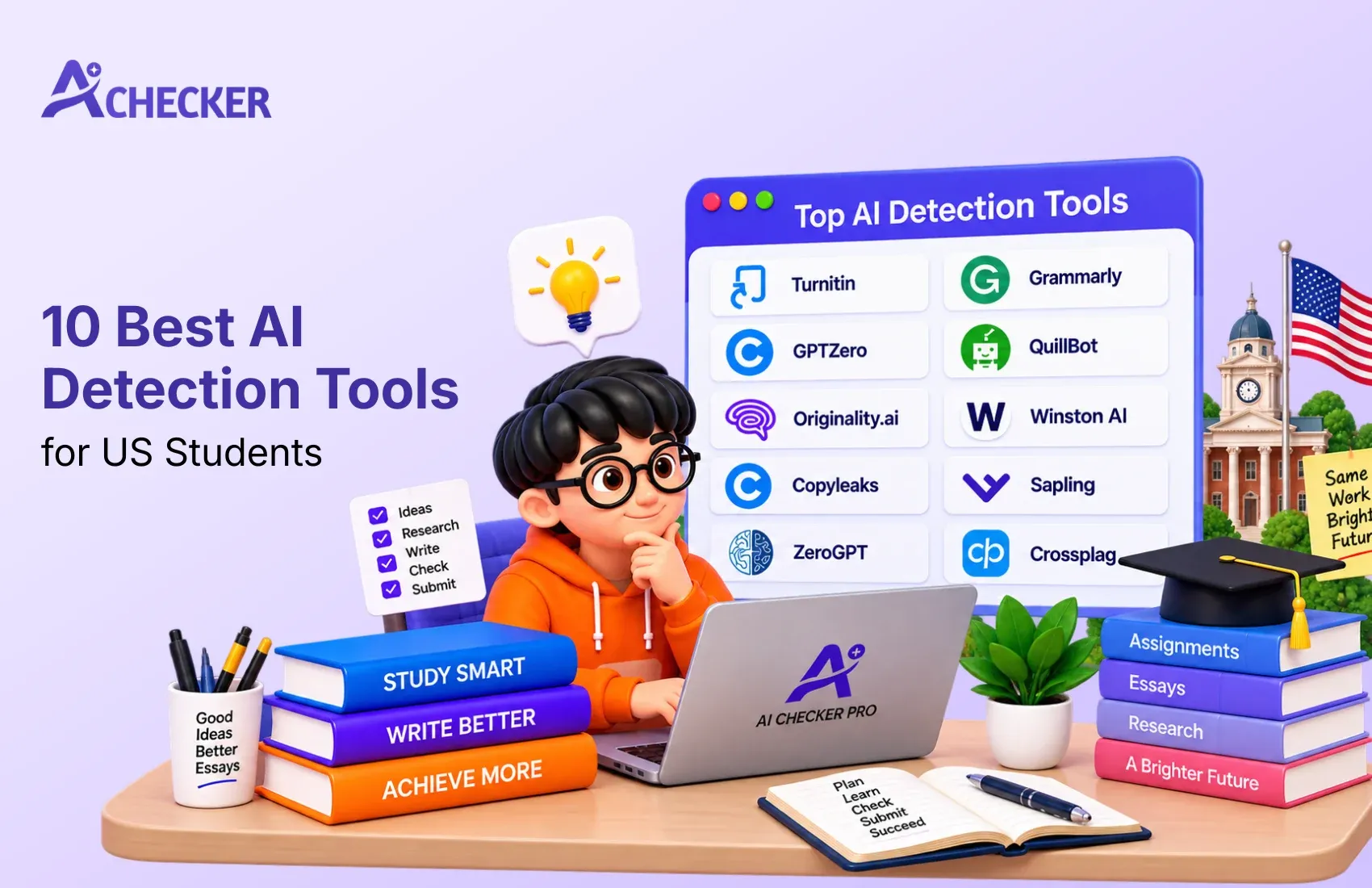
| Tool | Best For | Accuracy Level | Free Tier |
|---|---|---|---|
| GPTZero | Academic writing detection | High | Yes (limited chars) |
| Copyleaks | Multi-language detection | High | Yes (limited scans) |
| ZeroGPT | Quick checks | Moderate | Fully free |
| Sapling AI Detector | Sentence-level analysis | Moderate-High | Yes |
| AI Checker Pro | Comprehensive analysis + breakdown | High | Yes |
| Originality.ai | Content + plagiarism combo | Very High | Paid (trial available) |
| QuillBot AI Detector | Student-friendly interface | Moderate | Yes |
1. GPTZero
One of the most widely recognized tools in academic circles. The system analyzes texts through its built-in features which enable evaluation of both individual sentences and entire documents to show which sections of the text appear to be generated by artificial intelligence.
Who it's for: Students who want detailed, section-by-section analysis.
Limitation: Free tier limits character count. Long essays may need to be split.
If you want a side-by-side comparison, check out AI Checker Pro vs GPTZero to see which one holds up better for student use cases.
2. AI Checker Pro
AI Checker Pro has become a go-to platform for students who want more than just a pass/fail result. The system provides percentage data which shows its results and the system identifies questionable parts while it describes the reasons for each identification.
Who it's for: Students who want to understand the "why" behind a detection, not just the score.
Standout feature: The explanatory breakdown makes it easier to identify and revise flagged sections, whether the content is actually AI-generated or just formally written.
3. ZeroGPT
ZeroGPT provides its services without charging fees and requires no registration process. The tool serves as a quick initial assessment solution, although it lacks the precision of other tools available on the list.
Who it's for: Students who want a fast sanity check without creating an account.
Limitation: Higher false positive rate compared to tools like GPTZero or AI Checker Pro. Read a full review of ZeroGPT to understand exactly where it falls short before relying on it.
4. Copyleaks AI Detector
The multiple language capabilities of Copyleaks make it valuable because it assists international students who write English with a higher chance of false positive results. If your school uses the LMS system, the system's integration with that platform provides instructors an advantage because they can use the system to evaluate student submissions.
Who it's for: International students or ESL writers.
5. Sapling AI Detector
Sapling highlights individual sentences it considers AI-generated instead of just giving an overall score. The system enables you to identify which specific writing element causes the detection system to activate.
Who it's for: Students doing targeted editing to reduce their AI score. You can also read the full Sapling AI content detector review for a deeper look at how it handles sentence-level detection.
How to Use These Tools the Right Way
Running your essay through an AI detector before submission is smart. Here is a practical workflow:
Step 1: Write your essay normally. Do not pre-optimize for AI systems; write as naturally as possible.
Step 2: Run it through two different tools. Various detection systems select particular modeling approaches for their operations. The system detects a genuine issue when both detection systems identify the same problem. The system shows a false positive result when only one detection system confirms the issue.
Step 3: Check sentence-level results. It seems the presented score is not a true reflection as some explicit sentences were noticed in the summary of the arrangement that were NOT meant to be from AI writers.
Step 4: Revise flagged sections if needed. You should include personal experiences, change your sentence structure, and add your personal viewpoint to your writing. The method helps with both identifying writing and creating authentic written work. If you need more guidance, this resource on how to humanize AI text manually for academic writing walks through it step by step.
Step 5: Run it through AI Checker Pro for a final detailed check. This feature is especially useful in the last row just before a critique with significant uncertainties because everyone has one too many questions.
Common Mistakes Students Make With AI Detectors
The established practice of conducting cross-validation requires testers to use multiple detection tools because no single detection tool can establish definitive results. The process of paraphrasing AI output creates a false sense of safety because current detectors are able to identify paraphrased AI content using their 2025 to 2026 advanced models.
Not keeping drafts. When you face a dispute about your work, the draft history stored in Google Docs or similar tools serves as the most reliable evidence that you developed your work through multiple writing sessions.
The process of using AI for editing purposes leads to the submission of work which violates academic integrity. The use of AI tools for grammar correction creates detection risks because the system rewrites complete sentences. This is a common point of confusion, and it connects to a broader issue many students miss when they avoid AI detection in college papers.
Your research results lack contextual understanding. The AI score of 40% for the methods section, which requires a standard formula approach, differs completely from the 40% score achieved on a personal reflection essay.
Pro Tips for Students
- Write in drafts, not one sitting. Human writing has natural stops, edits, and revision marks. This shows up in document history.
- Use AI for research assistance, not writing. Asking AI to explain a concept is different from asking it to write your paragraph.
- Know your school's policy. Some schools permit AI-assisted writing with disclosure. Know exactly what yours allows.
- Keep a writing journal. Noting your thought process as you write creates a paper trail that is very hard to fake.
- Use tools like AI Checker Pro to self-audit before submission. It is better to find issues yourself than have your professor find them.
For students who want to go further, this detailed guide on how students use AI detectors and humanizers covers real-use strategies that actually work.
What to Do If You Are Falsely Flagged
This occurs more often than people believe. If a detector flags your original work:
Stay calm and document everything. Draft history, outline notes, research sources - gather them all.
Request a human review. Most academic institutions have a process for contesting AI detection results. Use it.
Run the text through multiple detectors. The tools show different results, which indicates that there is a possibility of incorrect identification.
Students should approach their professors before starting formal academic procedures. A direct, documented conversation is often the fastest resolution.
Detection tools serve as advisory instruments that do not provide final results. Courts and academic appeals boards increasingly recognize this. Understanding the importance of AI content detection in education also helps you frame this conversation more clearly with instructors.
Future Trends: Where AI Detection Is Heading
The detection systems for artificial intelligence in 2026 operate with greater accuracy because of their advanced abilities to identify writing patterns than their abilities two years ago. The following description shows what will happen next:
Tools for writing assessment use behavioral biometrics to analyze your writing process through their advanced typing measurement abilities. Some tools are experimenting with tracking how you type, your pace, your revision patterns, even your typo corrections, to build a "writing fingerprint." This approach delivers greater accuracy compared to using only text analysis methods.
Watermarking at the model level. The developers at OpenAI and other organizations create methods for putting hidden markers into AI-produced content that detection systems can recognize. This approach would enhance detection precision to an extreme level, but organizations face problems with its implementation.
Institutional AI logs. Some schools are exploring requiring students to log all AI tool use with timestamps. This system requires students to disclose their AI usage instead of making it necessary for schools to find evidence of AI usage.
Multimodal detection. Future tools will analyze not just what you wrote, but how you formatted it, what images you chose, and how your citations cluster, creating a holistic picture that is harder to game.
The takeaway? Detection will get more reliable. The best approach requires you to study the current tools while using artificial intelligence. You should use AI in an ethical manner which complies with your school's regulations while establishing methods to track your genuine accomplishments. This is also why staying informed about AI detectors used by colleges for research gives you a real advantage.
Conclusion
Research shows that AI detection technology will become permanent in academic systems, which will develop throughout each upcoming year. Students need to focus on two main areas because they need to grasp how these tools function and identify which tools provide actual value.
The best free AI detectors for students in 2026 combine accuracy with explainability. GPTZero, Copyleaks, and AI Checker Pro provide users with more than just a score because these tools display the reasons behind their suspicious assessment while assisting users in fixing the issues.
Use detection technology in a proactive manner instead of waiting to respond after problems occur. You need to examine your work before submitting it, and you must learn about false positives to create a record of your writing process. The combination of these two elements protects your academic integrity more effectively than any individual tool.
FAQs
1. What is the best free AI detector for students in 2026?
2. How does an AI detector free tool actually work?
3. Can an AI checker give a false positive on human writing?
4. Is there a reliable ChatGPT detector that works for essays?
5. How can I humanize AI text before submitting an essay?
6. What is the difference between an AI text detector and a plagiarism checker?
7. Can AI detection tools identify paraphrased AI content?
8. What should I do if my original essay gets flagged as AI-generated?
9. How do I convert AI text to human text without losing meaning?
10. Are AI checker free tools accurate enough for academic use?

Harshil Barvaliya
SEO Executive & Content Writer at AI Checker Pro
I’m Harshil Barvaliya, an SEO Executive and Content Writer at AI Checker Pro. I focus on improving the website’s search engine visibility through effective SEO strategies, including keyword research, on-page and off-page optimization, and content development.Get Started Free
Create a free account for advanced AI detection and scan history.
Trusted by thousands worldwide.
Recent Blog's
Discover how AI-powered content creation can elevate your website's reach and engage your audience like never before. Explore the real impact of AI on crafting content that connects.