How US University Students Use AI Detectors and Humanizers Without Getting Flagged
TABLE OF CONTENTS
Why US Universities Are Using AI Detection Tools
How AI Detectors Actually Work
Why Innocent Students Get Falsely Flagged
The Two Types of Students Using AI Checkers
How to Check Your Essay with a Free AI Detector (Step-by-Step)
How to Use an AI Humanizer to Lower Your Detection Score
What AI Humanizers Actually Do (and Do Not Do)
The Re-Check Step Most Students Skip
Staying on the Right Side of Your University's AI Policy
Conclusion
FAQs
Get an AI summary of this post on:





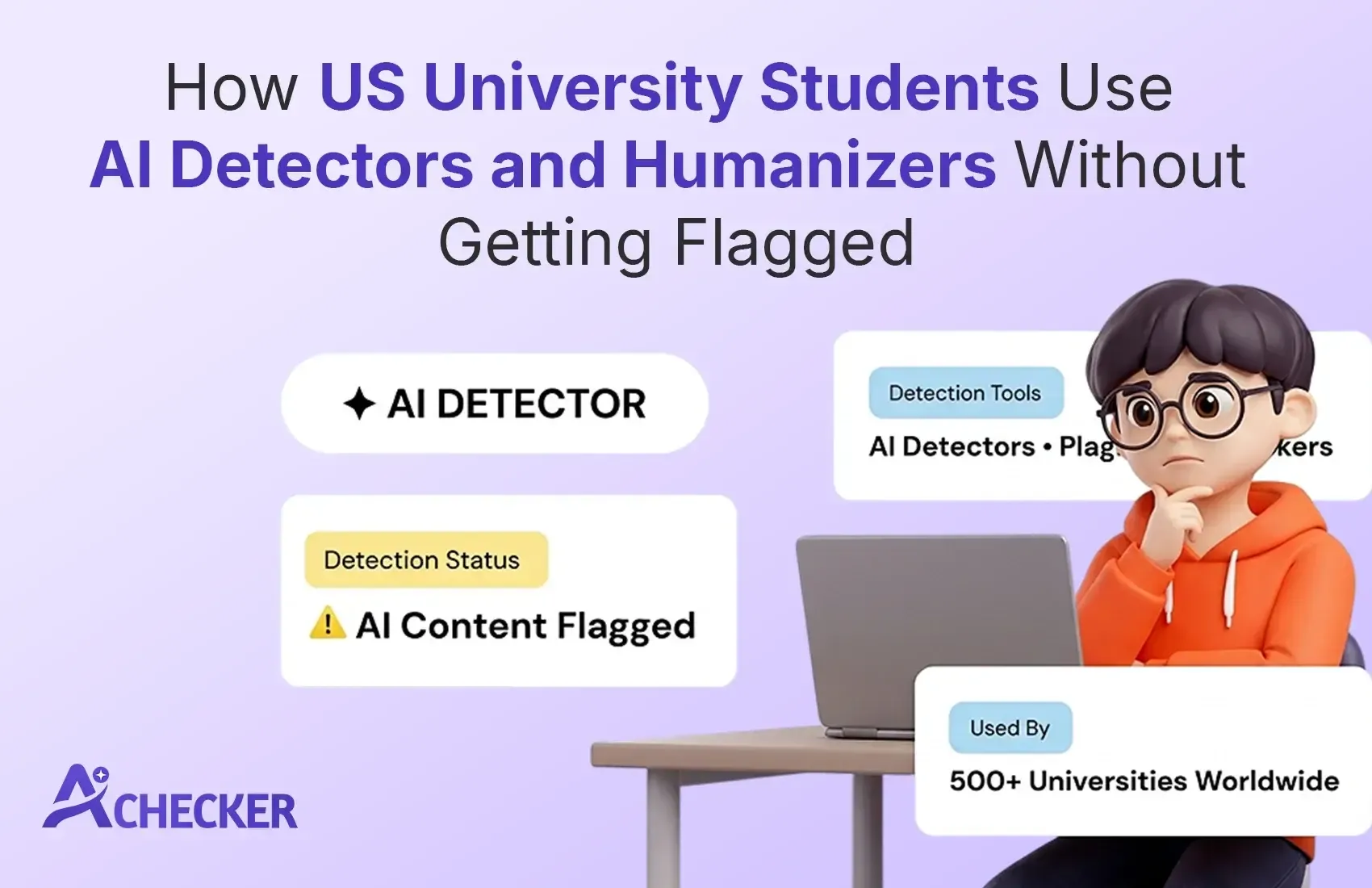
The first day, you worked through two entire evenings to create your essay. You researched information, organized your ideas, and created the entire content of your essay. You turned in your work with assurance.
Your professor brought you to a private location after several days to inform you that your essay had been detected as plagiarized by an AI system. You are now experiencing confusion. You are feeling anxious. You are feeling ashamed at this moment, despite your innocence in this situation.
This situation occurs more frequently than people believe. The opposite side shows students who used AI tools for writing help but now need to find a method to fix their writing before they submit it. Both groups face a difficult situation. Both groups require solutions to their problems.
This article exists to fulfill that purpose. This guide provides an honest assessment of your writing process, whether you completed your essay independently or received AI support. The conclusion will teach you to use a free AI detector, explain AI humanizer functions, and show methods for safeguarding your academic work until you submit your work.
Why US Universities Are Using AI Detection Tools
Universities throughout the United States have dedicated substantial financial resources to developing software that detects writing produced by AI since 2023. The educational system now uses Turnitin and GPTZero as common assessment tools. The area has expanded, according to my personal experience, because of its rapid growth rate.
Broward County in Florida purchased Turnitin licenses for more than 550,000 dollars, which represents a significant financial commitment. The amount of money universities spend on this problem shows their determination to resolve it. They established permanent systems instead of conducting a basic assessment.
Students who receive flags face serious consequences. Academic institutions impose different penalties, which include grade reduction, honor code violations, and formal disciplinary actions for extreme violations. To better understand how colleges detect AI in essays, it helps to first learn what these tools are actually scanning for.
The students I work with tend to underestimate the consequences they will face until they encounter their first disciplinary problem.
The situation becomes complicated at this specific point. The existing AI detection systems lack complete accuracy. The system produces false positives at a high frequency. The system will identify a student who demonstrates formal writing skills because of their precise and organized writing method. The detector will identify a non-native English speaker who uses correct grammar as a threat. Students who edit their essays with Grammarly face detection because the final result appears excessively polished and smooth.
How AI Detectors Actually Work
Most AI text detectors work by analyzing patterns in writing. The system uses perplexity, which measures how predictable the text is. AI writing shows consistent patterns that create minimal unexpected elements.
The system measures burstiness through its assessment of short sentences and long, complex sentences. Human writing tends to mix these up naturally. AI writing does not always do that. The patterns enable the system to determine whether a human or a machine created the content. If you want a deeper look at this process, this guide on how AI content detectors work breaks it down in plain terms.
Why Innocent Students Get Falsely Flagged
The ChatGPT detection systems currently available in the market face the problem of false positive results according to their documented performance.
Students who write in a formal academic style, students who are non-native English speakers, and students who heavily edit their drafts using writing tools are all at higher risk of being flagged. The system operates according to its existing detection capabilities because this situation represents a fundamental system restriction. Understanding this is the first step in protecting yourself. You can also review AI detector accuracy data to understand just how often these errors occur.
The Two Types of Students Using AI Checkers
The general public believes that people who use AI checkers need to conceal their activities. The statement is incorrect because it does not reflect reality. The students who use these tools for their studies represent two distinct groups who both need their tools because the studies need to be done.
The first group consists of students who used AI tools, like ChatGPT, to help them draft, brainstorm, or organize their ideas. Their concerns about AI-generated text exist because they need to verify the entire content for possible AI-induced errors. These students plan to use a free AI checker on their complete work before submission, then use an AI humanizer to rewrite any sentences that received a flag.
The second group is students who require proof of their complete authorship because they face false accusations. The system operates unfairly to students, but they want to take active steps for their protection. The use of an AI detection tool for self-checking purposes does not constitute dishonesty.
The two groups need accurate, useful solutions. The ai checker pro solution functions exactly for this purpose. The process for protecting your original work or editing your AI-assisted writing will follow the same route, which we will explain through each section.
How to Check Your Essay with a Free AI Detector (Step-by-Step)
The process of using a free AI detector becomes easier for students than they expect. The following guide demonstrates how to use ai checker as an example for its operation. The free plan provides immediate access to its services without requiring users to create an account for access.
Most people struggle with knowing what to do after they get their results, so let me explain simply, step by step:
- Paste your essay text directly into the input box, or upload your document file if that option is available.
- Click the "Check for AI" button and wait a few seconds. The tool will analyze your writing for patterns associated with AI generation.
- Review the sentence-level breakdown. Most good AI text detectors will highlight specific sentences that look AI-generated, not just give you an overall score.
- Note the overall percentage. Most tools will show you something like 78% human or 34% AI. The lower the AI percentage, the safer you are.
- Make a decision. If your score is low enough, you are probably fine to submit. If it is high, you may want to rewrite some of the flagged sections or use a humanizer AI tool to rework them.
One thing I have noticed is that many students skip the sentence-level review and only look at the total score. That is a mistake. A sentence-by-sentence view helps you understand exactly which parts of your writing are triggering the detector, so you can fix them more precisely. For a side-by-side breakdown of your options, check out this comparison of free vs paid AI checker tools.
How to Use an AI Humanizer to Lower Your Detection Score
Your essay returned with an AI detection score showing significant artificial intelligence presence in your work. The AI humanizer function exists to provide help at this point. People believe that humanizing a text only requires them to replace words with their synonyms. The modern tools need to operate in different ways because their current methods fail to provide effective results.
A good humanize AI text tool actually goes deeper. The software changes how sentences sound by adding authentic speech patterns and creating new sentence structures that break away from the standard AI output. The result should read like a real person wrote it, not just like someone ran a thesaurus over it.
The humanize AI feature of aichecker.pro functions immediately after users obtain their detection results. The process starts when you choose specific areas that have been identified as problematic and then use the humanizer to create an updated version, which you can assess before making your final choice.
What AI Humanizers Actually Do (and Do Not Do)
I need to establish what people realistically should expect. An AI humanizer is not a magic button. The solution will decrease obvious AI indicators from your writing, thus making it less probable to receive detection.
The system does not resolve the issue of weak ideas or thin research. The process of humanizing text will not improve an argument that lacks strength or research that lacks depth. Think of it as a basic tool that controls both writing style and word choice while leaving actual content untouched. If you want to understand more about what humanizing AI content actually involves, this breakdown is worth reading before you start.
The requirement to establish original content with proper backing while writing your own ideas and arguments remains essential for you.
The Re-Check Step Most Students Skip
This is probably the most important thing in this entire article, and almost nobody does it. After you humanize text and make changes, the AI checker needs to evaluate your updated text for a second time.
I have seen students humanize their essays, assume the problem is solved, and then get flagged anyway because they skipped the re-check. The re-check tells you whether the humanization actually worked. You need to know if specific sentences still maintain AI-generated characteristics before you submit your work, not after.
The workflow is simple: check, humanize, re-check, then submit. The third step must never be skipped. For more practical guidance on this exact process, this article on how to avoid AI detection in writing covers additional steps worth knowing.
Staying on the Right Side of Your University's AI Policy
The AI policies of universities establish different rules that apply to different courses and professors. Some schools permit AI use for brainstorming purposes, while other schools completely prohibit its use. Some courses have specific rules that differ from the general university policy. You need to know your own institution's rules before you submit anything.
Using a free AI detector to self-check your work is not academic dishonesty. It serves as due diligence because it functions like any other proofreading tool. Running your essay through an AI detection tool to protect yourself from false accusations is responsible behavior.
Using an AI humanizer to polish AI-assisted writing and then presenting it as your own without disclosure is a different matter. Most universities define that as academic dishonesty, even if the ideas were partly yours. The line is not always clear, but the spirit of the rule usually is: your submitted work should reflect your own thinking and effort. You can read more about the role of AI detection in protecting academic integrity to understand why these standards exist.
My honest advice is this. Use AI as a starting point, a brainstorming partner, or an editing helper. Submit the final work that will demonstrate your understanding through your own writing. Save your drafts. Keep your research notes. If you are ever questioned, you want to be able to show your work. Transparent use of AI, where your professor permits and you disclose how you used it, is always the safer path. Academic integrity is worth protecting, not just because of the rules, but because your education genuinely matters.
Conclusion
Students who want to study effectively can follow this straightforward process, which begins with using an AI detection system to check their essays and ends with submitting their work after they have verified all changes. The tools exist to safeguard your work while improving your writing skills because they do not exist to replace your thought process.
The most effective writing practice involves using a free AI checker tool to test your work before you submit it, whether you created all of the content yourself or received AI help during your writing process. The reality of false accusations requires active defense measures as the most effective protection method.
Ready to check your essay before you submit? The free detector from AI Checker provides instant results, which you can access at ai checker.
FAQs
1. What is an AI detector and how does it work?
2. Is there a free AI detector I can use before submitting my essay?
3. Can an AI checker give false results for essays I wrote myself?
4. What does an AI humanizer actually do to my text?
5. Is using an AI humanizer considered cheating at university?
6. What is the difference between an AI checker and a plagiarism checker?
7. How do I lower my AI detection score before submitting?
8. Which AI detection tool do universities use to catch students?
9. Can I use a chat GPT detector on my own writing before my professor does?
10. Does humanizing AI text always make it pass the AI detector?

Harshil Barvaliya
SEO Executive & Content Writer at AI Checker Pro
I’m Harshil Barvaliya, an SEO Executive and Content Writer at AI Checker Pro. I focus on improving the website’s search engine visibility through effective SEO strategies, including keyword research, on-page and off-page optimization, and content development.Get Started Free
Create a free account for advanced AI detection and scan history.
Trusted by thousands worldwide.
Recent Blog's
Discover how AI-powered content creation can elevate your website's reach and engage your audience like never before. Explore the real impact of AI on crafting content that connects.