Why Is My Essay Flagged as AI? Causes, False Positives & What to Do
TABLE OF CONTENTS
Why Is My Essay Flagged as AI? Top Feasible reason
How Do AI Essay Detectors Work?
Can Human-Written Essays Be Flagged as AI?
How to Check Whether an AI Detection Result Is Accurate
What to Do If Your Essay Is Wrongly Flagged as AI
How to Make Your Essay More Original and Authentic
Conclusion
FAQs
Get an AI summary of this post on:





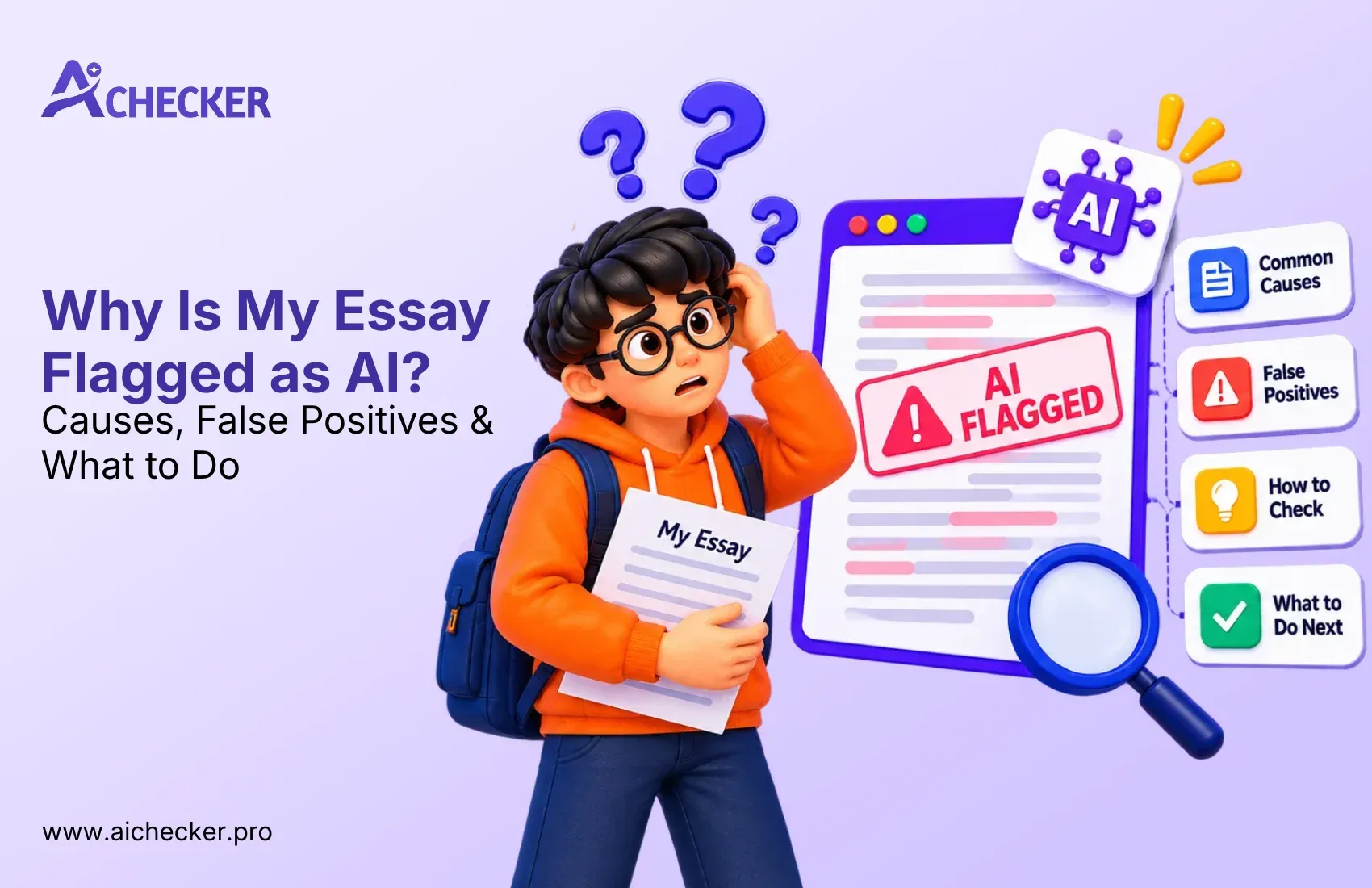
Have you ever had an essay flagged as AI-generated, even though you wrote or edited it yourself? If so, you are not alone. AI writing detectors can sometimes label human-written content as AI-generated, and their results are not always accurate.
As a technical content writer with over three years of experience, I have tested several AI writing tools, including AI detectors and humanizers. In this article, I will share what I have learned, explain why essays may be flagged as AI-generated, and discuss practical ways to make your writing more original, clear, and useful.
An AI detection result does not automatically mean your essay is poor or that you have used AI incorrectly. It is important to understand why a detector may flag your writing and how to review your content before making changes.
Why Is My Essay Flagged as AI? Top Feasible reason
In my earlier writing process, I used AI to create content on a specific topic and then ran the draft through a humanizer tool. I repeated this process several times, hoping to make the content sound more natural.
However, the results often felt generic. The articles did not always include enough original insights, detailed examples, or a clear personal perspective. I also noticed that some of my articles were not getting indexed as I had expected.
I cannot say that using AI or a humanizer caused the indexing issues. Several factors can affect indexing and search performance. However, this experience made me review my writing process and think more carefully about originality, content quality, and the value I was giving readers
Here is what I learned from that experience:
- Avoid generic content: Do not publish an article that only repeats common information. Add original insights, relevant examples, and useful explanations.
- Review AI-generated drafts carefully: If you use AI for research or drafting, check every claim, rewrite weak sections, and add your own knowledge and analysis.
- Do not rely on humanizer tools: A humanizer cannot guarantee that content will sound authentic or pass an AI detector. Review the content yourself instead of relying on a tool's score.
- Use clear, natural language: Choose words that fit your audience. Use technical terms when they are necessary, but explain them when readers may not understand them.
- Add your own experience: Share relevant examples, lessons learned, observations, and original analysis. These details can make your article more useful and distinctive.
The biggest lesson I learned is that no single AI detector or humanizer should control your entire writing process. Focus on creating content that is accurate, original, and helpful to readers. Use AI detection tools only as one source of feedback, not as the final judgment of your writing.

Get Lifetime Access with 60% OFF
Stop paying monthly subscriptions. Enjoy unlimited AI detection and humanizer access forever with future updates included.
- One-time payment
- Unlimited access forever
- All future updates included
How Do AI Essay Detectors Work?
Whenever I talk about how AI detectors work. Many audiences think the whole process.
But real experience is quite different.
I want to share how I used an AI essay detector in daily use:
AI essay detectors check different writing patterns to estimate whether a piece of content was written by AI. They may look at word choices, sentence structure, and how predictable the text is.
However, the results aren't always accurate. Sometimes, human-written content may also receive an AI score. That is why I don't think we should judge an entire essay based only on the detector's result.
An AI score can give us an idea about the content, but it cannot prove who actually wrote it. We should also look at the writing process, the original draft, and the changes made during editing before concluding.
Can Human-Written Essays Be Flagged as AI?
Yes, human-written essays can sometimes be flagged as AI-generated. This is one of the main problems students and writers face when using AI detection tools.
As a technical content writer with over three years of experience, I believe we should not judge the quality or originality of content only by looking at an AI detector score. These tools look for patterns in writing, but those patterns do not always tell us who wrote the content.
For example, the student might have used plain language, standard sentence structures, and a formal tone. An AI detector might pick up on those as traits of writing generated by an AI, but that doesn't necessarily mean the student used one.
The same concern can apply to non-native English speakers and writers who prefer simple, direct language.
So, what should you do if your essay is flagged as AI?
First, do not panic or rewrite your entire essay just to lower the AI score. Review the result carefully and check whether it matches your actual writing process. Keep your original drafts, notes, research sources, and document version history as evidence of how you developed your work.
Remember, an AI detector provides an estimate, not final proof of authorship. If you believe your original work has been incorrectly flagged, use your writing records to explain your process and follow your institution's review procedure.
How to Check Whether an AI Detection Result Is Accurate
When an AI detector reports on the content of an essay, I believe that we should not just accept the result but rather verify it. One score is rarely enough to say what we want it to say.
Here are four steps you can follow to check the result more carefully.
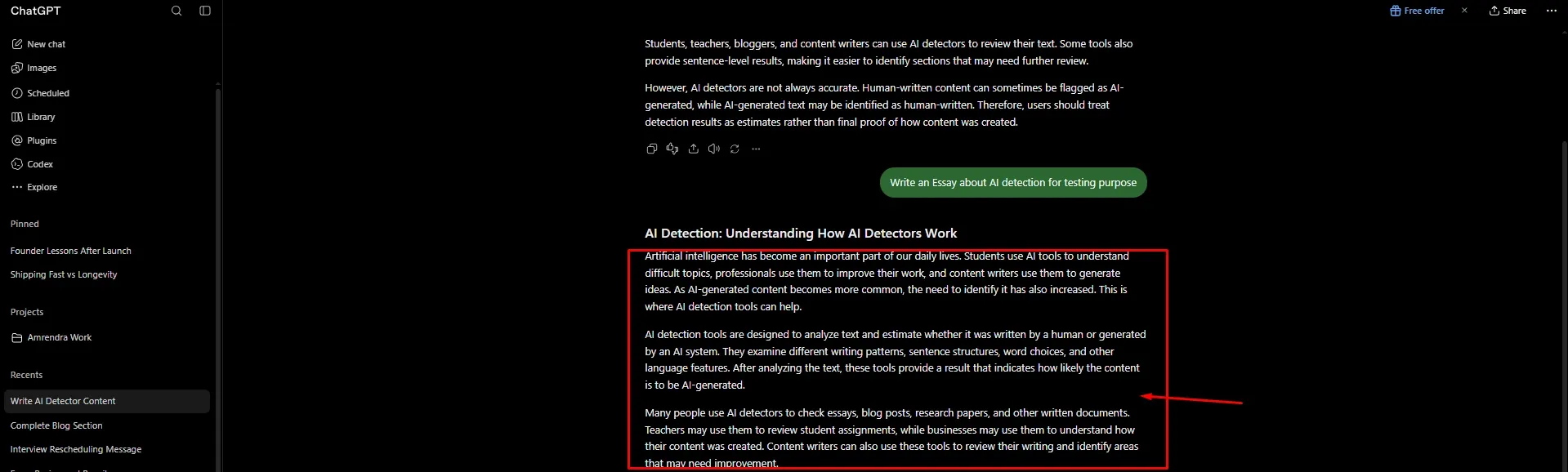
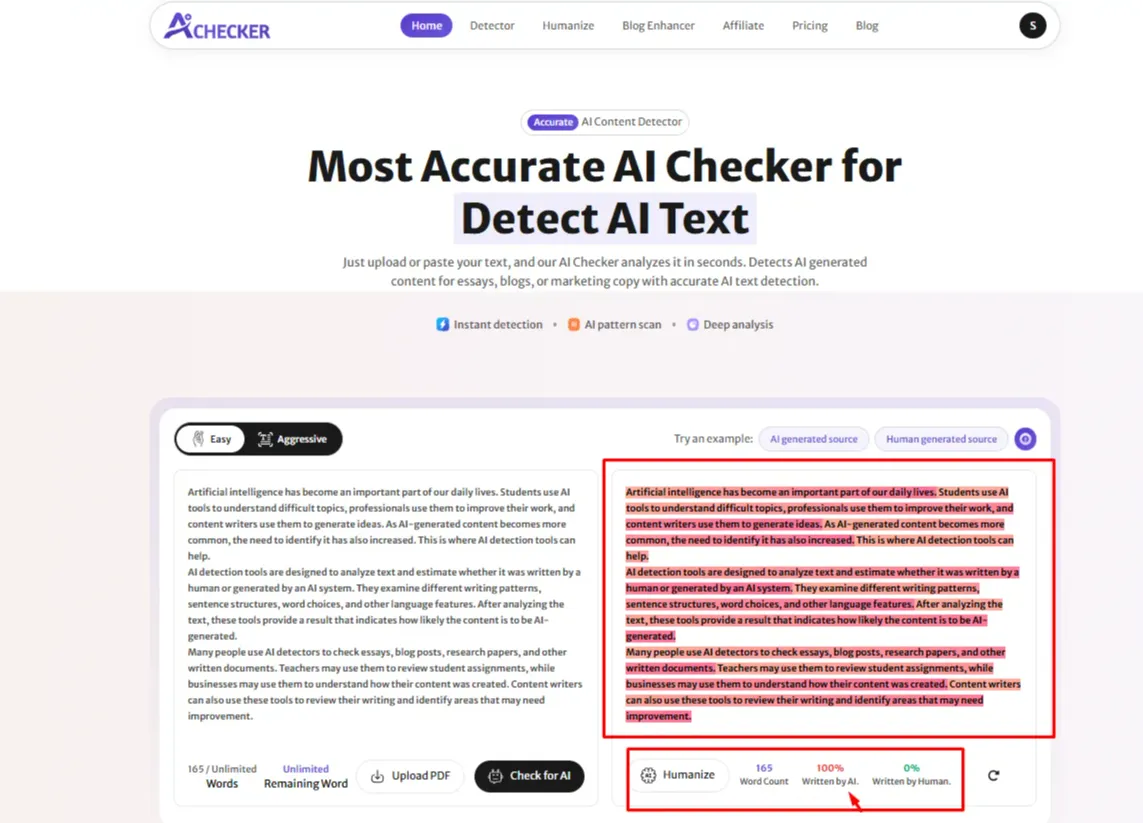
1. Generate AI-Generated Content
I wrote a sample of text through AI to check this whether content Flagged as AI or not.
2. Test the Same Text With my AI detector
First, copy the same text and check it with my AI detector. Do not change the text between tests.
Compare the results from both tools. If one tool flags the content as AI-written while another gives a different result, note the difference. This shows why we should not depend on only one detector
3. Review AI-generated content again
I'm not using any AI humanizer because AI humanizer tools do not provide me with correct sentence structure. I want to review my testing paragraph using my own method.
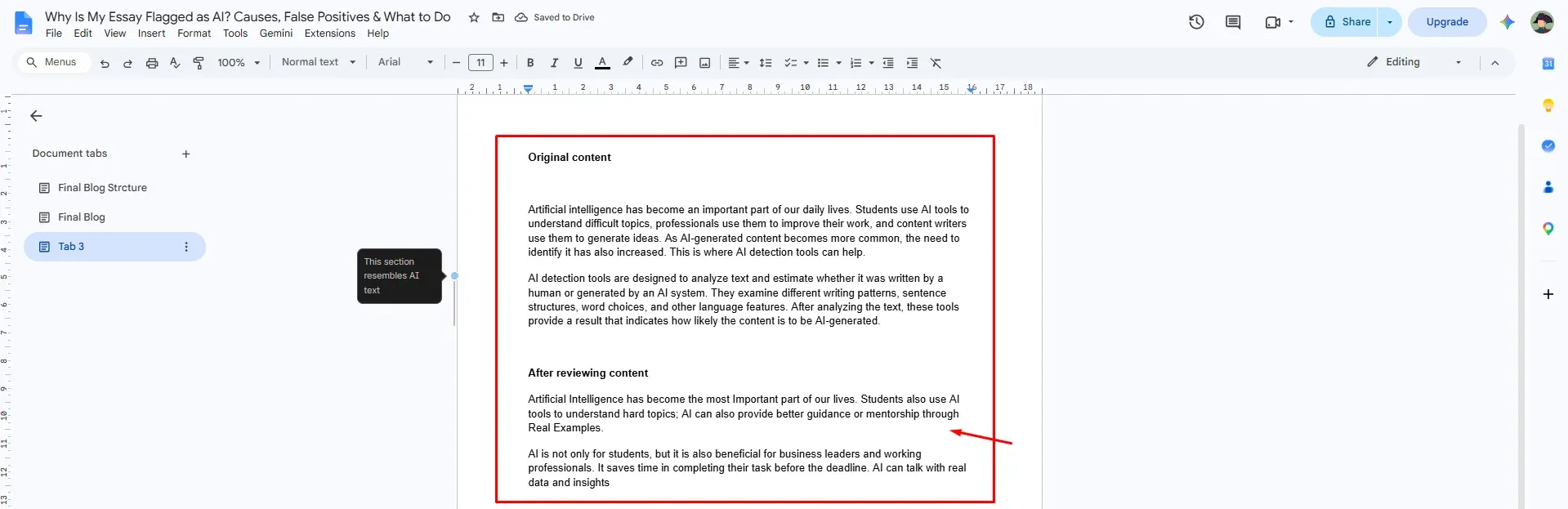
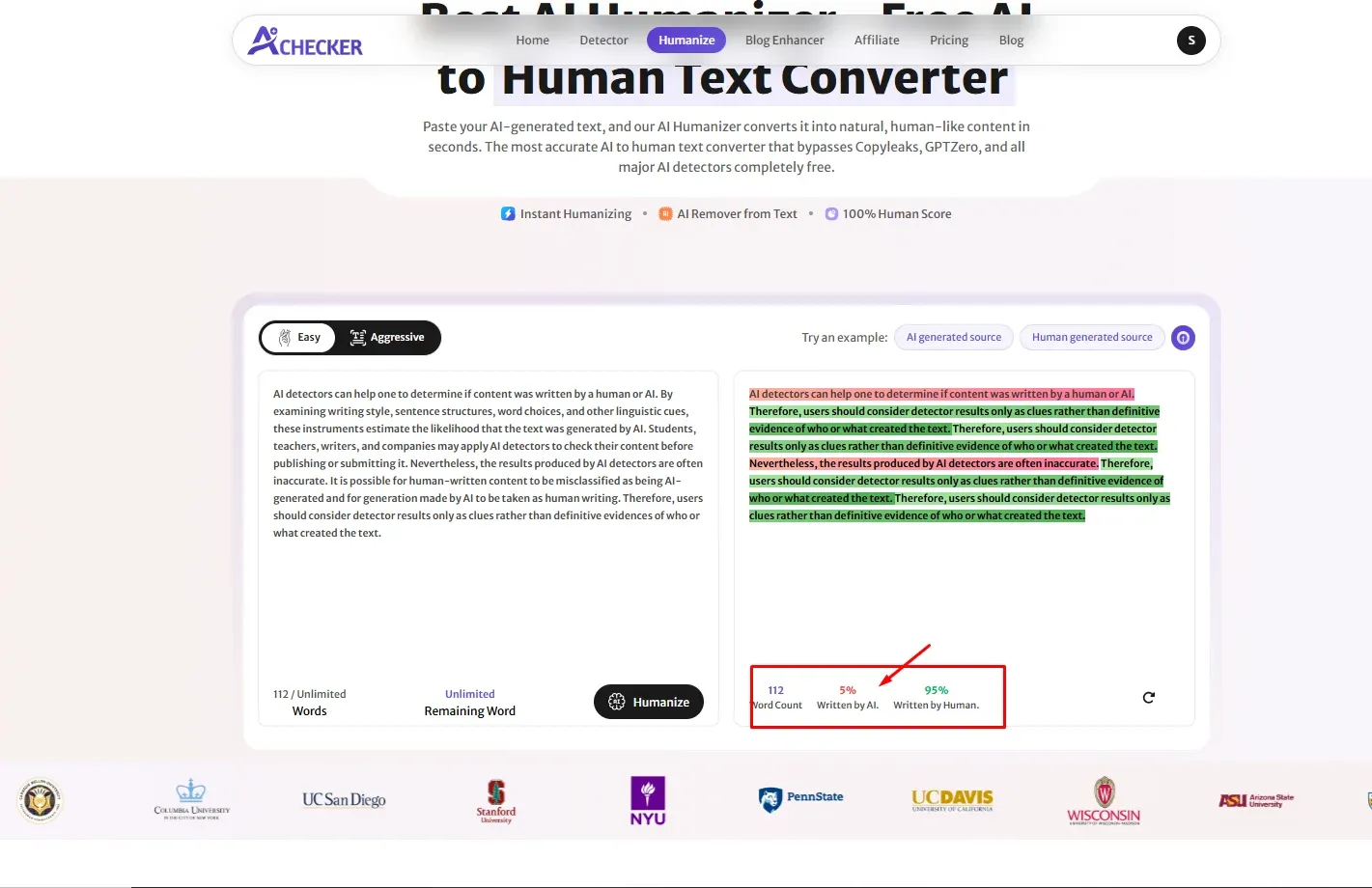
4. Test again with my AI detector, AI Checker Pro
Now I tested again my review content against AI Checker Pro again; it provided the best accuracy, which seems whenever I rewrite content it works as human-written.
I want to check by another AI detector, so I want to check through QuillBot, this tool is well known for AI deetction also generating content.
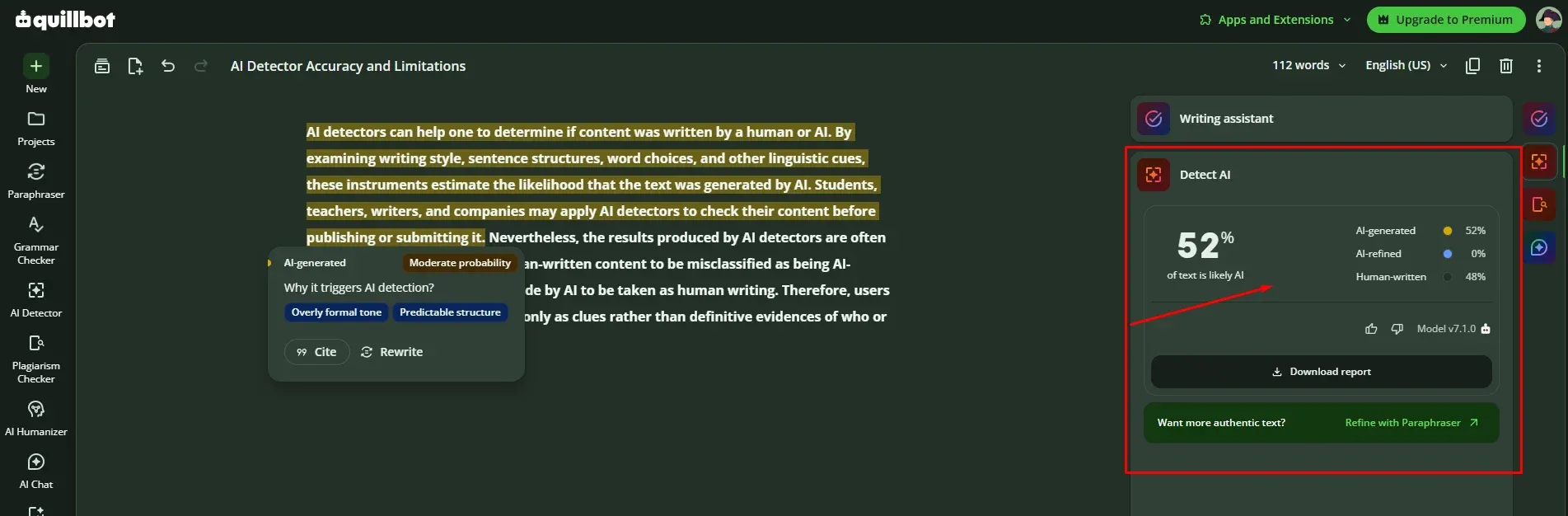
I wanted to understand whether AI detector results would remain consistent when the same text was checked with different tools. To explore this, I prepared a sample paragraph, checked it with an AI detector, and then reviewed the paragraph myself.
I also compared the results from different detectors instead of relying on a single score. I aimed to understand how the results changed after editing and whether the tools gave similar assessments.
This experiment helped me examine the limitations of AI detection tools. However, the results from a small test cannot establish which detector is the most accurate in every situation.
4. Final Decision
As above, I also discussed a real experiment, whenever I use AI text, my AI checker tools provide some % of AI text vs. humanized text.
After I rewrite and review the text, the AI checker pro provides real data insights that also look genuine.
What to Do If Your Essay Is Wrongly Flagged as AI
While testing AI detectors, I noticed that a high AI score does not always mean the essay was written by AI. The results can vary depending on the tool, writing style, and sentence structure. Here are a few things I would suggest based on my observations.
1. Don't Trust a Single AI Detector
If your essay is marked as having been created by an AI, make sure that it is so by more than one tool. I have found that many essays may get flagged by one, but not the other; therefore, there is a big difference in what the two have to say.
2. Check the Sentences Highlighted by the Tool
If a detector highlights certain sentences, read them carefully. Look for repeated phrases, unnatural wording, or sentences that don't sound like you. However, don't rewrite every highlighted sentence just to lower the AI score. A detector can also flag normal human writing.
3. Keep Your Original Drafts and Notes
One thing I would recommend is keeping your original essay, research notes, and revision history. These can help you explain how you developed your ideas if a teacher questions your work. In my view, showing your writing process is more useful than relying only on an AI detection report.
4. Focus on Your Writing, Not Just the Score
During my testing, I learned that chasing a 0% AI score is not a reliable way to improve an essay. Instead, focus on explaining your ideas clearly, adding your own analysis, and supporting your points with relevant examples. Your goal should be to make your essay accurate and genuinely reflect your work, not simply to satisfy a detector.
How to Make Your Essay More Original and Authentic
While testing AI detectors, I realized that making an essay authentic is not just about changing a few words or using different sentence structures. It is about how you explain your ideas and connect them with your own understanding. Here are a few things I would personally recommend.
1. Write From Your Own Understanding
When I write about a topic, I first try to understand it instead of copying the first explanation I find online. I use my own words to explain what I have learned. This helps me create content that reflects my understanding rather than simply repeating existing information.
2. Add Your Own Examples and Observations
I have found that examples make an essay more meaningful. Instead of making general statements, explain your point with a relevant example, a real observation, or a result from your own research. These details also help readers understand why your point matters.
3. Avoid Making Every Sentence Sound Perfect
One mistake writers can make is trying to make every sentence sound formal or complicated. Clear and simple language often communicates ideas better. I prefer writing short sentences when possible and using words that feel natural to me. However, the main goal should be clarity, not deliberately adding mistakes to appear human.
4. Review the Essay Before Submitting It
After finishing an essay, I read it again to check whether the ideas flow naturally and whether each point makes sense. I remove unnecessary repetition, check facts, and make sure the conclusion matches the main discussion. I also verify that any information taken from other sources is properly cited. For a more structured routine, you can check your essay before submission.
Conclusion
If your essay is flagged as AI, don't panic or assume your writing is wrong. From my experience testing AI detectors and reviewing my own writing process, I learned that detection scores can vary between tools and should not be treated as final proof of authorship.
Instead of relying on AI humanizers or chasing a 0% AI score, focus on writing clear, original, and useful content. Review your work, add your own insights, verify facts, and keep your drafts as evidence of your writing process. Remember, the real goal is to create content that reflects your understanding and provides genuine value to readers.
FAQs
Why is my essay flagged as AI when I wrote it myself?
Can human written essays be flagged as AI?
What should I do if my essay is flagged as AI?
How do I prove I wrote my essay without AI?
Why does Turnitin say my essay is AI?
Are AI detectors accurate for student essays?
Can I appeal an AI detector result?
What causes false positives in AI detection?
Does ChatGPT detection give false positives?
Why does my writing sound like AI?

Harshil Barvaliya
SEO Executive & Content Writer at AI Checker Pro
I’m Harshil Barvaliya, an SEO Executive and Content Writer at AI Checker Pro. I focus on improving the website’s search engine visibility through effective SEO strategies, including keyword research, on-page and off-page optimization, and content development.Get Started Free
Create a free account for advanced AI detection and scan history.
Trusted by thousands worldwide.
Recent Blog's
Discover how AI-powered content creation can elevate your website's reach and engage your audience like never before. Explore the real impact of AI on crafting content that connects.