Most Accurate AI Detector in 2026? A Transparent Test and Comparison
TABLE OF CONTENTS
Quick Summary
Key Highlights
What Is the Most Accurate AI Detector Right Now?
How I Ran This AI Detector Accuracy Test
AI Detector Comparison: How the Main Tools Stack Up
Tool by Tool Breakdown: What I Noticed
Where AI Checker Pro Fits In
AI Detector False Positives: The Part Nobody Likes
AI Detector False Negatives: When Tools Miss AI
ChatGPT Detector Accuracy in 2026
Free vs Paid AI Detectors: Is It Worth Paying?
Which AI Detector Is Best for Students, and What About Teachers and Bloggers?
Are AI Detectors Reliable in 2026?
Conclusion
FAQs
Get an AI summary of this post on:

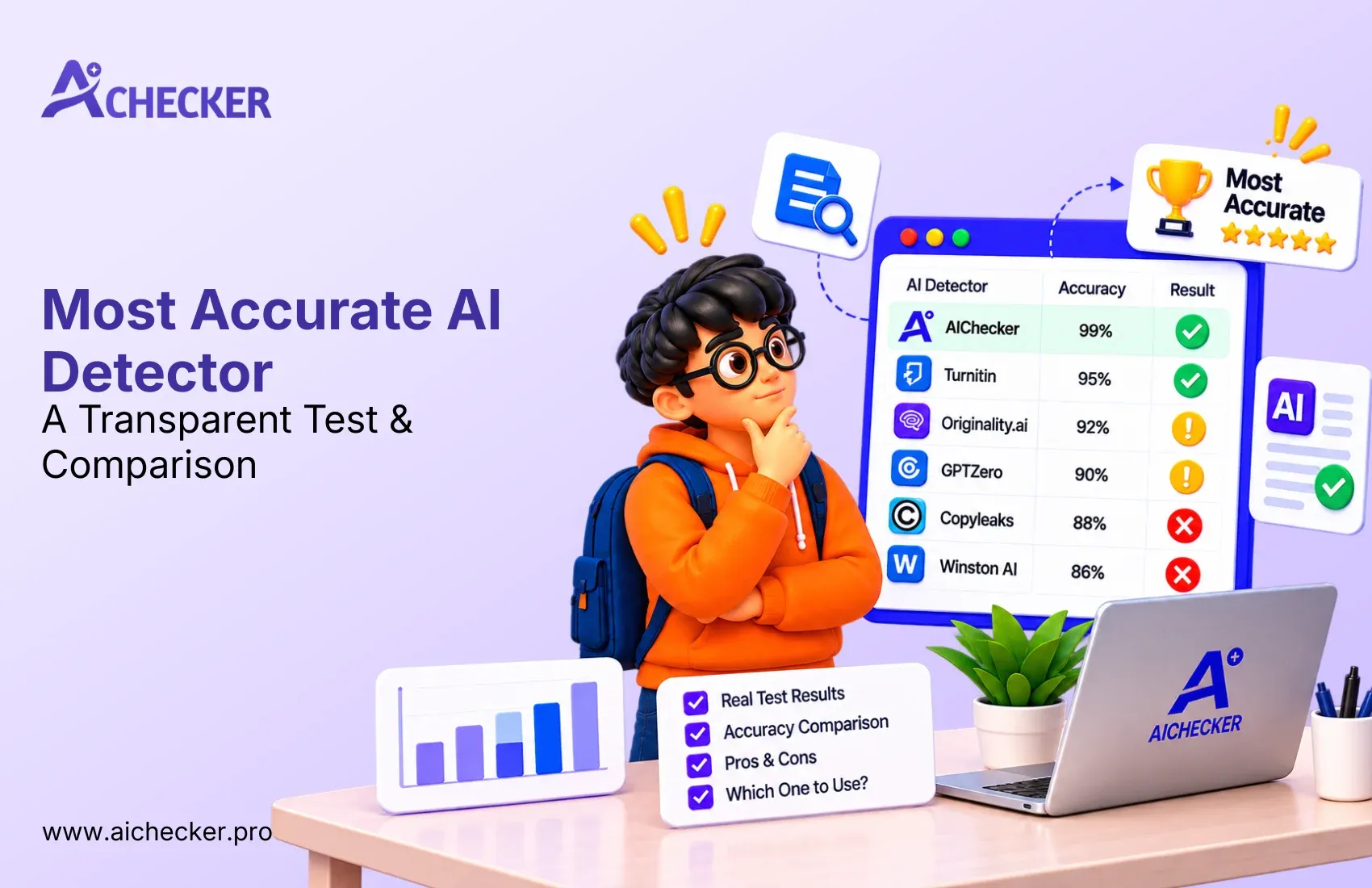
The most precise AI detector is the one that can reliably identify unedited AI text and never flags human writing. In 2026, there are no such tools. Tools like Originality.ai, GPTZero, Copyleaks, AI Checker Pro, and others can detect raw ChatGPT output with good accuracy, but any of them has issues with paraphrased and humanized text.
The reality is that I have tested dozens of AI detectors, and the majority of them are not as good as they claim. If you are a student, teacher, blogger, or entrepreneur looking for the most accurate AI detector, this article will help you sort out the best options by conducting an honest experiment, comparing the results, and discussing the outcomes.
Quick Summary
No one tool is the best AI detector for every test in 2026. The best-performing tools are good at detecting raw text written by an AI, but they are often not accurate when text is paraphrased, humanized, or mixed with human writing. Human writing, particularly non-native English, can be falsely flagged as AI writing. Additionally, make sure to look at sentence-level results, test the tool on your own text, and remember that these are only suggestions.
Key Highlights
- No AI detector is 100% accurate, and that includes every tool in this comparison.
- Raw ChatGPT, Gemini, and Claude text is caught far more often than edited or paraphrased text
- False positives hit formal writing and non native English writers the most
- Short samples are the least reliable for every detector
- Picking the most accurate AI detector means testing it on your own samples
- Sentence-level detection gives you more context than one overall score
- Free tools work for quick checks, while paid tools suit bulk and team use
- Keep drafts and version history to protect yourself from a false flag
What Is the Most Accurate AI Detector Right Now?
Let me explain this in a simple manner. Sometimes you hear questions such as "which is the most accurate AI detector?" as if it's a competition where one side always wins.
There are two sides to accuracy. The first is about catching AI text, and the other is about avoiding false accusations of being AI.
A tool that accuses everyone of being AI will certainly catch every ChatGPT essay out there, but it will also accuse honest writers of being fake.
Meanwhile, a tool that accuses nobody will never falsely accuse someone, but it won't catch any AI content either.
So when you read an article about the most accurate AI detector 2026 or the most accurate AI detector 2026, always, always ask yourself one question: accurate at what? Because AI detector accuracy is rarely a zero-sum game, and the best tools simply do the best job of balancing the two.
And finally, which AI detector is the most accurate in 2026 depends on who you are asking. The most accurate AI detector for a university professor may not be the most accurate AI detector for a blogger, as their texts tend to look quite different.
What Actually Works in 2026
Here's what will work in 2026. You want something that provides sentence-level results, explains the score, and admits to being able to be wrong. Steer clear of anyone who claims to be 100% accurate. That's a big red flag.
How I Ran This AI Detector Accuracy Test
Before naming the most accurate AI detector, I needed proof. When I ran this test last month, I wanted something repeatable, not a one-off screenshot. If you want to run your own AI detector accuracy test, here is the setup I used, and you can copy it.
The Sample Groups
I built a small batch of samples in five groups:
- Fully human essays and blog posts written by real people, including a few from non native English speakers
- Raw output from ChatGPT, Gemini, and Claude with no edits
- AI text that I edited by hand for tone and structure
- AI text run through a paraphrasing tool
- Mixed documents, with human intros and AI body paragraphs
Then I ran every sample through each tool, noted the overall score, and checked whether the sentence-level highlights made sense. I did not trust the headline score alone, because a single percentage hides a lot.
Limits of This Test
I have to be clear about the limitations. This was a pragmatic experiment, not a peer-reviewed study, and results change as the tools update their models. Treat my notes as hands-on observations; run your own samples before relying on one over another. That is how you test the accuracy of an AI detector: with your own writing, your own AI-generated text, and then comparing the results. Without testing, any claims about the most accurate AI detector tool are just marketing.
AI Detector Comparison: How the Main Tools Stack Up
To find out which tool detects artificial intelligence most accurately, you need to test them on the same samples. Below is an example of such a comparison based on publicly available information and my own experiments. I have left the third column describing the accuracy of detection as it is, since these numbers are subject to change with each update, and I do not want to provide false information.
| Tool | Accuracy on Raw AI Text | Free Tier | Humanizer Included | Best For |
|---|---|---|---|---|
| AI Checker Pro | Strong, with sentence-level detection | Yes | Yes | Students, bloggers, agencies |
| Turnitin | Strong, but institution-controlled | No for individuals | No | Schools and universities |
| GPTZero | Strong, with limits on edited text | Limited free plan | No | Teachers and students |
| Originality.ai | Strong, tuned for publishers | No, credit-based | No | SEO teams and content agencies |
| Copyleaks | Strong, supports many languages | Limited free use | No | Businesses and multilingual teams |
The comparison of AI detection tools reveals critical insights. On raw, unedited text, the leading tools are fairly similar. The most significant differences can be found in edited text, texts with fewer words, and non-native English language. These are the areas in which you should concentrate your testing if you are a paying customer of an AI detection service. If the vendor's marketing team promises you the moon and the stars, ask them precisely which of the previously mentioned samples they have tested.
Tool by Tool Breakdown: What I Noticed
GPTZero Accuracy
GPTZero accuracy is generally solid on raw ChatGPT writing, and it became popular with teachers because the interface is easy to read. It highlights suspicious sentences, which helps you judge the result yourself instead of trusting one number.
Where it struggles is the same place most tools struggle. Lightly edited AI text and very formal human writing can both land in the gray zone. Is it the most accurate AI detector for teachers? On raw text, it is a strong contender, but not on every sample. If you use it, treat the score as a conversation starter, not a verdict.
Turnitin AI Detector Accuracy: The Student Worry
For many US college students, the accuracy of Turnitin AI is the one that matters, because it is integrated into the submission system. Turnitin has publicly stated that their tool is designed to support a teacher's judgment, not replace it, and that it can produce errors.
Whether Turnitin is the most accurate AI detector, it is the one that many schools use, which means how it behaves affects you. That's worth repeating.
Several major universities have reduced the weight given to a single score in detection, because a number alone is not proof of misconduct.
If you are a student, keep your drafts, notes, and version history in case you are falsely accused. If you are a professor, talk to the student before deciding anything.
Originality AI Accuracy and Copyleaks AI Detector Accuracy
Originality AI accuracy tends to get good marks from publishers and SEO teams, since the tool is built around content workflows. Many SEO teams call it the most accurate AI detector for publishing work, though that is an opinion and depends on your content. It can be strict, which helps catch AI content but can also raise more flags on polished human writing.
Copyleaks AI detector accuracy is respected for broad language support and business use. Like the others, it performs best on longer samples and loses confidence on short snippets and mixed documents. For a closer look, see this Copyleaks accuracy breakdown.
My honest takeaway after testing these side by side: none of them is a clear winner on every sample type. The "winner" depends on your use case, and that is why a single ranking can mislead you.
Where AI Checker Pro Fits In
I have personally seen bloggers clean their content using AI Checker Pro, and that workflow is a big reason I include it here. The tool works as an AI writing detector with sentence-level detection, so you can see exactly which lines look machine-written instead of guessing from one score.
If you want the best AI checker for daily use, look for clear highlights and honest limits. I would not call any single tool the most accurate AI detector for every case, but AI Checker Pro handles a lot of everyday needs. It works with text from ChatGPT, GPT -4, GPT -55, Gemini, and Claude; it is easy to use, and it has an AI humanizer included. Used by 100K+ users, it is a practical option if you want to check and fix in one place.
Instead of rewriting manually, many users now rely on AI Checker Pro to find the weak spots and then smooth them out. If you want to see what that cleanup looks like, check the AI Humanizer page.
Get Lifetime Access with 60% OFF
Stop paying monthly subscriptions. Enjoy unlimited AI detection and humanizer access forever with future updates included.
- One-time payment
- Unlimited access forever
- All future updates included
AI Detector False Positives: The Part Nobody Likes
This is the section I wish more people read before. AI detector false positives are cases when a human-written text gets flagged as AI-generated. They are not an exception, unfortunately.
Essays, formal texts, and non-native writings are some examples of these scenarios. Texts that have simple syntax and grammar might be seen as robotic by the system, even if they were all written by humans.
A writing tool can also appear to be the best AI detector on the market but penalize honest writers just for being different from fabricated ones. A sophomore student attending a State University is writing an essay for her Writing Proficiency Exam. The exam is in English, which is her second language. The text she produces gets flagged, but she is innocent and did nothing wrong. This is why one mark should not determine someone's grade.
How to Lower Your Risk
Here is how you can lower your risk of a false flag:
- Add specific personal examples, class details, or real experiences
- Vary your sentence length instead of writing in one steady rhythm
- Keep drafts and version history as proof of your process
- Run your own text through a checker before you submit it
AI Detector False Negatives: When Tools Miss AI
The opposite problem is equally pertinent. False negatives on the AI Detector happen when AI-written text goes unnoticed as such.
This often happens with edited and paraphrased texts. My tests showed that raw texts generated by ChatGPT, Gemini, or Claude had a much better chance of being flagged as AI-written than their paraphrased or manually-edited counterparts.
Detecting paraphrased or humanized AI content was significantly more difficult than raw texts, and all detectors I tested had that issue.
A flawless result on an AI detector does not always mean a flawless text. Even if you are a teacher who only wants to punish students for using AI content, or a blogger who wants to ensure their articles are not flagged by any AI detector, human-level quality might still be an issue.
ChatGPT Detector Accuracy in 2026
ChatGPT detector accuracy is the easiest thing to test, because ChatGPT text has recognizable patterns. Even so, newer models write more naturally, and each update makes the job harder for any AI text detector. Even the most accurate AI detector struggles when the text has been edited.
The same is true for Gemini and Claude, and a good AI text detector will show uncertainty instead of faking confidence. When I mixed outputs from different models, the tools still did best on long, unedited samples. Short answers of a few sentences were the least reliable for every detector I tried.
So if someone asks you which tool has perfect ChatGPT detector accuracy, the honest answer is that no tool has it.
Free vs Paid AI Detectors: Is It Worth Paying?
The free vs paid AI detectors controversy has been going on for ages. And there are reasons to believe that it will continue for as long as people seek to use these tools. The truth is, the accuracy of both free and paid detectors largely depends on the approach and the amount of effort put into the detection process.
In this regard, one should note that free AI detectors are great for a quick inspection of a small piece of text. They may, however, have a limited number of words or characters analyzed, provide less detail on the results, and utilize an outdated detection algorithm. Meanwhile, the paid options offer more comprehensive analysis, better report generation, and higher volumes of text inspected at once, making them suitable for businesses and educators who need to screen thousands of papers.
Which AI Detector Is Best for Students, and What About Teachers and Bloggers?
Let me break it down by who you are. Choosing the most accurate AI detector for your situation takes about five minutes of testing.
Students: Pick the most accurate AI detector you can access, ideally one with sentence-level feedback, so you can see what looks flagged and fix it. Also use a checker before you submit, since your school may run its own.
Teachers: Use detectors as one signal, not the only one. Compare writing to earlier work and have a conversation first.
Bloggers and SEO experts: Google cares about helpful content more than where it came from, but low-effort, generic text can still hurt your rankings. Check, edit, and add real expertise.
Agencies and businesses: Look for bulk checking and clear reports so your team can review work fast.
Are AI Detectors Reliable in 2026?
How accurate are these artificial intelligence detectors on average? Partially. The reliability of such tools depends on the length of the texts submitted for analysis and their authenticity. Put otherwise, the accuracy of AI detectors in identifying computer-made texts is decent for lengthy raw texts, but they are generally unreliable elsewhere.
Like any other security measure, an AI detector tool can be likened to a domestic smoke alarm. It may not be absolutely reliable, but it is better to have it than not. If the device rings every time you are roasting bread and nothing when there is an actual fire, it might still save your house. Nevertheless, the final verdict must always be given by humans, not AI.
Therefore, if one were to ask which AI plagiarism detector has the lowest false positive rate, the answer would always be "it depends." The accuracy rate may differ depending on the text submitted for analysis. As such, it is essential to compare a few tools' results on the same text rather than rely on one source. Remember that even the best AI detectors can only provide evidence, not conclusions.
Conclusion
So, what's the best AI detector in 2026? Unfortunately, there's no universal solution, as most of the discussed tools perform similarly in terms of accuracy. All products have a significant ability to detect AI text and less ability to identify rewritten content, and each has its own false-positive rate. The most reliable detector is the one you have tested yourself, meaning you should always consider your samples and avoid relying on one score.
If you are looking for something simple, run your drafts through AI Checker Pro and see what issues it would flag. What would you test first?
FAQs
What is the most accurate AI detector?
Which AI detector is most accurate in 2026?
How accurate are AI detectors?
Which AI detector has the lowest false positive rate?
What is the best AI detector for ChatGPT?
Are AI detectors reliable in 2026?
Which AI detector is best for students?
Can AI detectors accurately detect AI written text?
Which AI detector is better, GPTZero or Turnitin?
How to test AI detector accuracy?

Harshil Barvaliya
SEO Executive & Content Writer at AI Checker Pro
I’m Harshil Barvaliya, an SEO Executive and Content Writer at AI Checker Pro. I focus on improving the website’s search engine visibility through effective SEO strategies, including keyword research, on-page and off-page optimization, and content development.Get Started Free
Create a free account for advanced AI detection and scan history.
Trusted by thousands worldwide.
Recent Blog's
Discover how AI-powered content creation can elevate your website's reach and engage your audience like never before. Explore the real impact of AI on crafting content that connects.