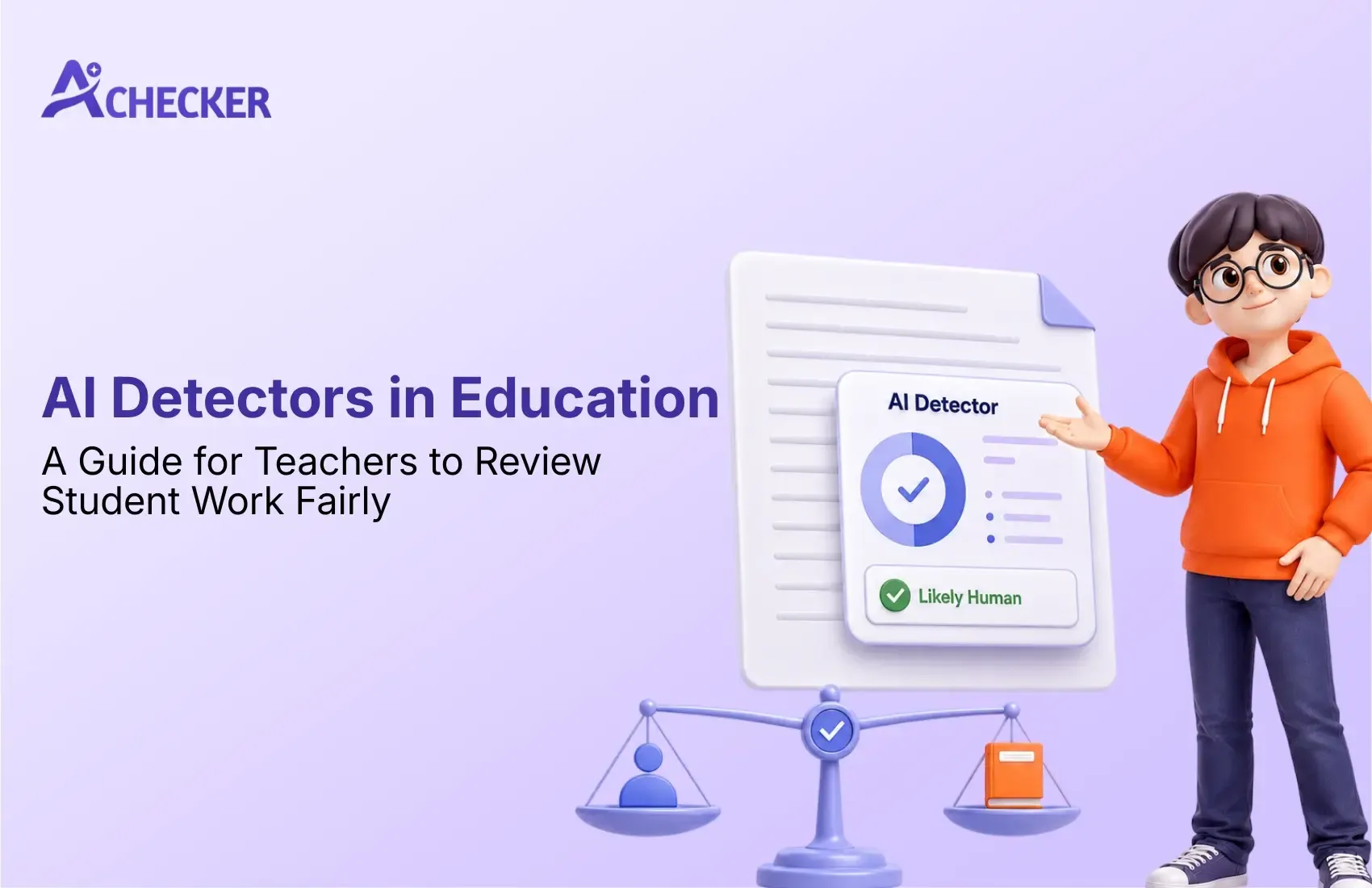
AI Detectors in Education: A Guide for Teachers to Review Student Work Fairly
TABLE OF CONTENTS
What Is an AI Detector, Exactly?
Why Teachers Are Turning to AI Detectors
How Accurate Is an AI Detector, Really?
How to Use an AI Detector Fairly in Your Classroom
AI Detector vs. Plagiarism Checker: What's the Difference?
Choosing the Right AI Detector for Education
What Detectors Can't Tell You
A Simple Decision Framework for Teachers
Conclusion
FAQs
Get an AI summary of this post on:




If you are a teacher, there is a good chance you have asked yourself this question at least once this semester: "Did a student actually write this, or did ChatGPT?"
You are not alone. An AI detector is now as common in the classroom as a plagiarism checker, but it is often just as misunderstood.
This guide will explain what an AI text detector is, how accurate it is, and how to use one responsibly to avoid falsely accusing students.
What Is an AI Detector, Exactly?
An AI content detector is a program that examines a text and estimates the likelihood that it was generated by a large language model such as ChatGPT, Claude, or Gemini.
In reality, it does not know for sure; it simply makes an educated guess.
Here's the core idea:
- AI-generated text tends to be more predictable at the word level (low "perplexity")
- AI-generated text tends to have uniform sentence structure (low "burstiness")
- Human writing is messier, more varied, and less statistically smooth
An AI checker looks for such patterns and gives you a result, most often, a percentage, that indicates how likely it is that your text was written by an AI. If you want to see how this actually plays out for teachers day to day, this breakdown of how AI checker tools detect AI generated content is a good place to start.
This is why the word "probability" is important here, by the way; remember that it doesn't always mean what you think it means.
Why Teachers Are Turning to AI Detectors
Since ChatGPT launched, take-home essays have become a lot harder to trust at face value. Teachers are dealing with:
- A surge in essays that read suspiciously polished for the student's usual voice
- Students openly admitting to using AI for "help" that goes well beyond brainstorming
- Academic integrity policies that haven't caught up with the technology
An AI essay checker gives teachers a starting point, a signal to investigate further, not a verdict to hand down immediately. For a deeper look at where these signals actually help, check out this teachers' guide to AI detection and spotting AI-written essays.
How Accurate Is an AI Detector, Really?
This is the part every teacher should understand before relying on one to make a grading decision.
No AI detector is 100% accurate. Independent testing and vendor disclosures demonstrate that AI detectors can, at times, falsely flag content as AI-generated when it was not, and vice versa.
- Flag human-written text as AI-generated (false positives)
- Miss AI-generated text that's been lightly edited (false negatives)
- Show bias against certain writing styles, including text from non-native English speakers and neurodivergent students, whose sentence structures can appear more "uniform" and trigger false flags
| Detector Behavior | What It Means for Teachers |
|---|---|
| High confidence AI score | Worth a closer look, not an automatic accusation |
| Low confidence score | Likely human, but not a guarantee |
| Mixed/borderline score | Treat as inconclusive, don't act on it alone |
| Edited AI text | Can slip past detection entirely |
| Non-native English writing | Higher false-positive risk, extra caution needed |
The takeaway: use the score as one data point, never the only evidence. If you want the full picture on why scores swing the way they do, this piece on AI detector accuracy breaks it down clearly.
Get Lifetime Access with 60% OFF
Stop paying monthly subscriptions. Enjoy unlimited AI detection and humanizer access forever with future updates included.
- One-time payment
- Unlimited access forever
- All future updates included
How to Use an AI Detector Fairly in Your Classroom
Here's a practical framework for using an AI detector for teachers without turning your classroom into a courtroom.
1. Never rely on the score alone
A single number from an AI text detector should never be the sole basis of a grade penalty or accusation of dishonest writing.
Combine that with:
- The writing history of the student (and past texts)
- If applicable, the draft history in Google Docs or your LMS
- And a brief chat with the student
If you can't do all three, do at least the first two.
2. Compare against the student's own baseline
Every writer has a voice. If a student's usual essays are simple and direct, and this one suddenly reads like a polished op-ed, that contrast is more telling than any AI score.
Keep early-semester writing samples on file. They're your best comparison tool. This lines up with how professors handle similar cases, covered in this guide on how professors detect AI-written assignments.
3. Look at the writing process, not just the output
Tools like Google Docs version history, Grammarly's activity log, or your school's LMS can tell:
- How long the student was writing
- Whether they were typing, pasting, or editing in big chunks
- The overall drafting timeline
A document that was pasted in one piece is a much stronger signal than any detector could be.
4. Have a conversation before a consequence
If the score is bad but the student was honest but got it wrong anyway, first ask the student to explain their process, ask them to explain a paragraph or so in the essay, and then do that.
This step helps to fix most mistakes and helps honest students from being accused of lying. Many of the common slip-ups happen at this exact stage, which is why it helps to review these AI checker mistakes students make before jumping to conclusions.
5. Set clear AI-use policies before you need them
Ambiguity is where most disputes happen. Decide in advance:
- Is AI allowed for brainstorming but not drafting?
- Is grammar-checking software like Grammarly considered "AI assistance"?
- What's the actual consequence for a confirmed violation?
Communicate this clearly in your syllabus, not after a student is already flagged. If you need a starting template, this AI content verification policy guide walks through what to include.
AI Detector vs. Plagiarism Checker: What's the Difference?
Teachers often lump these together, but they solve different problems.
| Feature | Plagiarism Checker | AI Detector |
|---|---|---|
| What it detects | Copied text from existing sources | Text likely generated by an AI model |
| How it works | Matches text against a database | Analyzes statistical writing patterns |
| Certainty level | High, direct matches are objective | Lower, based on probability |
| Common false positives | Rare, mostly quotes/citations | More common, especially with formal or simple writing |
| Best used for | Confirming copied content | Flagging content worth a closer look |
A strong integrity process uses both, but treats their results very differently in terms of confidence. For schools comparing options side by side, this rundown of the best Turnitin alternatives for AI detection and plagiarism checking is worth a look.
Choosing the Right AI Detector for Education
Not all detection tools are built the same. When evaluating an AI detector for essays or classroom use, look for:
- Transparency about accuracy: vendors that hide their false-positive rates are a red flag
- Sentence-level highlighting: shows exactly which parts triggered the flag, not just one score
- Regular updates: detectors go stale fast as AI models improve
- Support for multiple AI models: a tool built only to catch ChatGPT will miss Claude or Gemini-generated text
- LMS integration: saves time if it plugs into tools you already use, like Canvas or Google Classroom
AICheckerpro works on these principles: a sentence-by-sentence analysis with transparent results instead of an aggregated numerical grade, allowing the educator to make a well-informed choice instead of relying on black-box solutions. You can see how this compares to other tools in this best AI checker tools for college students comparison.
If you're weighing multiple options, Getsolved AI detector is another one worth checking it pairs sentence-level AI detection with built-in fact-checking and tone-refinement tools, so teachers can review flagged sections and understand why something reads as AI-generated, not just get a single score.
Therefore, if you want a simple option for running your students' essays through a high-quality ChatGPT detector with no doubts about the obtained results, you should consider this tool as part of your essay review process.
What Detectors Can't Tell You
It's worth being honest about the limits here, because overselling detection accuracy is how false accusations happen.
An AI detector cannot definitively prove:
- That a specific student used AI
- Which AI tool was used
- Whether AI assistance was minor (grammar help) or substantial (full generation)
It can only tell you: this text has patterns statistically associated with AI generation. Everything after that requires human judgment. These blind spots are exactly why it helps to understand the known AI detection problems before making any decision based on a score alone.
A Simple Decision Framework for Teachers
When a submission gets flagged, walk through this before taking any action:
- Check the score and highlighted sections: is it borderline or high-confidence?
- Compare it to the student's writing history; does the voice match?
- Review draft/version history if available
- Talk to the student, give them a chance to explain
- Apply your syllabus policy consistently, same standard for every student, every time
Following this sequence protects both your integrity process and your students' trust in it. This full walkthrough of detecting AI-generated essays for teachers and students covers each of these steps in more detail.
Conclusion
An AI detector, while powerful, is a tool, not a judge. Used right, this could help teachers establish an impartial discussion with their students. Used wrong, it may cause irreparable damage to teacher-student relationships by falsely accusing students of misconduct.
The right solution lies somewhere in the middle. Balancing the capabilities of an accurate AI content detector, paired with your own intuition and a healthy discussion with the student before any punishment is issued.
Looking for a plagiarism and AI content detection tool designed from an educator's perspective? AI Checker pro offers sentence-level detection and intuitive reports, allowing you to review the work with your students rather than overhauling their entire learning path with no accountability on your end.
FAQs
1. What is an AI detector and how does it work?
2. How accurate is an AI text detector?
3. Can an AI detector be wrong about human writing?
4. What is the best AI detector for teachers?
5. Can ChatGPT detectors catch edited AI text?
6. What is the difference between an AI detector and a plagiarism checker?
7. Are AI detectors biased against non-native English speakers?
8. How can teachers use an AI essay checker fairly?
9. Can an AI content detector prove a student used AI?
10. What should teachers do before punishing a student for a flagged AI score?

Harshil Barvaliya
SEO Executive & Content Writer at AI Checker Pro
I’m Harshil Barvaliya, an SEO Executive and Content Writer at AI Checker Pro. I focus on improving the website’s search engine visibility through effective SEO strategies, including keyword research, on-page and off-page optimization, and content development.Get Started Free
Create a free account for advanced AI detection and scan history.
Trusted by thousands worldwide.
Recent Blog's
Discover how AI-powered content creation can elevate your website's reach and engage your audience like never before. Explore the real impact of AI on crafting content that connects.