How Professors Are Fighting Back Against AI-Written Assignments in 2026
TABLE OF CONTENTS
Why AI-Written Assignments Became a Crisis in 2026
How Professors Detect AI in Student Work
A Multi-Layered Approach to AI Detection
AI Assignment Detection vs. Plagiarism Detection: What's the Difference?
College AI Policies in 2026: What's Changed
The Limitations of AI Essay Checkers
What Smart Institutions Are Doing Differently
Conclusion
FAQs
Get an AI summary of this post on:




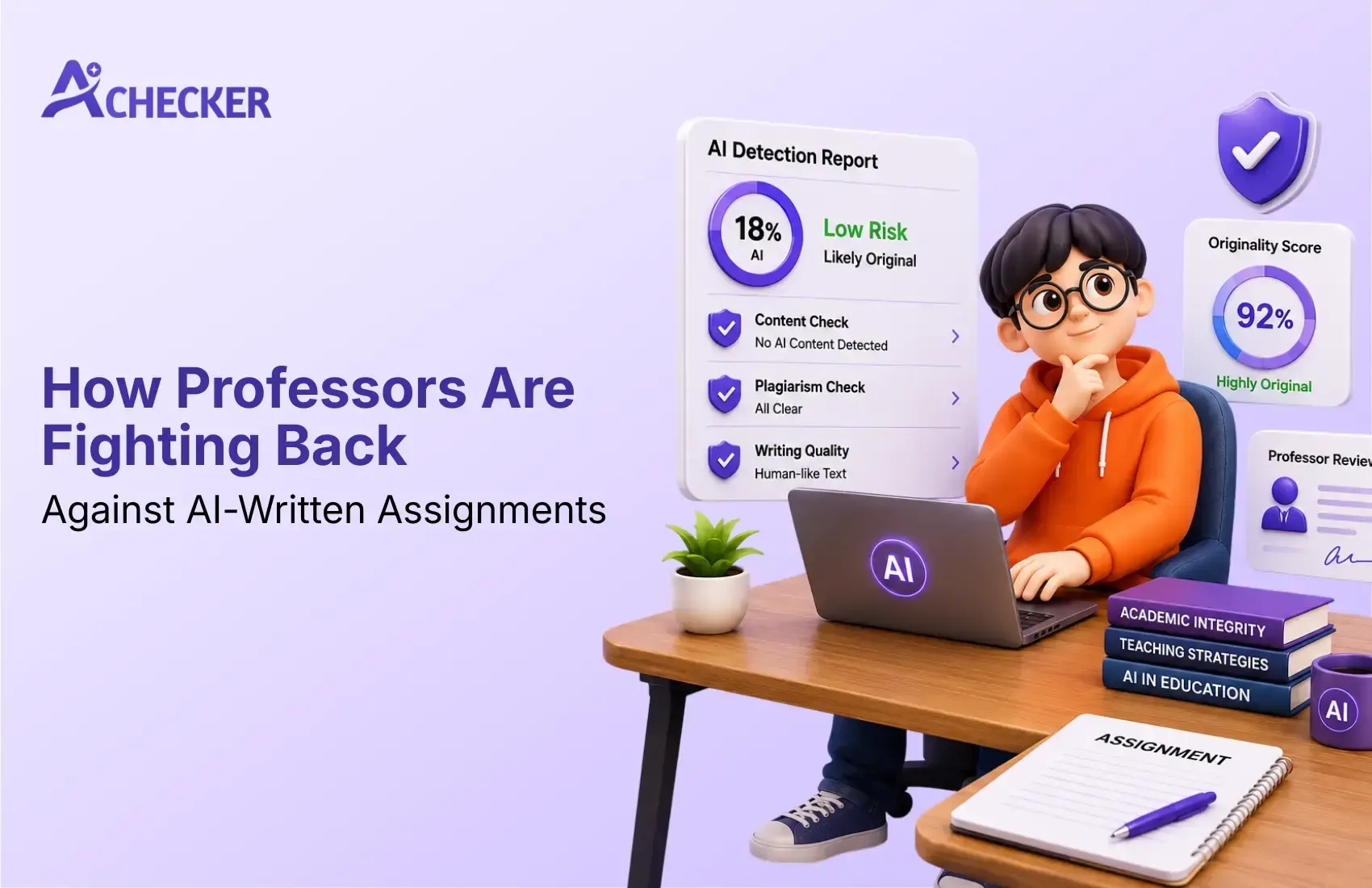
AI-generated schoolwork has officially entered the realm of existential crisis in higher education. As of 2026, professors are now developing tools, policies, and procedures to detect and deter the use of AI writing assistants.
If you're an instructor, dean, or education policy-maker, you've likely wondered just how professors can tell if a student is using an AI detector or not.
This article serves as a guide to methods, tools, policies, and procedures instructors can leverage in the detection of AI-driven homework, essays, and other schoolwork assignments.
Why AI-Written Assignments Became a Crisis in 2026
Generative AI Tools became significantly better at replicating the style, tone, and logic of a human writer. Consequently, distinguishing AI-assisted assignments from those written by students became much more difficult than before.
Moreover, students can use various AI detectors to make their assignments undetectable or use paraphrasing tools and 'humanizer' AI to alter plagiarized text.
The result: a widening gap between what professors suspect and what they can prove.
Quick stats worth knowing:
Faculty surveys consistently show a majority of instructors believe AI misuse in assignments has increased year over year.
Most universities have updated their academic integrity policies at least once since 2023 to explicitly address AI.
Detection tool usage on campuses has grown, but so has the sophistication of AI evasion techniques.
The takeaway? This isn't a passing trend. It's a permanent shift in how academic integrity works.
How Professors Detect AI in Student Work
As AI writing becomes more sophisticated, instructors are finding new ways to differentiate between student-generated text and computer-created text.
Many people think that instructors are using common sense when determining whether a paper is computer-generated or not, but in reality, there are several different methods that educators have developed that they use in combination with one another, as well as common sense, to identify computer-generated text.
Here are the five most common methods professors use in 2026.
1. AI Detection Tools
Usually, AI detection software is the first step in the evaluation process. These programs analyze sentence structure, word choice and predictability, language, and other factors to identify if the text was likely created by an AI.
Although there is no one hundred percent accurate AI detector, it's an easy first step for professors who can combine this technology with another type of research.
2. Writing Style Baselines
Many instructors like to gather an in-class writing sample from their students during the beginning of the semester. This is to establish what each individual's natural writing style is like.
If a student's later work has a drastically different vocabulary, tone, sentence structure, and/or overall quality from this initial paper, professors may be justifiably suspicious that an AI essay checker may have flagged the discrepancy for good reason.
3. Process-Based Assessment
Instead of evaluating only the final submission, professors are increasingly assessing the entire writing process.
Students may be asked to submit:
- An outline before writing
- Multiple drafts showing revisions
- Google Docs or Microsoft Word version history
- Short reflections explaining how they developed their ideas
This approach encourages genuine learning and makes it much more difficult to submit AI-generated essays without evidence of the writing process.
4. Oral Defense and Follow-Up Questions
Another rising trend is the implementation of short oral presentations following a submission of an assignment.
Professors could ask students to explain certain arguments and information, or reasons and sources for ideas that they included in their work.
If a student has created their assignment themselves, it may be easier for them to explain the origins of the information included in it. On the contrary, students who used AI to generate their assignment may have difficulty answering questions about the specifics, which is one reason more instructors want to know can teachers detect ChatGPT text before relying on oral checks alone.
5. Metadata and Document Forensics
Some instructors also choose to analyze the document's metadata and edit history. Various papers' time stamps could present different stories about the writing process.
For instance, one could clearly see if the essay was written in stages (over several days) or if it was simply copied into the document as a whole in one sitting. While such data might not necessarily prove AI use, these details could be used as additional evidence to help identify possible cases of academic dishonesty, especially when paired with an understanding of how AI checker tools detect AI-generated content.
A Multi-Layered Approach to AI Detection
In 2026, detecting assignments written by means of artificial intelligence is not limited to a detection tool. Professors can rely on software detection, comparison of writing styles, process evaluation, discussion or presentation, and document examination to ensure an assignment was completed by the student who produced it.
The goal of all of these means of verification is not to limit student productivity to a detection tool, but to ensure that a student fully comprehends the material they are being tested to learn and to develop their writing and critical thinking skills, an approach outlined further in this AI detection tools guide for educators.
AI Assignment Detection vs. Plagiarism Detection: What's the Difference?
This is one of the most common points of confusion for both students and faculty.
| Factor | Plagiarism Detection | AI Assignment Detection |
|---|---|---|
| What it checks | Copied text from existing sources | Statistical patterns typical of AI-generated text |
| Tools used | Turnitin, Copyscape-style checkers | AI essay checkers, perplexity/burstiness analysis |
| Evidence type | Direct text match | Probabilistic likelihood, not a guarantee |
| False positives | Rare with proper source matching | More common, especially with non-native English writers |
| Best used for | Copy-paste violations | Fully or partially AI-written content |
The key distinction: plagiarism vs AI detection are related but not the same problem. A student can submit 100% original, non-plagiarized text that was still entirely written by AI. That's why comparing options like the best Turnitin alternatives for AI detection and plagiarism checking has become a common step for institutions rethinking their toolkits.
That's why relying on a single plagiarism checker is no longer enough.
College AI Policies in 2026: What's Changed
Academic integrity used to have one clear line: don't copy someone else's work. AI blew that line up.
Most institutions have now settled into one of three policy models, and many administrators start by asking do colleges really use AI detectors before drafting their approach.
1. Full Restriction
No AI assistance at all is allowed for any assignments, even with the most basic prompts. This level is typically chosen by academic courses, such as English or writing classes. Using AI assistance for any part of the assignment is considered cheating and can be penalized accordingly. This could include formal reporting and disciplinary measures.
Some schools opt for this model in conjunction with requiring students to submit writing samples in class so professors have a basis for comparison.
2. Tiered Permission
This model offers a distinction between thinking aids and writing aids: students may use them for idea generation, outlining, researching, and proofreading but not for actually generating the text of their essays.
Moreover, usage has to be disclosed, usually in footnotes or in a separate statement about the use of AI.
The model is gaining ground as it better reflects the reality of AI use in the workplace.
3. Course-by-Course Discretion
Instead of having a university-wide policy, this model leaves it up to the individuals.
For example, a computer science professor may promote the use of AI to code, whereas a creative writing professor may prohibit the use of AI altogether.
This allows the policy to be flexible depending on the class, but it can cause issues for students taking multiple classes with different professors. Universities implementing this model usually require explicit statements of the policy in each syllabus to prevent confusion, similar to how institutions describe what AI detectors universities use to check for AI in their own guidelines.
What this means for student AI usage: transparency is now the expectation. Students who disclose AI assistance (where permitted) face far fewer consequences than those caught hiding it.
The Limitations of AI Essay Checkers
No AI essay checker is perfect; most professors are well aware of this fact. Sometimes they can flag completely original essays as AI-generated or fail to catch them entirely.
Because of this, colleges tend to rely on more than just an AI checker to determine if a student has tried to use an essay writing AI or not. This is mainly done by analyzing the students' writing style, earlier essays, and overall grasp of the subject material, an issue explored in depth in this breakdown of common AI detection problems.
- False positives happen. Formulaic or simple writing styles can trigger false flags.
- Paraphrasing tools can lower detection scores without actually changing authorship.
- Detection accuracy varies significantly between tools and file types.
- Over-reliance creates legal and reputational risk for institutions accusing students without solid evidence.
What Smart Institutions Are Doing Differently
By 2026, the most successful colleges and universities have realized that protecting academic integrity requires more than simply purchasing an AI detection tool. Instead of relying on a single detection score, they have adopted a comprehensive, evidence-based approach that balances academic standards with fairness for students, much like the framework laid out in this teacher's guide to AI detection and spotting AI-written essays.
Here are the practices leading institutions are implementing:
1. Clear AI Policies from Day One
Students are made aware at the beginning of any course as to how (or whether) AI tools may be used. Rather than leaving it up to interpretation, institutions should present detailed instructions on AI use, disclosure, and penalties for policy violations, a topic covered further in this look at AI in academic writing.
2. Multiple Detection Signals Instead of One Score
Responsible educators no longer rely on the probability score provided by an AI detector alone when determining whether a given text was produced by an AI or not. They take into account various factors, including but not limited to AI detection results, plagiarism checkers, similarities in writing style, assignment history, and instructor evaluations, which ties back to understanding how do AI content detectors work in the first place.
3. Process-Based Assignments
A lot of places are starting to make assignments that have students turning in all their notes along with the writing. Students might be required to turn in their outlines, research, first drafts, revision history, and version logs. In doing this, it allows for a clear view of the process taken in producing the work, and authentic writing is much easier to track, particularly when compared against tools built to detect text written by ChatGPT and other AI tools.
4. Faculty Training on AI Literacy
Universities are taking steps to ensure that teachers understand both the capabilities and limitations of AI detection technology. Instead of relying solely on scores generated by these tools, instructors are being trained to interpret results in context and make informed judgments about potential misconduct, often using resources like these AI checker tools built for teachers.
5. Fair Review and Appeals Process
Because AI detection tools can make false accusations, some places have made formal processes. This is so students can explain what they did, give evidence, and make appeals before being punished, reinforcing the broader role of AI in protecting academic integrity.
Conclusion
The professors who win the fight against AI in 2026 have stopped thinking about AI detection in terms of a product to buy. They are thinking in terms of an ecosystem of technology, policy, and human review.
The same principles that apply to students applying to universities apply to any organization looking to detect AI content at scale. Whether your students are applying to your university or your business is looking to validate that vendors or applicants aren't using AI to beat your security measures, you'll need to build a process around detection technology that includes policy and review.
If your students or business needs to rely on detecting AI content, RejoiceHub can help you build an AI detection and automation platform for your specific use case that can scale to meet your growing needs while upholding the highest standards of accuracy and integrity.
If you're interested in learning more about how AI detection fits into your broader strategy, AIChecker.pro would be happy to help you explore your options in terms of products and implementation strategy.

Save 60% on Lifetime AI Detection Access
Get lifetime access to powerful AI detection tools with a one time payment. Check unlimited content, receive future updates, and save more with our limited time 60% discount.
- Save 60% with a one time payment
- Unlimited AI detection for life
- Free future updates included
FAQs
1. How do professors know if an assignment was written by AI?
2. Can AI detectors be wrong about student work?
3. What is a writing style baseline?
4. Why do some professors ask oral questions after assignments?
5. What is process based assessment in schools?
6. Is AI detection the same as plagiarism detection?
7. What AI policies do colleges use in 2026?
8. Can metadata prove a student used AI?
9. Why do false positives happen with AI checkers?
10. What should students do if AI detection tools are used in their classes?

Harshil Barvaliya
SEO Executive & Content Writer at AI Checker Pro
I’m Harshil Barvaliya, an SEO Executive and Content Writer at AI Checker Pro. I focus on improving the website’s search engine visibility through effective SEO strategies, including keyword research, on-page and off-page optimization, and content development.Get Started Free
Create a free account for advanced AI detection and scan history.
Trusted by thousands worldwide.
Recent Blog's
Discover how AI-powered content creation can elevate your website's reach and engage your audience like never before. Explore the real impact of AI on crafting content that connects.