College Essay AI Checker: Check Your Essay Before Submission
TABLE OF CONTENTS
Do Colleges Actually Check College Essays for AI?
How Many Colleges Are Actually Using Detection Tools?
What Happens If Your Essay Gets Flagged?
What AI Detectors Do College Admissions Use?
School-by-School AI Policy Quick Reference
How Do Colleges Detect AI in Essays? 5 Methods They Use
How to Check Your Essay Before Submitting
Tips for Writing a College Essay That Passes Any AI Check
Conclusion
FAQs
Get an AI summary of this post on:





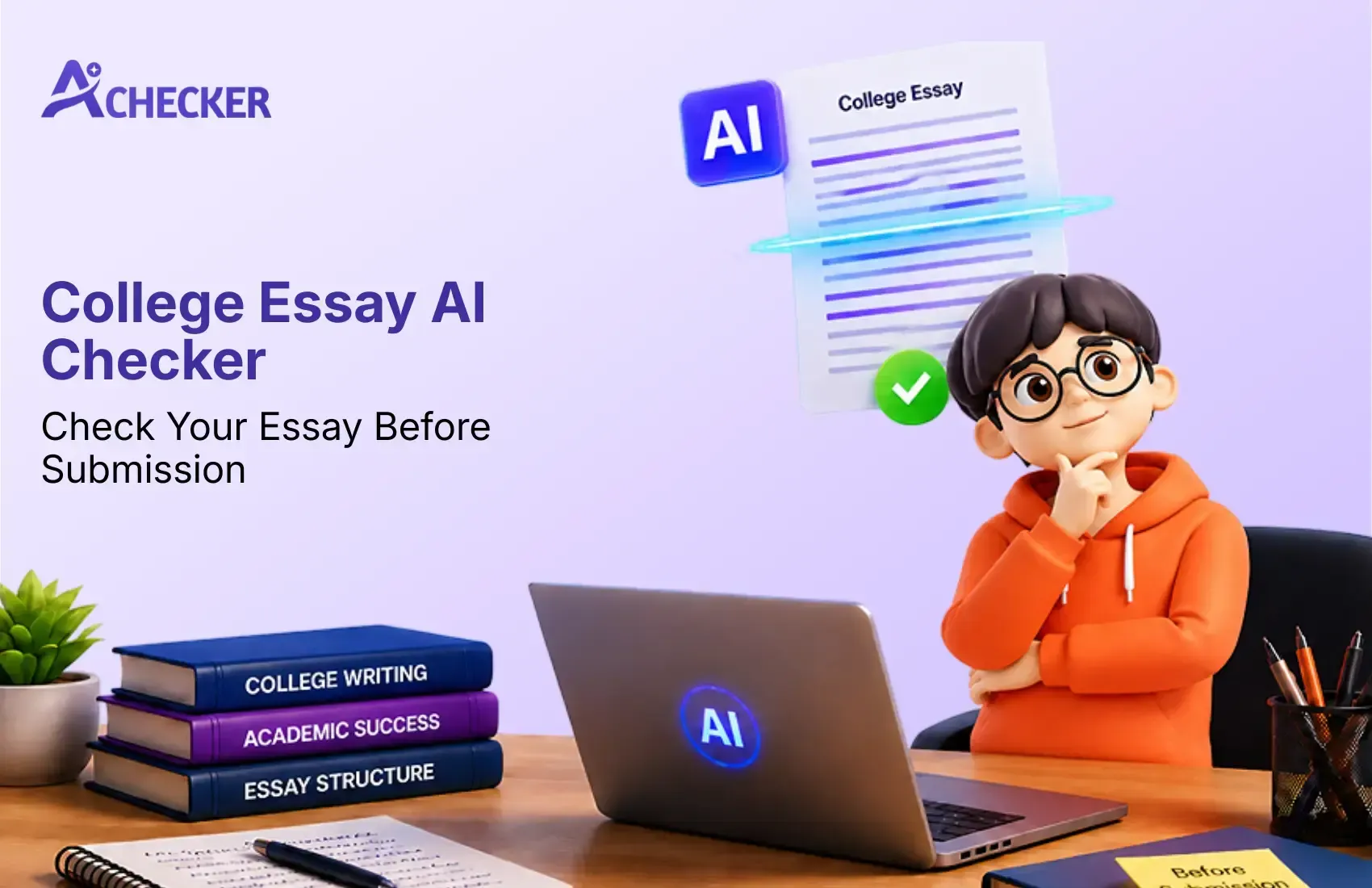
Your college essay required weeks, perhaps even months' worth of work. You revised the beginning part five times. Yoagonised about every single word. But at some point in the process, you turned to ChatGPT for ideas, a quick edit of your writing, or simply inspiration.
However, there remains a nagging question in your mind: Can colleges detect if I used ChatGPT in my writing?
Fortunately, the short answer is sometimes, but not always. However, the potential consequences are so severe that you should never take any chances. Before submitting your application via the Common App, using a college essay AI detection service is perhaps the most sensible thing you could do.
Here's everything you need to know about how colleges check for ChatGPT in college essays.
Do Colleges Actually Check College Essays for AI?
Yes, and the practice is growing fast.
About 40 per cent to 5 per cent of schools use AI detection technology to check students' college application essays, particularly large universities that handle thousands of applications every year.
It is not only about the individual school policies; rather, the Common App guidelines, accepted by more than 1,000 universities, views submission of any content created by AI technology as application fraud. It implies that regardless of whether your targeted university has announced an AI detection policy or not, you must comply with the Common App guidelines as soon as you apply.
How Many Colleges Are Actually Using Detection Tools?
Unfortunately, adoption is inconsistent. While many big state schools and some selective private colleges have adopted the use of plagiarism checkers such as Turnitin and GPTZero in their admissions process, others rely entirely on human review or honourr code compliance.
Then there are some schools, like Johns Hopkins, which have deactivated these plagiarism detectors because of concerns over inaccuracy.
So what does this mean for you? You shouldn't take the chance that your college isn't using one of these detectors. Even if they aren't running all essays through one, an odd looking one could get flagged.
What Happens If Your Essay Gets Flagged?
The key aspect that is ignored by most publications is the following: being flagged does not automatically mean being denied.
AI detection services do not provide evidence; they give probabilities. When a program says that something is "90% probably made by AI," it just means that certain statistical patterns were detected. This does not amount to a confession. Admission departments understand this perfectly well.
That review typically involves:
- Comparing your essay against other written materials in your application (short answers, activity descriptions, emails)
- Checking whether your essay voice matches what your recommenders describe
- In some cases, requesting an additional writing sample or conducting an interview where you discuss your essay
The danger is not necessarily rejection, but that it puts the entire submission into question. The possibility of a false positive means that one has to defend his/her work. This is unnecessary stress.
What AI Detectors Do College Admissions Use?
The tools vary by institution, but these are the most commonly used platforms in college admissions workflows:
- Turnitin: The most widely adopted tool in higher education; its AI detection module analyses sentence structure, writing predictability, and vocabulary patterns
- GPTZero: Built specifically to detect ChatGPT and similar models; used by some admissions offices and widely referenced in admissions circles
- Copyleaks: Scans for both plagiarism and AI generated content; used across academic institutions globally
- Originality.ai: Produces a percentage score indicating the likelihood of AI generation.
Not one of them is foolproof. They all analyse language structures, such as the level of predictability in the words used, the uniformity of sentence lengths, and the overall statistical safety that the text seems to offer when compared with human writing.
And this should be remembered: Human essays, when well structured and formally presented, may often rate high on artificial intelligence probability scales, especially those essays written by non native English speakers or highly coached students using their formal, well polished prose style.
School-by-School AI Policy Quick Reference
Policies vary widely, so here's a snapshot of where major schools stand on AI as of 2026:
| College / Platform | AI Policy Summary |
|---|---|
| Common App (1,000+ schools) | AI generated content submitted as your own = application fraud |
| Brown University | Explicitly bans AI generated essay content |
| Georgetown | Explicitly bans AI generated content in applications |
| Cornell | AI for idea generation is OK; drafting or editing by AI is prohibited |
| Yale | Grammar checking is allowed; AI content generation is not |
| Caltech | Requires disclosure; has one of the most detailed AI policies in the US |
| Duke University | Reduced essay weighting in response to AI concerns |
| Stanford / Harvard / MIT | Existing honour codes prohibit misrepresentation; no separate AI specific policy |
| Johns Hopkins | Disabled AI detection tools due to accuracy concerns |
| Vanderbilt / Emory / UVA | AI for light editing or proofreading only; essay must reflect the student's own voice and ideas |
Important: These policies are updated frequently. Always check your target school's current admissions guidelines directly before submitting.
How Do Colleges Detect AI in Essays? 5 Methods They Use
Even without dedicated software, experienced admissions officers have developed a sharp instinct for AI assisted writing. Here's how detection actually works in practice:
AI detection software: AI detection software such as Turnitin and GPTZero analyses your essays based on certain statistical parameters: overly regular lengths of sentences, repetitive use of words, and poor "perplexity," which means that the text has too high a level of predictability.
Cross checking with other application materials: Your essay is measured against your short answer questions, activity description, and all emails to the school. When your personal statement seems more professional while your short answer questions have an authentic tone of a young person, the contrast is apparent.
Comparing against recommendation letters: Does your recommendation mention your tendency to be contemplative and reflective when writing? If not, then you need to consider this. Admission officers review thousands of applications and can pick up on inconsistencies.
The "vague and generic" test: Based on interviews conducted by The Washington Post with admissions officers, some of the surefire ways to recognise an AI written essay include vague statements without concrete examples, jumping from topic to topic, irrelevant information, failure to introduce anything new and unique to the reader, and overuse of clichés.
Writing sample requests or interviews: When an essay triggers suspicion among admissions teams, some schools ask applicants to submit an additional timed writing sample or discuss their essay in an interview. If you didn't write it, this step is very hard to pass.
How to Check Your Essay Before Submitting
Here's the simplest thing you can do to protect yourself: run your essay through a college essay AI checker before you submit.
aichecker.pro is free, instant, and requires no account. Here's how it works:
- Paste your essay into the text box on aichecker.pro
- Click "Check for AI": the tool analyses your essay across multiple signals, including sentence variation, vocabulary patterns, perplexity indicators, and emotional depth.
- Review your score: a low AI probability score means your essay reads as human written; a higher score tells you which sections to review and rewrite
- Revise if needed: if specific paragraphs are flagged, rewrite them in your own voice: add a personal memory, a specific detail, or an emotional reflection that only you could provide
In case you have used AI tools during the writing process and need your essay to be 100% human like, then the best place to go is to try out the AI Humaniser service available at aichecker.pro/ai-humaniser.
Think of it the way you think about spellcheck: running a quick scan isn't an admission of wrongdoing, it's a smart final step that every careful applicant should take.
Tips for Writing a College Essay That Passes Any AI Check
Whether or not you used AI assistance, these principles to avoid AI detection in your writing will make your essay sound unmistakably human, and more compelling to admissions readers:
Lead with a specific scene, not a theme. Don't open with "Leadership has always been important to me." Open with the exact moment you realised something. Specific scenes are nearly impossible for AI to generate authentically.
Use your real voice, including its quirks. If you say "honestly" a lot, let it appear once. If you have a slightly unusual way of phrasing things, keep it. Polished uniformity is a red flag.
Vary your sentence rhythm deliberately. Mix short, punchy sentences with longer, more reflective ones. AI tends to produce paragraphs where every sentence is roughly the same length.
Include emotions you actually felt, not the emotions that should belong to the story. "I was more relieved than proud" is a human thought. "I felt an overwhelming sense of accomplishment" is an AI thought.
Name real people, places, and details. The name of your coach. The specific street where you grew up. The exact words someone said to you. These details authenticate your essay in a way no AI can fake.
Run a final check. Before you submit, paste your finished essay into aichecker.pro to confirm it reads as fully human written.
Conclusion
They get better and better each year. However, the silver lining to this problem is that genuine writing beats artificial intelligence every time. Your unique story, written in your voice with unique information known only to you, will beat any piece of essay written by artificial intelligence.
However, if you do not want to be paranoid when submitting your work, here is what you should do.
FAQs
1. Do colleges check essays for AI?
2. How do colleges detect AI in essays?
3. What AI detector do college admissions use?
4. Can a college essay be falsely flagged as AI written?
5. What happens if my essay gets flagged for AI?
6. Is submitting an AI written essay considered fraud?
7. How can I check my essay for AI before submitting?
8. Does using AI for idea generation count as cheating?
9. Can an AI humanizer tool help my essay pass detection?
10. Do all colleges use AI detectors for application essays?

Harshil Barvaliya
SEO Executive & Content Writer at AI Checker Pro
I’m Harshil Barvaliya, an SEO Executive and Content Writer at AI Checker Pro. I focus on improving the website’s search engine visibility through effective SEO strategies, including keyword research, on-page and off-page optimization, and content development.Get Started Free
Create a free account for advanced AI detection and scan history.
Trusted by thousands worldwide.
Recent Blog's
Discover how AI-powered content creation can elevate your website's reach and engage your audience like never before. Explore the real impact of AI on crafting content that connects.