Do Colleges Check for AI in Application Essays? Complete Guide for Students
TABLE OF CONTENTS
Do Colleges Actually Check Essays for AI?
Do Colleges Use AI Detectors on College Essays?
How Colleges Detect AI-Written Essays
Can AI Detectors Reliably Tell If an Essay Was AI-Written?
What May Raise Questions About AI-Generated Writing
Can Colleges Prove an Essay Was Written by AI?
Do All Colleges Have the Same AI Policy?
Can AI-Generated Essays Hurt Your College Admission Chances?
What Happens If Your Essay Gets Flagged?
How to Write (and Check) an Authentic, AI-Safe Essay
Conclusion
FAQs
Get an AI summary of this post on:





You have finally finished your college essay. You have rewritten the intro statement five times, taken out the one part that sounds too formal, and hit save with a sigh of relief. But now comes the scary question: what if it sounds like it was written by AI?
This is a growing concern in 2026 as AI writing and editing tools become more widely used. College admissions officers are increasingly aware of these tools, which brings us to the question many applicants are asking: Do colleges check for AI in essays?
The short answer is more complicated than it may seem. Understanding how colleges approach AI can help you follow application policies and submit an authentic essay.
Do Colleges Actually Check Essays for AI?
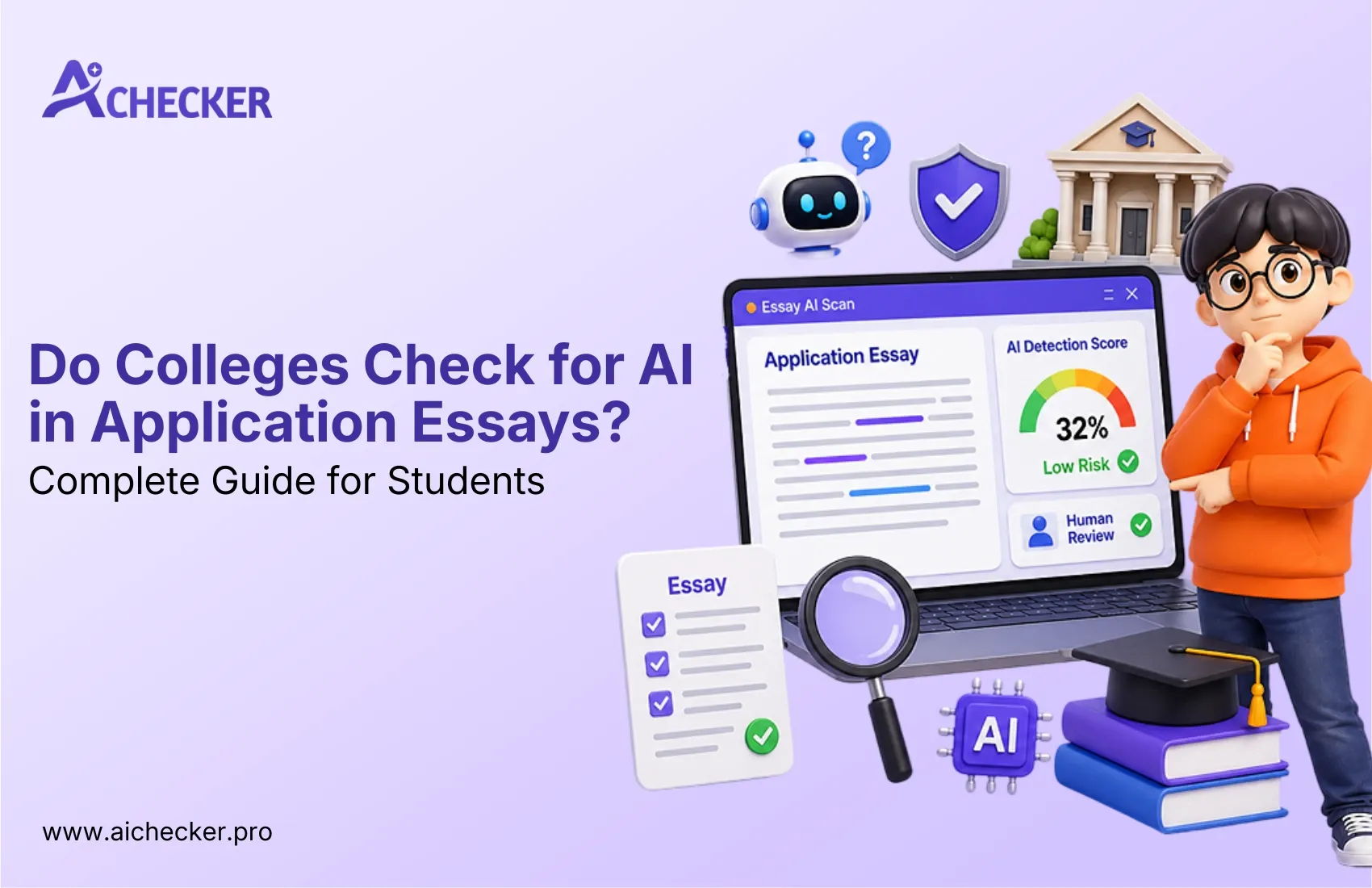
Some colleges and universities may use AI-detection tools or other methods to evaluate whether application materials appear to contain AI-generated content.
There is no universal percentage showing how many colleges use AI detectors for application essays, and practices vary by institution. Even when an AI-detection tool is used, its result should not automatically be treated as definitive evidence that a student used AI.
Admissions decisions generally involve reviewing the application as a whole and considering the school's specific policies.
Admissions officers may review the essay alongside other parts of the application, including short answers and other written materials.
Therefore, even when an AI-detection result is considered, it should be viewed in the broader context of the application rather than as conclusive evidence on its own.

Get Lifetime Access with 60% OFF
Stop paying monthly subscriptions. Enjoy unlimited AI detection and humanizer access forever with future updates included.
- One-time payment
- Unlimited access forever
- All future updates included
Do Colleges Use AI Detectors on College Essays?
Some colleges may use AI detection tools when reviewing application materials, but there is no universal system or standard that every college follows.
However, these tools cannot reliably establish who wrote an essay, and their results can sometimes be inaccurate. Colleges may instead consider the detector result alongside the overall application, including the student's writing style, short answers, and other submitted materials. Students should always check the current AI policy of each college before using AI during the application process.
How Colleges Detect AI-Written Essays
Admissions offices may use more than one method when evaluating concerns about AI-generated writing.
AI Detection Software
Some colleges may use AI detection software to assess whether an application essay contains patterns associated with AI-generated writing. These tools may analyze factors such as word choice, sentence structure, predictability, and other linguistic patterns.
The result is not conclusive. AI detectors typically provide a probability or classification indicating how likely the text appears to be AI-generated, but these results can include both false positives and false negatives.
Human Review by Admissions Officers
Admissions officers read large numbers of application essays and may notice writing that appears inconsistent with a student's overall application.
Reviewers may notice patterns such as generic language, unusually polished phrasing, repetitive structures, or a lack of specific personal details. These characteristics are not proof of AI use, but they may prompt an admissions officer to look more closely at the application.
Human readers may also notice inconsistencies without using specialized detection software, although writing style alone cannot reliably establish whether AI was used.
Cross-Referencing Your Application
Your essay is one part of a larger application that admissions officers may consider as a whole.
They may consider whether the essay's tone, style, and language are consistent with your short answers, other written responses, academic record, and the overall application.
Can AI Detectors Reliably Tell If an Essay Was AI-Written?
AI detectors can estimate whether an essay contains patterns associated with AI-generated writing, but they cannot reliably establish that an AI tool wrote the essay.
However, human writing can sometimes trigger an AI detector, resulting in a false positive. AI-generated content can also avoid detection, creating a false negative.
This is especially important for college essays, where writing styles can vary significantly between students. A detector score should therefore be treated as a signal rather than definitive evidence.
Admissions officers may consider other factors, such as the student's previous writing, application responses, and the consistency of their voice. The safest approach is to follow each college's AI policy and make sure the final essay genuinely reflects your own experiences and ideas.
What May Raise Questions About AI-Generated Writing
Certain patterns show up again and again in AI-assisted or fully AI-generated essays. Knowing them can help you self-edit before you submit:
- Repetitive phrasing: Similar ideas or wording may appear multiple times, creating a repetitive or formulaic writing style.
- Tone mismatch: Language, vocabulary, or maturity level that doesn't match the rest of your application materials.
- Overly polished, generic language: Essays that sound impressive but say very little that's specific to you.
- Limited personal detail: Essays that lack specific experiences, observations, emotions, or details may feel less personal and distinctive.
If your essay leans heavily on any of these patterns, it's worth a revision pass, regardless of whether AI was involved in writing it.
Can Colleges Prove an Essay Was Written by AI?
An AI detector score alone generally cannot establish that a college essay was written by AI.
Detection tools provide an estimate based on writing patterns, but they can produce both false positives and false negatives. If an admissions office has concerns about an essay, it may look at the broader application rather than relying on a single score.
Admissions staff may compare the essay with other responses, previous writing samples, or the student's overall writing style. In some situations, a student may also be asked to explain their essay or provide additional evidence of their writing process. Keeping drafts, notes, and revision history can help demonstrate how the essay developed.
Ultimately, students should focus less on trying to "beat" an AI detector and more on following the college's AI policy and submitting work that honestly represents their own experiences, ideas, and voice.
Do All Colleges Have the Same AI Policy?
No - and this is where some people get confused. Different schools and universities have different rules on AI use. Check your desired schools' requirements before you start writing.
Schools That Allow Limited AI Use
Some universities take a measured approach, allowing AI for certain supporting tasks while drawing a firm line at content generation:
| School | AI Policy | What's Typically Allowed |
|---|---|---|
| Cornell | Limited use | AI for idea generation only, not drafting or editing |
| Caltech | Limited use | Grammar and clarity tools, not content creation |
| WashU | Limited use | Grammar and clarity tools, not content creation |
| Bucknell | Limited use | Grammar and clarity tools, not content creation |
Schools That Ban AI-Generated Content
Meanwhile, other schools have a strict policy about not allowing students to use AI for their essays at all and demanding that all work be original from the idea to the execution. Since every year the rules can change, it is essential to look at the requirements on each school that your interested in's website the year that you are applying.
Can AI-Generated Essays Hurt Your College Admission Chances?
Yes, submitting an AI-generated college essay can potentially hurt your admission chances, especially if the college's application policy prohibits AI-generated content. Admissions officers use personal essays to understand an applicant's experiences, personality, goals, and writing ability. An essay that appears heavily AI-generated may fail to communicate those qualities or could raise questions about whether the submitted work is genuinely the student's own.
The consequences can vary depending on the school's policies and how much AI assistance was involved. Using AI for an allowed purpose, such as brainstorming or basic proofreading, is different from submitting an essay largely written by an AI tool. Students should therefore review each college's current guidelines before using AI. The safest approach is to make sure the final essay reflects your own experiences, ideas, writing, and authentic voice.
What Happens If Your Essay Gets Flagged?
Getting flagged isn't the same as getting rejected. Detection software produces a signal, not a sentence. When something looks unusual, admissions offices typically respond with additional review rather than an automatic penalty:
- Comparing your essay against other parts of your application, like short answers or recommendation letters
- Consulting with your high school counselor to check whether the writing aligns with your demonstrated ability
- In some cases, requesting an additional writing sample or an interview where you discuss your essay directly
It is also important to note that false positives are common, especially among students who write in a more formulaic style or whose English is not native to them, as their work may appear more "algorithmic" to these tools than that of native writers. This is why most institutions use a mix of artificial and human grading, rather than relying on just one or the other.
How to Write (and Check) an Authentic, AI-Safe Essay
The safest strategy isn't trying to outsmart a detector, it's writing an essay that's genuinely, unmistakably yours. A few practical steps:
- Draft in your own voice first. Get your real thoughts on the page before you touch any writing tool.
- Use AI only within your school's policy. If a college allows AI for brainstorming or grammar checks, stick strictly to that, don't let it touch your actual sentences or ideas.
- Lean into specific, personal detail. The exact moment, the specific object, the particular thing someone said to you, these are the details AI can't invent and admissions officers can't help but notice.
- Check your essay before you submit. Before you hit send, it's worth running your essay through an AI checker to see how it reads. A quick scan can flag sections that feel overly generic or "polished" so you can rewrite them in your own words, the same way you'd proofread for typos.
Conclusion
Colleges checking for AI when reviewing application essays has become a thing in 2026 – and while that might make some people nervous, it's actually really easy to avoid issues. The best way to do that is by writing a genuine, specific, and personal essay using your own words.
If you're ever even slightly concerned about the tone or word choice in your essay, it's always a good idea to plug it into [AI Checker Pro's free AI detector to see how it's coming off to others after all, knowing how it looks and sounds is the only way to be safe when you're submitting it!
FAQs
Do colleges check for AI in application essays?
Can AI detectors tell if a college essay was written by AI?
What happens if a college essay gets flagged for AI?
Do all colleges have the same AI policy for essays?
Which colleges allow limited AI use in essays?
Can using AI hurt your college admission chances?
How do admissions officers detect AI-written essays?
What triggers a false positive on AI detectors?
Can AI-generated essays get you rejected?
How can I write an AI-safe college essay?

Harshil Barvaliya
SEO Executive & Content Writer at AI Checker Pro
I’m Harshil Barvaliya, an SEO Executive and Content Writer at AI Checker Pro. I focus on improving the website’s search engine visibility through effective SEO strategies, including keyword research, on-page and off-page optimization, and content development.Get Started Free
Create a free account for advanced AI detection and scan history.
Trusted by thousands worldwide.
Recent Blog's
Discover how AI-powered content creation can elevate your website's reach and engage your audience like never before. Explore the real impact of AI on crafting content that connects.