Teacher's Guide to AI Detection: Spot AI Essays for Free
TABLE OF CONTENTS
Why Teachers Need an AI Detector Right Now
5 Signs an Essay Was Written by AI
How to Use AIChecker.pro to Detect AI Essays
Combining Manual Review With AI Detection
Assignment Design That Reduces AI Cheating
What to Do After You Detect AI Writing
Conclusion
FAQs
Get an AI summary of this post on:





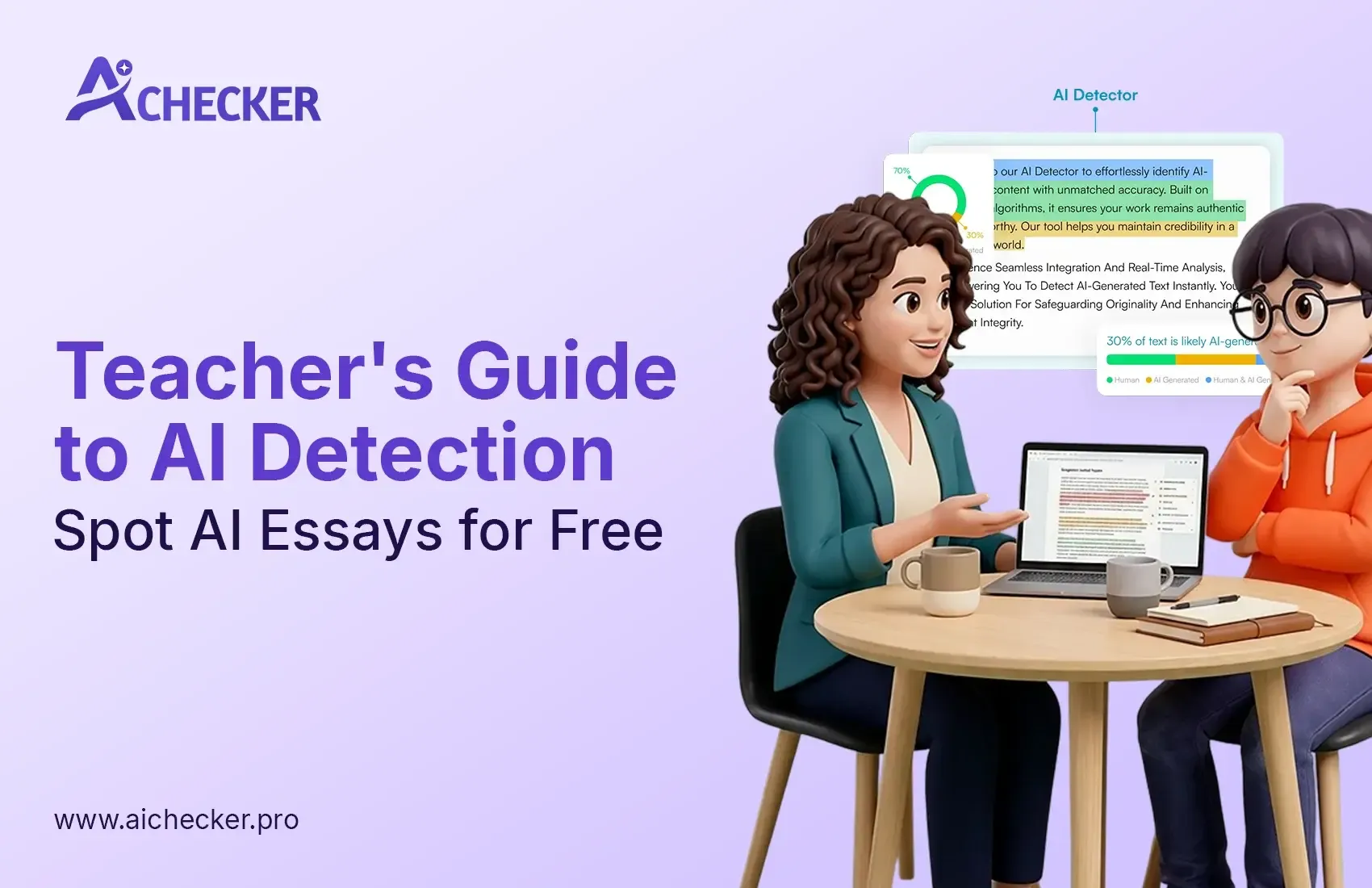
Teachers working today need to solve problems which their training did not prepare them to handle. Your students are submitting essays that look polished, well-structured, and almost too perfect. Your conscience tells you that something important needs your attention, yet you do not know what it is.
With tools like ChatGPT, users can produce a complete 1,000-word essay within 10 seconds. The output comes without any effort because there are no writing errors, and the text lacks a distinct authorial style. The system generates standard content which fulfills all the requirements listed in your assessment criteria.
The good news? You do not have to guess anymore. Anyone can use this free AI detector to check essays within seconds. This guide walks you through a practical process using a free AI detection tool that helps you maintain academic integrity without spending hours on manual assessment.
Why Teachers Need an AI Detector Right Now
The Rise of ChatGPT in Student Assignments
The rapid change in this situation has become apparent. In just the last couple of years, AI writing tools have become everyday instruments that students rely on. And here is the problem: traditional plagiarism checkers like Turnitin were built for copying, not for AI-generated text.
A student can ask ChatGPT to write an original essay on any topic, and Turnitin will give it a clean pass because it technically is not copied from anywhere.
That is exactly where a proper ChatGPT detector for teachers becomes essential. A dedicated AI checker does not look for copied text. The system analyzes AI-generated text through its identification of writing patterns, detection of text structure, and measurement of statistical attributes that all AI systems produce in their output. It uses entirely different technology to solve a problem that requires a different approach.
What Is at Stake
Educational institutions face a problem that goes beyond academic dishonesty. Students who turn in AI-generated content lose their opportunity to develop essential skills through cognitive processes, argumentation, and writing activities. The path to success requires students to endure challenges which they need to overcome through their own efforts. The consequences of this practice will exceed the effects of any grading system on their long-term academic progress.
Academic assessments require students to present authentic work for evaluation. The assessment fails when some students present original work while others submit AI-generated content in education. The system creates an unjust situation which impacts every student who dedicates genuine time to studying.
5 Signs an Essay Was Written by AI
These five indicators exist before you even open a free AI detector window. Once you learn to spot them, you will start to see them everywhere.
1. Unnaturally perfect grammar with zero personality. Human writing has small quirks. A student might write a run-on sentence or use a comma in the wrong place. AI-generated text tends to be grammatically flawless but also strangely flat. It reads like a Wikipedia article, not a person.
2. Overuse of generic filler phrases. If you see phrases like "It is important to note that," "Throughout history," or "In conclusion, it is clear that," those are classic signals. AI models love these openers because they are statistically common in writing samples. Real students rarely write this way.
3. No personal voice or lived experience. Ask yourself: Does this essay sound like this specific student? Human writing has rhythm, personality, and opinion. AI writing is almost always neutral, careful, and deliberately inoffensive. If the essay could have been written by anyone, it probably was not written by your student.
4. A sudden vocabulary jump. If a student normally writes at an intermediate level and suddenly submits something with academic vocabulary and complex sentence structures they have never used before, that contrast is worth investigating. It does not mean they cheated, but it is a signal worth following up on. You can read more about how AI detectors identify these writing shifts to understand the technical side of what makes AI text different.
5. Vague or completely fabricated citations. This one surprises a lot of teachers. AI tools are genuinely bad at citations. They will confidently list sources that do not exist or get the author, title, and year completely wrong. If you check two or three citations and they lead nowhere, that is a strong red flag.
How to Use AIChecker.pro to Detect AI Essays
This is the hands-on part. The process requires no technical expertise. You do not have to register for an account. The service is completely free to use.
Step 1: Copy and Paste the Essay
Visit AIChecker.pro. The website displays an empty text box for users to interact with. Copy the student essay from your email, Google Docs, or your learning management system and paste it directly into the text box without any need for formatting.
Step 2: Read the AI Probability Score
The AI text detector will provide results within seconds after you press the detection button. The system displays an overall score indicating the probability that the text was created by artificial intelligence. A score above 70 to 80 percent is a strong indicator. A score below 20 percent suggests the writing is mostly human.
The system functions as a signal that draws your attention to specific areas. It tells you where to investigate further, not just whether something is wrong.
Step 3: Review the Sentence-Level Highlights
This is where AIChecker.pro demonstrates its strength as a detection tool. The system provides multiple assessment scores instead of delivering a single overall verdict. It shows which sentences carry the highest probability of being AI-generated, giving you specific essay sections to reference when discussing the work with a student. This prevents you from making vague or general accusations.
Step 4: Save or Export the Report
Preserve the detection report for use at academic integrity meetings and for school records. The report gives you a precise and professional presentation of your findings. It also serves as a beneficial resource if the matter advances to a formal administrative assessment. Understanding how accurate AI content checkers really are can also help you present your findings with appropriate confidence.
Combining Manual Review With AI Detection
Most guides will not share this part. A free AI checker tool cannot achieve perfect accuracy, so users must not depend on it as the only solution. The best approach combines the tool with your own teacher judgment.
Begin by examining the student's prior work and comparing it to the submitted essay. Evaluate the vocabulary, sentence rhythm, and overall cognitive level. Real quality assessment requires contextual knowledge that no tool can replace.
Ask the student several questions about the essay. Have them identify their central argument and explain a specific piece of evidence they chose. A student who wrote the essay themselves can do this easily. A student who submitted AI work often cannot.
Next, verify whether the listed sources actually exist. As mentioned earlier, AI tools frequently fabricate citations. A brief Google or library search takes about 30 seconds and can confirm your suspicions quickly.
When your school uses Google Docs or a similar platform, examine the document version history. A legitimate essay should show development through various writing stages, including drafting, editing, and finalizing. An AI-generated essay that was pasted in will appear as a single large addition with no editing history.
Assignment Design That Reduces AI Cheating
The most effective long-term approach involves designing assignments that students simply cannot complete through AI tools. One strong method is asking students to write content that describes their actual personal experiences with the topic.
AI technology cannot create real human memories. It can produce writing about personal experiences, but that writing rarely sounds authentic to the person submitting it.
Require students to include specific paragraph and page numbers from primary sources. AI performs this task exceptionally poorly. It will generate fake paragraph numbers and present them as accurate, and those numbers can be checked quickly for authenticity.
Short spoken assessments are also highly effective. A five-minute conversation where a student explains their argument and defends one or two choices they made is something AI-written essays simply cannot support.
Using draft submissions is another reliable approach. Ask students to submit three versions of their work: a rough draft, a revised draft, and a final version. Real writing develops over time. AI output remains essentially constant throughout.
What to Do After You Detect AI Writing
A detection result is a starting point for dialogue, not a final verdict.
Do not walk into a classroom and make an accusation in front of other students. Do not send an angry email. Treat the detection result as evidence that opens a private, calm conversation.
Bring the student aside and say something like: "I want to talk to you about your recent essay. I have some questions about parts of it." Give the student the opportunity to explain. Some students may have used AI tools for editing assistance, which may or may not violate school rules depending on how the policy is written.
When you proceed with an academic integrity discussion, use your school's specific academic integrity policy as your reference point. Familiarizing yourself with the role of AI in protecting academic integrity can help you frame these conversations constructively.
Create thorough documentation using the AIChecker.pro report, your notes from the conversation, and all supporting evidence such as citation checks and version history. This documentation protects both you and the student if the case reaches administrative authorities.
Conclusion
Identifying essays written by artificial intelligence does not need to create feelings of stress or uncertainty. The entire process becomes manageable after you learn the signs, use a free AI detection tool, and follow a clear procedure for handling the situation.
The approach is straightforward. Know the five signs. Use AIChecker.pro as your AI detection checkpoint. Combine your personal assessment with a short student interview before reaching any conclusion.
You have already accomplished the most difficult part by deciding to investigate. The tools are here to support you.
Try AIChecker.pro free today. Paste any essay into the system without creating an account, and receive a complete AI detection report within seconds.
FAQs
1. What is the best free AI detection tool for teachers?
2. . How can a teacher tell if an essay was written by AI?
3. Can Turnitin detect ChatGPT-written essays?
4. How does AI detection work for student essays?
5. Is AIChecker.pro really free to use?
6. What should a teacher do after detecting AI-written content?
7. Can AI detectors give false results for student writing?
8. How can teachers design assignments to prevent AI cheating?
9. Why is detecting AI content important in schools?
10. Does document version history help detect AI-written essays?

Harshil Barvaliya
SEO Executive & Content Writer at AI Checker Pro
I’m Harshil Barvaliya, an SEO Executive and Content Writer at AI Checker Pro. I focus on improving the website’s search engine visibility through effective SEO strategies, including keyword research, on-page and off-page optimization, and content development.Get Started Free
Create a free account for advanced AI detection and scan history.
Trusted by thousands worldwide.
Recent Blog's
Discover how AI-powered content creation can elevate your website's reach and engage your audience like never before. Explore the real impact of AI on crafting content that connects.