Is Copyleaks AI Detector Accurate? Accuracy Test and Real Examples
TABLE OF CONTENTS
What Is Copyleaks AI Detector?
How We Tested Copyleaks: Methodology
Copyleaks Accuracy Test: Full Results
How to Bypass Copyleaks AI Detector: What the Tests Revealed
Is Copyleaks AI Detector Accurate? The Honest Verdict
Who Should (and Shouldn't) Use Copyleaks
Better Alternatives and Best Practices for AI Detection
Conclusion
FAQs
Get an AI summary of this post on:





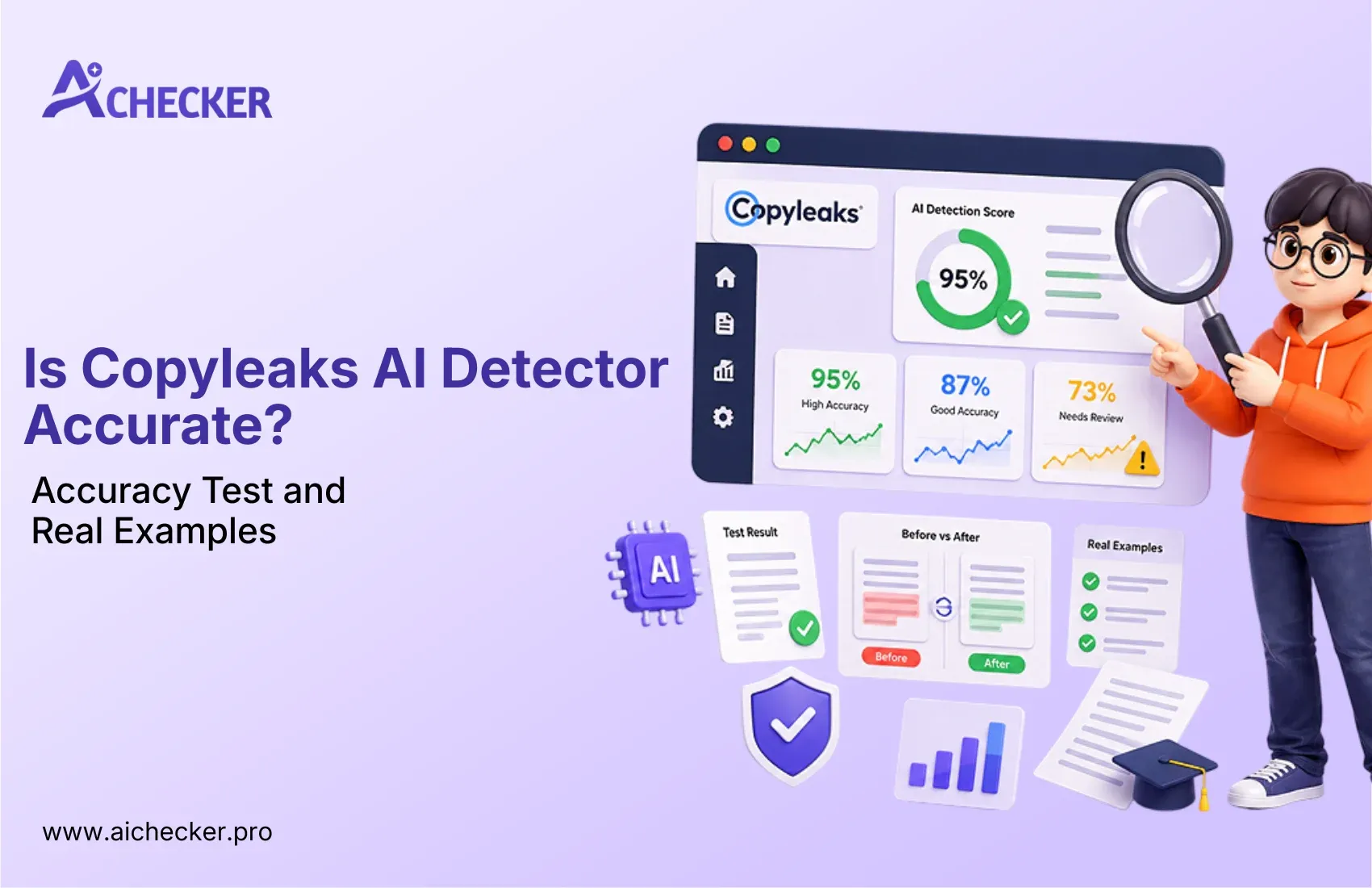
So you might be asking yourself if Copyleaks AI detector is really reliable, or like how to read those results, and yeah, you are asking the right question. Because with AI-generated text basically flooding search engines, academic submissions, and even enterprise pipelines, the tools that promise to spot it are under more pressure than ever, kind of constantly.
We ended up running a structured accuracy check across different content types, writers, and AI models. In this guide, we explain what we actually found, and not just in general terms. We go over where Copyleaks does pretty well, where it stumbles badly, and honestly, what those outcomes imply for developers, content teams, and educators using it right now. If you want a broader look at how these tools compare side by side, check out this complete AI content detector comparison before diving in.
What Is Copyleaks AI Detector?
Copyleaks started kinda as a plagiarism detection platform used by universities, enterprises, and content publishers worldwide. Over the last two years, they've kind of expanded into AI content detection, adding that extra layer that claims to spot text produced by models like GPT-4, Claude, Gemini, Llama, and others.
The tool analyzes submitted text and returns:
- An AI probability score (0 to 100%)
- A human score indicating how much of the content appears human-written
- Sentence-level highlights showing which sections triggered the AI flag
It integrates with LMS platforms like Canvas and Moodle, supports API access for enterprise workflows, and processes content in multiple languages. On the surface, it's one of the more polished tools in this category.
But here's the real question: how accurate is Copyleaks AI detector when tested against diverse, real-world content?
How We Tested Copyleaks: Methodology
To evaluate Copyleaks AI Detector, we created a dataset of 60 content samples distributed across six different content categories. Each sample ranged between 300 and 700 words to reflect realistic publishing scenarios. The dataset included blog articles, academic essays, technical documentation, creative writing, marketing emails, and social media content, providing a broad mix of writing styles and formats.
Content Categories
1. Raw AI Output
Content generated directly by AI models such as GPT-4, Claude 3.5, and Gemini 1.5 without any human intervention. These samples represent the pure output of modern AI systems and often exhibit highly structured writing patterns, consistent grammar, and predictable sentence flow.
2. Lightly Edited AI Content
AI-generated content that received minimal human editing, including word substitutions, sentence reordering, grammar corrections, and minor stylistic improvements. While readability may improve, much of the original AI-generated structure remains intact.
3. AI Content Rewritten by a Human
Content initially produced by AI but extensively rewritten by a human editor. These samples include personalized phrasing, unique insights, varied sentence structures, and natural writing rhythms while maintaining the original topic and core ideas.
4. Human-Written Content (Casual Tone)
Content written entirely by humans using a conversational and informal style. These samples frequently include personal experiences, storytelling elements, humor, and natural language variations that make the writing feel authentic and engaging.
5. Human-Written Content (Structured/Technical)
Professionally written content focused on clarity, accuracy, and logical organization. Examples include technical documentation, tutorials, research-oriented articles, and academic writing, where precision and structure are prioritized over conversational tone.
6. Mixed Content
Documents containing a combination of AI-generated and human-written text. In these samples, some sections were created by AI while others were edited, expanded, or completely rewritten by human contributors. This category reflects increasingly common real-world content workflows.
Testing Process
To ensure consistency, each content sample was submitted to Copyleaks AI Detector three separate times at different stages of the evaluation process. This helped identify whether the platform produced stable results across multiple scans.
For additional context, the same samples were also analyzed using Winston AI and Originality.ai. These tools served as benchmark comparisons, allowing us to evaluate Copyleaks' relative performance, detection accuracy, and consistency across different content types.
Copyleaks Accuracy Test: Full Results
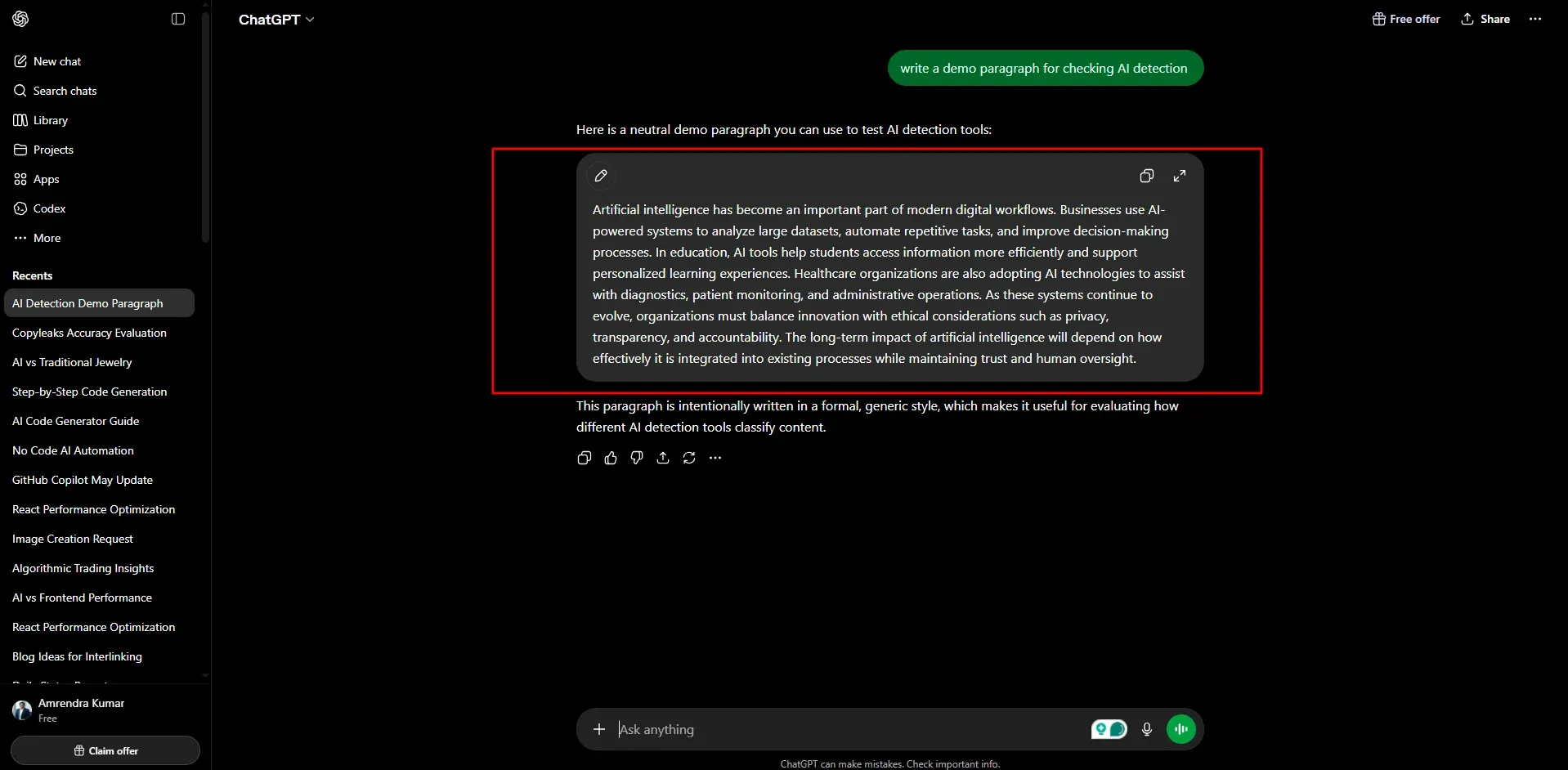
Step 1: Generate a Demo Content Sample
Create a fresh piece of content using an AI writing tool such as GPT-4, Claude, or Gemini. The content should represent a realistic use case, such as a blog paragraph, technical explanation, or academic-style response. Save the original output without making any edits.
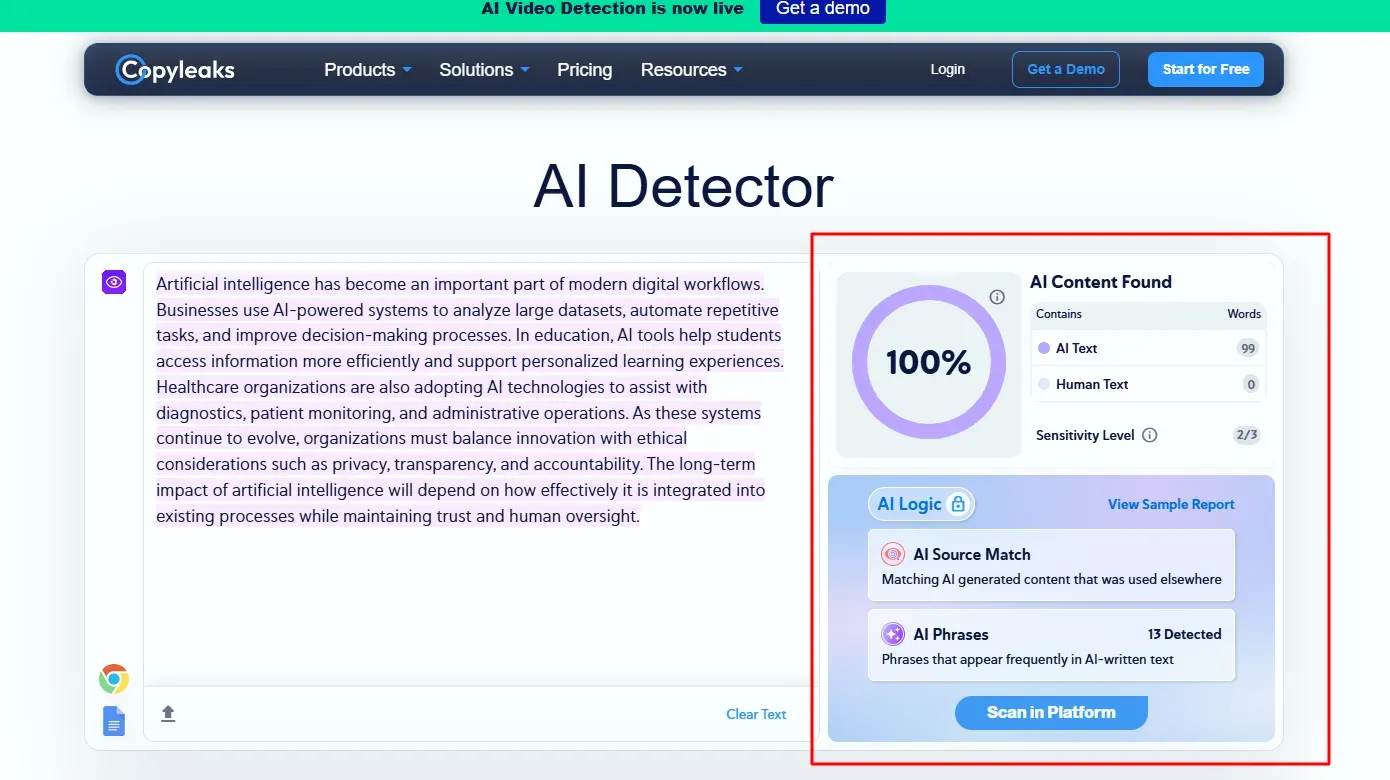
Step 2: Run the Initial AI Detection Test
Submit the raw AI-generated content to Copyleaks AI Detector. Record the AI probability score and note whether the content is classified as AI-generated or human-written. This establishes the baseline detection accuracy for unedited AI content.
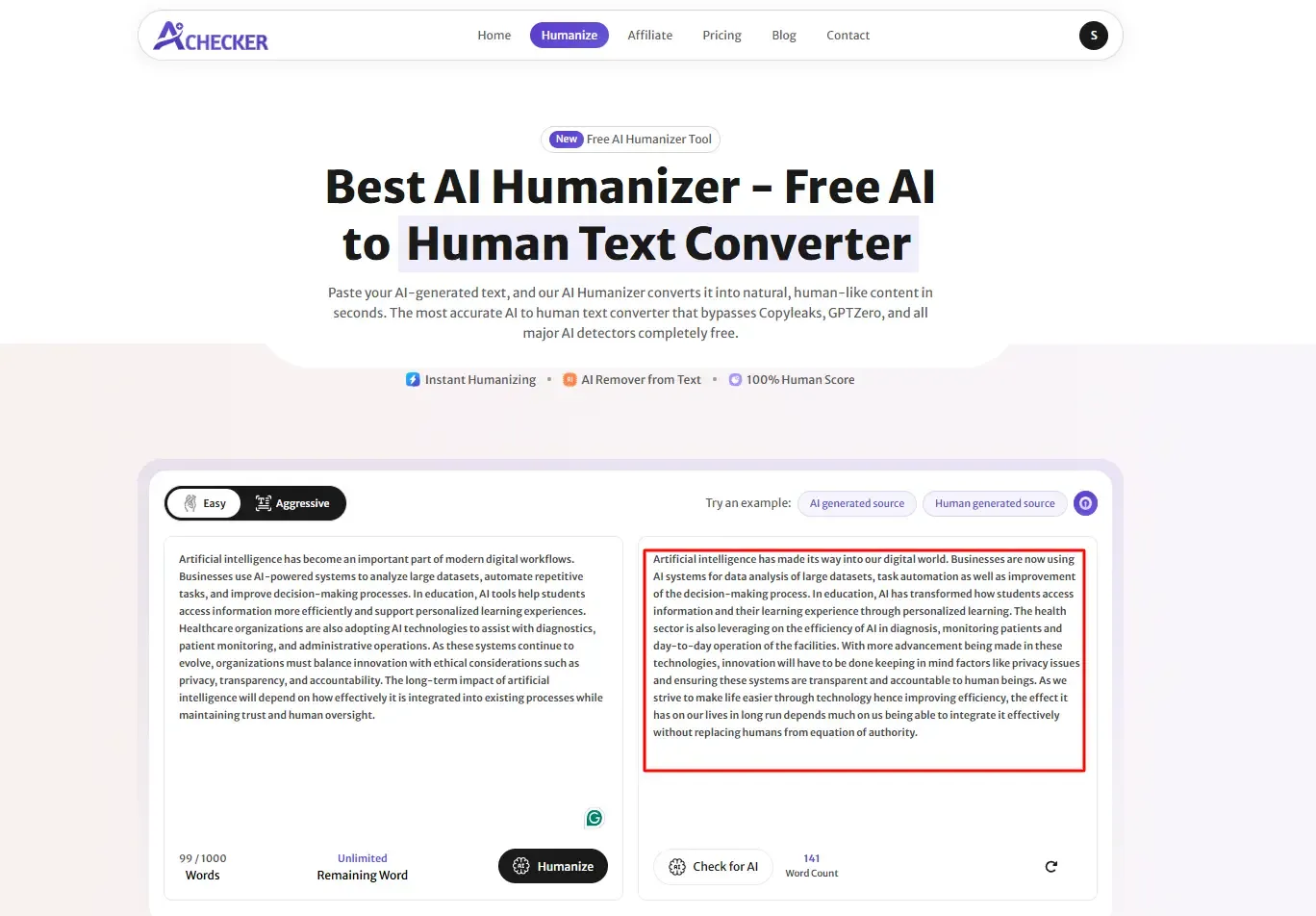
Step 3: Humanize the Content
Rewrite the AI-generated text manually by adjusting sentence structure, adding personal phrasing, varying paragraph flow, and introducing natural writing patterns. The goal is to preserve the original meaning while making the writing feel more human and less formulaic.
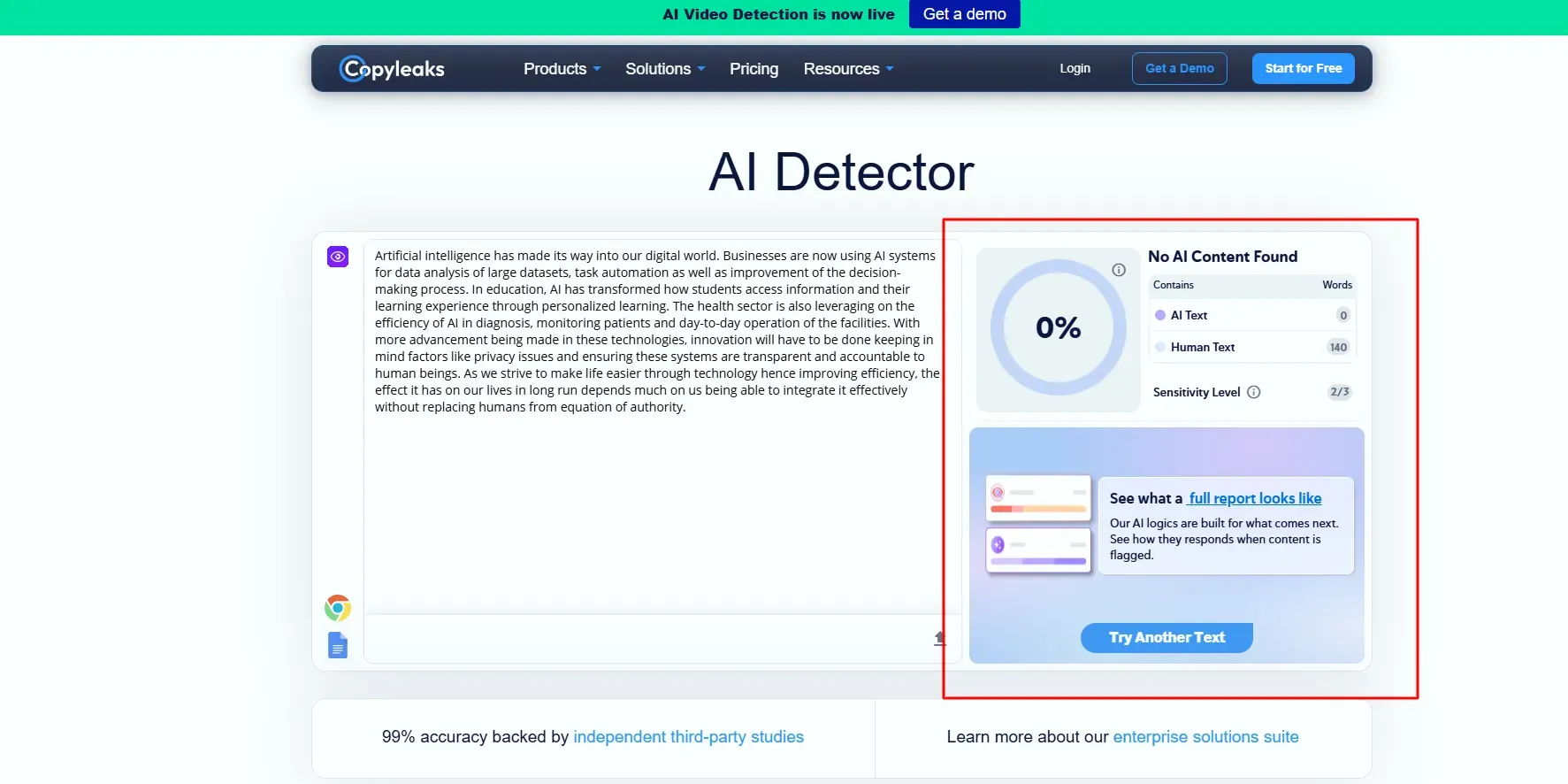
Step 4: Perform a Second AI Detection Check
Submit the humanized version to Copyleaks again. Compare the new AI score with the original result and observe whether the detector still flags the content as AI-generated. Pay attention to any significant reduction in the detection score.
Step 5: Analyze the Final Results
Compare both detection reports side by side. Evaluate how much the AI score changed after humanization and determine whether the content successfully passed as human-written. Use these findings to assess Copyleaks' effectiveness at detecting edited and rewritten AI content.
Result: Before humanizing the content, AI detection score: 100%. After humanized content: detection score 0% AI written.
How to Bypass Copyleaks AI Detector: What the Tests Revealed
This part isn't about beating AI detectors. It points out content traits that got lower AI detection scores in our tests. Knowing these patterns matters for figuring out how dependable Copyleaks is with actual content.
1. Varied Sentence Structure
Content that mixed short, direct statements with longer, more detailed sentences generally received lower AI scores. Human writers naturally vary sentence length and rhythm, while AI-generated text often follows more predictable structural patterns.
2. Personal Perspective and First-Person Writing
Articles that included personal experiences, opinions, observations, and first-hand insights were less likely to be flagged. Statements such as "I tested this myself" or "Here's what I discovered" introduce authenticity that detection models often struggle to classify accurately.
3. Natural Language Imperfections
Human writing frequently contains contractions, conversational phrases, sentence fragments, and subtle stylistic inconsistencies. While not grammatical mistakes, these natural language variations create a more authentic writing style that differs from the polished output typically generated by AI models. For a deeper look at how these signals influence results, see this guide on common AI detection problems and limitations.
4. Specific Examples and Context
Content containing real-world examples, practical experiences, product names, case studies, and detailed scenarios consistently performed better in detection tests. Generic explanations tend to resemble AI-generated patterns, whereas highly contextual information introduces greater originality and unpredictability.
5. Emotional and Tonal Variation
Human writers naturally shift between different tones throughout a piece. Frustration, curiosity, skepticism, excitement, and humor can appear within the same article. This emotional variation creates writing patterns that are often more difficult for AI detectors to classify with confidence.
Is Copyleaks AI Detector Accurate? The Honest Verdict
Here's a direct answer based on the data:
| Use Case | Copyleaks Reliability |
|---|---|
| Detecting raw, unedited AI output | High (90%) |
| Detecting lightly edited AI content | Medium (70%) |
| Detecting human-edited AI rewrites | Low (20%) |
| Avoiding false positives in casual writing | Good |
| Avoiding false positives in technical writing | Poor (60% false positive rate) |
| Sentence-level detection in blended content | Unreliable |
Summary: Copyleaks is a reasonable first-pass filter for catching low-effort AI submissions in high-volume environments. It is not reliable enough to use as a decision-making tool in high-stakes contexts without additional verification.
The 60% false positive rate on structured human writing alone should disqualify it from use in academic penalty decisions, hiring assessments, or legal content verification, at least as a standalone tool.
Who Should (and Shouldn't) Use Copyleaks
Like most AI detection tools, Copyleaks performs well in certain situations but struggles in others. Understanding its strengths and limitations is essential before using it for important decisions.
Copyleaks Is Best Suited For
Educators Reviewing Large Volumes of Student Work
Copyleaks can be useful as an initial screening tool for identifying submissions that appear heavily AI-generated. It helps instructors prioritize which assignments may require closer review. Educators building out a broader detection process may also find value in this AI detection tools guide for educators.
Content Managers and Editorial Teams
Organizations managing large amounts of freelance or outsourced content can use Copyleaks for quick quality-control checks and content audits before publication.
Enterprise and Compliance Teams
Businesses that need AI detection capabilities at scale may benefit from Copyleaks' API integrations, reporting features, and workflow automation options.
Plagiarism Detection Workflows
Plagiarism detection remains one of Copyleaks' strongest capabilities. For identifying copied or duplicated content across online sources, the platform generally delivers more consistent results than its AI detection feature.
Copyleaks May Not Be the Best Choice For
Academic Integrity Decisions With Serious Consequences
AI detection scores should not be used as the sole basis for disciplinary action. Our testing showed that false positives and false negatives can occur frequently enough to make high-stakes decisions risky.
Evaluating Professional Writers and Technical Content Creators
Structured, well-organized writing often receives elevated AI scores even when it is written entirely by humans. This can create unfair outcomes for technical writers, researchers, developers, and subject-matter experts.
Detecting Heavily Edited AI Content
Once AI-generated text has been substantially rewritten by a human, detection accuracy drops significantly. Copyleaks often struggles to distinguish between genuine human writing and AI-assisted content that has undergone meaningful editing.
Non-Native English Writers
Writers who produce grammatically correct and highly structured English content may be more likely to receive elevated AI scores. This can introduce bias against certain writing styles and language backgrounds.
Better Alternatives and Best Practices for AI Detection
As AI writing models continue to improve, relying on a single AI detector has become increasingly risky. No detection tool currently offers perfect accuracy, and every platform has its own strengths, weaknesses, and blind spots. For this reason, the most reliable approach in 2026 is to use multiple detection systems and compare their results rather than depending on a single verdict.
Tools Worth Including in an AI Detection Workflow
AIChecker Pro
AIChecker Pro performs particularly well in educational and academic environments. It generally produces fewer false positives on structured writing and is often better at distinguishing between professional human writing and AI-generated content.
Originality.ai
Designed with publishers, agencies, and content marketers in mind, Originality.ai is especially effective at identifying paraphrased AI content and AI-assisted writing that has undergone moderate editing. You can read a full breakdown in this Originality.ai review.
GPTZero
GPTZero remains a popular option for schools and universities. In addition to AI detection, it provides readability and writing-pattern analysis that can help reviewers better understand why a piece of content was flagged. See how it stacks up in this GPTZero AI detector review.
Copyleaks
Copyleaks can still be a useful component of a broader detection strategy, particularly when screening large volumes of content. However, its results should be treated as one signal among several rather than definitive proof of AI usage.
Recommended Detection Strategy
For organizations, educators, publishers, and compliance teams, the most effective workflow is a multi-detector consensus model. Instead of acting on the results of a single tool, content should be analyzed across multiple platforms and reviewed collectively.
A practical approach is to trigger manual review only when two or more detectors identify a document as highly likely to be AI-generated. This significantly reduces the risk of false positives while improving the chances of identifying genuinely AI-written content.
Final Recommendation
AI detection should be viewed as a probability assessment, not a certainty. The strongest review processes combine automated detection tools with human judgment, contextual evaluation, and editorial review.
When content authenticity carries academic, legal, hiring, or business consequences, a multi-tool verification process is far more reliable and defensible than relying on the output of any single AI detector. As AI-generated content becomes increasingly sophisticated, consensus-based analysis is quickly becoming the industry standard for responsible AI detection. If you're also thinking about how humanized content fits into this picture, this resource on humanizing AI text for better authenticity is worth reading.
Conclusion
Copyleaks AI detector is a legitimate tool with real strengths. It's fast, well-integrated, and effective at the easy end of the detection spectrum. But the accuracy picture is much more nuanced than its marketing suggests.
A 60% false positive rate on structured human writing is not a minor edge case. A 20% detection rate on human-edited AI content is not a rounding error. These are fundamental limitations that make it unsuitable as a standalone verdict tool in high-stakes environments.
Use it as one layer in a broader strategy. Cross-reference with other detectors. And if you're building a system that makes real decisions based on AI detection scores, use a multi-model approach from day one.
If you're working in this space right now, this is the perfect time to build it right.
FAQs
1. Is Copyleaks AI detector accurate?
2. Can Copyleaks detect ChatGPT generated text?
3. How do you bypass Copyleaks AI detector?
4. What is a good AI score on Copyleaks?
5. Does Copyleaks have a high false positive rate?
6. Is Copyleaks AI detector free to use?
7. What is the best free AI detector alternative to Copyleaks?
8. Can Copyleaks detect AI text in languages other than English?
9. Should schools use Copyleaks for academic integrity decisions?
10. What is the most reliable way to detect AI written content?

Harshil Barvaliya
SEO Executive & Content Writer at AI Checker Pro
I’m Harshil Barvaliya, an SEO Executive and Content Writer at AI Checker Pro. I focus on improving the website’s search engine visibility through effective SEO strategies, including keyword research, on-page and off-page optimization, and content development.Get Started Free
Create a free account for advanced AI detection and scan history.
Trusted by thousands worldwide.
Recent Blog's
Discover how AI-powered content creation can elevate your website's reach and engage your audience like never before. Explore the real impact of AI on crafting content that connects.