How Should Companies Create an AI Content Verification Policy?
TABLE OF CONTENTS
What Is an AI Content Verification Policy?
Why Every Business Needs an AI Content Verification Policy Today
Core Components of an Effective AI Content Verification Policy
Step-by-Step Guide: How to Build Your AI Content Verification Policy
AI Content Review Process: Sample Workflow
What to Include in Your AI Content Verification Policy Template
Common Mistakes Companies Make with AI Content Governance
Tools & Technology to Support Your AI Content Governance Framework
Real-World Example: How a SaaS Company Improved AI Content Quality
Conclusion
FAQs
Get an AI summary of this post on:




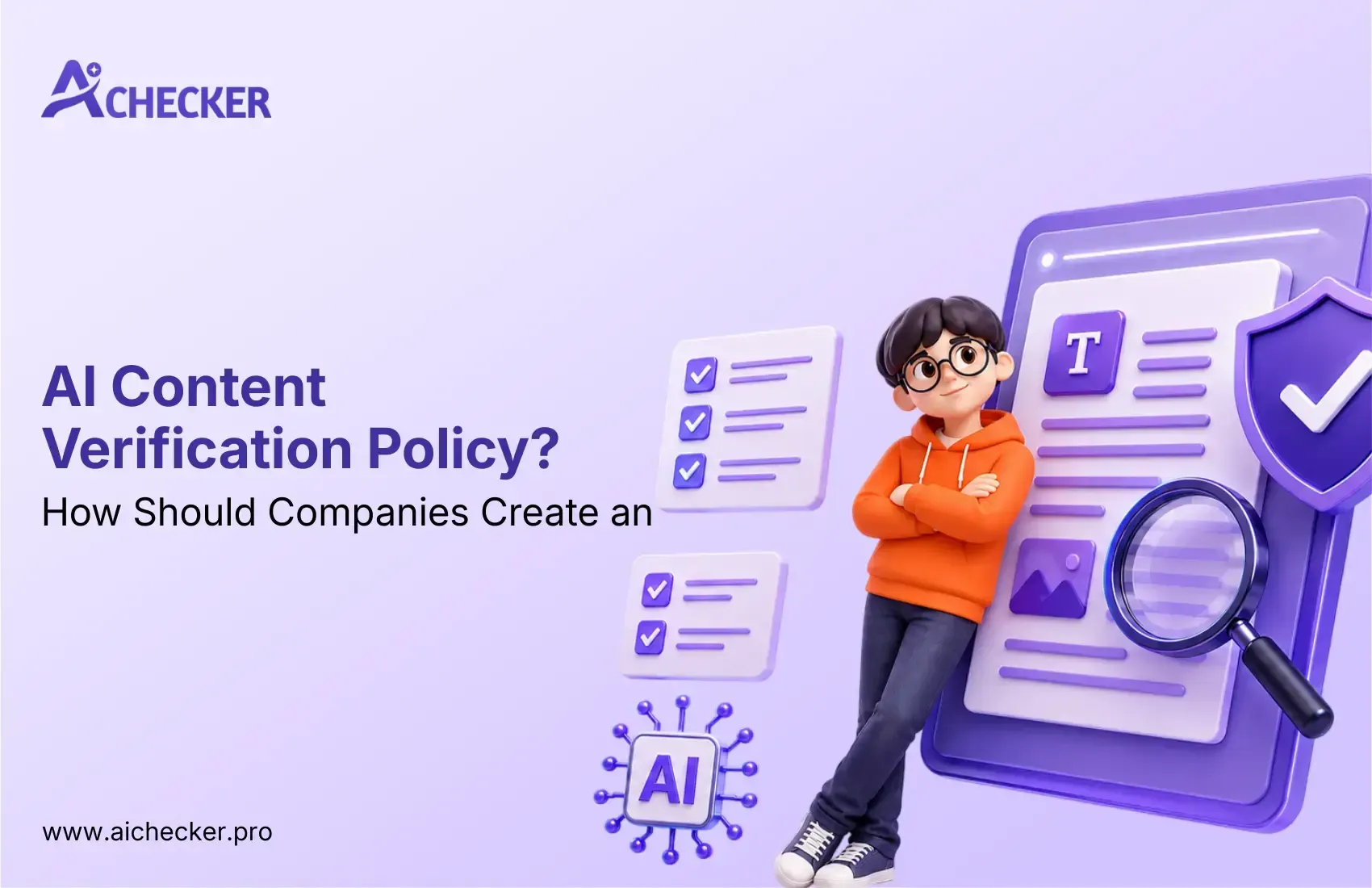
Your company's content is likely being written by AI more than you think. This includes everything from blog posts and product descriptions to emails and customer service responses. That is why it is so important for every company to have a comprehensive AI content verification policy.
A policy like this is crucial to any business's success. Otherwise, you are leaving yourself open to false claims and misleading consumers.
Below is an outline for this guide:
What is an AI Content Verification Policy? Why do we need one? And finally, how can we develop an effective AI content verification policy?
What Is an AI Content Verification Policy?
An AI content verification policy is a formal set of rules that governs how a company creates, checks, approves, and publishes AI-generated content.
It answers questions like:
Who can use AI tools to create content? What must be fact-checked before publishing? Who signs off before content goes live? How do you disclose AI involvement? What happens if AI content is factually wrong?
Think of it as the rulebook that sits between "AI drafted this" and "this is safe to publish."
This is not the same as a general AI use policy for businesses that covers topics like data privacy and access to tools; it's more focused on quality and accuracy of results.
Why Every Business Needs an AI Content Verification Policy Today
AI content tools are fast, but speed without oversight creates real business risk.
Here's what's at stake without a proper AI content compliance process in place:
Factual errors: AI models can confidently state incorrect information (commonly called "hallucination") Brand voice drift: AI content that doesn't sound like your company Legal exposure: copyright issues, unverified claims, or regulatory violations SEO penalties: low-quality, unedited AI content can hurt search rankings Customer trust damage: inaccurate content erodes credibility fast
A Stanford HAI study found leading AI models still hallucinate facts in a meaningful percentage of outputs, even the best-performing tools aren't error-free. You can read more on how these gaps show up in practice in this breakdown of common AI detection problems.
For a business publishing content daily, that adds up to real risk without a checkpoint in place.
If you're looking to build a custom AI agent that handles content drafting and built-in verification checkpoints, AIChecker Pro can help you design that workflow from scratch.

Get Lifetime Access with 60% OFF
Stop paying monthly subscriptions. Enjoy unlimited AI detection and humanizer access forever with future updates included.
- One-time payment
- Unlimited access forever
- All future updates included
Core Components of an Effective AI Content Verification Policy
A strong policy isn't a single rule, it's a system. Here are the seven components every enterprise AI content policy should include.
1. Clear AI Usage Guidelines
Define exactly where AI is allowed to help and where it isn't.
For example:
Blog drafts, meta descriptions, internal notes First-draft social captions Legal disclaimers or compliance-sensitive copy without legal review Final financial or medical claims without expert sign-off
2. Human Review & Approval Workflow
No AI content should go live without a human checkpoint. This is the backbone of any real AI content approval workflow.
At minimum, define:
Who reviews first (writer, editor, subject-matter expert) Who gives final approval What the escalation path looks like for disputed content
3. Fact-Checking & Source Verification
Every factual claim, statistic, or quote generated by AI needs a verifiable source.
A simple rule that works well: no citation, no publish. Understanding how AI content detectors work can help your team spot unverified claims before they ever reach an editor.
4. Disclosure & Transparency Rules
Decide when (and how) you'll disclose AI involvement to readers, clients, or regulators. Some industries (finance, healthcare, legal) already require this by law.
5. Compliance & Legal Standards
Your policy should align with:
FTC guidelines on AI-generated marketing claims Copyright and IP considerations Industry-specific regulations (HIPAA, FINRA, etc.)
6. Quality & Brand Voice Standards
AI content should sound like you, not like a generic chatbot. Build a style guide AI tools (and human editors) can reference, and lean on resources like this guide to humanize AI content so your published pieces keep a consistent, natural tone.
7. Audit Trail & Documentation
Keep records of what was AI-generated, who reviewed it, and when it was approved. This protects you if content is ever challenged.
Step-by-Step Guide: How to Build Your AI Content Verification Policy
How to create an AI content verification policy? The process is surprisingly simple, and your AI content verification checklist should be designed to make everyone's job easier and more standardized. Take this approach as a reference.
Step 1: Audit Your Current AI Usage
Start by understanding how AI is already being used across your organization. Many companies discover that employees are using multiple AI tools without any formal guidelines.
Ask questions like:
Which AI tools are employees using? What type of content is being generated with AI? Which departments rely on AI the most? Is AI being used for drafting, editing, research, or publishing?
This audit provides a clear baseline and helps identify where governance is needed first.
Step 2: Identify High-Risk Content Areas
Not every piece of AI-generated content carries the same level of risk. Categorize your content based on its potential business impact.
For example:
Low Risk: Internal meeting notes, brainstorming documents, outlines Medium Risk: Marketing blogs, social media posts, newsletters High Risk: Legal documents, financial reports, healthcare content, compliance materials, customer contracts
Prioritize verification efforts where errors could create legal, financial, or reputational consequences.
Step 3: Create Clear Policy Guidelines
Once you've classified content by risk, define straightforward rules for each category.
Your policy should answer questions such as:
When is AI allowed? What level of human review is required? Are citations mandatory? Which AI tools are approved? When should content be rewritten or rejected?
Avoid overly complex policies. Clear and practical guidelines are much easier for teams to follow consistently.
Step 4: Assign Ownership
Every stage of content creation should have a responsible owner. Without accountability, verification often gets skipped.
Clearly define roles such as:
Content creator Editor or reviewer Subject matter expert Final approver Policy owner responsible for updates
Everyone should know exactly where their responsibility begins and ends.
Step 5: Build a Standard Review Workflow
AI Draft → Fact Verification → Citation Review → Brand & Tone Check → Compliance Review (if required) → Final Approval → Publish
A standardized workflow reduces inconsistencies and makes quality control much easier to manage.
Step 6: Train Your Team
Even the best policy won't work if employees don't understand its purpose.
Training should focus on:
Why AI verification matters Common AI hallucinations and factual errors How to verify claims efficiently When human expertise is required Best practices for responsible AI usage
When people understand the reasoning behind the policy, adoption becomes much smoother. Sharing practical resources such as tips to avoid AI detection in writing during training can also help teams understand how AI content is evaluated in the first place.
Step 7: Pilot the Policy and Improve It
Do not apply your policy to every single article created by the company at once.
First, you should trial run your new policy on a few AI article drafts or on one department, analyze the feedback, and make adjustments based on that information. This is because AI is constantly evolving and you need to keep your policy up to date as well.
Step 8: Automate Verification Wherever Possible
Manual verification works for small teams, but it quickly becomes inefficient as content volume grows.
This is where AI-powered automation becomes valuable.
AI agents can automatically:
Flag unsupported or unverified claims Detect missing citations Identify inconsistent tone or brand voice Highlight factual inaccuracies Check compliance with internal content policies Route content to the appropriate reviewer
Automation allows human reviewers to focus on critical decisions instead of repetitive quality checks. Many teams also run a quick pass through a reliable AI detector as part of this stage to confirm content still meets internal standards before it moves further down the pipeline.
AI Content Review Process: Sample Workflow
Here's what a typical AI content review process looks like in practice:
| Stage | Responsible Party | Action | Output |
|---|---|---|---|
| 1. Draft | AI tool + Writer | Generate first draft | Raw AI content |
| 2. Fact-check | Editor / SME | Verify claims, sources, stats | Verified draft |
| 3. Brand review | Content lead | Check tone, voice, formatting | Brand-aligned draft |
| 4. Compliance check | Legal/Compliance (if needed) | Review sensitive claims | Compliant draft |
| 5. Final approval | Manager/Owner | Sign-off | Published content |
| 6. Audit log | Content ops | Record who approved what, when | Documentation |
What to Include in Your AI Content Verification Policy Template
If you're starting from scratch, your written policy should cover:
Purpose statement: why the policy exists Scope: which teams and content types it applies to Approved AI tools: a defined list, not a free-for-all Review roles: who checks what Fact-checking standards: sourcing requirements Disclosure rules: when AI use is stated publicly Escalation process: what happens when something's wrong Review cadence: how often the policy itself gets updated
Keep it to 2-3 pages. A policy nobody reads doesn't protect anyone.
Common Mistakes Companies Make with AI Content Governance
Many companies understand the importance of establishing AI content governance but face the challenge of determining how to implement it correctly. One of the worst approaches is to have no policy at all, leaving employees to do as they see fit, which leads to poor quality, compliance risks, and a lack of accountability.
Many companies focus too heavily on certain types of content, such as web articles and blog posts, while neglecting other essential ones, such as email, social media, and various other materials that pose identical threats. This is especially true for bloggers and content teams who often assume detection risk only applies to long-form articles.
Tools & Technology to Support Your AI Content Governance Framework
Manual review works fine at small scale. But once you're publishing dozens of pieces a week across blog, social, email, and support content, manual checks become a bottleneck.
This is where AI agents come in, not to replace human review, but to make it faster and more consistent:
Fact-check agents that flag unsupported claims automatically Brand voice agents that catch tone drift before a human even sees the draft Compliance agents that scan for regulatory red flags Approval routing that automatically sends content to the right reviewer
If you're evaluating how to bring this kind of automation into your AI content review process, AIChecker Pro specializes in building custom AI agents that plug directly into your existing content and approval workflows. Businesses weighing the tradeoffs between speed and accuracy may also find this look at AI detection and humanization for businesses useful when shaping their own governance stack.
Real-World Example: How a SaaS Company Improved AI Content Quality
A medium-sized B2B SaaS company utilized AI writing tools for publishing more than 15 blog posts per month. Since these tools only provided a basis for creation, the company had to implement a thorough review policy for all AI-generated posts.
As a result, the first two blog posts contained incorrect product statistics, which damaged the company's reputation and required extra time and effort for revision.
The new policy considerably reduced errors in content creation, and the revision process became faster due to a checklist used for proofreading and publishing articles. Teams looking to replicate this can also draw on strategies from how AI can be used to write content that ranks on Google while still holding a firm verification standard.
Conclusion
An AI content verification policy is not about slowing down your team but about accelerating AI content production while ensuring high accuracy and brand safety. First, define the rules, owners, and review process.
Would you like to create an AI content review workflow that is guaranteed to scale exponentially with your business? AIChecker Pro offers organizations a solution to design and implement AI agents for content verification, fact-checking, and approval automation. Contact us to discuss your requirements.
FAQs
1. What is an AI content verification policy?
2. Why do businesses need an AI checker before publishing content?
3. Is there a free AI detector businesses can use?
4. How does an AI detector work?
5. What's the difference between an AI checker and a ChatGPT detector?
6. Can an AI text detector be wrong?
7. What does it mean to humanize AI text?
8. Why should you humanize AI content before publishing?
9. Is a free AI checker accurate enough for business use?
10. How often should companies update their AI detection tool?

Harshil Barvaliya
SEO Executive & Content Writer at AI Checker Pro
I’m Harshil Barvaliya, an SEO Executive and Content Writer at AI Checker Pro. I focus on improving the website’s search engine visibility through effective SEO strategies, including keyword research, on-page and off-page optimization, and content development.Get Started Free
Create a free account for advanced AI detection and scan history.
Trusted by thousands worldwide.
Recent Blog's
Discover how AI-powered content creation can elevate your website's reach and engage your audience like never before. Explore the real impact of AI on crafting content that connects.