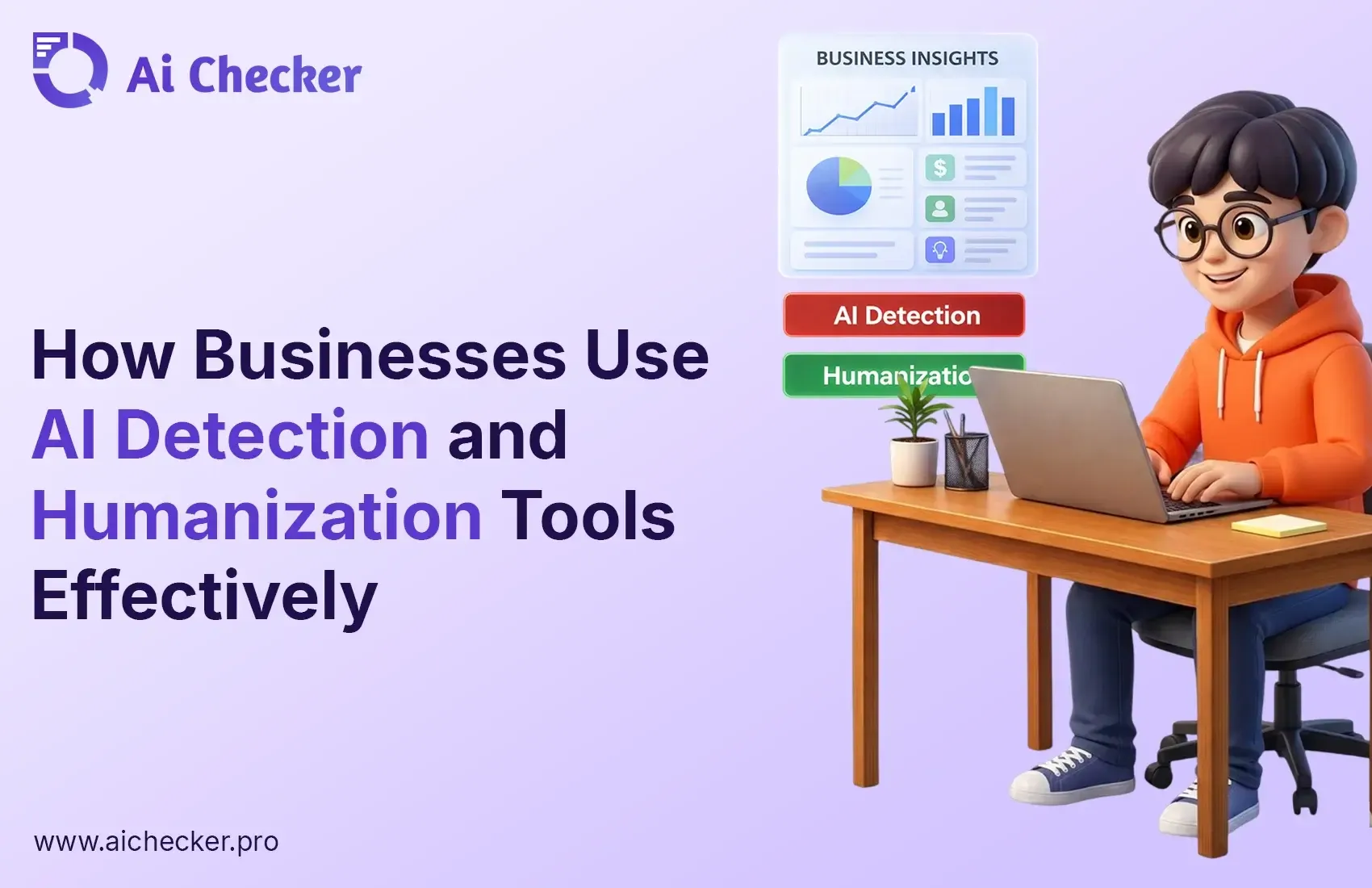
How Businesses Use AI Detection and Humanization Tools Effectively
TABLE OF CONTENTS
Why AI Content Is Growing Fast
Why Businesses Care About Detection and Humanization
What Are AI Detection Tools?
What Are AI Humanization Tools?
Why Businesses Use These Tools
Where Businesses Use AI Detection
Where Businesses Use Humanization Tools
Step-by-Step Process Businesses Follow
Best Practices for Using AI Detection
Challenges and Limitations
Future of AI Detection and Humanization
Conclusion
Get an AI summary of this post on:





A few years ago, if you wanted to create a blog post, a product description, or a weekly newsletter, you needed to hire a writer. Today, thousands of businesses create content that includes AI-generated material using tools such as ChatGPT, Claude, and Gemini. The speed is astonishing. The cost savings are real. And the volume of output surpasses what any human team could produce alone.
But as AI writing reached peak popularity, so did detection tools. Publishers, universities, hiring managers, and search platforms all began asking the same uncomfortable question and that question gave birth to an entirely new category of software. Understanding the full landscape of AI detection and humanization is now a business necessity, not just a technical curiosity.
The article describes how companies balance their operations with AI detection systems and humanization technologies to create authentic, readable material that holds up under scrutiny.
Why AI Content Is Growing Fast
By 2024, most online content creation was receiving some level of AI assistance. The marketing industry, e-commerce sector, and media companies all adopted the technology because of its financial advantages.
A single product description takes approximately 20 minutes to write manually. A full team needs months to complete 5,000 product descriptions. An AI system can generate those same descriptions within hours giving startups without large content budgets a serious edge.
Then there is the SEO element. Content marketing works when you publish consistently and at volume. Publishing consistently at volume for SEO was previously only achievable for companies with deep pockets. AI changed that equation for businesses that previously couldn't afford it. Teams developed their entire content range blog posts, social media captions, email sequences, and landing pages at a pace that was simply impossible before.
But the adoption wasn't just about speed. AI tools have improved dramatically. What once produced awkward, obviously robotic output has evolved into something far more capable. Modern AI writing systems now produce content that is far harder to distinguish from human writing which is why understanding AI-written content that actually ranks has become a critical skill for content strategists.
Why Businesses Care About Detection and Humanization
The tension is real. AI-generated content delivers high productivity but carries potential risks.
The first concern is search performance. Google and other search engines have made clear that content quality matters more than its source. Content that uses standardized language, unnatural sentence patterns, and lacks genuine insight will not perform well regardless of how fast it was produced. High bounce rates quickly reveal when readers are not engaged. Businesses concerned about whether Google penalizes AI content are right to investigate before publishing at scale.
Trust is a second major factor. A law firm publishing AI-generated legal advice, a healthcare brand releasing AI-drafted patient guidance, or a journalist submitting AI-written news to an editor all three face significant credibility risks if their content has not been reviewed and verified properly.
Finally, platform rules require careful attention alongside reputation management. AI-generated material faces increased scrutiny from academic journals, freelance platforms, and certain advertising networks. Organizations that violate those rules face both financial and reputational consequences.
Businesses found they needed two things: a way to check their content for AI signals, and a method for refining that content until it reads like authentic human writing.
What Are AI Detection Tools?
AI detection tools are software applications that analyze text to determine how likely it is that the content was written by AI rather than a human. Understanding how AI detection works at a technical level helps businesses interpret their scores accurately and make smarter editing decisions.
These tools primarily look for two signals: perplexity and burstiness.
Perplexity measures how predictable the text is. AI models are trained to generate the most statistically likely word combinations, which makes their output feel "safe" and uniform. Human writers surprise you they choose unusual words, digress, use humor, or structure sentences in unexpected ways. Low perplexity often signals AI.
Burstiness describes how much variation exists in sentence length and complexity across a piece of writing. Human writers naturally alternate between long, complex sentences and short, punchy ones. AI tends to maintain a consistent structure that becomes identifiable once you know what to look for.
Tools like Originality.AI, GPTZero, Winston AI, and Copyleaks use these signals along with additional proprietary models to generate percentage scores showing how likely content is to be AI-generated. No tool is perfect, but together they give businesses a reliable quality-assurance layer before publishing.
What Are AI Humanization Tools?
If detection tools ask "Does this read like AI?", humanization tools answer: "Let's fix that."
Learning how to humanize AI text effectively means understanding what these tools do under the hood: they restructure sentence patterns, swap in less common vocabulary, and shift tonal elements to produce writing that reads as though it was authored by a human.
Some tools automate this entirely. Platforms like Undetectable.AI, HIX Bypass, and QuillBot's paraphraser allow users to submit AI-generated content and receive a transformed version that achieves lower detection scores. Other tools function more like writing assistants flagging problematic passages and offering alternative phrasings.
But good humanization goes beyond gaming detection systems. The best humanization tools genuinely improve the writing. They push content toward specificity, voice, and flow the qualities that make readers want to keep reading. Content that reads like it came from a real person consistently earns higher conversion rates, better search rankings, and stronger audience trust than content that feels machine-produced.
Why Businesses Use These Tools
Different industries have different reasons for adopting these tools. Understanding how content teams use AI detection shows just how varied and strategic those reasons can be.
Agencies and in-house marketing teams need to publish content they can stand behind. Detection tools let them build confidence that content will not trigger reader skepticism or platform alerts before it goes live.
Client requirements. Many clients now specify that their content must either be human-written or must pass AI detection tests. Businesses delivering on those promises need reliable checking tools built into their workflow.
Platform compliance. Amazon sellers, Upwork freelancers, and contributors to certain media platforms must follow terms that restrict AI-generated content. Detection tools help organizations verify compliance before submitting.
Editing efficiency. Businesses also use detection tools to identify which sections of an AI draft need the most human attention making the editing process faster and more targeted.
Where Businesses Use AI Detection
Publishing and journalism. Digital media companies require editorial teams to validate submitted content using detection tools before acceptance. This has become standard practice among organizations that accept outside contributors.
Educational platforms. E-learning companies use detection tools to validate that course content, assessments, and instructor notes reflect genuine human expertise. The growing conversation around AI content detection in education reflects how seriously institutions are taking this issue.
SEO agencies. Agencies handling content for multiple clients use AI detection tools for SEO content during their editorial process to catch material that could fail quality assessments before it reaches the client.
Human resources departments. Companies receiving job applications, cover letters, or writing samples sometimes use detection tools to identify submissions that may have been entirely AI-generated especially for roles where writing is a core skill.
Legal and compliance teams. Firms producing client-facing documents or regulatory filings check their drafts to ensure nothing sounds templated or suspiciously uniform.
Where Businesses Use Humanization Tools
Marketing copy. Product descriptions, email campaigns, and landing page copy all benefit from humanization. The goal is to make AI-generated content feel personalized and on-brand not like a template filled in by a machine.
Blog and thought leadership content. Long-form articles benefit most from humanization. Authentic, humanized content has a distinct voice, specific examples, and a perspective that makes it feel authoritative. The deeper reason this matters is that authenticity always wins in the long run both with readers and with search algorithms.
Social media content. AI tends to create social media posts that feel overly polished and generic. Informal humanization passes and quick human edits help restore the natural personality that these platforms reward.
Customer service scripts and FAQs. Businesses use humanization processes on chatbot scripts and help center articles to create content that sounds natural to customers not like a standardized response system.
Step-by-Step Process Businesses Follow
The companies that succeed with this approach have developed a structured content workflow where both tools integrate smoothly. Here is a typical process.
- Brief and outline. A human creates the content brief the topic, audience, angle, and key points to cover.
- AI draft. The AI tool produces a first draft based on that brief.
- Detection check. The draft is run through a detection tool. Sections that score high on the AI likelihood scale are flagged.
- Human review and editing. A human editor rewrites flagged sections, adds personal anecdotes, specific examples, or brand voice elements. Following a proven framework to improve your writing to pass AI detection can make this step significantly faster.
- Humanization tool pass (optional). If the piece still feels too uniform, a humanization tool is applied to specific sections.
- Second detection check. The revised content is checked again to confirm the score has dropped to an acceptable level.
- Final review. A human reads the entire piece for quality, accuracy, and tone before publication.
Best Practices for Using AI Detection
Don't use AI as a replacement for thinking. The best outputs happen when humans bring the ideas, structure, and perspective and AI handles the drafting. Content that starts with genuine insight survives detection much better than content that starts with a vague prompt.
Edit aggressively. Treat the AI draft as a starting point, not a finished product. The more you reshape it, the more it becomes yours.
Add specificity. AI tends toward the general. Replace generic claims with specific data, named examples, and concrete scenarios. This is both good SEO practice and the fastest path to humanizing content. Applying proven tips to avoid AI detection consistently at this stage pays significant dividends.
Match your brand voice. If your brand has a defined tone informal, expert, witty, or direct make sure the final content reflects it. Humanization tools can help, but a strong style guide and a sharp editor work better.
Don't rely on one detection tool. Different tools use different models and produce different scores. If you need content to pass reliably, test it on two or three platforms before publishing.
Challenges and Limitations
Detection tools create false positives. Human-written content that follows predictable patterns can be flagged as AI-generated. Businesses and writers have faced consequences for content they created entirely by hand which is an important limitation to communicate to clients and stakeholders.
Humanization software can introduce inaccuracies. Automated rewriting transforms entire sentences, and the results are not always faithful to the original meaning. Over-processed content can lose coherence and structure.
The arms race is real. Detection models require constant retraining because AI writing keeps improving. Humanization tools develop new methods to counter improved detection systems in response. The honest reality about whether humanizer tools actually bypass detection is more nuanced than most marketing claims suggest and businesses need to understand that landscape before building it into their workflow.
Ethical questions remain unresolved. How much human input does content require before it can be authentically attributed to a human author? These questions vary across contexts, but businesses using these tools need to evaluate them seriously.
Future of AI Detection and Humanization
The landscape is changing rapidly, and one direction seems increasingly clear. Detection technology will evolve beyond text pattern analysis to incorporate metadata, behavioral signals, and cross-document consistency checks making it harder to game the system through surface-level rewrites.
All companies will eventually need formal AI content policies because audiences will demand transparency about how content is created. Content labeling for AI-assisted material may become standard practice operating much the way sponsored content disclosures work today.
Content management systems and publishing platforms will integrate humanization tools directly, building editing and verification into the publishing flow. Staying ahead of this means understanding which AI detection model fits your workflow today not after the landscape has shifted further.
The businesses that succeed will be the ones that treat AI as essential infrastructure but infrastructure that requires skilled human oversight to perform at its highest potential.
Conclusion
AI content will continue to be examined and it will continue to be produced. The businesses that thrive are the ones that stay focused on authentic quality while using AI as a tool to accelerate and scale that quality, not replace it.
AI detection tools serve as quality assessment instruments checkpoints businesses use to inspect their work before publishing, not finish lines to cross. Humanization tools help content reach a more natural register, but they still require skilled human editors to produce results worth publishing.
Specificity, real examples, and conversational language are what make content relatable. And above all, being transparent about AI use builds the kind of trust that sustains a brand long-term. The businesses that embrace this approach work smarter and produce content that genuinely earns its place in front of an audience.
1. What are AI detection tools?
2. Why do businesses use AI detection tools?
3. What are AI humanization tools?
4. Do AI detection tools give 100% accurate results?
5. Why is humanizing AI content important?
6. Can businesses rely only on AI tools for content creation?
7. Where are AI detection tools commonly used?
8. How do businesses combine AI detection and humanization tools?
9. What are the risks of overusing humanization tools?
10. What is the future of AI detection and humanization?

Nathan Porter
Content writer at @Aichecker
I am a content writer at AI Checker, where I craft engaging, SEO-optimized content to enhance brand visibility and educate users about our AI-driven solutions. My role involves creating clear, impactful messaging across digital platforms to drive engagement and support company growth.Get Started Free
Create a free account for advanced AI detection and scan history.
Trusted by thousands worldwide.
Recent Blog's
Discover how AI-powered content creation can elevate your website's reach and engage your audience like never before. Explore the real impact of AI on crafting content that connects.