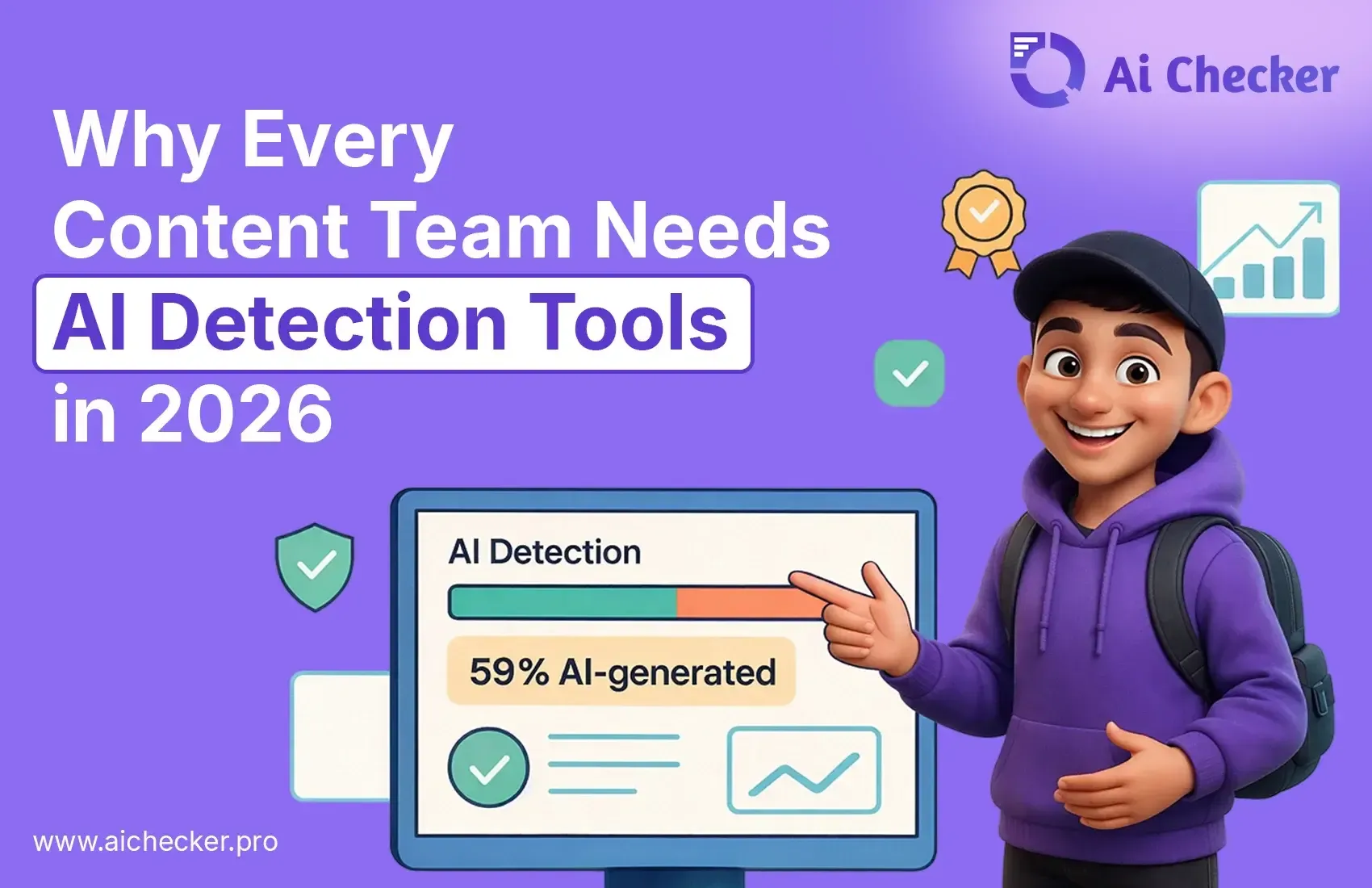
Why Every Content Team Needs AI Detection Tools in 2026
TABLE OF CONTENTS
From Manual to AI-Assisted Creation
The State of Content Creation in 2026
What Are AI Detection Tools?
Why Content Teams Need AI Detection Tools
Key Use Cases
The SEO Perspective
The Real Benefits
Limitations You Should Know About
Popular AI Detection Tools in 2026
Best Practices for Content Teams
The Future of AI Detection
Conclusion
FAQs
Get an AI summary of this post on:





Modern content workflows now require AI writing tools as essential components. The situation has moved into a new development stage not an emergency, but a more complex and fascinating reality.
Content teams face a challenge that operates at a lower volume yet demands more resources: maintaining genuine work standards while protecting their operational processes.
From Manual to AI-Assisted Creation
Just a few years ago, content creation was almost entirely manual. Writers drafted, editors reviewed, teams revised. It was slow, expensive, and entirely human.
Then came the AI wave. First-generation tools helped with brainstorming and outlines. Second-generation tools could produce full drafts. By 2025, AI-assisted content had become the industry norm rather than the exception. A recent survey by the Content Marketing Institute found that over 78% of content teams were regularly using some form of generative AI in their workflows.
Authenticity concerns started quietly, at first. Clients began asking whether their blog posts were actually written by humans. Brand voices started drifting. Content that looked polished on the surface felt hollow underneath. Quality assurance became harder when you couldn't always tell what had been written by a person and what had been generated by a model.
The State of Content Creation in 2026
AI writing tools have reached an advanced stage of development. Models like GPT-5, Claude 3.5, and Gemini Ultra have developed advanced abilities to replicate human writing styles, create complex arguments, and generate extended text that appears to be human-made.
Content Velocity vs. Quality
The pressure to produce more content faster has pushed many teams to lean heavily on AI often without adequate guardrails. The result is high output volume with inconsistent quality underneath.
The Human-AI Blur
As AI writing becomes more sophisticated, the line between human and machine-generated content grows increasingly difficult to identify, making structured detection processes more necessary than ever.
What Are AI Detection Tools?
AI detection tools are software systems that detect whether text was produced by an AI language model, by a human, or through a combination of both methods. They don't read content the way an editor does they evaluate writing by examining statistical and linguistic patterns that typically vary between human-written and machine-generated text.
How They Work
Human writing exhibits remarkable variability. Writers combine various sentence lengths with uncommon word choices, shift style across a piece, and use nonstandard constructions for artistic effect.
AI models, by contrast, operate through statistical prediction determining the most likely next word in a sequence. Detection tools exploit this distinction through several methods:
- Perplexity analysis: Measuring how "surprising" a piece of text is relative to what a language model would predict. Low perplexity often signals AI-generated content.
- Burstiness scoring: Human writing tends to alternate between short, punchy sentences and longer, complex ones. AI output tends to be more consistent in length and structure.
- Pattern recognition: AI models often overuse certain connective phrases, transition patterns, and sentence constructions. Detection tools are trained to recognize these signatures.
How They Differ from Plagiarism Checkers
This is a common source of confusion. Plagiarism detection systems such as Turnitin and Copyscape work by comparing text with published material to identify copied content. AI detection tools operate differently they examine text through its writing style and statistical features, not by comparing it to existing documents.
An AI detector can flag content as potentially AI-generated even when it contains entirely "original" material not duplicated from any source. The two tools serve different editorial functions and should be used together, not interchangeably.
Why Content Teams Need AI Detection Tools
Protecting Original Voice
Brand voice is one of a content team's most important and difficult-to-replicate assets. Developing tone guidelines, style rules, and editorial sensibility for a brand takes months. Careless use of AI tools creates a flattening effect that removes the unique writing characteristics that define a brand's content. Editors use detection tools to find sections of a draft that have drifted into generic AI-written content catching the issue before publication.
Avoiding Over-Reliance on AI
The real danger occurs when teams depend too much on AI to do their thinking for them. Writers who stop drafting their own work lose their ability to reason through what needs to be said. Detection tools establish checkpoints that require human participation instead of allowing automatic approval of AI-generated content.
Editorial Quality Control at Scale
At scale, you can't read every piece of content as carefully as you'd like. Detection scores provide editors with an initial assessment not a definitive conclusion, but an effective indicator of where detailed review is needed. A piece that scores 80% AI likelihood is worth a second look before it goes live.
Key Use Cases
Content Agencies
Agencies operate under pressure from two directions: clients who want more content faster, and the need to maintain quality standards that justify their rates. AI detection tools enable agencies to develop precise internal guidelines around acceptable degrees of AI assistance and monitor compliance across their writing teams.
In-House Content Teams
Brand consistency is the primary concern for internal teams. When a company's blog begins to sound like every other tech company blog polished but slightly formal, unnaturally smooth detection tools identify the drift before it becomes a brand issue.
Freelancers
Clients increasingly expect transparency around AI use. Freelancers who document their process and use detection as a self-audit mechanism are better positioned to demonstrate the value of their human contribution.
Academic and Research Validation
Universities and research institutions have been using AI detection since the early days of generative AI. In 2026, the tools are part of standard submission review at many institutions though their limitations mean they are used as one input among several, not as a final verdict.
Compliance and Brand Voice Protection
In regulated industries finance, healthcare, legal content accuracy and accountability are mandatory. AI detection tools function as one component within a broader compliance system, helping organizations monitor machine-generated content and ensure human review occurs before anything goes live.
The SEO Perspective
Google's Actual Position
Google evaluates content on quality, usefulness, and relevance not on how it was created. A well-researched, accurate, genuinely helpful article produced with AI assistance is fine. A shallow, repetitive, keyword-stuffed article written entirely by a human is not.
Running an AI detection check will not directly boost your rankings.
Where Detection Helps SEO Indirectly
The connection is indirect but real. AI-generated content at scale particularly when it's low-effort, templated, and thin on genuine insight tends to underperform in search. It generates less engagement, fewer backlinks, and shorter dwell times. Detection tools help editors identify this kind of hollow content before it goes live, prompting improvements that do matter for SEO.
Think of it less as "detection for Google" and more as "detection as a proxy for quality."
The Real Benefits
- Editorial credibility: Organizations that establish AI usage policies with enforcement mechanisms gain greater market trustworthiness.
- Risk reduction: Client-facing agencies protect their business from disputes through documented AI use processes that define their delivery standards.
- Transparency culture: Detection tools help teams define acceptable AI practices and optimal usage boundaries, strengthening editorial culture through that clarity.
- Trust with audiences: Readers in 2026 are increasingly skeptical of content. Material that demonstrates real human insight, knowledge, and personal expression builds the trust that drives loyalty and return visits.
Limitations You Should Know About
Accuracy Is Not Absolute
Even the best tools in 2026 don't achieve 100% accuracy. Results vary across content types, and at scale, margin-of-error scenarios accumulate.
False Positives Are Real
Certain human writing styles formal academic prose, technical documentation, or writers who naturally use clean and structured sentences can trigger false positives. A human expert writing precisely and efficiently might score surprisingly high on AI likelihood. Excessive dependence on detection scores creates real problems.
The Humanization Challenge
A growing industry of "AI humanization" tools specifically exists to rewrite AI-generated content to evade detection. These tools introduce deliberate inconsistencies, vary sentence structures, and mimic human stylistic patterns. It's an arms race, and detection tools are constantly playing catch-up.
Ethical Gray Areas
Implementing AI detection as a surveillance mechanism can damage workplace trust. Writers who feel monitored rather than supported respond accordingly. How you introduce detection tools to your team matters as much as which tools you choose.
Popular AI Detection Tools in 2026
| Tool | Strengths | Best For |
|---|---|---|
| AI Checker (aichecker.ai) | Strong perplexity measurement, multi-language support, API access | Agencies managing high content volume |
| Copyleaks | Combines plagiarism and AI detection, strong enterprise accuracy | Publishers needing an all-in-one solution |
| Writer (writer.com) | Integrated into a full content management system | Internal teams with established style standards |
| Originality.ai | Bulk scanning, team management, readability scoring | SEO and content agency market |
| GPTZero | Sentence-level analysis showing where AI content appears | Academic contexts |
Each tool has trade-offs around accuracy, pricing model (per-word vs. subscription), API availability, and language support. The right choice depends on your volume, budget, and how detection fits into your existing workflow.
Best Practices for Content Teams
Read Scores Contextually, Not Literally
A 65% AI likelihood score doesn't mean 65% of the content is AI-generated. It means the tool finds the writing statistically consistent with AI patterns to that degree. Treat scores as editorial signals, not verdicts.
Always Combine with Human Review
Detection tools work best as a first filter, not a final judgment. When something scores high, a human editor should investigate examining coherence, voice, depth of insight, and accuracy of claims. The tool opens the conversation; the editor closes it.
Build Balanced Workflows
Define clear internal guidelines: what levels of AI assistance are acceptable, what requires disclosure, and what requires human rewrite. Detection tools are most valuable when they support a workflow that's already thoughtfully designed, not when they're being used reactively to fix a process that doesn't exist.
Avoid Detection Obsession
Some teams develop an unhealthy fixation on getting content to score "100% human" running it through humanization tools, tweaking phrasing endlessly. This misses the point. The goal is genuine quality, not a clean score. Content that is thoughtful, accurate, and useful is doing its job regardless of what the detector says.
The Future of AI Detection
Detection technology is shifting from document-level scoring toward sentence and paragraph-level analysis identifying which specific sections of a piece feel AI-generated rather than providing a single overall score.
Standardization and CMS integration are coming. Editorial platforms will execute content verification internally, flagging issues during the draft and review stages before content reaches publication.
Governance and regulatory frameworks are also emerging. The EU AI Act and developing US and UK frameworks are establishing standards for AI content disclosure in specific contexts. Detection tools will be integrated into compliance processes that extend well beyond editorial functions.
Will detection tools become obsolete as AI writing becomes truly indistinguishable from human writing? Possibly, in their current technical form. But the mission content governance, quality control, and editorial responsibility will remain. The tools will evolve to serve that mission even as the specific challenge of "detecting AI" changes shape.
Conclusion
AI detection tools exist not to eliminate AI from content workflows, but to ensure it's used responsibly with human oversight, quality standards, and editorial accountability intact.
The content teams that will succeed in the coming years are those that use AI intelligently, maintain established processes, operate transparently, and have editorial systems that support high-quality work.
AI detection tools are a practical monitoring layer that advanced teams in 2026 must adopt not as absolute proof of anything, but as one essential input in a thoughtfully designed content operation.
FAQs
1. What are AI detection tools?
2. Are AI detection tools 100% accurate?
3. How do AI detectors identify AI-generated content?
4. Can human-written content be flagged as AI?
5. Do AI detection tools replace human editors?
6. Are AI detection tools useful for SEO?
7. What is the difference between AI detection and plagiarism checking?
8. Should content teams avoid AI completely?
9. Can AI-generated content be “humanized” to avoid detection?
10. Why are AI detection tools important in 2026?

Megan Harris
Content writer at @Aichecker
I am a content writer at AI Checker, where I craft engaging, SEO-optimized content to enhance brand visibility and educate users about our AI-driven solutions. My role involves creating clear, impactful messaging across digital platforms to drive engagement and support company growth.Get Started Free
Create a free account for advanced AI detection and scan history.
Trusted by thousands worldwide.
Recent Blog's
Discover how AI-powered content creation can elevate your website's reach and engage your audience like never before. Explore the real impact of AI on crafting content that connects.