AI Content Policy Template for Teams: Rules, Checklist & Examples (2026)
TABLE OF CONTENTS
Key Highlights
What Is an AI Content Policy?
Why Do Businesses Need an AI Content Policy?
What Should an AI-Generated Content Policy Include?
AI Writing Guidelines for Employees
How to Review AI-Generated Content Before Publishing
AI Content Review Checklist (Before Publishing)
AI Content Policy Examples for Companies
Can AI Detectors Be Used to Enforce Content Policies?
Conclusion
FAQs
Get an AI summary of this post on:


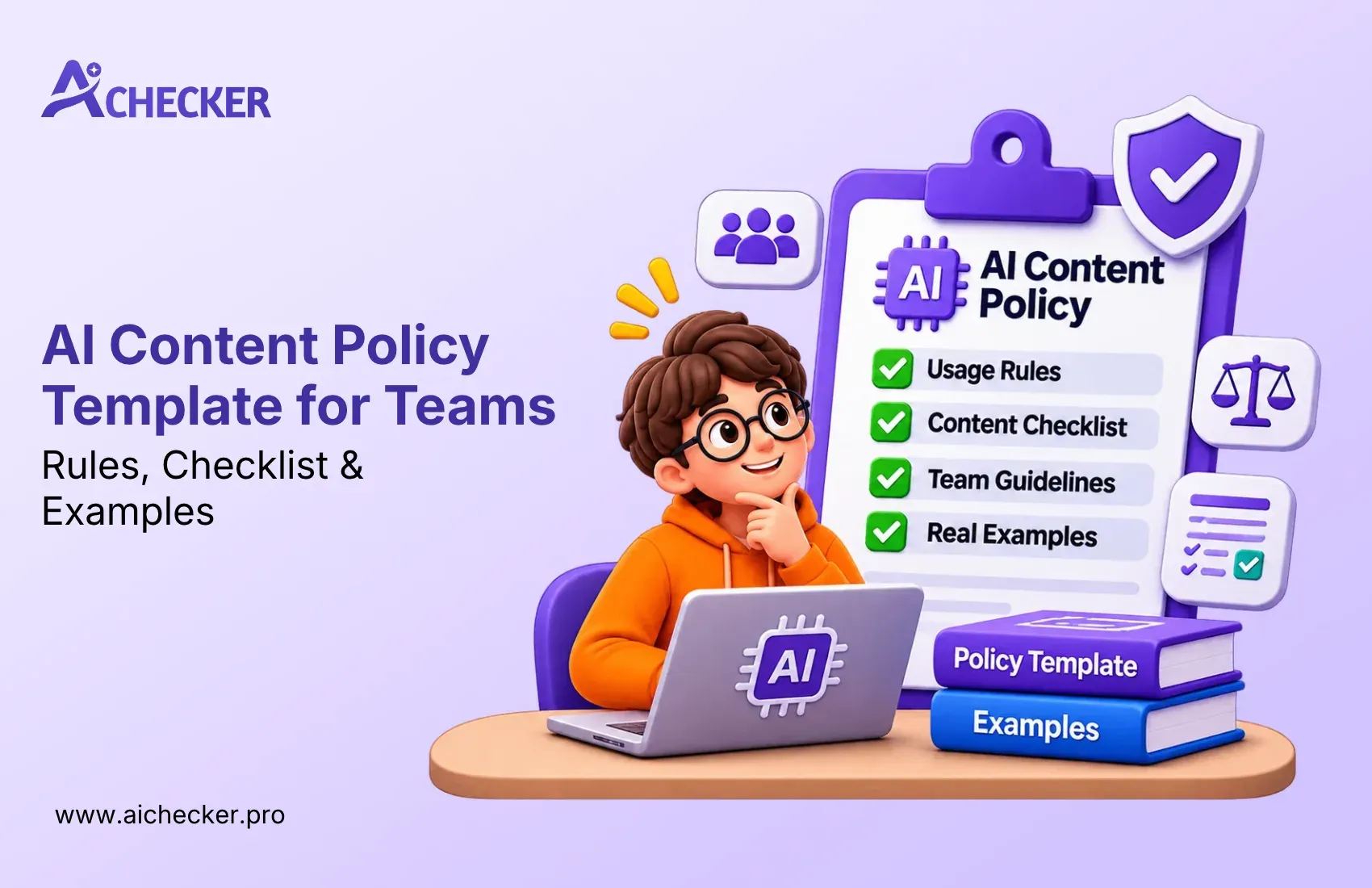
Most marketing teams I work with have started using tools like ChatGPT, Gemini, and Claude to create content. These tools save time and make writing easier, but there is one thing many teams still miss: clear rules for using AI.
An AI content policy template can help solve this problem. It gives your team a clear idea of when to use AI, how to review its output, who is responsible for checking the content, and what should never be shared or published. In simple terms, an AI content policy helps everyone use AI without compromising content quality, accuracy, or brand trust.
I've seen how easy it is to rely on AI-generated content without checking every detail. A wrong fact, copied paragraph, or confidential customer detail can create problems that are difficult to fix later.
That's why having written guidelines matters. In this guide, I'll share a ready-to-use AI content policy template, practical employee guidelines, a content review checklist, and real-world examples your team can adapt to its daily workflow.
Key Highlights
- An AI content policy explains how teams should create and publish AI-generated content, while an AI usage policy for employees covers AI use across the entire company.
- A complete policy should cover 10 key areas, including its purpose, approved AI tools, data privacy, content review, and regular updates.
- Get a ready-to-use AI content policy template with clear responsibilities for employees, managers, and content editors.
- Follow the 10-point AI content review checklist to check accuracy, originality, brand voice, and quality before publishing.
- AI disclosure rules can vary by content type, platform, location, and business agreements. Always check the rules that apply to your situation.
- AI detector scores can help flag content for further review, but they are not proof that AI wrote something. No detector is 100% accurate.
- Your organization and its reviewers remain responsible for the accuracy, quality, and compliance of everything they publish.
What Is an AI Content Policy?
An AI content policy is a set of clear rules that helps your team use AI responsibly when creating or editing content. Think about your daily content workflow: someone uses ChatGPT to write a blog, another person uses Gemini to research a topic, and an editor uses Claude to improve the draft. Who checks the facts? Which tools are safe to use? Who gives final approval before publishing?
An AI content policy answers these questions. It sets expectations for AI use, fact-checking, approved tools, content reviews, final approvals, and disclosure to readers.
However, an AI usage policy for employees covers a much wider area. It explains how employees across the company can use AI for tasks such as research, coding, customer support, data analysis, and content creation. Both policies are connected, but they serve different purposes.
| AI Usage Policy | AI Content Policy |
|---|---|
| Covers overall AI usage | Focuses on content creation |
| Defines approved AI tools | Defines content quality standards |
| Covers data security | Covers accuracy and originality |
| Applies across departments | Primarily applies to content teams |
Why Do Businesses Need an AI Content Policy?
AI tools have made content creation much faster. Your team can now draft a blog, create social media posts, or research a topic in less time. But speed alone does not guarantee good content. A wrong statistic, an unverified claim, or confidential information shared with an AI tool can create problems for your business.
This is where a ready-made AI content policy template becomes useful. Instead of letting every employee decide how to use AI, you can set clear expectations for the entire team. Good AI content governance helps you get the benefits of AI while keeping content quality, privacy, and accountability under control.
Maintain Content Accuracy and Reliability
One thing I always recommend when using AI for content is to never trust every answer without checking it. Tools like ChatGPT, Gemini, and Claude can generate convincing explanations, but they can also provide outdated statistics, incorrect facts, or made-up sources.
Your policy should make fact-checking a required step before publishing. Ask writers and editors to verify important claims, dates, statistics, and references using reliable sources. This simple habit helps your team publish content readers can actually trust.
Protect Company Data and Customer Privacy
Think about a situation where a writer pastes a client's project details, customer information, or an internal business report into an AI chatbot to get a quick summary. It may save a few minutes, but it can also expose information that should remain private.
Your AI content guidelines for teams should clearly explain what information employees can and cannot share with AI tools. Define approved platforms, restrict sensitive customer and company data, and explain when employees need permission before using an external AI service.
Maintain Brand Voice and Content Quality
Have you ever read two different articles that sound almost exactly the same? This can happen when multiple writers depend on AI-generated drafts without adding their own ideas or understanding of the topic.
Your AI content quality guidelines should explain how to maintain your company's writing style, tone, and messaging. Encourage writers to add real examples, industry knowledge, original insights, and relevant experience instead of publishing raw AI output. The goal is to make AI support your brand voice, not replace it.
Reduce Plagiarism and Copyright Risks
AI-generated content is not automatically original or free from copyright concerns. Sometimes, an output may closely resemble existing material, while AI-generated images can also raise questions about usage rights and licensing.
Make originality checks part of your content review process. Ask editors to review suspiciously similar text, check image sources and licenses, and avoid copying content directly from AI responses. These steps help reduce unnecessary legal and reputational risks.
Establish Employee Accountability
Imagine a blog goes live with incorrect information, and the writer says, "I got that answer from ChatGPT." Who takes responsibility? This is exactly the kind of confusion a written AI content policy should prevent.
Define responsibilities at every stage of the content workflow. Writers should verify their drafts, editors should review accuracy and quality, and managers should approve content when required. AI can help with the work, but the final publishing decision must always involve an accountable person.
What Should an AI-Generated Content Policy Include?
A good AI-generated content policy does not need to be a 20-page document full of complicated rules. It should be simple enough for employees to understand and practical enough to follow in their daily work.
For example, if your marketing team uses ChatGPT to draft blogs, Gemini for research, and Claude to improve existing content, everyone should know which activities are allowed and what needs human approval. A well-structured AI content policy template should cover these 10 important areas.
1. Purpose and Scope
Start by explaining why your company needs an AI content policy and who must follow it. Don't limit the rules to your in-house content team. Freelance writers, marketing agencies, editors, and other employees who create content for your business should also understand these guidelines.
Make it clear that the policy applies whenever someone uses AI to create, edit, summarize, or publish company-related content. This avoids confusion about who is covered by the rules.
2. Approved AI Tools
Your employees may already have their favorite AI tools, but that doesn't mean every platform is suitable for company work. Create a list of approved tools for writing, research, editing, image generation, and other content-related tasks.
For example, your company might approve ChatGPT, Gemini, and Claude for specific workflows. Also, explain that employees should not upload company information to unapproved AI platforms without permission.
3. Acceptable AI Usage
Employees should know where AI can help them and where human input is still necessary. Instead of restricting every AI activity, give your team practical examples of acceptable usage.
You can allow employees to use AI for:
- Brainstorming blog topics and content ideas.
- Creating outlines and preparing first drafts.
- Improving grammar, sentence structure, and readability.
- Summarizing existing documents and research.
- Repurposing blogs into social media posts or newsletters.
These activities can save time, but employees should still review the output before using it.
4. Prohibited AI Usage
Just as important as explaining what employees can do is telling them what they must avoid. Without clear restrictions, someone might publish AI-generated information without checking it or share confidential company details to get a faster response.
Your policy should clearly prohibit:
- Publishing facts, statistics, or claims without verification.
- Creating misleading or deceptive content.
- Uploading confidential company or customer information to unapproved tools.
- Copying copyrighted material without proper permission.
- Publishing AI-generated content without the required human review.
Keep these restrictions easy to understand so employees can follow them without needing constant clarification.
5. Content Accuracy and Fact-Checking
AI-generated content can look professional even when some of its information is incorrect. I've found this is especially important when working on technical blogs, product comparisons, industry reports, or content that includes statistics.
Your AI content verification policy should require writers to check facts, sources, dates, product details, and important claims before submitting a draft. For technical or industry-specific content, ask a subject matter expert to review details that require deeper knowledge.
6. Human Review and Approval
AI can prepare a draft, but it should not make the final publishing decision. Every piece of AI-assisted content should go through a review process before it reaches your audience.
Define who checks the content, who handles corrections, and who gives final approval. For example, a writer can prepare the draft, an editor can review its accuracy and readability, and a content manager can approve it for publication.
This makes accountability clear and reduces the chances of publishing unchecked information.
7. AI Content Disclosure
Your policy should explain when employees need to disclose AI assistance. This may apply to internal reports, client deliverables, published articles, images, or other content, depending on the platform and applicable requirements.
Don't assume that every AI-assisted sentence needs a public disclosure. Instead, define clear disclosure rules based on the type of content, client agreements, platform requirements, and applicable laws. Employees should know when to disclose AI use internally and when readers or clients must be informed.
8. Data Privacy and Security
Before employees use an AI tool, they should understand what information is safe to share. A prompt containing customer details, unpublished product information, passwords, or internal business documents can create serious security risks.
Set clear data-sharing limits and explain which AI tools are approved for handling company information. You should also require employees to use authorized company accounts and follow your organization's data protection rules rather than relying on personal accounts for sensitive work.
9. Copyright and Originality
AI-generated content still needs an originality and rights review. A draft may contain text that closely resembles existing material, while images, quotes, and other creative assets may have separate usage restrictions.
Your AI content policy should require originality checks before publication. Ask employees to verify image licenses, get permission where needed, and properly attribute sources. This helps protect your business from avoidable copyright and plagiarism issues.
10. Policy Monitoring and Updates
Creating an AI content policy is only the first step. AI tools, features, security practices, and regulations change regularly, so your guidelines should not remain the same forever.
Assign a person or department to manage the policy and review it at regular intervals. Update the approved tool list, employee responsibilities, and review requirements whenever your business needs or applicable rules change. This keeps your policy useful as your team adopts new AI tools.
AI Writing Guidelines for Employees
Your team will only follow rules they understand. These AI writing guidelines for employees should be short enough to fit on one page and pinned where people work.
What Employees Can Do With AI
- Generate content ideas
- Create initial outlines
- Improve sentence structure
- Summarize research
- Repurpose existing company content
What Employees Should Avoid
- Publishing raw AI drafts
- Inventing statistics or sources
- Copying competitor content
- Sharing confidential information
- Using AI images without checking the rights
AI Writing Rules for Different Teams
| Team | Permitted AI usage | Important restrictions |
|---|---|---|
| SEO team | Keyword research, outlines, drafts | Verify facts and search intent |
| Content team | Drafting and editing | Maintain originality |
| Social media team | Captions and post ideas | Check brand voice |
| Email marketing | Subject lines and drafts | Verify claims and offers |
| Product team | Documentation assistance | Validate technical accuracy |
An AI generated content policy for marketing teams works best when each team gets its own short rules. A subject line has different risks than a product manual.
How to Review AI-Generated Content Before Publishing
Having an AI content policy is a good start, but your team also needs a clear process to follow before publishing anything. A draft may look complete and professional, but that does not mean every detail is correct or ready for readers.
When reviewing AI-assisted blogs or marketing content, I recommend checking it in six steps. This AI content review and approval process helps your team catch mistakes, maintain quality, and publish content with confidence.
Step 1. Check Factual Accuracy
Start by checking every important fact in the AI-generated draft. Look closely at statistics, dates, product details, technical explanations, and industry claims because even a small mistake can affect your content's credibility.
Don't depend on another AI tool to confirm the answer. Instead, compare the information with official documentation, trusted research, company websites, or other reliable sources before approving it.
Step 2. Verify Sources and Citations
If an AI tool includes research links, references, or citations, open each one before using it. Sometimes, AI tools provide links that look relevant but do not actually support the statements in your article.
Check whether the source exists, whether the information is up to date, and whether it supports the exact claim you're making. If a reference cannot be verified, replace it with a reliable source or remove the claim.
Step 3. Check Originality and Plagiarism
Before publishing, review the draft for copied sentences, closely paraphrased content, and unnecessary similarities with existing articles. AI-generated text should not be treated as automatically original just because it was created from a prompt.
Use a plagiarism or originality checker as an additional review step. If you find similar passages, rewrite them with your own explanation, relevant examples, and original insights rather than simply changing a few words.
Step 4. Review Brand Voice and Readability
AI-generated drafts can sometimes sound repetitive, overly formal, or disconnected from your company's usual writing style. Read the content carefully and check whether it sounds natural and communicates ideas in a way your audience can understand.
Remove unnecessary phrases, simplify complicated sentences, and add relevant examples or practical experience where needed. A useful test is to read the article aloud. If it sounds awkward or unnatural, edit it before moving forward.
Step 5. Check SEO and Search Intent
Once the content is accurate and readable, review whether it meets the reader's search intent. Check keyword placement, heading structure, internal links, meta title, and meta description, but avoid adding keywords where they don't fit naturally.
More importantly, ask yourself whether the article answers the actual question behind the search. Add useful examples, clear explanations, and relevant information instead of repeating what already exists online. Google's guidance also emphasizes helpful, reliable, people-first content rather than content created mainly to manipulate search rankings.
Step 6. Complete Human Approval
Before the content goes live, send the final draft to the assigned editor, content manager, or subject matter expert for approval. They should confirm that factual checks, originality reviews, brand guidelines, and required corrections have been completed.
Keep a record of the final reviewer, approval date, and important changes. This creates a clear accountability process and ensures that AI does not become the final decision-maker in your publishing workflow.
AI Content Review Checklist (Before Publishing)
Here is a quick AI content review checklist your team can reuse for every article, email, and post.
| Review item | Checklist |
|---|---|
| Factual accuracy | Claims and statistics verified |
| Sources | References checked |
| Originality | No unauthorized copied content |
| Brand voice | Matches company guidelines |
| Readability | Clear and natural language |
| SEO | Search intent and keywords checked |
| Privacy | No confidential data exposed |
| Copyright | Content and image rights checked |
| Disclosure | Disclosure requirements reviewed |
| Human approval | Final editor approval received |
So, how can teams review AI-generated content before publishing? Run it through these ten checks, and do not publish until a named person has signed off.
AI Content Policy Examples for Companies
A written policy becomes easier to follow when employees can see how it applies to their daily work. For example, using AI to create a blog outline is different from publishing an AI-generated article without checking its facts.
The following AI content policy examples for companies show how marketing teams can use AI tools while maintaining content quality, accuracy, and brand trust.
Example 1: AI-Assisted Blog Writing
AI can help writers research topics, organise ideas, and create an initial blog outline. However, the writer or subject matter expert must verify facts, statistics, and technical claims before publication.
- Allowed: Using ChatGPT to create a blog outline, suggest headings, or improve a first draft.
- Not allowed: Publishing AI-generated research, statistics, or technical claims without verification.
Example 2: AI-Generated Social Media Posts
Social media teams can use AI to generate post ideas, write captions, and adapt content for different platforms. Before publishing, an editor should check the message, brand voice, and promotional claims.
- Allowed: Using AI to suggest LinkedIn captions, post hooks, and content ideas.
- Not allowed: Publishing misleading product claims, fake customer stories, or unsupported performance promises.
Example 3: AI-Assisted Email Marketing
AI can make email creation faster by suggesting subject lines, improving email structure, and adjusting the tone for different audiences. However, marketing teams must verify offers, prices, product details, and campaign dates before sending emails.
- Allowed: Using AI to improve subject lines, rewrite email copy, or suggest a clearer call to action.
- Not allowed: Sending emails with unverified discounts, incorrect pricing, or promises the company cannot deliver.
Example 4: AI-Generated Images and Visuals
Design and marketing teams can use approved AI tools to create blog graphics, social media images, and campaign visuals. They must also check usage rights and make sure generated images do not mislead the audience.
- Allowed: Creating original visuals with approved AI tools and properly licensed assets.
- Not allowed: Copying another brand's copyrighted images or creating misleading visuals that appear to show real people, products, or events.
Acceptable vs. Unacceptable AI Content Practices
| Acceptable use | Unacceptable use |
|---|---|
| AI-generated blog outline reviewed by an editor | Publishing a raw AI draft without human review |
| AI-assisted social caption checked for brand voice and accuracy | Publishing social posts with unchecked claims |
| AI-suggested email subject line reviewed and approved | Sending emails with unverified discounts or product promises |
| Original visual created using an approved tool and licensed assets | Using unauthorised copyrighted images or misleading visuals |
Can AI Detectors Be Used to Enforce Content Policies?
Yes, but carefully, and your AI content policy should say exactly how. I have tested a lot of AI detectors over the years, and honestly most of them should never be used as the final judge. Your AI detection policy for businesses needs to say that out loud.
How AI Detectors Help Content Teams
- They flag passages that may be AI generated
- They support content quality reviews
- They point editors to sections that need a closer look
| Tool | Detection style | Humanizer included | Best for |
|---|---|---|---|
| AI Checker Pro | Sentence level highlights | Yes | Bloggers, agencies, and business teams |
| Turnitin | Document level reports inside school systems | No | Schools and universities |
| GPTZero | Sentence and document scores | No | Teachers and general checks |
| Originality.ai | Document scores with plagiarism checks | No | Publishers and SEO teams |
This comparison reflects my own testing and general public information. Features and pricing change, so always check each tool's current page.
Why AI Detector Scores Are Not Proof
Let me be direct about this. No AI detector is 100% accurate, including Turnitin, GPTZero, Originality.ai, and Copyleaks. Here is why a score should never decide a person's job or grade:
- False positives happen. Human written text can get flagged, especially formal writing or text from non native English writers.
- Tools disagree. I ran the same batch of blog posts through three detectors last month, and the results did not match.
- Edited or humanized AI text is hard to catch. Accuracy drops a lot once AI content is paraphrased or rewritten.
- A score cannot establish authorship. It is a signal, not evidence.
Several major universities have scaled back how much they rely on a single detection tool for exactly these reasons. If you want to reduce the risk of false flags on your own writing, keep your drafts and version history, and use the AI Humanizer to smooth out stiff phrasing when needed. Many users now rely on AI Checker Pro instead of rewriting everything by hand.

Get Lifetime Access with 60% OFF
Stop paying monthly subscriptions. Enjoy unlimited AI detection and humanizer access forever with future updates included.
- One-time payment
- Unlimited access forever
- All future updates included
Conclusion
A good AI content policy template helps your team use AI with confidence instead of guessing what is allowed and what is not. Set clear rules for AI use, verify important facts, protect company data, and make human review a necessary step before publishing.
From a content team's perspective, AI should make everyday work easier, not replace editorial judgement. Whether your team uses AI for blog writing, social media, email campaigns, or visuals, someone must take responsibility for the final output. AI detectors can support content reviews, but their scores should never be treated as final proof.
Start with the template in this guide, adjust it to match your team's workflow, and review the rules as AI tools and company needs change. The goal is simple: use AI to improve productivity while keeping content accurate, original, and trustworthy.
FAQs
What is an AI content policy?
Why do businesses need an AI content policy?
How do you write an AI content policy for employees?
What should an AI-generated content policy include?
Should companies disclose AI-generated content?
How can teams review AI-generated content before publishing?
Can AI detectors be used to enforce content policies?
What is the difference between an AI usage policy and an AI content policy?
What should you never share with AI tools?
How do you verify AI-generated content before publishing?

Harshil Barvaliya
SEO Executive & Content Writer at AI Checker Pro
I’m Harshil Barvaliya, an SEO Executive and Content Writer at AI Checker Pro. I focus on improving the website’s search engine visibility through effective SEO strategies, including keyword research, on-page and off-page optimization, and content development.Get Started Free
Create a free account for advanced AI detection and scan history.
Trusted by thousands worldwide.
Recent Blog's
Discover how AI-powered content creation can elevate your website's reach and engage your audience like never before. Explore the real impact of AI on crafting content that connects.