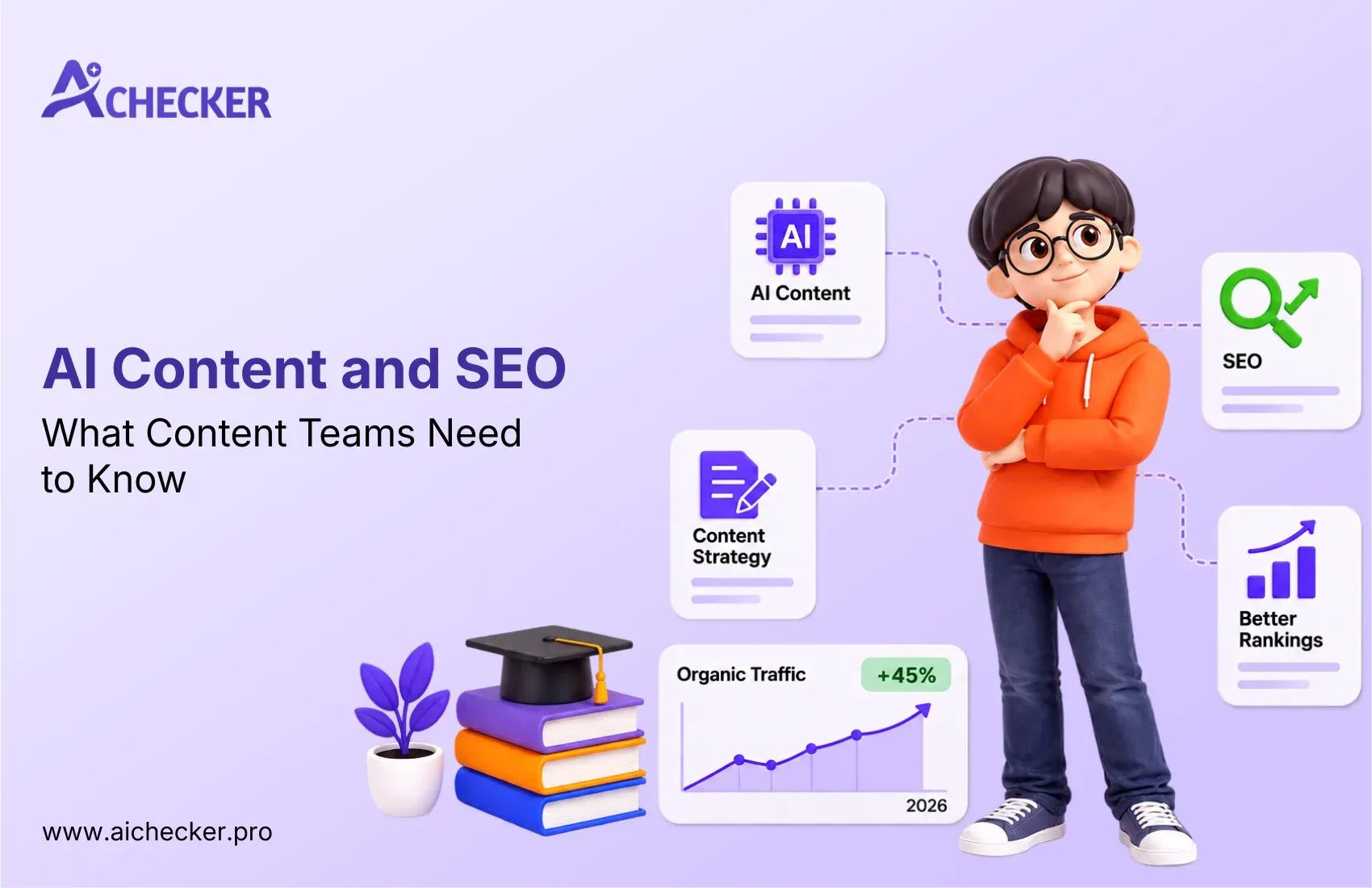
AI Content and SEO in 2026: What Content Teams Need to Know
TABLE OF CONTENTS
Search Intent Snapshot
What Is AI Content and SEO, Exactly?
Does Google Penalize AI-Generated Content?
How Has AI-Generated Content and SEO Changed Since 2023?
Why Does AI Content Optimization Matter for Answer Engines?
How Do You Optimize AI Content for Google AI Overviews and Search Engines?
What Are the Most Common AI Content and SEO Mistakes?
What Is AI Content Strategy in 2026?
How Do You Measure ROI From AI Content and SEO?
AI Content and SEO: Key Takeaways
Conclusion
FAQs
Get an AI summary of this post on:





If you have been publishing content during the last year, you have surely noticed something wrong.
Google's AI Overviews begin to answer questions before a user clicks on any result. ChatGPT, Perplexity, and Gemini attract traffic that previously would have gone to search engines. Moreover, content creators worldwide are wondering if AI content and SEO are compatible or opposing forces.
Good news! AI content and SEO work together in perfect harmony if you know how to create the former. Anything hastily thrown out there without much thought will inevitably be beaten by careful, well-worded replies from other creators. If you know what to do, you can beat other AI-generated content pieces and even get positioned by search assistants as the go-to reference for a particular topic.
Below are the tips for succeeding in the SEO space with AI content in 2026.
Search Intent Snapshot
Primary Intent: Informational, understand how AI content affects SEO performance
Secondary Intent: Commercial, evaluate tools or services to implement AI content workflows
Pain Points: Ranking drops after AI adoption, uncertainty about Google's stance, low-quality AI output, no visibility in AI Overviews
Desired Outcome: A content and SEO strategy that works across Google, AI Overviews, and answer engines like ChatGPT and Perplexity
What Is AI Content and SEO, Exactly?
AI content and SEO refers to the practice of creating content with the help of artificial intelligence while optimizing it to appear in traditional search results and be surfaced by AI answer engines, such as Google AI Overviews, ChatGPT, and Perplexity. It is a combination of content creation, technical SEO, and structuring information in such a way that it is understandable by both humans and AI.
This isn't just "using ChatGPT to write blog posts." It's a full discipline that touches:
- Content strategy and topic research
- AI-assisted drafting and editing
- On-page SEO optimization
- Structuring content for AI extraction (AEO)
- Building authority so AI models trust and cite your content (GEO)
Companies that treat this as one connected system, not separate tasks, are the ones seeing the strongest results.
Does Google Penalize AI-Generated Content?
No, Google does not penalize content created by an AI for being created by an AI. Google has stated that it rewards high-quality, useful articles, whether they were written by humans or by AI. Google does, however, penalize poor, unoriginal, and/or mass-produced content, which they refer to as "scaled content abuse."
The difference between these two approaches has real-world implications for what gets ranked and what doesn't.
The distinction matters a lot in practice.
Here's what tends to get flagged or quietly buried in rankings:
- Bulk-generated articles with no editing or fact-checking
- Content that repeats the same information as dozens of competitor pages
- Thin pages created solely to target keywords, with no real value
And here's what tends to perform well:
- AI-assisted drafts that go through human review and expert input
- Original data, examples, or perspectives not found elsewhere
- Content structured clearly enough that both readers and AI models can extract the answer
Anthropic, OpenAI, and Google's own search leadership have all pointed to the same theme: quality and originality matter more than the production method.
How Has AI-Generated Content and SEO Changed Since 2023?
AI-generated content and SEO have moved from a numbers game to a trust-based game. Those that jumped on the AI bandwagon have benefited from early-mover advantages.
Now, it's no longer about quantity, but rather quality. Search engines reward well-structured, properly formatted content that demonstrates expertise, and which search engines (using AI-powered answer engines) will cite as a source.
A few concrete shifts content teams should know about:
| Then (2023-2024) | Now (2026) |
|---|---|
| Publish high volumes of AI content fast | Publish fewer, deeper, expert-reviewed pieces |
| Optimize mainly for Google's 10 blue links | Optimize for Google, AI Overviews, and chat-based answer engines |
| Keyword density and backlinks drove rankings | Structured answers, E-E-A-T signals, and citations drive visibility |
| One-size-fits-all blog posts | Content built for a specific funnel stage and intent |
| Traffic measured only in clicks | Visibility measured in clicks and AI citations/mentions |
This is why a business publishing two well-researched, well-structured articles a week can now outperform one publishing twenty rushed ones.
Why Does AI Content Optimization Matter for Answer Engines?
AI content optimization is critical. Because solutions such as ChatGPT, Gemini, Claude, and Perplexity tend to directly answer questions posed to them, if you cannot extract information from your content, it will not be present in their answers.
This is where Answer Engine Optimization (AEO) comes in. AI systems scan for:
- Clear, direct answers near the top of a section
- Well-labeled headings that match real questions people ask
- Bullet points, tables, and defined terms
- Content that stands on its own without needing surrounding context
Key Takeaway Box
To get cited by AI assistants, answer the question in the first 1 to 2 sentences under each heading. AI models extract concise, self-contained answers far more often than long, meandering paragraphs.
If you're building a business around AI visibility, this single change, leading with the answer, often produces the fastest measurable results.

Get Lifetime Access to AI Checker Pro at 60% OFF
Stop worrying about AI penalties. Detect and humanize your AI content in one place, with lifetime access and every future update included.
- One-time payment
- Unlimited AI detection and humanizing
- All future updates included
How Do You Optimize AI Content for Google AI Overviews and Search Engines?
To improve results for AI Overviews and search, aim to lead with a direct answer, followed by details and support with unique examples, data, or expert analysis that will be used by AI to rank the content.
Here's a practical framework content teams can apply today:
1. Start With Real Search Intent Research
Before writing anything, map out what people actually want to know, not just the keyword. Someone searching "AI content and SEO" wants strategy, not a dictionary definition.
2. Write the Answer First, Then Explain
Every major section should open with a tight, 2 to 3 sentence answer. This serves both featured snippets and AI extraction, a genuine two-for-one.
3. Add Original Business Examples
Generic explanations don't differentiate. A marketing team that shares a real workflow with human review, for example, using an AI agent to auto-draft product descriptions and route them for human approval, creates content competitors can't easily copy.
4. Define Key Terms Clearly
AI models favor content that explicitly defines terms (like this guide does with AEO and GEO), because it reduces ambiguity when generating answers.
5. Use Structured Formatting
Bullet points, comparison tables, and numbered steps aren't just for readability, they're how AI systems parse and extract meaning efficiently.
6. Keep Paragraphs Short
Two to three lines per paragraph keeps content scannable for both mobile readers and AI crawlers.
7. Build Topical Depth, Not Just One Post
A single article rarely earns topical authority. Search engines and AI models trust sites that cover a subject from multiple angles, strategy, tools, mistakes, case studies.
What Are the Most Common AI Content and SEO Mistakes?
The most common mistakes are publishing the AI draft as it is, targeting the wrong search intent, not double-checking the facts, and not organizing it properly for the AI to process and extract. Those are the most common mistakes that lead to businesses witnessing their rankings plummet when utilizing AI technologies, and those that let them skyrocket.
| Common Mistake | Why It Hurts | Better Approach |
|---|---|---|
| Publishing raw AI drafts | Reads generic, lacks depth, low trust signals | Always edit with expert review and original input |
| Ignoring search intent | Content mismatched to what users actually want | Research intent before drafting |
| No fact-checking | Risk of inaccurate claims, hurts trust | Verify stats and claims against reliable sources |
| Keyword stuffing | Reads unnatural, can trigger spam signals | Target ~1% keyword density, use natural variation |
| No unique perspective | Nothing to differentiate from competitors | Add proprietary data, case studies, expert opinions |
| Ignoring AEO/GEO structure | Missed visibility in AI Overviews and chat tools | Lead with direct answers, use clear formatting |
What Is AI Content Strategy in 2026?
An efficient AI content strategy in 2026 is one that capitalizes on the rapidity of artificial intelligence while simultaneously taking advantage of the expertise of human writers, while leveraging proper presentation to answer engines, in addition to a strong funnel structure that follows the buyer's journey from awareness to consideration to decision.
A balanced content calendar generally looks like this:
- 50% Top-of-Funnel (TOFU): Educational, no-sell content that builds awareness, think "What is an AI agent?" or "How does AI content optimization work?"
- 30% Middle-of-Funnel (MOFU): Comparison and evaluation content that helps decision-makers weigh options, "Best AI content tools compared" style pieces
- 20% Bottom-of-Funnel (BOFU): Conversion-focused content aimed at people ready to act, trial comparisons, ROI breakdowns, implementation guides
This hybrid approach powers both high-level content ideation for the top of the sales funnel while also fueling demand generation assets that nudge near-buyers to conversion.
For teams that need to scale content research, drafting, or SEO analysis at enterprise levels, AI Checker Pro can design a customized AI-powered workflow that fits your processes, not the other way around.
How Do You Measure ROI From AI Content and SEO?
Practical metrics to track:
- Organic sessions and ranking movement for target keywords
- Appearances in Google's AI Overviews or "People Also Ask"
- Mentions or citations in AI assistant responses (harder to track directly, but visible through referral patterns and brand searches)
- Lead form submissions or demo requests from organic content
- Time and cost saved per published piece versus fully manual production
Expert Tip: Track AI Overview appearances manually for your top 20 target keywords each month. There's no perfect tool for this yet, but manual spot-checks reveal patterns fast, especially which content formats get pulled into AI summaries most often.
AI Content and SEO: Key Takeaways
- AI content isn't penalized by Google, low-quality, unoriginal content is
- Answer Engine Optimization (AEO) is now essential for visibility in ChatGPT, Gemini, Perplexity, and AI Overviews
- Leading each section with a direct, concise answer improves both featured snippet and AI citation chances
- Original examples and expert input are what separate ranking content from ignored content
- A 50/30/20 TOFU/MOFU/BOFU content mix keeps the funnel balanced
- ROI should include AI visibility metrics, not just clicks
Conclusion
AI content and SEO can work well together in 2026 when technology and human expertise are used together. AI can help teams create content faster, but human review, original ideas, accurate information, and clear structure are still important.
The goal is not to publish more AI content. It is to create useful, trustworthy, and original content that answers people's questions clearly. By focusing on search intent, AEO, expert input, and a balanced content strategy for both AI and human readers, businesses can improve their visibility across Google and AI-powered search platforms.
FAQs
Does Google penalize AI-generated content?
What is AEO in SEO?
How do you get your content cited by ChatGPT or Perplexity?
What is the difference between SEO and AEO?
How much human editing does AI content need?
What is GEO in content marketing?
How do you optimize content for Google AI Overviews?
What is a good content strategy for 2026?
How do you measure ROI from AI content?
What are the most common AI content mistakes?

Harshil Barvaliya
SEO Executive & Content Writer at AI Checker Pro
I’m Harshil Barvaliya, an SEO Executive and Content Writer at AI Checker Pro. I focus on improving the website’s search engine visibility through effective SEO strategies, including keyword research, on-page and off-page optimization, and content development.Get Started Free
Create a free account for advanced AI detection and scan history.
Trusted by thousands worldwide.
Recent Blog's
Discover how AI-powered content creation can elevate your website's reach and engage your audience like never before. Explore the real impact of AI on crafting content that connects.