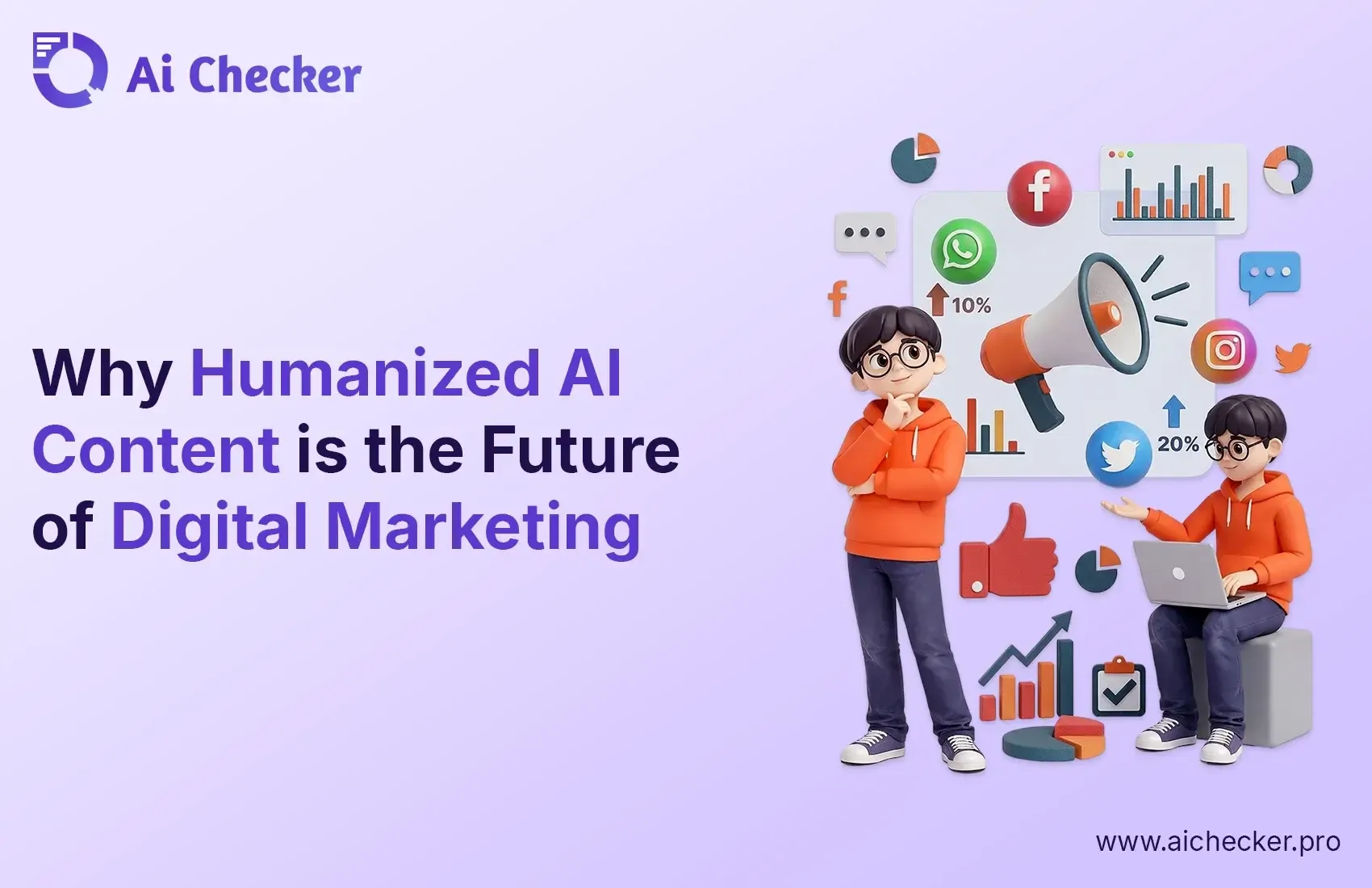
Why Humanized AI Content is the Future of Digital Marketing
TABLE OF CONTENTS
The Evolution of Content in Digital Marketing
What is Humanized AI Content?
Key Characteristics of Humanized AI Content
Why AI Content Needs Humanization
Benefits of Humanized AI Content in Digital Marketing
Humanized Content and SEO: A Powerful Combination
Common Mistakes in AI-Generated Content
How to Humanize AI Content (Step-by-Step Guide)
Tools for Humanizing AI Content
Real-World Use Cases in Digital Marketing
The Future of AI in Digital Marketing
Conclusion
FAQs
Get an AI summary of this post on:





The recommendation process requires you to seek a personal recommendation because you need someone to provide you with an authentic assessment of your request. The answer immediately establishes a connection because it describes a personal experience that the speaker wants to share with you.
The plain AI content creates a distant and generic experience, while humanized AI content delivers emotional content and specific details that people can connect with. The expression creates a mental image that establishes trust through its brief content.
The human element in digital marketing creates a conversion process that transforms readers into active participants.
What is AI-Generated Content?
AI-generated content is text created by artificial intelligence tools like ChatGPT, Gemini, or Claude. These tools are built on large language models that generate an article, an email, a caption, or ad copy when you provide a topic all within seconds.
The system operates with high speed and low costs, and its performance delivers impressive results.
The Rise of AI in Digital Marketing
In the last few years, AI writing tools have become extremely popular. Marketers and bloggers, together with business owners, started using them to produce more content in less time. A blog post that used to take 4 hours could now be ready in 4 minutes.
The situation presents a problem because fast results fail to deliver proper quality.
The Evolution of Content in Digital Marketing
Traditional Writing vs. AI-Generated Content
At present, humans create all content through their writing work. A copywriter would spend hours crafting the perfect blog post. The process required extensive time, but the final result demonstrated an authentic and deep understanding.
The introduction of AI technology brought a complete transformation to all existing systems.
What is Humanized AI Content?
Humanized AI content starts from artificial intelligence creation but develops into something more. A human writer reviews, edits, and improves it, adding personality, examples, emotion, and clarity until it reads like something a real person wrote.
Raw AI Content vs. Humanized Content
Here's a quick example to show the difference:
Raw AI Content:
"Social media marketing helps businesses build brand recognition through its effective use as a marketing approach. Organizations can leverage platforms such as Instagram and Facebook to enhance their digital presence."
Humanized Version:
Social media platforms are essential tools for increasing brand visibility among potential customers. Your target customers actively use Instagram and Facebook for their daily activities, making these platforms effective for reaching them.
Key Characteristics of Humanized AI Content
1. Natural Tone
The text sounds like an actual conversation, which does not follow the patterns of a textbook. The text uses short sentences that contain simple words. The text presents information in a friend-to-friend manner.
2. Emotional Connection
Good content creates three distinct emotional experiences for people by making them feel excited, curious, and reassured. AI alone cannot achieve this outcome. A human touch creates that special quality.
3. Personalization
Humanized content better engages readers because it does not treat them as mere audience members. The content directly solves their particular issues while addressing their existing worries and future aspirations.
4. Context Awareness
AI cannot notice the context of language. Human editors add context, including present-day trends, local references, and real-time scenarios, which give value and relevance to the content.
Why AI Content Needs Humanization
AI Detection Tools and Their Impact
The AI detection tools used today have become widespread throughout 2026. The platforms GPTZero and Copyleaks, together with other systems, can accurately detect AI-generated text through their analysis capabilities. If you want to understand how AI detectors actually work, it helps to know what patterns they look for before you publish anything.
The situation presents an actual danger to companies. AI-generated content immediately loses its value to readers and search engines after they detect it as AI-generated.
Trust Issues with Robotic Content
The reader experience needs to be considered for this analysis. People who visit a website will not trust a brand when its content appears to be unfeeling and robotic. Marketing depends entirely on trust. When you compare AI vs. human content for SEO, human-edited content consistently builds more trust and drives better results.
Content Fatigue and Audience Expectations
People are consuming more content than ever while they develop better skills to identify low-quality content. The 2026 audience requires content that demonstrates intelligence, relatable elements, and worthwhile value. Raw AI-generated content simply cannot meet that standard.
The Importance of Originality and Authenticity
Authenticity functions as a fundamental principle that drives customer loyalty for some brands, while other brands fail to achieve basic online engagement. The humanized content shows that a brand values its audience, which people can perceive through their interactions with the content.
Benefits of Humanized AI Content in Digital Marketing
1. Better User Engagement
When content feels real, people stay longer and read more content, which they share with others. The emotional connection of content with viewers results in a higher engagement rate, which includes likes, comments, shares, and time spent on the page.
2. Higher SEO Performance
Search engines measure how long people stay on your page and whether they come back. Understanding how AI detection tools impact SEO content can help you build a smarter content strategy that improves rankings over time.
3. Improved Readability and Retention
Short and clear writing that uses everyday language lets readers understand the text better. The way you present information to your audience will help them understand better and increase their chances of taking action.
4. Builds Brand Trust and Authority
Consistent, high-quality humanized content tells your audience: "We know our stuff, and we care about you." That builds authority in your niche and turns visitors into loyal customers.
5. More Conversions
At the end of the day, marketing is about results. Humanized content that speaks to real needs and emotions drives more sign-ups, purchases, and clicks than any generic AI output ever could.
Humanized Content and SEO: A Powerful Combination
Google's algorithms use more than keyword counting for their analysis. The system evaluates various elements, which include sentence structure that develops naturally and delivers authentic value to readers.
The Role of E-E-A-T
E-E-A-T stands for Expertise, Authoritativeness, and Trustworthiness. This is the evaluation system employed by Google for online content.
- Experience: Does the content show real-world knowledge?
- Expertise: Is the writer clearly knowledgeable on the topic?
- Authority: Is the website a trusted source in its field?
- Trust: Is the content honest, accurate, and helpful?
When humanized AI content is created effectively, it achieves all four required criteria. If you want to see this in practice, check out how AI-assisted content can still rank on Google when it is properly humanized and structured.
Why Humanized Content Ranks Better
Plain AI content fails to provide sufficient research depth because it lacks personal insights and original perspectives, which Google uses as evaluation criteria for content. Many creators also wonder does Google penalize AI content the short answer is that unedited, low-quality AI content is what gets penalized, not AI assistance itself. Adding human elements brings content that search engines recognize as valuable.
Reducing AI Detection Risks
Content that presents information naturally through personal stories, varied sentence patterns, and authentic examples shows lower chances of being detected by AI systems. For a practical breakdown of this, reading up on tips to avoid AI detection can give you a clear action plan before publishing.
Writing for Humans First, Algorithms Second
The golden rule of content marketing requires you to create content that people will read, which will result in search engine algorithms following your work. Your SEO performance will increase when actual users find value in your content.
Common Mistakes in AI-Generated Content
It is time to discuss problems. Having directly published AI-generated content, without any editing, is an almost certain way to have made at least one of the following mistakes or a similar one.
1. Overuse of Generic Phrases
The phrases "In today's fast-paced digital world" and "It is important to note that" serve as typical AI detection triggers. These words create unnecessary filler content, which should be removed.
2. Lack of Real Examples
AI loves vague statements. It states "businesses have achieved success through this method" without revealing which businesses used which method to achieve which success. Real examples need to exist because they make content credible.
3. No Emotional Tone
If your content does not make the reader feel things like curiosity, motivation, relief, or excitement, it goes the mechanical route. Emotions create action.
4. Repetitive Structure
AI follows a fixed sequence introduce topic, explain, summarize, repeat. This becomes boring fast. Good writing requires different rhythmic patterns throughout.
5. Blindly Trusting AI Output
AI systems can generate incorrect results with complete certainty. They produce false statistics, attribute statements to experts who never made them, and deliver outdated information. Before publishing, always verify your content and if you are unsure about a tool's reliability, learning how accurate AI content checkers really are will help you make a smarter choice.
How to Humanize AI Content (Step-by-Step Guide)
This is good news. To make a human out of an AI text, all you need is a process.
Step 1: Start with AI, But Don't End with It
Create your first draft using AI to establish basic content and structural elements. Treat the resulting draft as unrefined material that needs transformation into a polished work.
Step 2: Add Personal Insights or Examples
Ask yourself: What do I know about this topic from real experience? Bring your personal experience, your client experiences, or common life situations into your story. The content becomes 10 times more authentic with the inclusion of even two of these experiences.
Step 3: Use Conversational Language
When you read your content aloud, does it sound like your normal self? If not, simplify it. Replace sophisticated words with familiar alternatives. Cut sentences in half.
Step 4: Break Monotony with Storytelling
Begin your article with a brief introductory story. Use a common situation as a midpoint element. Conclude with a practical lesson from real-life experience. Stories serve as the most ancient method of communication because they effectively convey information.
Step 5: Edit for Clarity and Flow
Eliminate all content that does not provide any beneficial results. Verify that every section connects with the subsequent one. The text should create continuous reasons for readers to keep reading.
Step 6: Use AI Detection and Humanization Tools
Check your content with an AI detection tool before you publish it. If it receives a negative assessment, the content needs additional work. The next section covers how to use humanization tools to detect and correct robotic speech patterns.
Tools for Humanizing AI Content
AI Detection Tools
These tools analyze your content and give it a "human score." Popular options include:
- AIchecker Pro: popular with educators and publishers
- Copyleaks: used by businesses for content verification
- Winston AI: detailed analysis with highlighted sections
They help you know where your content sounds robotic before it goes live. If you are looking for a comparison to find the best AI detector for your needs, it is worth testing a few before committing to one.
Humanization Tools and How They Work
Humanization tools go beyond detection they can also rewrite content to sound more human. The tool modifies text by changing sentence patterns and removing robotic expressions to enhance reading comprehension.
AIchecker: A Tool Worth Knowing
The 2026 AIchecker tool has been gaining recognition as an emerging technology in this space. The system enables writers and marketers to assess their content through AI detection while receiving humanization improvement suggestions. For a full walkthrough, you can read how to detect and humanize AI content with AIchecker to get started quickly.
Real-World Use Cases in Digital Marketing
There is an increase in the use of humanized AI content everywhere you look. Here are the primary use cases across different marketing channels:
Blogging and SEO Content
Marketers use AI to generate blog drafts quickly, then humanize them with examples, internal links, updated stats, and a conversational tone. For bloggers specifically, understanding how AI content checkers serve content creators can help you build a faster, more reliable publishing workflow.
Social Media Posts
AI can suggest captions and post ideas, but a human makes them feel authentic. The best brand social media accounts operate with two components only humans possess: a specific voice and distinct company characteristics.
Email Marketing
Nobody wants to read a robotic email. Humanized email copy creates personal connections with readers because it appears to be specially written for them. The result shows improved open rates, increased click rates, and decreased unsubscribe rates.
Website Copywriting
Your homepage, about page, and product descriptions create your initial impression on visitors. AI can create drafts of this material, yet humanized content is necessary to transform website visitors into paying customers.
Ad Creatives
Advertisements succeed or fail through their ability to establish emotional connections with viewers. The humanized advertisement headline connects directly to an authentic customer need or market demand. Generic AI-generated content gets dismissed immediately because it lacks any distinctive elements.
The Future of AI in Digital Marketing
The most successful content creators in 2026 use both artificial intelligence and human writing for their work. AI handles speed and scale. Humans handle creativity, authenticity, and emotional intelligence.
The collaboration model we see today will remain in existence and its importance will only increase with time.
Increasing Importance of Authenticity
The internet now experiences an overwhelming influx of AI-generated content, which increases the worth of authentic elements that cannot be duplicated. The ability to prove oneself as genuine has developed into a crucial element for business competition.
Smarter AI, But Smarter Audiences
Artificial intelligence systems have improved significantly since their early days. However, audiences have also become better at detecting low-quality content. People follow creators they trust. They buy from brands they connect with. AI will not produce technology that can fully replicate genuine human relationships. For a deeper look at this trend, the discussion around AI detectors vs. advanced AI models shows just how fast both sides are evolving.
Why Human Creativity Will Always Matter
AI produces written content but cannot feel empathy toward its audience. It does not possess actual human emotions, nor can it draw on years of lived experience. It cannot craft a perfectly timed joke, or understand what a tired parent really needs to read at midnight.
Conclusion
Artificial Intelligence enables you to produce content at an unprecedented speed, yet distribution success depends on creating connections with your audience. The primary benefit in 2026 arises from organizations that combine AI operational speed with authentic human interaction.
AI-generated content becomes genuinely valuable when you enhance it through real examples, spoken language, and thoughtful edits. The method boosts SEO, increases audience participation, and builds your brand's reputation. Digital marketing today requires humanized AI content because nothing else comes close to delivering that level of connection and trust.
FAQs
1. What is the main difference between AI-generated and humanized content?
2. Why is humanized content important in 2026?
3. Can AI-generated content rank on Google?
4. What are AI detection tools used for?
5. Is AI-generated content bad for SEO?
6. How can I make AI content sound more human?
7. Does humanized content increase conversions?
8. Can beginners use AI and still create high-quality content?
9. How much editing does AI content usually need?
10. What is the future of AI in digital marketing?

Harshil Barvaliya
SEO Executive & Content Writer at AI Checker Pro
I’m Harshil Barvaliya, an SEO Executive and Content Writer at AI Checker Pro. I focus on improving the website’s search engine visibility through effective SEO strategies, including keyword research, on-page and off-page optimization, and content development.Get Started Free
Create a free account for advanced AI detection and scan history.
Trusted by thousands worldwide.
Recent Blog's
Discover how AI-powered content creation can elevate your website's reach and engage your audience like never before. Explore the real impact of AI on crafting content that connects.