Does Google Penalize AI-Generated Content in 2026? What the Data Actually Shows
TABLE OF CONTENTS
Google's Official Position on AI-Generated Content
Google AI Content Guidelines: The Framework Explained
What the 2026 Data Actually Shows
Is AI-Generated Content Bad for SEO? The Honest Answer
Google Search AI Content: How the Ranking Systems Actually Work
AI Content Best Practices for 2026
AI-Generated Content vs. Human-Written Content: A Quick Comparison
Conclusion
FAQs
Get an AI summary of this post on:





If you are avoiding using AI content because you fear a Google penalty, you are not alone, but you are also mistaken.
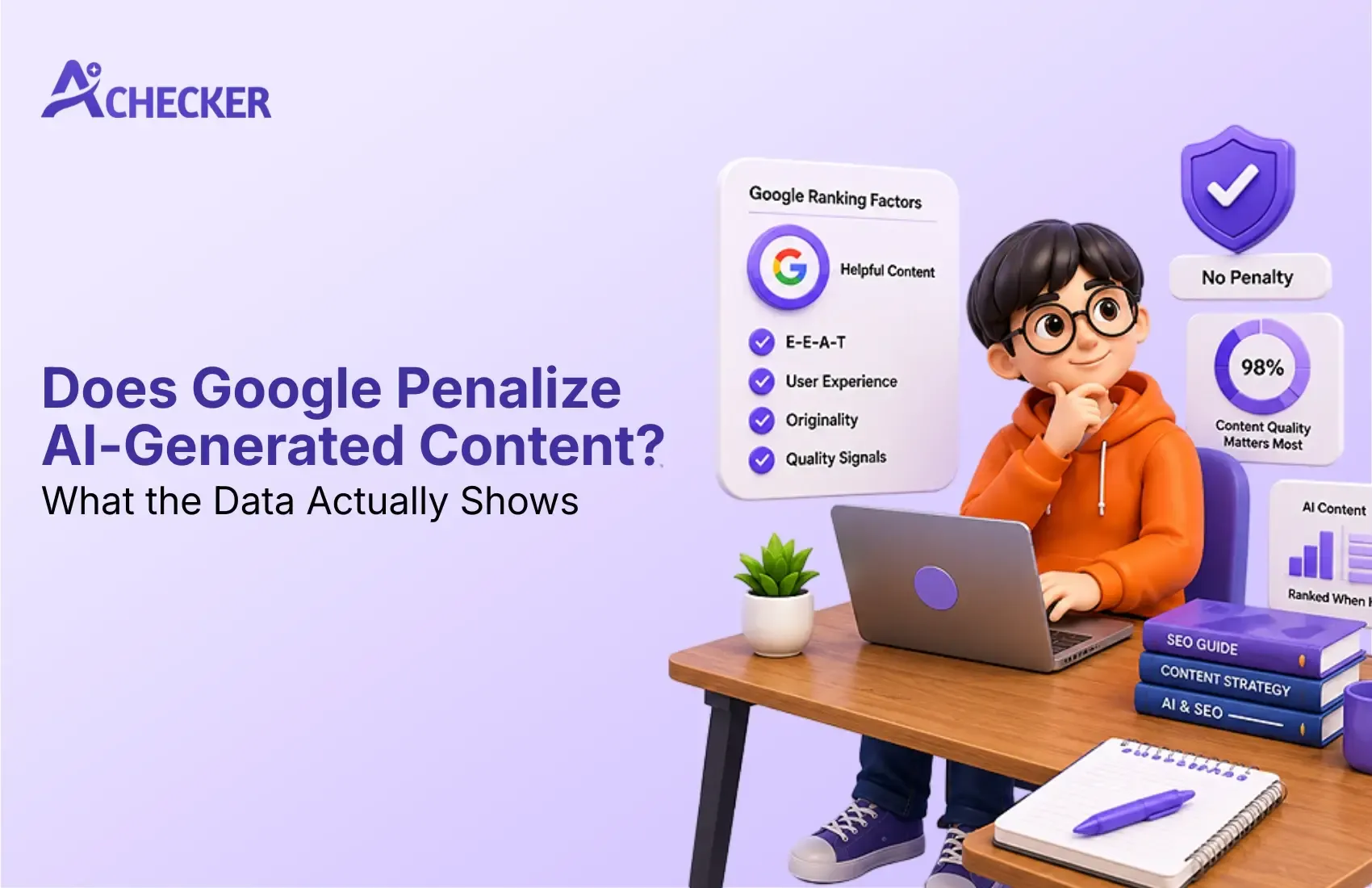
Does Google penalize AI content? No, Google does not penalize AI content per se. Google has been saying this since 2023, and the recent 2026 search quality updates have not changed this. What Google does penalize is low-quality content, whether it is written by humans or by an AI detector-flagged tool.
But there is a catch, and in this article, you will learn what Google's official policy on AI content is, what the recent research says about how AI content ranks in Google, and how to develop an effective AI content strategy that actually helps you grow your traffic.

Get Lifetime Access with 60% OFF
Stop paying monthly subscriptions. Enjoy unlimited AI detection and humanizer access forever with future updates included.
- One-time payment
- Unlimited access forever
- All future updates included
Google's Official Position on AI-Generated Content
Google's guidance on this hasn't wavered much since it was first published. The core message: appropriate use of AI or automation is not against Google's guidelines.
Here's the exact distinction Google draws:
Using AI to create content primarily to manipulate search rankings, that's a spam violation.
Using AI to assist in creating genuinely helpful content for people, that's fine.
Google's ranking systems are designed to favor authentic, high-quality content that reflects E-E-A-T: expertise, experience, authoritativeness, and trustworthiness. Google cares more about the quality of the content rather than how it is produced.
Google even states this explicitly: about a decade ago, when there was an increase in spammy human-written content, everyone was up in arms about it, but no one seriously suggested a total ban on human-made content.
What actually triggers a Google penalty
Using automation, including AI, to generate content with the primary purpose of manipulating search rankings is a violation of Google's spam policies, this is not an issue of means but of goals and results.
In case you need to create a custom AI agent capable of generating relevant and brand-specific content, not other types of text, AI Checker can help you build the necessary workflow, within which you will always retain control over everything that happens.
Google AI Content Guidelines: The Framework Explained
Google evaluates content, AI-assisted or not, against the same quality bar. The framework to know is E-E-A-T:
| E-E-A-T Element | What It Means | Why It Matters for AI Content |
|---|---|---|
| Experience | First-hand knowledge of the topic | AI can't have real experience; a human should add it |
| Expertise | Subject-matter depth and accuracy | AI drafts need expert review before publishing |
| Authoritativeness | Recognized credibility in your niche | Author bylines and credentials still matter |
| Trustworthiness | Accuracy, transparency, and reliability | Fact-check every AI-generated claim before it goes live |
Google's guidance is equally clear when it comes to disclosure. "AI or automation disclosures are appropriate when a reader would benefit from knowing how a piece of content was created and should be considered when it is reasonably foreseeable that disclosure would be beneficial." "Giving credit to AI as an author is not an appropriate way to disclose the use of AI."
In plain English: you don't need a giant "written by AI" banner, but you shouldn't pretend a chatbot is a named human expert either. Running your drafts through AI content detection tools before publishing can help you decide where disclosure actually matters.
What the 2026 Data Actually Shows
Policy statements are one thing. Real search results are another. Here's what recent analysis shows about how AI content actually performs.
AI content is already ranking, a lot of it
Roughly 17% of top-20 search results were already AI-generated as of 2025, and that share has only grown. AI content isn't an edge case in search results anymore, it's becoming the norm.
Quality still separates winners from losers
A 2026 research study analyzed 487 high-ranking pages for competitive commercial keywords using an AI content detector. The results showed the same pattern: Google rewards content that looks like it was written by humans, no matter what, despite the directional nature of the study. Understanding how AI content detectors work can help you see why generic drafts tend to underperform.
That doesn't mean AI content can't rank; it means unedited, generic AI output tends to underperform compared to content with a real point of view.
The takeaway: AI didn't create a new penalty category. It just made it easier to produce the same old spam faster, and Google's existing systems still catch it.
Is AI-Generated Content Bad for SEO? The Honest Answer
Short answer: not inherently. Long answer: it depends entirely on execution.
AI content SEO works when you:
- Add original data, examples, or first-party insight AI can't generate on its own
- Have a subject-matter expert review and edit before publishing
- Answer the search query more completely than what's already ranking
- Cite real sources and avoid vague, unverifiable claims
- Keep author transparency where readers would expect it
AI content SEO fails when you:
- Publish raw AI output with zero human review
- Use it to spin or duplicate existing top-ranking content
- Prioritize keyword volume over actually answering the question
- Skip fact-checking on statistics, dates, or claims
- Mass-produce near-identical pages to target long-tail variations
One 2026 analysis stated it quite simply: Google penalizes low-quality content, and most AI content happens to be low-quality specifically because people publish without editing. It's a matter of workflow, not algorithm. If you want a side-by-side look at how each approach performs, this breakdown of AI vs human content for SEO is worth a read.
Google Search AI Content: How the Ranking Systems Actually Work
It helps to understand Google isn't running a single "AI detector" that flags and demotes pages. Instead:
- The Helpful Content System evaluates whether content was created primarily for people or primarily for search rankings.
- SpamBrain and related spam-fighting systems target manipulative patterns, AI-generated or not.
- Search quality raters assess pages using human review guidelines that never ask "was this AI?", only whether it's helpful, accurate, and satisfying to the searcher.
- Core updates (like those released through 2026) refine how well these systems distinguish genuinely useful pages from thin, templated ones.
One 2026 analysis stated it quite simply: Google penalizes low-quality content, and most AI content happens to be low-quality specifically because people publish without editing. It's a matter of workflow, not algorithm. Teams that rely on AI detection tools for SEO content tend to catch these gaps before publishing rather than after a ranking drop.
AI Content Best Practices for 2026
If you're building an AI-assisted content strategy, whether for a blog, product pages, or a full content operation, here's a practical checklist.
Before you publish:
- Fact-check every claim. AI models can generate confident, wrong information.
- Add a real human perspective. Case studies, screenshots, original data, and specific outcomes AI can't fabricate.
- Edit for redundancy. AI drafts often repeat the same point three different ways, cut it down. A good AI humanizer can speed this step up without losing your voice.
- Match search intent precisely. Don't answer a slightly different question than what was searched.
- Use accurate author information where readers would expect to know who's behind the content.
Ongoing:
- Monitor which AI-assisted pages are actually ranking and which are stalling, that gap tells you where your editing process needs work.
- Treat AI as a first-draft generator, not a publish button.
- Build a review workflow, so every piece gets human eyes before it goes live. Teams that regularly humanize AI content as part of this workflow tend to see fewer stalled pages.
This is a classic example of a process that's begging to be automated by AI agents. If the team is doing manual review, fact-checking, and formatting of the AI's drafts anyway, why not use this opportunity to build their own AI agent that would do much of this repetitive work for them, while being overseen by people who can perform the nuanced judgment required for final approval?
AI-Generated Content vs. Human-Written Content: A Quick Comparison
| Factor | AI-Generated (Unedited) | AI-Assisted + Human-Edited | Fully Human-Written |
|---|---|---|---|
| Speed | Very fast | Fast | Slow |
| Cost | Very low | Moderate | High |
| Risk of generic output | High | Low | Low |
| E-E-A-T signal strength | Weak | Strong | Strong |
| Scalability | High | High | Low |
| Google ranking risk | Higher (if unedited) | Low | Low |
The middle column, AI-assisted, human-edited, is where most competitive teams are landing in 2026. It combines the speed of automation with the credibility signals Google actually rewards, and it's the same approach behind why humanized AI content is becoming the future of digital marketing.
Conclusion
Google doesn't care whether a human or an AI model wrote the first draft. They care whether the final version was actually useful to the person who searched for it.
So the real question for your business isn't "will AI content get penalized?", it's "is our AI content process actually creating something genuinely better than what's currently ranking?"
If the answer is no, there's an easy fix: develop a better, more accountable process around content creation, the same approach behind how to write AI content that actually ranks on Google.
FAQs
1. Does Google penalize AI-generated content in 2026?
2. What is an AI detector and how does it work?
3. Is there a reliable free AI detector I can use?
4. How accurate is AI detection technology right now?
5. What is the best ChatGPT detector available today?
6. What does it mean to humanize AI text?
7. Can an AI humanizer help content rank better on Google?
8. Should I disclose that I used an AI checker or AI writing tool?
9. Why do AI detection tools sometimes flag human writing as AI?
10. What is the difference between an AI checker and a plagiarism checker?

Harshil Barvaliya
SEO Executive & Content Writer at AI Checker Pro
I’m Harshil Barvaliya, an SEO Executive and Content Writer at AI Checker Pro. I focus on improving the website’s search engine visibility through effective SEO strategies, including keyword research, on-page and off-page optimization, and content development.Get Started Free
Create a free account for advanced AI detection and scan history.
Trusted by thousands worldwide.
Recent Blog's
Discover how AI-powered content creation can elevate your website's reach and engage your audience like never before. Explore the real impact of AI on crafting content that connects.