AI Content Audit Guide: How to Review AI-Written Content for Quality & SEO
TABLE OF CONTENTS
Key Highlights
What Is an AI Content Audit?
Why Is an AI Content Audit Important for SEO?
Does Google Penalize AI Generated Content?
AI Content SEO Best Practices for Publishers
How to Audit AI-Generated Content: A Step by Step Guide
Best AI Content Audit Tools in 2026
How to Use AI Detectors the Right Way
AI Content Audit Checklist
Common AI Content Audit Mistakes to Avoid
Conclusion
FAQs
Get an AI summary of this post on:





An AI content audit is a process I use to turn a basic AI draft into useful, trustworthy content. When I review an AI-written article, I do not just check grammar or readability. I also verify facts, check for copied content, match search intent, and ensure the article provides real value to readers.
In my experience, AI-generated content often needs better examples, clear explanations, and a more natural tone before it is ready to publish. In this AI content audit guide, I will share 10 practical steps, a reusable checklist, useful tools, and common mistakes to avoid in 2026.
Key Highlights
- Google does not penalize content only because AI wrote it. Thin, unhelpful, mass-produced pages are the real risk.
- No AI detector is 100% accurate, so never judge quality by a single score.
- Fact-checking is the step most people skip and the one that hurts most.
- Sentence-level review shows you exactly what to fix.
- Run an AI content audit before you publish, then again on a schedule.
Last month, I reviewed several blog drafts written with ChatGPT and Gemini. At first, they looked good, but a closer check revealed problems I had missed, including made-up statistics, repeated points, and unclear explanations. Since then, I have made an AI content audit a regular part of my publishing process in 2026.
What Is an AI Content Audit?
I think of an AI content audit as a quality check before publishing. AI-generated drafts may sound natural, but they can still contain made-up statistics, repeated ideas, or advice that lacks real value.
I have seen articles that looked ready to publish at first but needed major changes after I checked the facts. That is why I never judge an article by its writing quality alone.
I also check whether the information is accurate, the examples are useful, and the content matches what readers are looking for. This simple process helps protect my credibility and improve content quality.
AI Content Audit vs. Traditional Content Audit
A traditional audit reviews old pages for traffic, decay, and overlap. An AI-generated content audit adds more questions: Is it accurate? Is it original? Does it sound human? A traditional audit asks whether a page performs. This one also asks whether the page was ever trustworthy. You need both, and you can run them together.
Why Is an AI Content Audit Important for SEO?
In my experience, weak content does not always show problems right away. Over time, a page may lose impressions, clicks, and reader trust. When I review blog drafts, I look for shallow answers, repeated sections, and missing details that leave readers with more questions.
These issues can also make content less useful for AI-generated summaries and search results. Another problem is publishing too many weak pages without fixing them. This can reduce the overall quality of a website's content. That is why I focus on improving existing pages instead of simply publishing more articles.
Does Google Penalize AI Generated Content?
Yes, Google does penalize AI-generated content. Google focuses on whether content is helpful, original, and made for people. The real danger is scaled content abuse, which means publishing many low-value pages mainly to manipulate rankings. Human writers can be guilty of that too.
AI Content SEO Best Practices for Publishers
Here are the AI content SEO best practices I depends on:
- Answer the main question in the first two or three sentences
- Add your own examples, data, or experience
- Verify every claim before publishing
- Write unique titles, meta descriptions, and helpful internal links
- Watch Google Search Console for pages with impressions but few clicks
How to Audit AI-Generated Content: A Step by Step Guide
In this section, I will guide you on how I used to follow for an audit of content. Here is detailed step which helps to understand more clearer way.
Step 1: Generate a Sample Paragraph Using AI
First, choose a topic and ask an AI writing tool such as ChatGPT to generate a sample paragraph. Keep your prompt clear so the tool understands the topic, target audience, and purpose of the content.
For example, if you are writing about time management for students, you can use this prompt:
Prompt:
"Write a short paragraph about time management for college students. Use simple English, explain why time management is important, and suggest two practical ways students can manage their time."
Save the generated paragraph before making any changes. You will use this original version to compare the content after reviewing and editing it.
Step 2: Check the Generated Content Using AI
Now I want to check this AI-generated content through AI Checker Pro so this will give me real verification of how much of the content is AI-generated.
Step 3: Humanize and Refine the Content Using AI Checker Pro
At first, I’ll humanize the content through AI Checker Pro; after that, I follow with the AI detector Process. Since AI-generated shows 96% AI content, so I’ve to humanize the content. So you can justify also clearly understand which one is better.
// Add Image
After that, I’ll again detect this as humanized text; whenever real data comes, it should be considered as humanized content
// Add Image
Step 4: Find the Right SEO Keywords
Once the paragraph is humanized or accurate, identify the keyword which might include:
- Primary keyword: time management for students
- Secondary keywords: student time management tips, time management techniques, study planning
Choose keywords based on the topic, search intent, and available keyword research data. Do not add unrelated keywords or repeat the same phrase unnaturally.
Use the primary keyword where it fits naturally, such as in the article title, introduction, and a relevant heading. Add secondary keywords only where they help explain the topic.
Step 5: Write an SEO-Friendly Meta Title and Meta Description
After selecting your keywords, write a meta title and meta description for the article page. These help search engines and readers understand what the page covers.
Example meta title:
Time Management for Students: 7 Practical Tips
Example meta description:
“Learn practical time management tips for students to plan study sessions, manage daily tasks, reduce distractions, and stay organized.”
Keep the title clear and relevant to the main topic. Write a useful meta description that summarizes the article and gives readers a reason to visit the page. Include the primary keyword naturally when it fits.
Avoid keyword stuffing or making promises that the article does not fulfill. Search engines may generate a different title link or snippet based on the page and the user's search.
Step 6: Review the Content Structure and Search Intent
Now check whether the article answers the main question that brought readers to the page. Review the introduction, headings, paragraphs, examples, and conclusion.
Make sure each section has a clear purpose and follows a logical order. Remove repeated information, unrelated details, and headings that do not add value. Add missing explanations if readers may need them to understand the topic.
Also check whether the article provides enough useful detail for its intended audience. A beginner's guide should explain concepts in simple language, while a technical article may need accurate terminology, examples, and supporting references.
Best AI Content Audit Tools in 2026
AI content audit tools help you review website content for quality, SEO performance, readability, and AI-generated text. In 2026, these tools make it easier to find content gaps, improve search visibility, detect outdated information, and create more helpful, search-friendly content.
| Tool | Accuracy Notes | Free Tier | Humanizer Included | Best For |
|---|---|---|---|---|
| [AI Checker Pro]( | Sentence-level highlighting, works with ChatGPT, GPT -4, GPT -5, Gemini, Claude | See the [Link to Pricing page] Pricing page | Yes | Bloggers, students, and agencies who want to detect and fix in one place |
| GPTZero | Popular with educators, but no tool is 100% accurate | Limited free scans | No | Teachers checking essays |
| Originality.ai | Built for publishers, also includes plagiarism checks | Paid credits | No | SEO teams and content agencies |
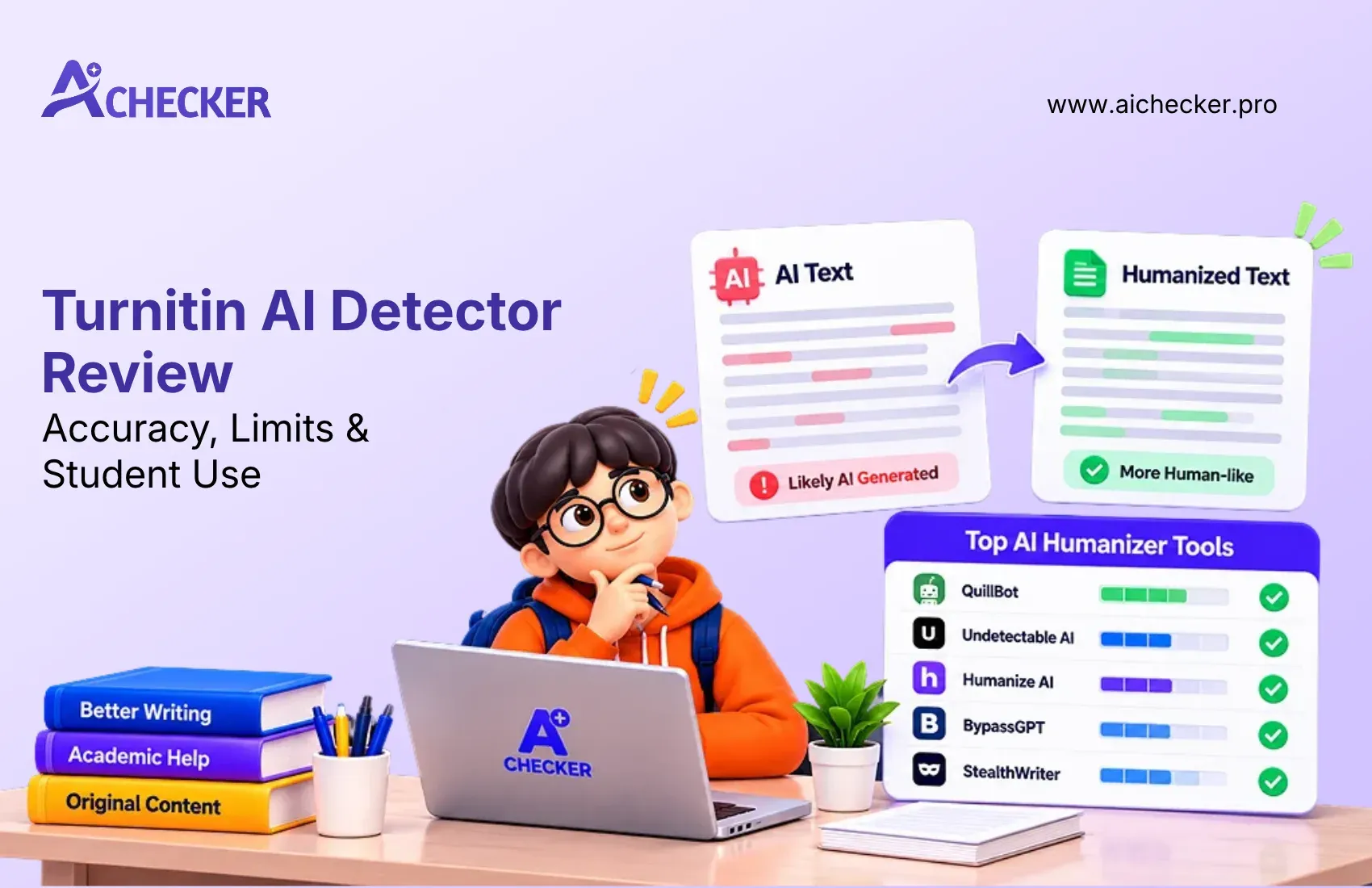
| Turnitin | Used inside many schools and universities; access usually comes through an institution | No public free plan | No | Academic submissions |
| Copyleaks | Offers AI detection and plagiarism scanning | Limited free scans | No | Businesses and education teams |

Get Lifetime Access with 60% OFF
Stop paying monthly subscriptions. Enjoy unlimited AI detection and humanizer access forever with future updates included.
- One-time payment
- Unlimited access forever
- All future updates included
How to Use AI Detectors the Right Way
After testing several AI detectors, I noticed that no two tools give the same results. I have checked the same paragraph with different detectors and often received completely different scores. That is why I never treat an AI detection score as the final answer.
Here is what I recommend based on my experience:
- Don't trust a single score: Check your content with more than one tool, but always review the writing yourself before making a decision.
- Be careful with false positives: Even fully human-written content can get flagged, especially academic writing, formal sentences, or writing by non-native English speakers. Keep your original drafts and notes as proof of your writing process.
- Understand what detectors can miss: AI detectors are generally more effective at identifying raw AI-generated text. Their results can become less reliable when the content is edited, paraphrased, or processed through a humanizer.
AI Content Audit Checklist
Whenever I review an AI-generated article, I follow a simple checklist before considering it ready for publishing. A draft may look good at first, but small issues like incorrect facts, repeated ideas, missing keywords, or unclear explanations can affect its overall quality.
I use this checklist to make sure I have not missed anything important during the review.
- Check factual accuracy: Verify statistics, dates, research findings, and other important claims using reliable sources.
- Review originality: Check for copied content and make sure the article offers useful information instead of repeating what other websites have already covered.
- Improve readability: Rewrite long or confusing sentences, remove unnecessary words, and keep paragraphs easy to understand.
- Check the writing tone: Make sure the content sounds natural and fits the target audience. Add personal insights or relevant examples wherever they add value.
- Review keyword placement: Check whether the primary and secondary keywords appear naturally in the title, introduction, headings, and relevant sections.
- Match search intent: Make sure the article answers the questions readers are actually searching for instead of adding unrelated information.
- Optimize meta tags: Write a clear SEO title and meta description that accurately describe the article.
- Check content structure: Review H2s, H3s, paragraphs, bullet points, and the overall flow to make the article easier to scan.
- Review internal and external links: Add relevant internal links and use reliable external sources to support important claims.
- Run a final quality check: Use an AI detector as an additional reference, review flagged sentences manually, and make sure the final article is accurate and ready to publish.
I do not consider an article ready just because it passes an AI detector or has no grammar mistakes. I look at the complete picture, including accuracy, originality, search intent, and reader value. Once these points are covered, I feel more confident moving the article to the publishing stage.
Common AI Content Audit Mistakes to Avoid
After reviewing and editing different types of AI-generated content, I have noticed that many websites make the same mistakes. Some focus too much on AI detection scores, while others publish content without checking its accuracy, quality, or search intent.
Here are the common mistakes I recommend avoiding during an AI content audit.
1. Depending on One AI Detector
Don't judge your entire article based on one AI detection score. Different detectors can give different results for the same text. Always review the content yourself instead of treating a score as proof.
2. Ignoring Fact-Checking
AI tools can sometimes generate incorrect facts, outdated statistics, or misleading information. Before publishing, check important claims, figures, examples, and sources. Even a well-written article can lose readers' trust if the information is wrong.
3. Publishing AI Content Without Editing
Copying AI-generated text directly into your website is not a good content strategy. Add your own experience, examples, useful insights, and explanations to make the article more valuable to readers.
4. Overusing SEO Keywords
Adding your primary keyword to every other sentence will not improve content quality. I always recommend using keywords naturally and including relevant variations only where they make sense.
5. Forgetting Search Intent
Before writing or auditing an article, understand what readers actually want to know. For example, someone searching for the best AI content audit tools probably wants tool comparisons and practical recommendations, not a basic explanation of AI content.
6. Publishing Too Many Low-Quality Pages
Publishing more articles does not automatically bring more organic traffic. Focus on creating useful pages that answer specific questions instead of filling your website with repetitive or low-value AI content.
7. Overusing AI Humanizers
Humanizers can change sentence structure, but they do not automatically improve content quality. During my reviews, I recommend checking whether the rewritten version still communicates the original meaning clearly. If it sounds awkward, edit it again.
8. Auditing Content Only Once
Content audits should not be a one-time activity. Search trends, facts, competitors, and user expectations change over time. Review your important pages regularly and update outdated information, broken links, and missing sections.
Conclusion
From my experience reviewing and editing AI-generated content, a good AI content audit is not about removing every trace of AI. It is about making sure your content is accurate, original, easy to understand, and useful to readers.
AI tools can speed up content creation, but the final quality still depends on how carefully you review and improve each page.
I suggest following the 6 audit steps, using the checklist, and avoiding reliance on a single AI detector score. Start with one of your existing articles, check what needs improvement, and make changes where necessary.
If you want to check your draft before publishing, try the AI checker Pro to get an additional perspective on your content. Use the results as a starting point, then review the writing yourself.
FAQs
What is an AI content audit?
How do you audit AI-generated content?
Does Google penalize AI-generated content?
How do you fact-check AI-generated content?
What should you check before publishing AI content?
How can you tell if AI content is low quality?
Can AI detectors be trusted for an AI content audit?
How do you optimize AI content for SEO?
How often should you run an AI content audit?
What are the best AI content audit tools?

Harshil Barvaliya
SEO Executive & Content Writer at AI Checker Pro
I’m Harshil Barvaliya, an SEO Executive and Content Writer at AI Checker Pro. I focus on improving the website’s search engine visibility through effective SEO strategies, including keyword research, on-page and off-page optimization, and content development.Get Started Free
Create a free account for advanced AI detection and scan history.
Trusted by thousands worldwide.
Recent Blog's
Discover how AI-powered content creation can elevate your website's reach and engage your audience like never before. Explore the real impact of AI on crafting content that connects.