Which AI Detectors Are Accurate? Top 7 AI Detectors in Education
TABLE OF CONTENTS
Key Takeaways
What Is an AI Detector and How Does It Work?
Why AI Detector Accuracy Matters in Education
How Accurate Are AI Detectors, Really?
Top 7 AI Detectors in Education (Compared)
Common Mistakes Schools Make With AI Detectors
Best Practices for Using AI Detectors Responsibly
Conclusion
FAQs
Get an AI summary of this post on:




If you have ever reviewed an AI detection report and questioned the accuracy of its results, you are not alone.
The accuracy of AI detectors is one of the most frequently asked questions about AI technology.
The short answer is that no AI detector is completely accurate. Results can vary based on the detector, text length, editing, model used, and the writer's language background.
In this guide, we will discuss how AI detectors work in the education field, compare the accuracy rates of the top 7 AI detectors, and give you tips on how to use detection reports responsibly to identify AI-generated text.
Key Takeaways
- No AI detector guarantees 100% accuracy; even top tools report false-positive rates between 0.2% and 18%, depending on the study.
- Text length, student language background, and editing level all affect detection accuracy.
- Turnitin, GPTZero, Copyleaks, and Originality.ai are the most widely used detectors in education, but each has different strengths.
- Independent benchmarks often disagree with vendor-published accuracy claims. Always check the methodology.
- AI detection scores should support a conversation with a student, not replace one.
Get Lifetime Access with 60% OFF
Stop paying monthly subscriptions. Enjoy unlimited AI detection and humanizer access forever with future updates included.
- One-time payment
- Unlimited access forever
- All future updates included
What Is an AI Detector and How Does It Work?
An AI detector is a tool that assesses whether text was likely created by a language model rather than written by a human. It does this by analyzing signals such as perplexity, burstiness, and stylometry.
AI detectors don't "read" writing the way a teacher does. Instead, they measure patterns, and understanding how AI detectors actually work can help educators interpret a report correctly:
- Perplexity: a measure of how predictable the next word is based on a language model.
- Burstiness: variation in sentence length and rhythm. Human writing is uneven; AI writing is often more uniform.
- Stylometry: vocabulary range, punctuation habits, and transition-word usage compared against known human and AI writing samples.
The detector combines these signals into a probability score, not a fact. That distinction matters more than most detection reports let on.
Why AI Detector Accuracy Matters in Education
AI detector accuracy matters because a false accusation can damage a student's academic record, while a missed detection can undermine the credibility of an assignment or degree.
Educators are caught between two real risks:
- False positives: flagging genuine student work as AI-generated, which disproportionately affects English-language learners.
- False negatives: missing AI-generated submissions, especially ones that have been paraphrased or "humanized."
A 2026 Stanford HAI investigation revealed significantly higher false-positive results for essays written by non-native English writers on standardized essay sets.
These findings prompted some institutions to question the value of relying on a single detection score. According to reports, some universities have also suspended the use of Turnitin's AI writing detection feature.
Curtin University deactivated Turnitin's new AI-writing detection feature in January 2026 due to reliability concerns, but left the standard plagiarism detection feature enabled. This kind of case shows why understanding the importance of AI content detection in education goes beyond simply running a scan.
If you're building internal review workflows around detection tools, a custom-configured AI agent can automatically route flagged submissions for human review. AI Checker Pro's AI agent development services can help you design this type of workflow.
How Accurate Are AI Detectors, Really?
There is no single accuracy metric that can be universally applied to AI detectors. Published accuracy rates range from approximately 90% to over 99%, but vendors may report higher rates than those found in independent evaluations.
This is the part that most "best AI detector" articles conveniently leave out. The accuracy rates claimed by vendors can differ significantly from results reported by independent tests. For a closer look at why the numbers shift so much, see this breakdown of AI detector accuracy.
Here's why the numbers move around so much:
- Sample length: shorter texts (under 300 words) are harder to classify accurately for almost every tool.
- Editing level: lightly "humanized" AI text is far harder to catch than raw, unedited AI output.
- Language background: ESL and multilingual writers are more often misflagged.
- Model source: detectors trained on GPT-style output may perform differently against Claude, Gemini, or newer models.
A practical rule: treat any single accuracy claim, including the ones in this article, as a snapshot from one dataset, not a universal truth.
Top 7 AI Detectors in Education (Compared)
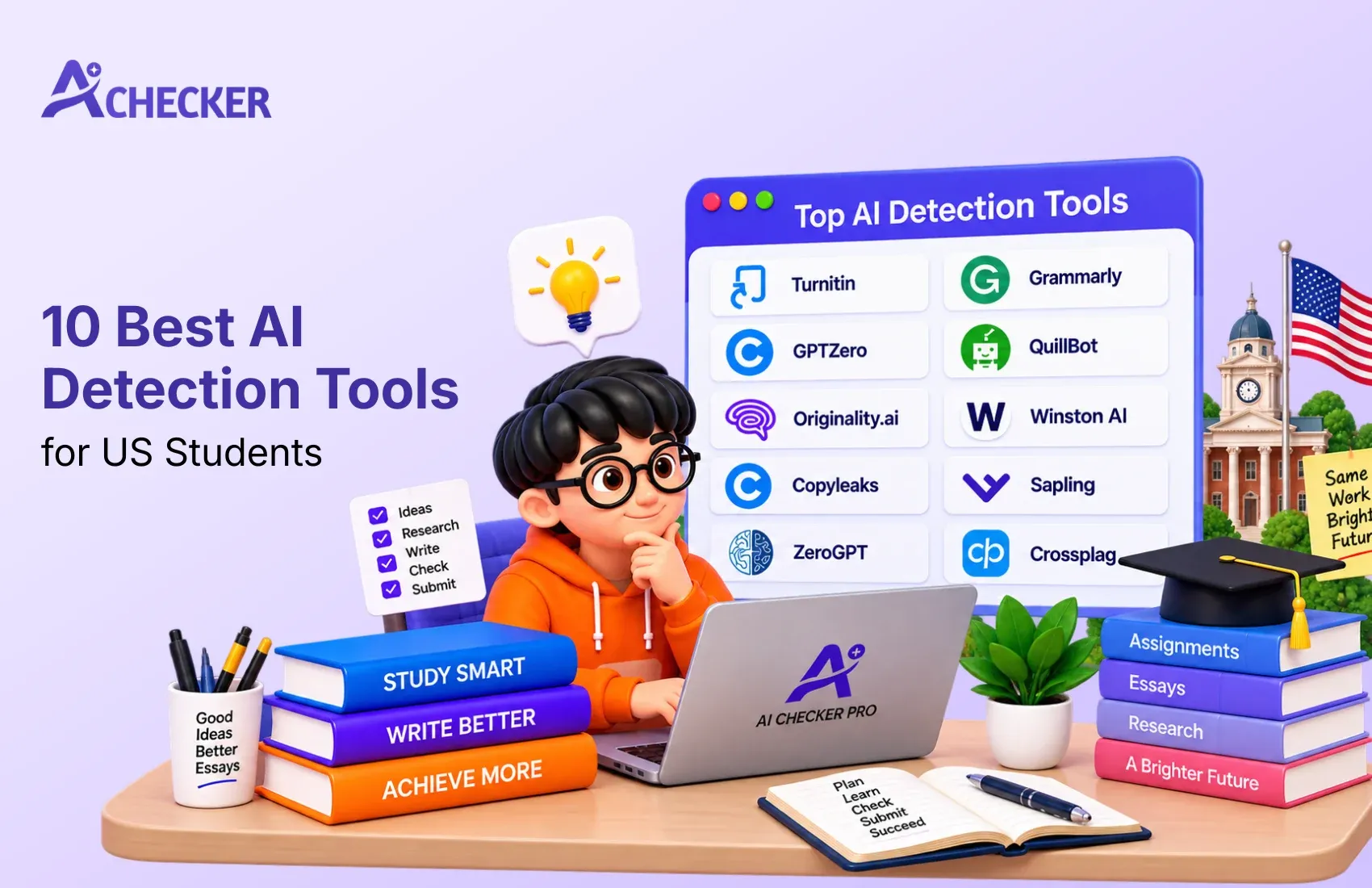
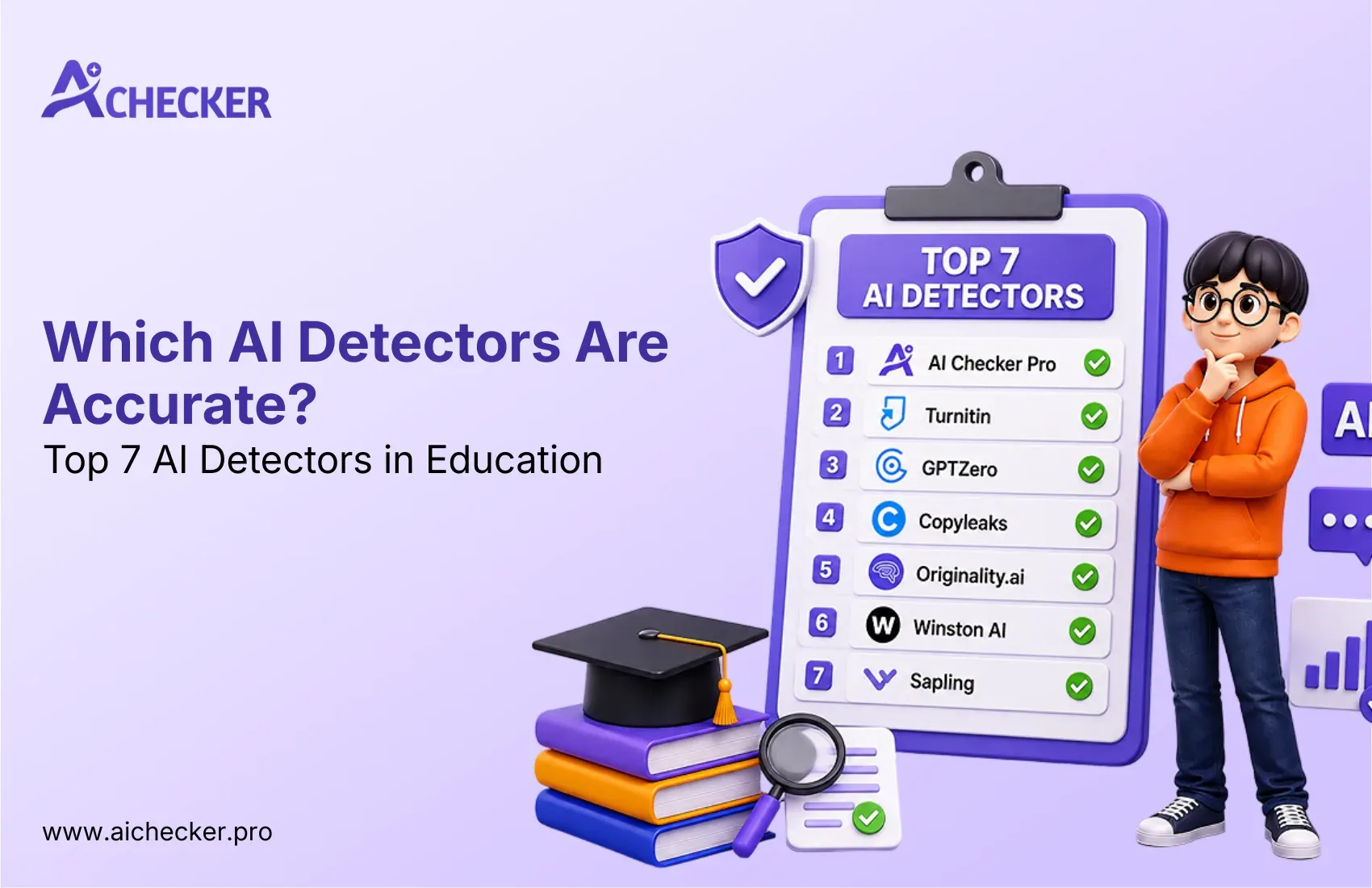
AI Checker Pro, Turnitin, GPTZero, Copyleaks, Originality, Winston AI, and Sapling are among the best-known AI detectors at the moment. They vary in accuracy, false-positive and false-negative rates, and level of integration with learning management systems.
| Detector | Best For | Reported Accuracy Range | False Positive Notes |
|---|---|---|---|
| AI Checker Pro | Students & educators wanting detection + humanizing in one tool | High-precision sentence-level detection (vendor-reported) | Free tier available; no sign-up required for a first check |
| Turnitin | University-wide LMS integration | ~92–98% on 300+ word docs | False-positive rates may be higher with short text and ESL writing |
| GPTZero | Free, fast individual checks | ~90–99% depending on benchmark | Generally low, but varies by study |
| Copyleaks | Multilingual detection | ~90–94% | Strong on edited/paraphrased AI text |
| Originality.ai | Freelance and content teams | ~96–99% | Low FPR reported in vendor benchmarks |
| Winston AI | Mixed-content classrooms | ~90%+ (self-reported) | Limited independent verification |
| Sapling | Lightweight browser checks | ~89% | Best for quick screening, not final decisions |
Ranges above reflect a mix of vendor-published and independent 2026 benchmarks, treat them as directional, not exact.
1. AI Checker Pro
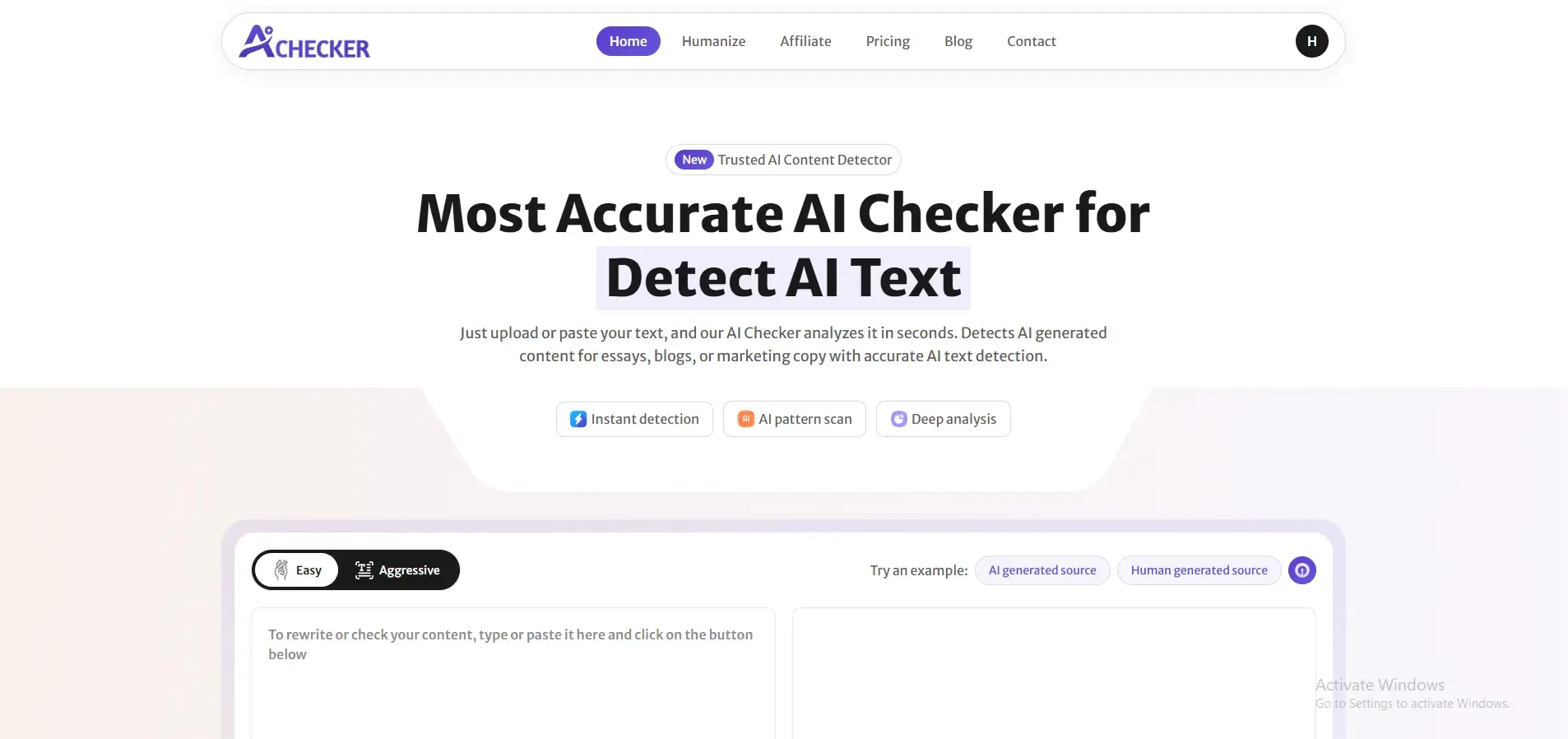
AI Checker Pro's AI detector provides sentence-level AI-versus-human analysis, unlike many competitors that provide only an overall score. This gives educators clearer insight into why specific parts of a submission were flagged.
Free AI Detection: No sign-up is required. The first check is always free.
It offers PDF uploads and connects directly to the integrated AI humanizer, allowing writers to review and edit sections flagged by the AI detector.
It is used by students at Stanford, Columbia, NYU, and Carnegie Mellon and also serves as an SEO content checker for bloggers and marketers who want to review their content before publishing.
2. Turnitin
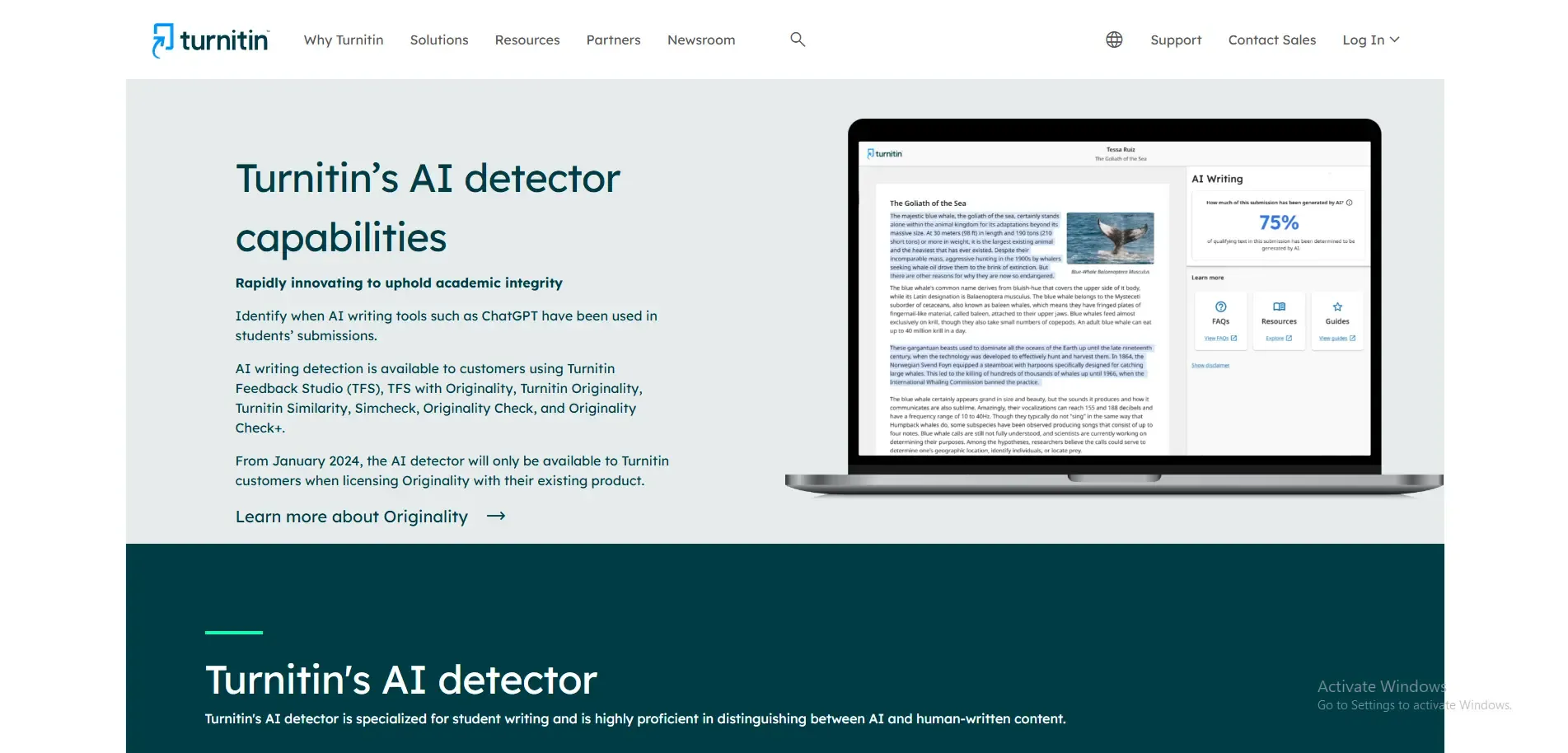
Turnitin is plagiarism-detection software used by higher-education institutions and can be integrated with learning management systems such as Canvas, Blackboard, and Moodle. Its plagiarism database, which contains billions of web pages and previously submitted documents, is one of its primary strengths. If you're curious about the underlying model, this guide on what AI detector Turnitin uses breaks it down further.
3. GPTZero
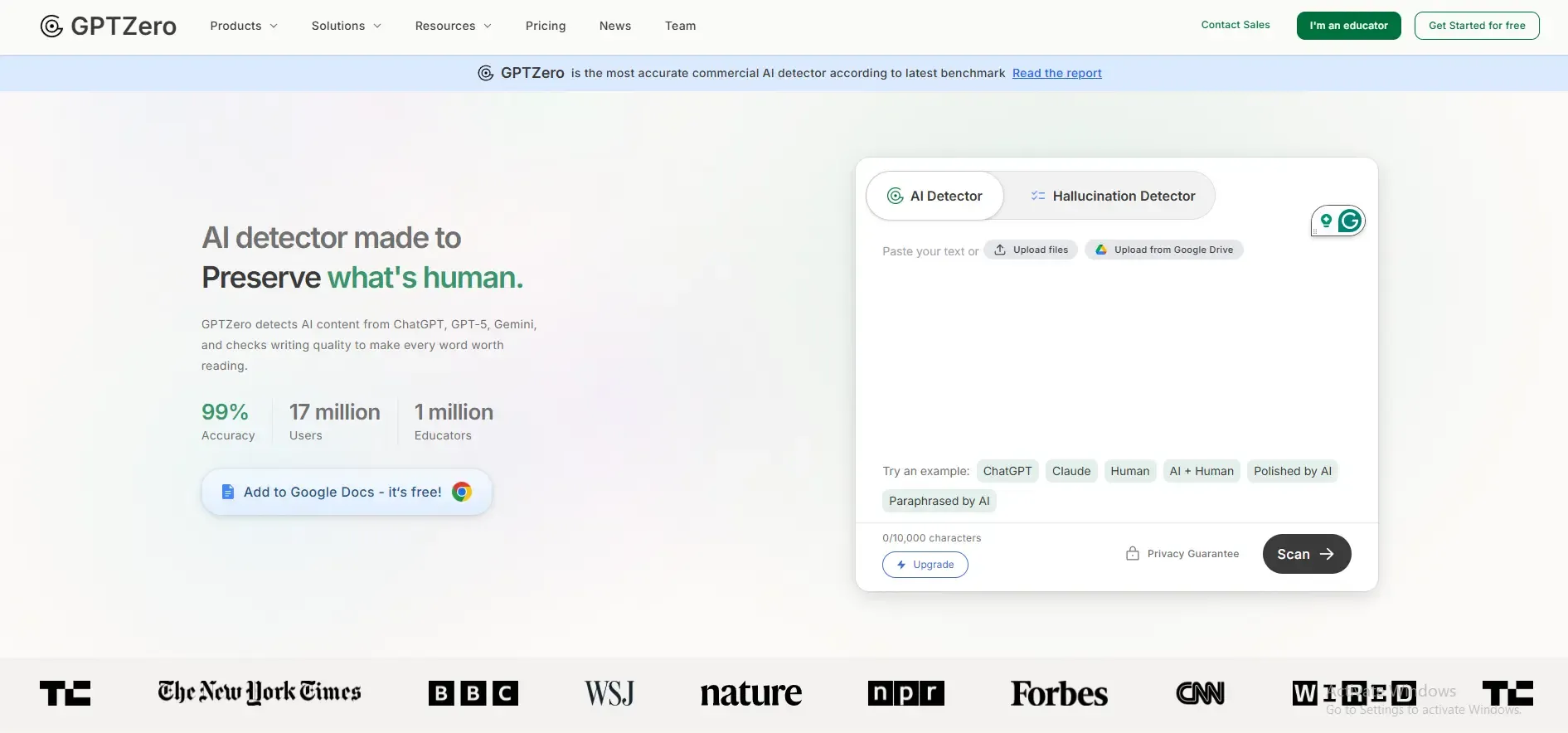
GPTZero is popular among individual users, including teachers and journalists, who value its quick performance and free plans. Its performance has been evaluated in multiple independent tests, although results may vary depending on the AI model used for comparison. This GPTZero review covers its strengths and limitations in more detail.
4. Copyleaks
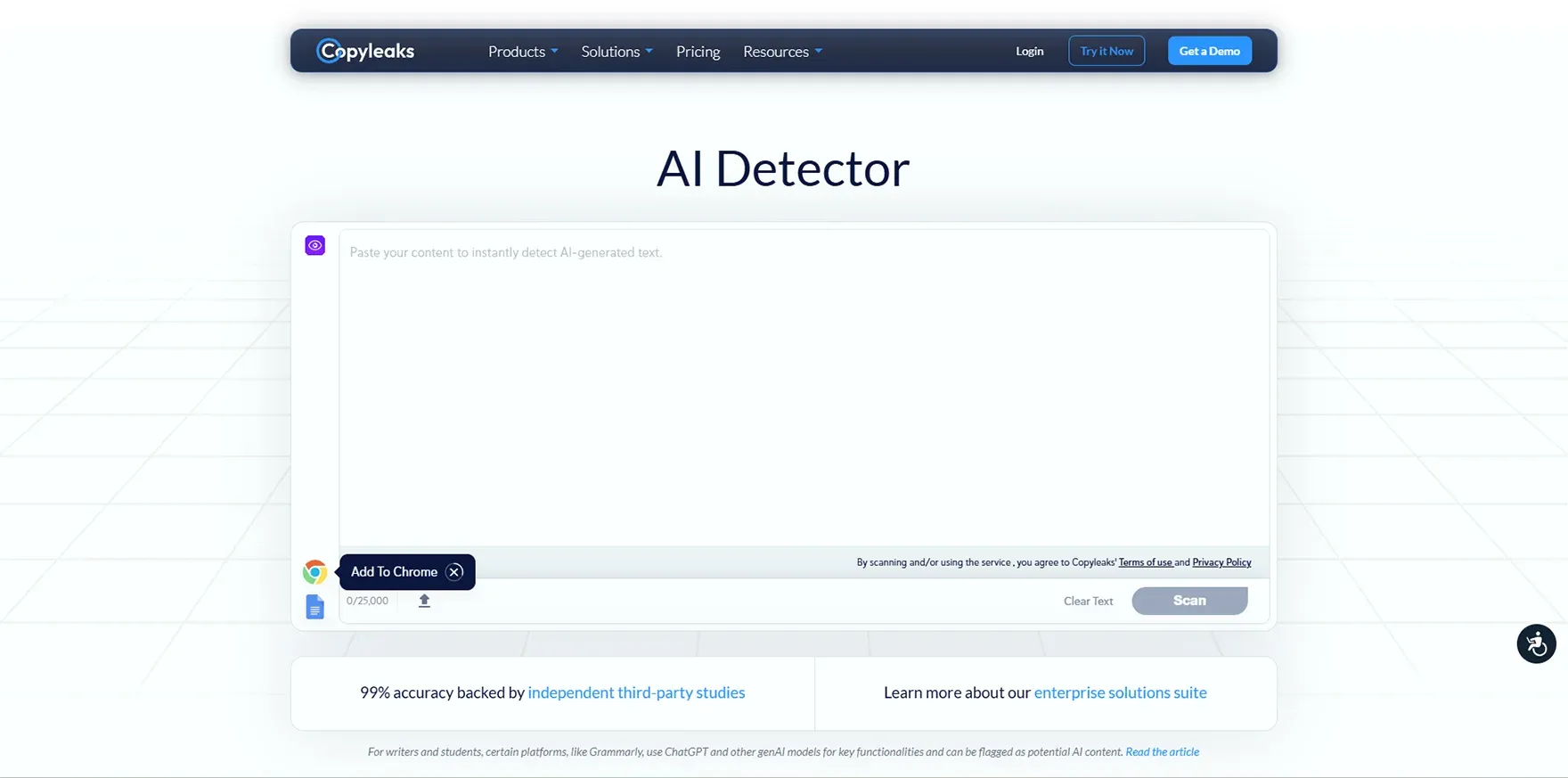
Copyleaks can be a good option for users who need detection across more than 100 languages, as it supports a wide range of international languages. In addition, the tool can help identify plagiarized or "humanized" AI text, although performance may vary depending on the content and benchmark used, a point explored further in this piece on whether Copyleaks' AI detector is accurate.
5. Originality.ai
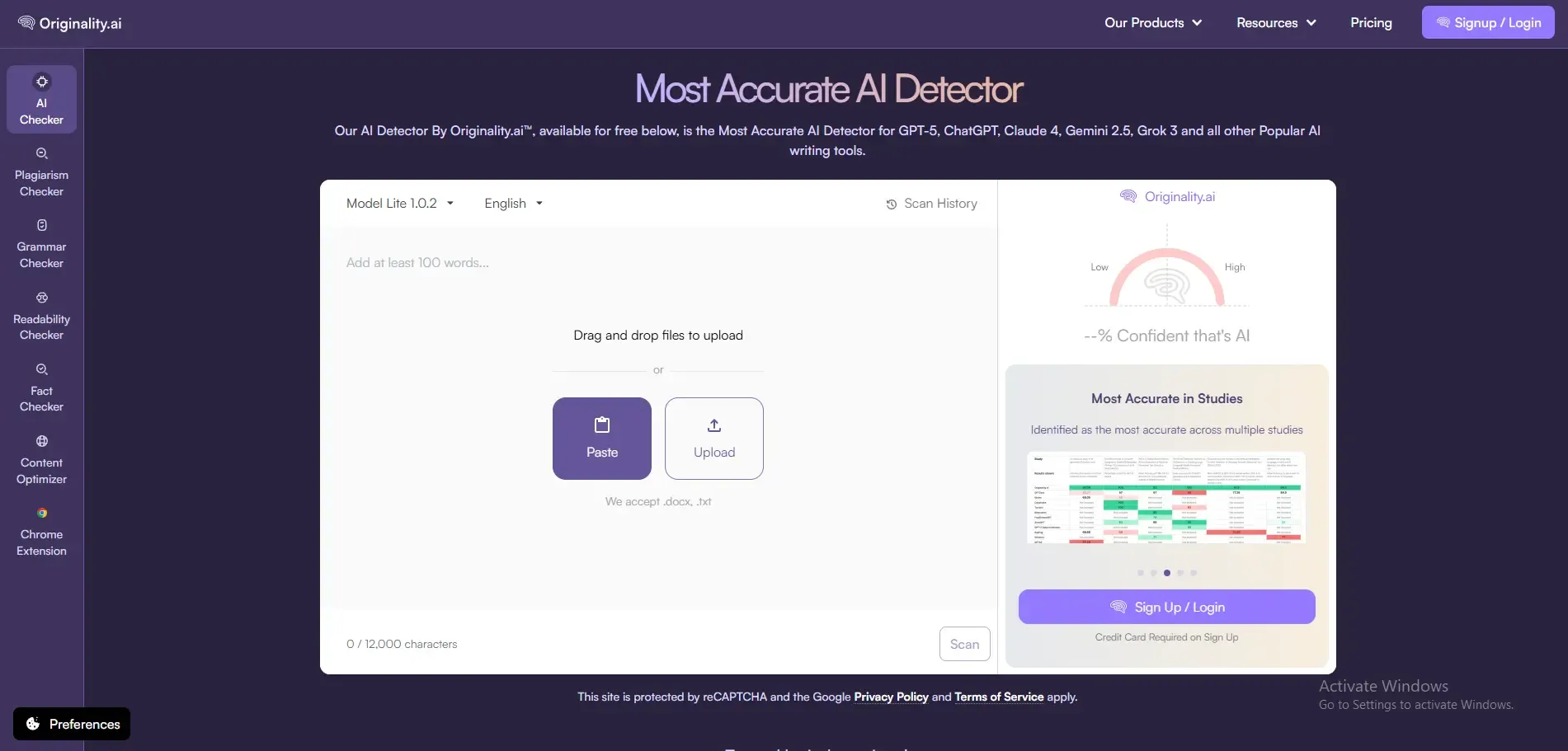
Mainly designed for content and marketing teams, Originality.ai is also used by some students because of its reported low false-positive rates. However, the lack of a free plan may make it less accessible to some students. See how it compares in this AI Checker Pro vs Originality breakdown.
6. Winston AI
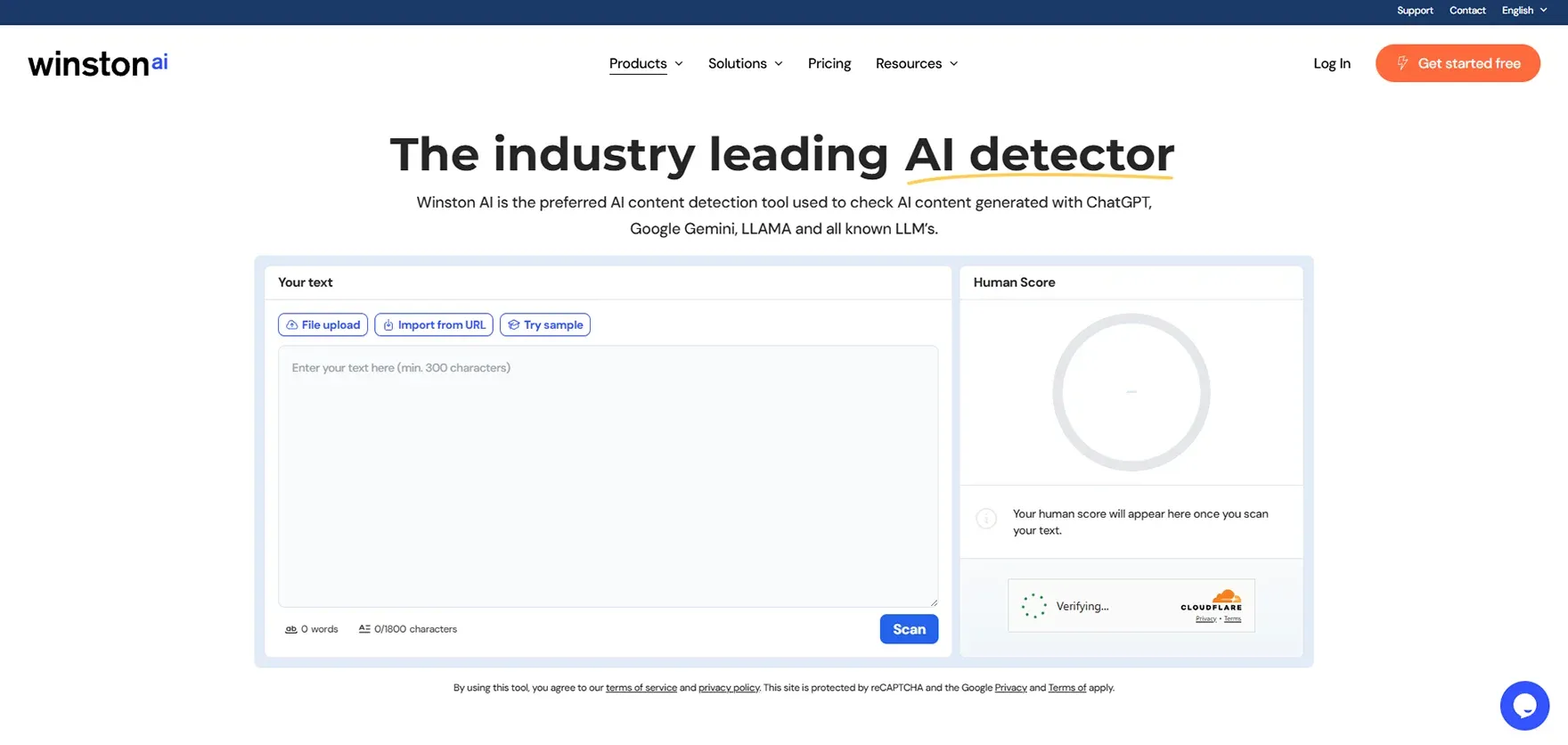
Winston AI is designed with ease of use in mind, making it suitable for educators and classroom environments. Its accuracy is less well-established than that of some larger competitors, as discussed in this Winston AI review.
7. Sapling
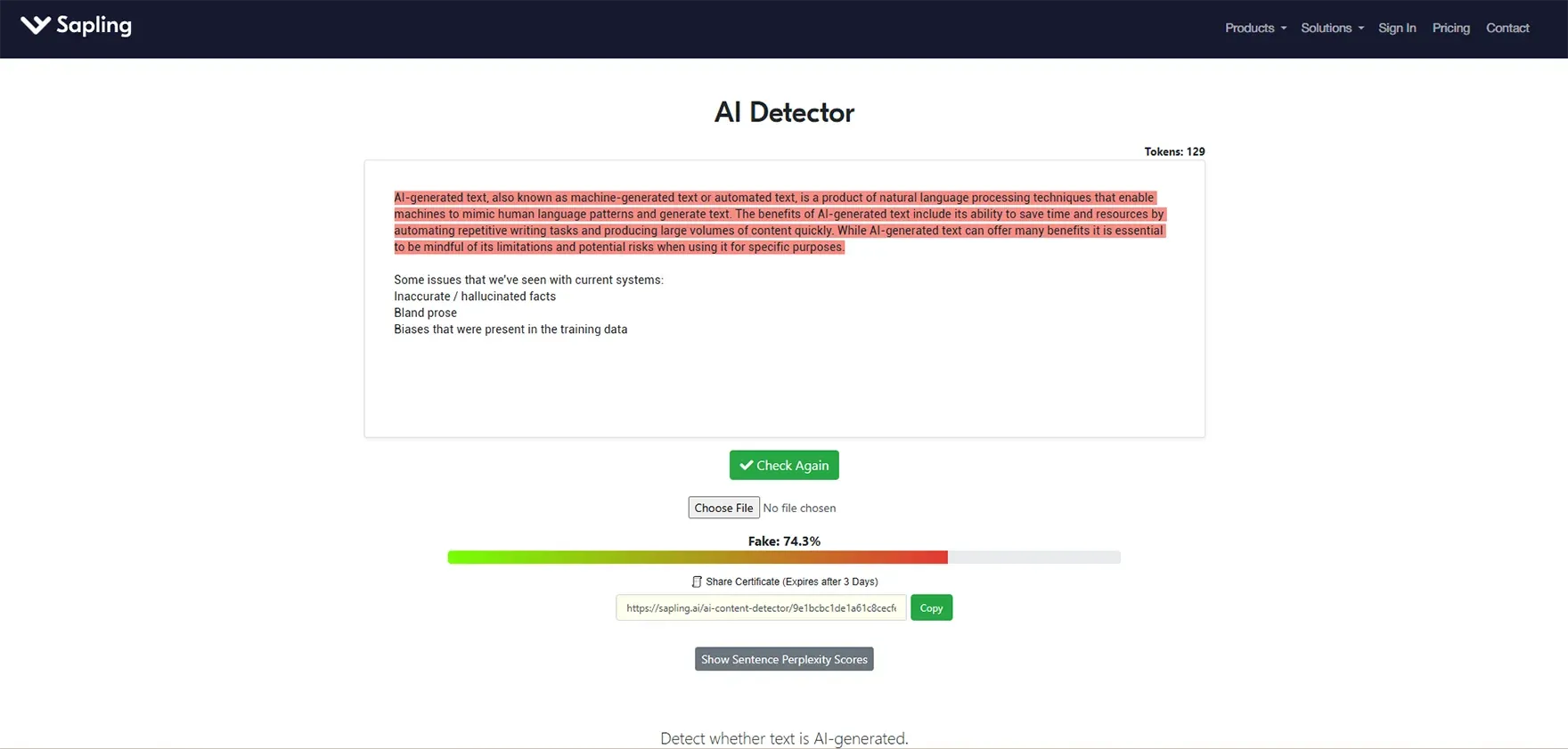
Sapling is a browser-based, lightweight option that is best used as a secondary rather than primary screening solution because its reported accuracy is lower than that of some enterprise options, as noted in this Sapling AI content detector review.
If you are looking to implement one of these products within an existing academic integrity review process, AI Checker Pro's automation consulting can help integrate detection outputs into your current screening workflow.
Common Mistakes Schools Make With AI Detectors
The most common mistake is treating an AI detection score as proof of misconduct instead of one data point in a broader review process.
- Using detection scores alone as grounds for a formal accusation.
- Applying detectors to very short assignments (under 300 words) where accuracy drops sharply.
- Ignoring documented false-positive risk for ESL and multilingual students.
- Not checking whether the detector has been updated for newer AI models.
- Skipping a human review step before contacting a student.
For a fuller list of pitfalls, this guide on AI checker mistakes students make is worth a read.
Best Practices for Using AI Detectors Responsibly
Best practice is to pair AI detection with process evidence, such as draft history or a short follow-up conversation, rather than relying on a single score.
- Set minimum word counts before running detection on an assignment.
- Cross-check flagged work with a second detector before escalating.
- Ask students for drafts, outlines, or version history as supporting evidence.
- Communicate detection policies clearly at the start of a course.
- Revisit your detector choice periodically as accuracy claims and models change.
Educators developing their own review dashboards or automated flagging pipelines may find that existing tools do not always fit their workflows. This AI detection tools guide for educators offers additional context on setting up a responsible workflow.
If this describes your workflow, AI Checker Pro's custom AI agent development can unify your LMS, detection tool, and review process into an automated pipeline for faster triage by your academic integrity team.
Conclusion
AI detector accuracy cannot be represented by a single percentage because it depends on factors such as text length, editing depth, and the writer's language background. As a result, no tool should be treated as a universally reliable indicator of AI-generated content.
The most critical lesson from comparing the seven AI detectors is that no single tool is perfect. Cross-checking detection results with context, supporting evidence, and conversations with students can provide a more responsible approach.
Therefore, before selecting an AI detector, pay close attention to its features. Look for tools that allow you to test sample text or use a free demo and provide clear, actionable insights into which parts of the text may require further review, such as the features offered by AI Checker Pro.
FAQs
Which AI detector is the most accurate?
Can AI detectors be wrong?
Do AI detectors flag human writing as AI?
Is Turnitin's AI detector reliable?
Why do AI detectors give different results for the same text?
Can humanized AI text avoid detection?
What is the best free AI detector for students?
Should teachers trust AI detection scores completely?
How does text length affect AI detector accuracy?
Do AI detectors work the same for every AI model?

Harshil Barvaliya
SEO Executive & Content Writer at AI Checker Pro
I’m Harshil Barvaliya, an SEO Executive and Content Writer at AI Checker Pro. I focus on improving the website’s search engine visibility through effective SEO strategies, including keyword research, on-page and off-page optimization, and content development.Get Started Free
Create a free account for advanced AI detection and scan history.
Trusted by thousands worldwide.
Recent Blog's
Discover how AI-powered content creation can elevate your website's reach and engage your audience like never before. Explore the real impact of AI on crafting content that connects.