How to Create Personalized Content That Passes AI Detection
TABLE OF CONTENTS
What Are AI Detection Tools and How Do They Work?
Why Normal Content Gets Flagged
How to Create Human-Like Content (Step-by-Step Guide)
Can You Use AI and Still Sound Human?
Conclusion
FAQs
Get an AI summary of this post on:






The most difficult challenge you face during writing under deadlines emerges from people doubting your work after its completion. The client asked, "Did you use AI for this?" which created an atmosphere that made people doubt your abilities, your work, and your unique perspective.
Human writing presents itself as mechanical when writers create work that exists in strict formats, which maintain complete accuracy without any trace of natural speech. Many writers now encounter this situation, which brings them endless frustration.
People now require comprehension of content perception because it has gained essential value in today's world. The reader experience depends on your writing content and the way it affects readers and AI detection tools, which search for specific patterns, repeated elements, and consistent styles.
The guide explains the methods used to identify content patterns that lead to human-generated material being marked as suspicious while showing you the process for restoring your distinctive writing style, which includes ownership and personal traits.
What Are AI Detection Tools and How Do They Work?
AI detector tools are software systems designed to identify whether a piece of content is written by a human or generated by artificial intelligence. Unlike plagiarism checkers, these tools focus on how AI detectors analyze your writing examining patterns, structure, and language behavior rather than source matching.
Popular AI detector tools such as Copyleaks, GPTZero, Originality.ai, and Turnitin use advanced algorithms to evaluate text based on statistical signals. These tools don't provide absolute answers; they estimate the probability that content was generated by AI.
Here are the main factors AI detector tools analyze:
AI Detection :
This measures how predictable your writing is. AI-generated content tends to follow common and safe patterns, while human writing usually includes more variation and unexpected phrasing.
Readability:
Human writing naturally mixes short and long sentences. In contrast, AI-generated text often maintains a more uniform sentence structure, which AI detector tools can easily identify.
Repetition and Structure
AI systems often reuse similar sentence formats and phrasing patterns across paragraphs, making the content feel formulaic and repetitive.
Common AI Phrases
Expressions like “in conclusion,” “it is important to note,” and “overall” are frequently overused in AI-generated content and are commonly flagged by AI detector tools.
That’s why the goal shouldn’t be to outsmart AI detector tools. Instead, focus on writing content that feels natural, personal, and authentic. When your writing reflects real experience and a unique perspective, it not only performs better with AI detector tools but also connects more effectively with real readers.
Why Normal Content Gets Flagged
This path is uncommonly chosen by most guides, yet it provides valuable insights for those who seek to comprehend it. The AI writing system learned from human writing samples, which caused it to generate text that reads as average because it maintains a standard level of competence, yet lacks interesting features.
The problem exists because many people write in this manner when they face time constraints, feel insecure, or need to adhere to strict writing guidelines.
Common signs that make content feel robotic, regardless of who wrote it:
- Opening every paragraph with a topic sentence that restates the heading
- Using filler transitions like "Furthermore," "Moreover," and "In addition"
- Never using contractions (it's, you're, don't these are natural in conversational writing)
- Avoiding the first person entirely
- Explaining obvious things in exhaustive detail
- Ending every section with a summary of what was just said
If your writing does these things, it may get flagged not because AI wrote it, but because it sounds like AI could have written it. That's exactly why authenticity always wins not just with detection tools, but with real readers too.
How to Create Human-Like Content (Step-by-Step Guide)
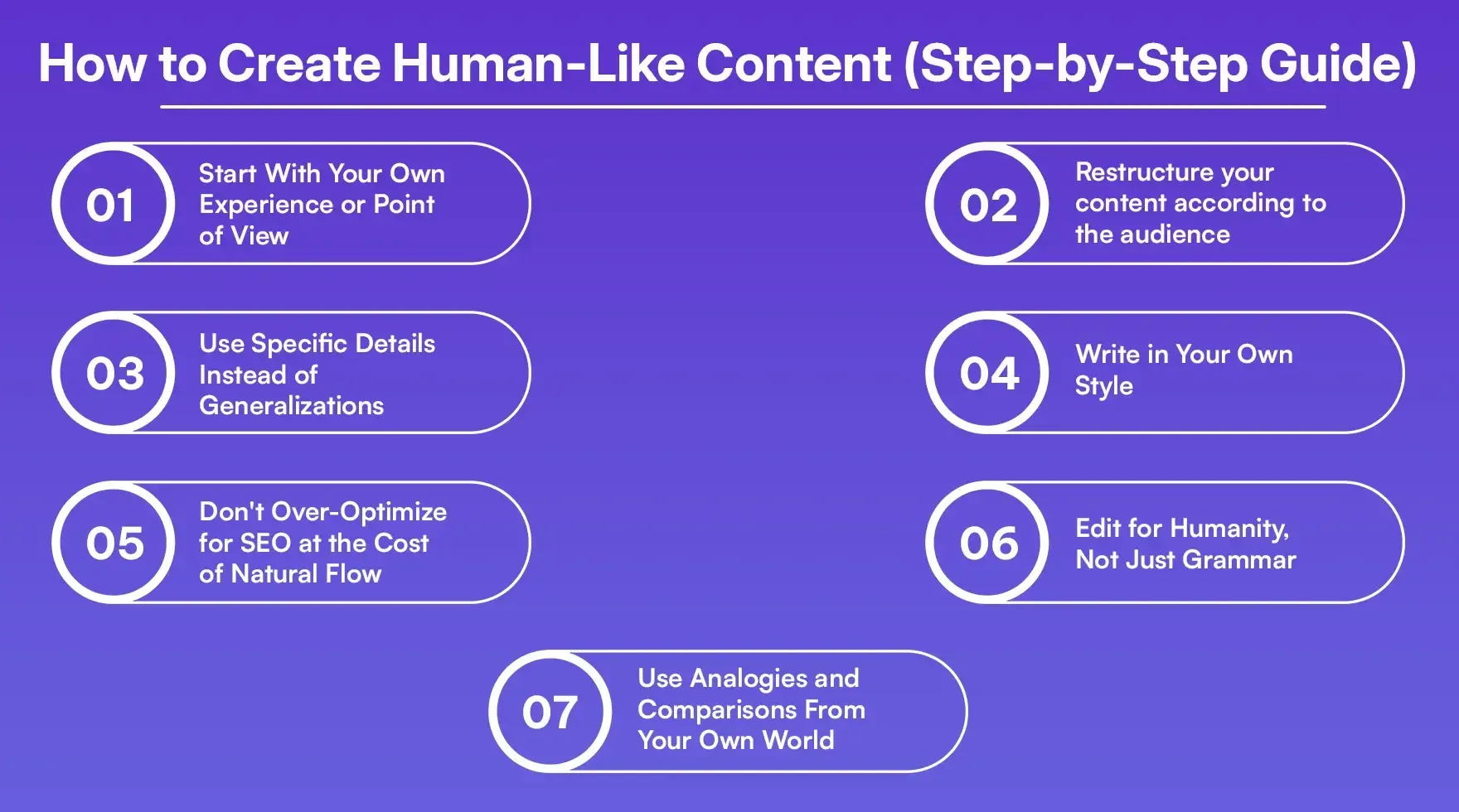
1. Start With Your Own Experience or Point of View
The fastest way to make content human is to make it yours. Before you write anything, ask yourself: Do I actually have an opinion on this? Have I seen this play out in real life? What surprised me when I first learned about this topic?
If you're working on improving your writing to pass AI detection, this first-person grounding is where it starts. A blog post that begins with "Content marketing is an important strategy for businesses today" results in a forgettable article. One that opens with "I used to write three posts a week and wonder why none of them converted until I realized I was writing for search engines, not actual readers" immediately feels different.
You don't need to share your life story. The particular moment you select, together with your observations and learned lessons, creates content elements that artificial intelligence technology cannot reproduce.
2. Restructure your content according to the audience
AI-generated text produces sentences that maintain a uniform flow throughout their duration. The text consists of sentences that maintain a uniform length between short and long. All paragraphs maintain a constant speed of delivery.
Human writing produces bursty content. You will create three brief, energetic sentences. Your thoughts will follow the pattern of one short sentence, which connects to an extended sentence that describes your mental process. This is exactly what humanizing AI text manually is all about breaking the mechanical rhythm and restoring a natural voice.
You should read your draft aloud. You need to rewrite the text when it sounds like a podcast transcript from a very calm, emotionally neutral host. Add a two-word sentence. Separate a lengthy thought into two distinct parts. A simple point will allow a paragraph to be expressed in one line.
3. Use Specific Details Instead of Generalizations
Most AI-generated content fails at this point, while personalized content establishes its unique identity. Consider these five simple ways to humanize ChatGPT content specificity sits at the top of that list for good reason.
Compare these two examples:
- "Many businesses have seen growth after using email marketing."
- "A small bakery in Austin started sending weekly recipe emails to their list, and their customer base increased by 100 percent within three months."
The second example is more memorable, more believable, and more useful. It presents authentic human writing because it demonstrates knowledge of real facts. You only need to reference your source when you make specific claims saying "I've seen this happen three times in the past year" provides stronger evidence than a vague citation from an unknown research study.
4. Write in Your Own Style
Good human writers have habits. These writers use dashes to create separate clauses which they employ throughout their writing. Some writers create incomplete sentences. Some writers use questions which they introduce during their writing to help their readers understand their content. Serious writers use funny elements throughout their writing.
The so-called imperfections present in this work function as unique identifiers that enable the identification of the author. The AI system operates to remove these elements because it seeks to achieve a clear and impartial understanding. The presence of slight stylistic imperfections, which include a casual speech pattern, an unusual comparison, and a display of uncertainty, enhances your content's credibility.
The exercise requires you to read three of your previous emails or messages. The phrases you use most frequently should become apparent to you. Your writing style emerges from your natural ways of using punctuation. Your blog writing should incorporate elements from that particular energy.
5. Don't Over-Optimize for SEO at the Cost of Natural Flow
Keywords matter for online content. Search intent requires your evaluation. But AI-generated content demonstrates its nature most clearly through forced sentence structures phrases that exist only to include a keyword, not to serve the reader.
If your goal is to understand how to avoid AI detection in writing, the answer almost always comes back to natural language flow. Your writing needs to sound authentic to both readers and detection tools. When concepts like "personalized content," "AI detection," and "human writing style" appear as natural parts of your sentences not repeated keyword patterns you've found the balance worth aiming for.
6. Edit for Humanity, Not Just Grammar
Most writers focus on fixing grammar and typos, but very few writers make their content more relatable to readers. After completing your first draft,t you should take time to assess your work from opposing perspectives.
The writer must create new sentences that improve their writing style, while they need to delete all basic and unnecessary content, and eliminate all phrases that provide no genuine worth from their work.
The writer should use smoother transitions to connect their ideas while using "I" to express their personal viewpoint. The basic editing process enables your writing to achieve greater authenticity and reader appeal than any other editing method.
7. Use Analogies and Comparisons From Your Own World
AI can generate analogies, but they're often generic. "Think of it like a recipe" or "Just like a road map" appear in roughly a thousand articles on any given topic.
The analogies that stick are the ones that come from somewhere specific.
If you grew up playing cricket, and you're writing about content strategy, maybe there's something useful in the way a batting lineup is built. If you've spent years cooking without recipes, maybe that's a frame for talking about creative writing. These comparisons don't need to be perfect; they need to be real.
Can You Use AI and Still Sound Human?
Current writers face this as a common concern. You can use AI to develop a first draft, save time, and get unstuck when ideas aren't flowing. But your draft becomes your actual work only after you've shaped it with your own voice, restructured it to match your rhythm, and replaced the generic with the specific.
If you're not sure where to start with that process, exploring the best AI humanizers that actually work can give you a practical shortcut tools designed to help bridge the gap between a raw AI draft and something that reads as genuinely yours.
Conclusion
In the end, passing AI detection is simply a byproduct of writing with intention, authenticity, and depth. When you focus on sharing real insights, expressing your unique voice, and crafting content that genuinely helps or connects with readers, the question of "AI vs human" naturally fades away.
Good writing has always been about clarity, personality, and trust and that hasn't changed. So instead of chasing loopholes or shortcuts, invest your effort in becoming a better storyteller and communicator. For a more focused starting point, these practical tips to avoid AI detection can help you put today's ideas into immediate action. Because content that feels real will always stand out, no matter how advanced the tools become.
FAQs
1. What is AI detection in content writing?
2. Can human-written content be flagged as AI?
3. How can I make my content feel more human?
4. Is it okay to use AI for writing content?
5. Why do AI tools detect repetitive content easily?
6. What are common signs of AI-like writing?
7. Does adding personal experience really help?
8. Should I focus more on SEO or natural writing?
9. How important is editing for human-like content?
10. What is the best way to pass AI detection tools?

Nathan Porter
Content writer at @Aichecker
Get Started Free
Create a free account for advanced AI detection and scan history.
Trusted by thousands worldwide.
Recent Blog's
Discover how AI-powered content creation can elevate your website's reach and engage your audience like never before. Explore the real impact of AI on crafting content that connects.