AI Blog Enhancer vs Manual Editing: Which Delivers Better Results?
TABLE OF CONTENTS
What Is an AI Blog Enhancer?
What Manual Editing Involves
How to Use the AI Checker Pro Blog Enhancer
AI Blog Enhancer vs Manual Editing: Direct Comparison
Where AI Blog Enhancers Win
Where Manual Editing Wins
The Real Question: Does Enhanced Content Read as AI-Generated?
How to Choose Between Them for Your Content
Common Problems Found in Blog Drafts
Conclusion
FAQs
Get an AI summary of this post on:





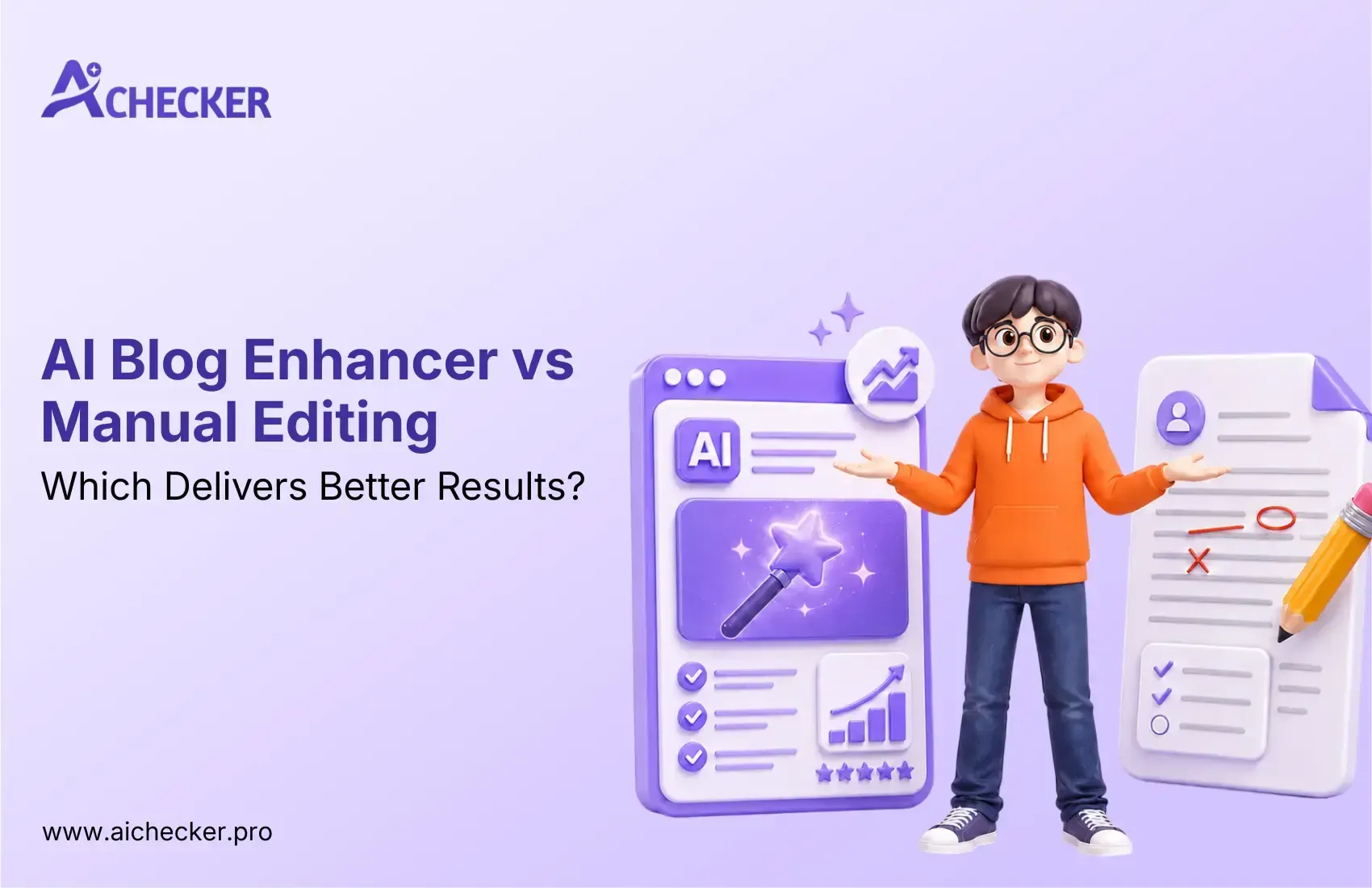
An AI blog enhancer allows you to fix grammar, structure, readability, SEO issues, and errors in minutes. Meanwhile, a manual edit can take hours to complete and provide better judgment than an algorithm can manage. Neither option is better, but depending on your situation, one will be a more practical choice than the other.
Those writing content for blogs every week do not have the luxury of hiring a professional editor to review each piece for grammatical errors. At the same time, independent bloggers cannot afford to skip the editing process entirely.
This article will present the advantages and disadvantages of using an AI blog enhancer versus manually editing blog posts.
It will explore the speed, cost, precision, SEO benefit, risk of getting flagged by AI content detectors, and other relevant factors of each option so that you can choose the best content improvement method for your situation.
What Is an AI Blog Enhancer?
An AI blog enhancer is software that analyzes a draft and automatically improves clarity, tone, grammar, sentence flow, and on-page SEO elements like headings and keyword placement. It is especially useful for bloggers who publish on a tight schedule.
Most tools work in three steps:
- Input: You paste or upload a draft.
- Analysis: The tool scans for readability issues, weak transitions, keyword gaps, and structural problems.
- Output: It returns a revised draft, often with a change log or suggestion list you can accept or reject.
Unlike basic grammar checkers, a blog enhancer looks at the piece holistically, checking pacing, heading hierarchy, and whether the content actually answers the searcher's question.
What Manual Editing Involves
Manual editing is a human editor reading a draft line by line, applying judgment about voice, argument strength, factual accuracy, and audience fit.
A thorough manual edit typically covers:
- Structural review (does the argument build logically?)
- Line editing (sentence-level clarity and rhythm)
- Fact-checking and source verification
- Tone and brand-voice alignment
- SEO pass (keyword placement, internal links, meta elements)
Experienced editors also catch things no algorithm reliably catches yet: subtle bias, tone mismatches with brand values, and claims that are technically correct but misleading in context.
How to Use the AI Checker Pro Blog Enhancer
Creating a blog post that is properly optimized for search engines doesn't have to be such a pain. With AI Checker Pro Blog Enhancer, you can optimize readability, grammar, formatting, SEO, quality, engagement, and more within just a few simple clicks of the button.
Whether you are a marketer, blogger, SEO analyst, or small business owner, this innovative new tool will make it easy for you to turn any draft blog post into a fully optimized SEO article that people will actually want to read.
Follow these steps to enhance your blog using AI Checker Pro:
Step 1: Paste or Upload Your Blog Content Start by opening the Blog Enhancer tool and paste your existing blog post into the editor. Whether the content is AI-generated, manually written, or a combination of both, the tool analyzes your draft and identifies areas that need improvement.
Step 2: Click "Enhance Blog" Once your content is added, click the Enhance Blog button. The AI immediately begins reviewing your article by checking grammar, sentence structure, readability, tone, content flow, keyword usage, and overall writing quality. It also looks for repetitive phrases, awkward wording, and sections that may reduce user engagement.
Step 3: Review the AI Suggestions After the analysis is complete, you'll receive an enhanced version of your blog. Compare the original and improved content, then review AI suggestions for:
- Grammar and spelling corrections
- Better sentence clarity and readability
- Improved paragraph structure
- More engaging and natural language
- SEO-friendly writing enhancements
- Stronger introductions and conclusions
This allows you to keep full control while making your content more valuable for readers.
Step 4: Customize the Content AI provides an excellent foundation, but your expertise makes the article unique. Add personal experiences, examples, industry insights, statistics, or brand-specific messaging to make the content more authentic and aligned with your audience. This combination of AI assistance and human editing produces the best results.
Step 5: Publish with Confidence Once you're satisfied with the improvements, copy the enhanced content and publish it on your website or blog. The final version will be easier to read, better optimized for search engines, and more engaging for your audience, helping improve user experience and content performance over time.

Get Lifetime Access with 60% OFF
Stop paying monthly subscriptions. Enjoy unlimited AI detection and humanizer access forever with future updates included.
- One-time payment
- Unlimited access forever
- All future updates included
AI Blog Enhancer vs Manual Editing: Direct Comparison
| Factor | AI Blog Enhancer | Manual Editing |
|---|---|---|
| Speed | Seconds to minutes | Hours per article |
| Cost per article | Low, often subscription-based | Higher, scales with editor's hourly rate |
| Consistency | High, same standard every time | Varies by editor and fatigue |
| Nuance and voice | Limited, can flatten style | Strong, preserves brand tone |
| Fact-checking | Weak or absent | Reliable when editor is subject-matter literate |
| SEO structure | Fast, rules-based | Slower, but context-aware |
| Scalability | High, hundreds of articles per month | Low, bottlenecked by editor headcount |
| Risk of generic output | Higher if used without review | Lower |
Neither column is universally "better." A news team publishing 40 posts a week needs the enhancer's speed. A brand launching a flagship report needs the editor's judgment.
Where AI Blog Enhancers Win
Speed at scale. A blog enhancer can process a backlog of drafts in an afternoon what would take a human editor a week to complete.
Consistency across writers. Your content hub won't look like patchwork when five different freelancers submit articles with five different tones, since an enhancer will apply the same level of polish to each according to your instructions.
First-pass SEO cleanup. Enhancers can identify missing subheadings, sparse sections, and weak keyword placement, and this kind of SEO cleanup happens with more speed (and less judgment) than a human would offer.
Budget-friendly iteration. Testing different headlines or introductions is much easier on the wallet when you can run multiple variations through an enhancer, rather than paying for separate rounds of professional editing.
Where Manual Editing Wins
Judgment calls an algorithm can't make. Knowing when to cite a source, recognizing a joke that only the target audience will understand, or determining whether a claim about a competitor is fair and accurate takes human insight.
Fact accuracy. Fact after fact, AI tools miss the errors in an otherwise polished piece of writing. Subject matter experts are needed to review works containing statistical information.
Brand voice depth. AI enhancers can make your writing sound like something out of a trade publication, but it's hard to inject that much personality into writing intended for the masses.
Sensitive or high-stakes content. Even if you're satisfied with your legal disclaimer, a medical disclosure, or a CEO's op-ed, you should always have high-stakes documents reviewed by a human.
The Real Question: Does Enhanced Content Read as AI-Generated?
This is where AI blog enhancer tools face another challenge: AI detection.
While search engines don't penalize AI-assisted writing outright, they reward content that demonstrates originality, expertise, and genuine value. AI-generated drafts often need refinement before they meet those expectations.
Independent testing in 2026 shows that detection results vary significantly depending on how much a draft has been edited:
- Raw AI-generated content is detected with high accuracy by leading AI detectors.
- Light editing reduces detection rates but may still leave recognizable AI patterns.
- Deep editing with original insights, real examples, and subject expertise makes content much harder to classify as AI-generated.
- False positives remain possible, especially for non-native English writers.
Before publishing, many content teams now verify their articles using an AI detection tool to understand how their content may appear to editors, clients, or academic reviewers.
AIChecker.pro makes this process simple by analyzing AI probability, highlighting AI-like sentences, and providing actionable suggestions to improve authenticity before publication. Instead of guessing whether your enhanced content sounds natural, you can verify it in just a few clicks.
How to Choose Between Them for Your Content
Use this quick framework:
- High volume, lower stakes (product updates, listicles, evergreen how-tos): lean on an AI blog enhancer with a light human review.
- High stakes, lower volume (thought leadership, legal or medical content, investor communications): lean on manual editing with AI used only for structural suggestions.
- Mixed content calendar: default to the hybrid workflow above and reserve full manual editing for your highest-traffic or highest-conversion pages.
Teams that want to ensure authenticity of content before publishing for regulatory compliance, to build trust with clients, or to satisfy a platform's requirements, often complete a quick check with an AI-powered content verification tool as part of their standard publishing process, not as an optional bonus.
Common Problems Found in Blog Drafts
Most first drafts have issues that make them less readable or less discoverable by search engines. Maybe you have long paragraphs that are hard to get through, or you accidentally used too many keywords or repeated yourself. Articles also often have messy headings or introductions that put off readers before they even get to the good stuff.
A blog enhancer can help you find what needs to be fixed in a few minutes by taking care of grammar, sentence structure, readability, formatting, and SEO for you. These content checkers also give bloggers a clear starting point for revisions.
Instead of having to look for all of these issues manually, you can get a list of edits that will help you improve your post quickly.
Conclusion
An AI blog enhancer and manual editting each serve a different purpose. An enhancer gives you speed, consistency, and a fast SEO boost. Manual editting gives you judgment, accuracy, and voice, what an algorithm just can't match.
The teams that are actually driving up traffic are using both, then running them through an AI content detector to humanize their content and ensure it's not too "robotic" and not "easy for an algorithm to generate." It's these specific teams that are then seeing a spike in their search engine rankings, and readers that are more engaged than ever.
FAQs
1. What is an AI blog enhancer?
2. Is an AI blog enhancer better than manual editing?
3. Does Google penalize AI enhanced blog content?
4. How long does manual blog editing take?
5. Can an AI blog enhancer improve SEO on its own?
6. Should I use AI or a human editor for my blog?
7. How do I know if my blog content sounds like AI?
8. What is the best way to combine AI and manual editing?
9. Are AI content detectors accurate?
10. Is an AI blog enhancer good for beginners?

Harshil Barvaliya
SEO Executive & Content Writer at AI Checker Pro
I’m Harshil Barvaliya, an SEO Executive and Content Writer at AI Checker Pro. I focus on improving the website’s search engine visibility through effective SEO strategies, including keyword research, on-page and off-page optimization, and content development.Get Started Free
Create a free account for advanced AI detection and scan history.
Trusted by thousands worldwide.
Recent Blog's
Discover how AI-powered content creation can elevate your website's reach and engage your audience like never before. Explore the real impact of AI on crafting content that connects.