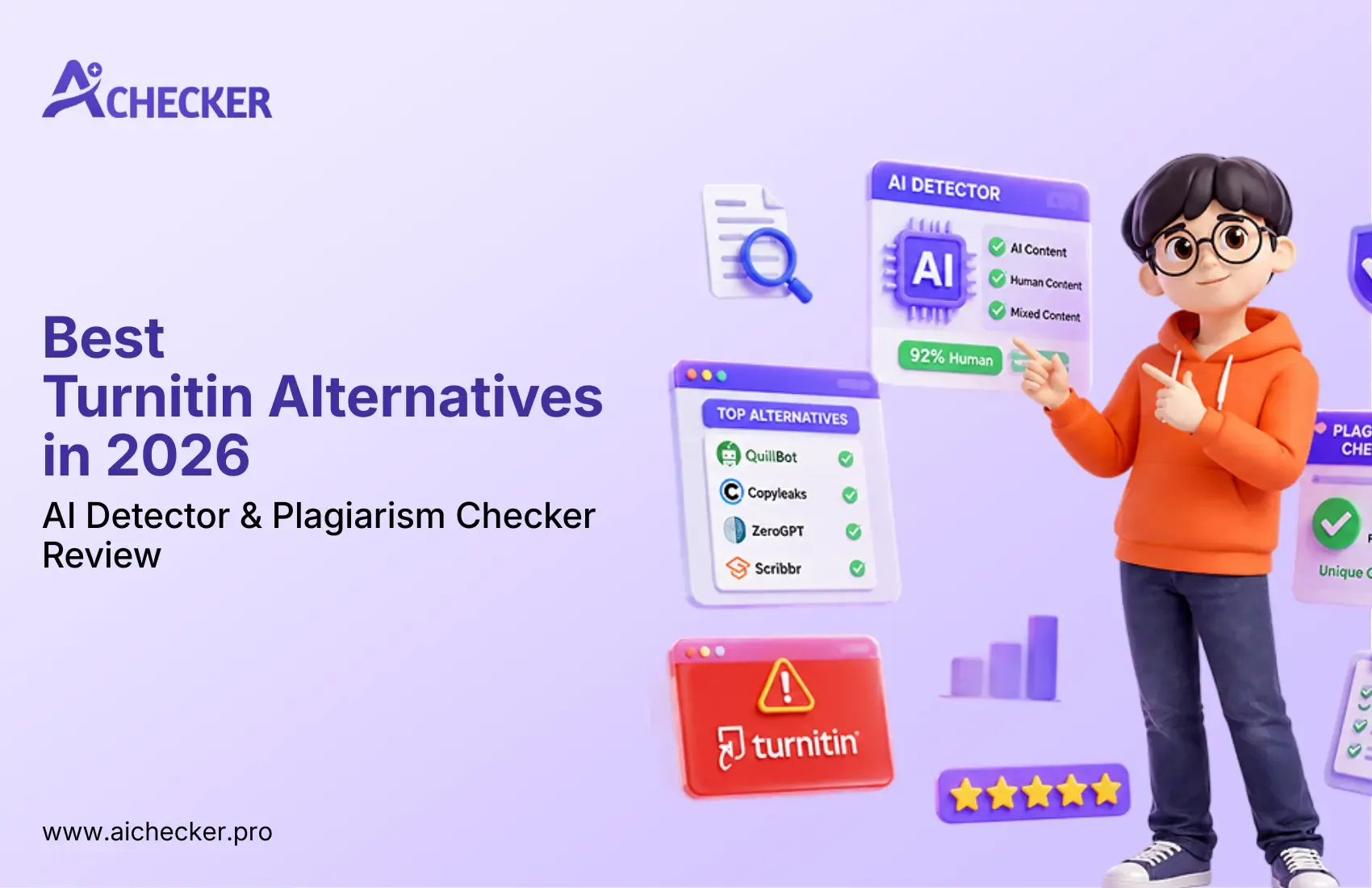
Best Turnitin Alternatives in 2026: AI Detector & Plagiarism Checker Review
TABLE OF CONTENTS
What Is Turnitin and Why Does It Still Matter?
Turnitin's AI Detection: What the Numbers Say
Turnitin Pricing Explained: What You Need to Know
Why People Look for Turnitin Alternatives
6 Best Turnitin Alternatives in 2026
Turnitin vs Alternatives: Quick Comparison
Which Tool Should You Choose?
Conclusion
Get an AI summary of this post on:


If you've ever hit "submit" on a paper and thought about what your professor's plagiarism tool would say, you already kind of know Turnitin. But in 2026, the whole question has shifted a bit. It's not just "Did I plagiarize?" anymore, it's "Will an AI detector flag my work?" And if you're an educator, a student, or a content creator trying to sort out which plagiarism checker actually fits what you need, this guide sorts through what Turnitin does, where it kind of breaks down, and which Turnitin alternatives are worth looking at right now.
What Is Turnitin and Why Does It Still Matter?
Turnitin has been sort of the academic integrity benchmark for over two decades. What began as a simple plagiarism detection tool has slowly turned into a larger academic integrity platform, with AI writing detection instructor guidance tools, and LMS integrations sort of baked into everything.
What you actually get is a Similarity Report, not really a "plagiarism report." Turnitin is pretty careful there. A 15% similarity score just means 15% of your text overlaps with something in the database, which might include properly cited quotes, common expressions, or routine academic language. So it does not automatically equal plagiarism.
For universities, Turnitin is deeply embedded. Canvas, Moodle, Blackboard, all of them, tend to plug in. That institutional trust is both its strongest point and, honestly, why most students never get a real choice in the matter.
Turnitin's AI Detection: What the Numbers Say
Since launching its AI detector Turnitin feature in 2023, the platform has seen meaningful improvements, kinda. By 2026, independent testing suggests Turnitin hits pretty solid accuracy rates, especially when the essays are fully AI-generated from mainstream models like ChatGPT and GPT-4, so yeah.
Here's what works well:
- High detection rate on pure, unedited AI output from popular LLMs
- Color-coded confidence system (red, yellow, blue) helps instructors assess risk at a glance
- Integrated reporting that combines plagiarism similarity and AI probability in a single document
- Exportable reports for academic documentation
Here's what still causes problems:
- Mixed human-AI content: lightly edited drafts and blended writing remain harder to flag accurately
- False positives on ESL students: non-native English writers and those with very precise, formal styles can get flagged unfairly
- Short submissions have historically produced inconsistent results, though this has improved
The false positive worries are real enough, like truly, and universities, including Vanderbilt, Northwestern, and the University of Waterloo, have at various points gone ahead and disabled the AI detection feature entirely, citing risks to students who had never even touched AI tools. If you want a deeper look at why these errors happen, this breakdown of AI detection problems covers the issue in a pretty straightforward way.
And if you are using Turnitin as an educator, then that professional judgment kind of stays essential; the score becomes more like a signal, not a verdict, you know.
Turnitin Pricing Explained: What You Need to Know
Okay, so here's the deal-breaker for most individuals: Turnitin is not really something you can just buy directly as a one-off, like for individuals. Instead, it works more on an institutional licensing system, where it gets sold to universities, schools, and all kinds of organizations.
The whole pricing setup is negotiated in a kind of opaque way, and yeah it can end up costing thousands of dollars per institution, depending on the agreement.
So if you're a freelancer, a solo content writer, a student trying to sanity check their paper before submitting, or even a small business owner, Turnitin is basically not built for that. This lack of easy access is, in my view, the biggest reason people start hunting for a Turnitin-free alternative, or a more reachable Turnitin-like option. There's also a useful rundown on free vs paid AI checkers that can help you figure out what actually makes sense for your budget.
Why People Look for Turnitin Alternatives
The reasons are pretty consistent across the board:
- No individual access: if your institution doesn't use it, you can't either
- Cost: Even institutions are feeling the budget pressure
- AI detection false positives: educators want a second opinion
- Content marketing use cases: SEO writers and agencies need tools built for their workflow, not academia
- Faster, more flexible scanning: batch uploads, APIs, pay-as-you-go credits
The good news is that the Turnitin alternatives plagiarism checker market has, like, matured quite a lot. Now there are actually some solid options depending on what you need in the moment, and not just the usual mediocre ones.
6 Best Turnitin Alternatives in 2026
1. AIChecker.pro: Best for Content Teams & SEO Writers
AIChecker.pro is like an AI content detection platform, made for students, bloggers, marketers, and publishers who need to spot AI-generated text kinda quickly. The idea is that it can identify writing made with tools such as ChatGPT, Claude, Gemini, and other current AI models, too.
It also gives a sentence-level breakdown, so users can see which little parts of the text may seem AI-generated, and not just the overall result. Somehow, that makes it easier to adjust wording without guessing.
Key Features
- AI content detection for ChatGPT, Claude, Gemini, and Grok
- Sentence-level AI analysis
- PDF and document upload support
- AI humanizer tool
- Fast AI scoring and reporting
- Designed for writers, educators, and marketers
Pricing
- Free AI detection available
- Premium plans available for advanced usage and higher limits
Pros
- Beginner-friendly interface
- Fast detection speed
- Useful for bloggers and SEO content teams
- Supports multiple AI models
- Includes AI humanization features
Cons
- Limited transparency about the detection methodology
- Pricing details are not fully clear on all pages
- May not be as academically established as Turnitin
- Enterprise compliance information is publicly limited
Best For
SEO writers, content agencies, bloggers, freelancers, and publishers checking AI-generated content
2. Copyleaks: Best for Multilingual Detection
Copyleaks really stands out for multilingual support, and it keeps the false positive rate pretty low, so it ends up being a strong Turnitin alternative type plagiarism checker for teams and organizations that work across different languages, globally, and at the same time. You can check out a full Copyleaks AI detector review if you want to go deeper on how it holds up in real testing.
Key features:
- AI detection across 30+ languages
- Source code plagiarism detection (great for technical educators)
- LMS integrations available
- API access on higher tiers
Pricing: Starts around $7.99–$12/month for AI detection; plagiarism plans scale with word volume. Free tier: 10 pages/month.
Pros: Low false positive rate (1–2% in independent tests), multilingual strength, good for both academic and professional use
Cons: Detection accuracy drops on paraphrased content (~50%), less intuitive UI compared to newer tools
Best for: International schools, multilingual publishers, technical educators
3. GPTZero: Best for Educators & Academic Use
If Turnitin is the institutional standard, GPTZero is kinda its strongest rival in the education space. It topped the 2026 Chicago Booth benchmark, at 99.5% accuracy with a 0.05% false positive rate, which is basically the best independently verified results around. A detailed GPTZero AI detector review breaks down exactly how it performs across different types of writing if you want the full picture.
Key features:
- Writing Replay: a video-level evidence trail showing how a document was written
- Sentence-level highlighting for granular review
- Canvas, Google Classroom, and Moodle integrations
- Hallucination Detector
- Batch upload support
Pricing: Free tier: 10,000 words/month (no credit card required). Paid Essential plan: $14.99/month for 150,000 words/month.
Pros: Best-in-class accuracy, strongest paraphraser detection (93.5% recall), best free tier of any AI detector, purpose-built for educators.
Cons: No direct individual plagiarism checker, not designed for content marketing workflows
Best for: Teachers, professors, academic integrity officers, students, and pre-checking work
4. Winston AI: Best for Google Classroom Users
Winston AI is kind of popular with K-12 and higher education educators, especially the ones who are working inside Google Classroom. The service says it has 99.98% accuracy, but that's vendor-reported, not truly independently checked to the same level as GPTZero. It also has a UI that feels clean and pretty approachable, like easy to use right away. For a closer look at how it performs, this Winston AI review covers both the strengths and the limitations pretty honestly.
Key features:
- AI image detection (unique in this category)
- Plagiarism checker included
- Readability score and word counter
- Chrome extension
- API with multilingual support
Pricing: Essential plan from $12/month (annual) covering 80,000 words/month. Free plan available, no credit card required.
Pros: Clean UI, free plan available, AI image detection, good for Google Classroom.
Cons: Smaller training dataset than GPTZero or Turnitin, no third-party academic validation matching GPTZero's benchmark, ~10% false positive rate reported in some tests
Best for: K-12 teachers, Google Classroom environments, educators wanting an approachable UI
5. QuillBot AI Detector: Best for Students
QuillBot uses a, honestly, a different kind of approach. Like Turnitin, which is an institutional tool that reports to your professor, QuillBot is more like a student-side writing companion; it helps you iron out trouble spots before you submit, not after. If you want to see how students are actually using tools like this in their workflow, this guide on how students use AI detectors and humanizers is worth a read.
Key features:
- AI detector with 1,200 words free
- Plagiarism checker with instant citation generation (APA, MLA, Chicago)
- Grammar checker and paraphrasing tool
- Scanning limit up to 25,000 words on premium (generous for academic use)
Pricing: Free tier available (1,200 words for AI detection); Premium plan around $9.95/month.
Pros: Student-friendly workflow, integrated citation generation, somewhat affordable, sure.
Cons: It's not really an institutional-grade tool, you need the premium plan for a plagiarism checker, and it is limited to three citation styles only.
Best for: Students pre-checking assignments, writers working on academic style
6. ZeroGPT: Best Free Option
ZeroGPT is the go-to thing when you need a quick, no-signup AI check without spending anything. It won't really match the accuracy of those paid tools, but for casual use or an initial screening, it kinda gets the job done, like it is enough. If you want a detailed breakdown of how it actually performs, this review of ZeroGPT lays out the accuracy numbers and limitations in a clear way.
Key features:
- No signup required for basic checks
- Sentence-level highlighting
- Multiple language support
- API available
Pricing: Free for basic use; paid plans available for higher volume.
Pros: Truly free with no credit card, instant results, easy to use
Cons: Higher false positive rate (over 20% in some tests), not reliable enough for high-stakes decisions, limited database compared to paid tools
Best for: Quick spot checks, budget-conscious users, casual content review
Turnitin vs Alternatives: Quick Comparison
| Tool | AI Detection | Plagiarism Check | Free Plan | Best For | Starting Price |
|---|---|---|---|---|---|
| Turnitin | Strong | Industry-leading | No | Universities & institutions | Institutional pricing |
| Copyleaks | Good | Yes | Limited free credits | Multilingual teams | $7.99/mo |
| GPTZero | Best accuracy | Limited | 10,000 words/month | Educators | $14.99/mo |
| Winston AI | Good | Yes | Yes | Google Classroom users | $12/mo |
| QuillBot AI Detector | Basic | Premium only | 1,200 words | Students | $9.95/mo |
| ZeroGPT | Basic | No | Yes | Quick AI checks | Free |
| AIChecker.pro | Good | Yes | Yes | SEO writers & content agencies | Custom / usage-based pricing |
Which Tool Should You Choose?
Best for universities and institutions: Turnitin is still an amazing tool. The LMS integrations, academic database depth, and institutional trust are just hard to copy. If your school already uses it, go ahead and keep using it, then maybe add GPTZero as a second glance for the tricky, contested situations.
Best for teachers and educators: In 2026, GPTZero comes off as the strongest independent alternative. The Writing Replay option, alone, is a real conversation-starter around academic integrity, and yes, the free tier is actually useful. You can also check this best AI detector tools guide for educators for more options built specifically around classroom use.
Best for students: QuillBot works well for that pre-submission routine. Before you submit, run your draft through its AI detector and plagiarism checker, so you can spot accidental problems and also drop in missing citations right then, not to "win" against the system. If you are not sure which tool fits best, this list of best free AI detectors for students has a clear breakdown.
Best for content writers and SEO agencies: Originality.ai is built around your workflow in a pretty direct way. The pay-as-you-go pricing keeps it cost-effective at scale, and the combined AI and plagiarism scan in one credit makes it efficient when you're pushing high-volume output through a pipeline. If you also want a way to make your content sound more natural after detection, the AI humanizer tool can help clean things up quickly.
Best budget-friendly option: GPTZero's free tier gives you 10,000 words per month, and you don't need a credit card. For occasional use, that's more than enough for most individuals.
Conclusion
For universities, yes, Turnitin is still kinda the best plagiarism checker for institutional academic integrity. The database depth, LMS integration, and the combo of AI plus similarity detection all in one report makes it feel uniquely suited for that environment, honestly.
For everyone else, though? The argument gets weaker. No personal access, the institutional-only pricing, and the fact that alternatives are getting sharper, like GPTZero and Originality.ai, mean there is now a Turnitin equivalent for pretty much every use case. Often it costs way less, or it's flat-out free. If you want an even broader comparison across tools, this best AI content detector comparison gives you a side-by-side look that's worth bookmarking.
Basically, the right tool depends on your situation, and in 2026, you're not stuck choosing between Turnitin and nothing anymore.
Looking for a reliable AI detector you can use right now? Check out the tools reviewed at aichecker.pro for side-by-side accuracy comparisons and free trial links.
1. What is the best free Turnitin alternative for students in 2026?
2. Is there a Turnitin equivalent that works for individual users?
3. Can an AI detector catch ChatGPT-written text accurately?
4. Does Turnitin have an AI detector built in?
5. What is the most accurate AI checker available right now?
6. How do I humanize AI text to avoid being flagged by an AI detector?
7. Is ZeroGPT a reliable free AI detection tool?
8. What is the difference between a plagiarism checker and an AI detector?
9. Which Turnitin alternative is best for content writers and SEO agencies?
10. Why do some universities disable Turnitin's AI detection feature?

Harshil Barvaliya
SEO Executive & Content Writer at AI Checker Pro
I’m Harshil Barvaliya, an SEO Executive and Content Writer at AI Checker Pro. I focus on improving the website’s search engine visibility through effective SEO strategies, including keyword research, on-page and off-page optimization, and content development.Get Started Free
Create a free account for advanced AI detection and scan history.
Trusted by thousands worldwide.
Recent Blog's
Discover how AI-powered content creation can elevate your website's reach and engage your audience like never before. Explore the real impact of AI on crafting content that connects.