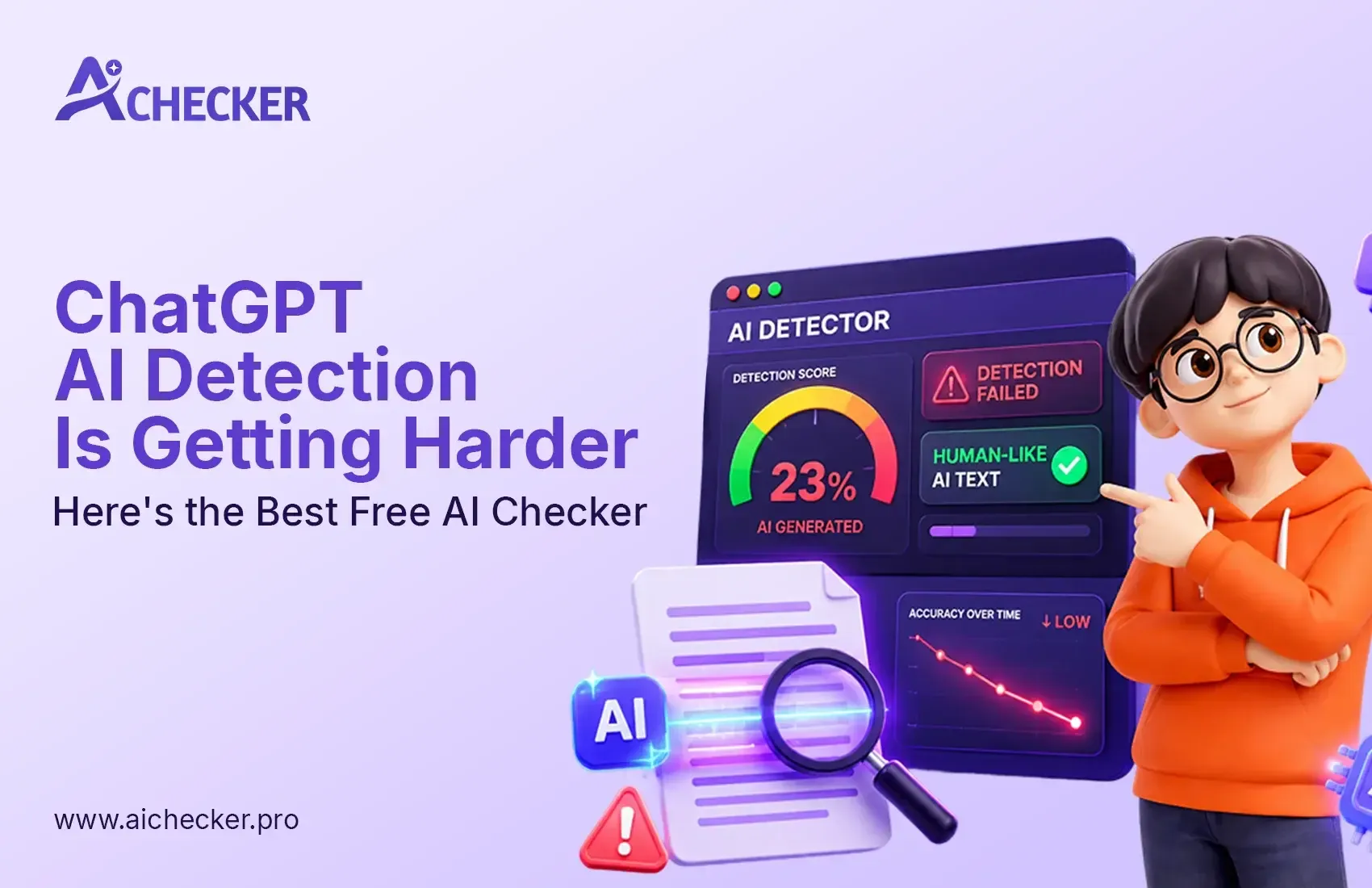
ChatGPT AI Detection Is Getting Harder: Here’s the Best Free AI Checker
TABLE OF CONTENTS
Why AI Detection Is Becoming More Difficult
What Is an AI Detector and How Does It Work?
Why Traditional AI Checkers Are Failing in 2026
ChatGPT Detector vs Human Writing: The Real Challenge
Features to Look for in an AI Checker Free Tool
Best Free AI Detector for Students, Bloggers, and Marketers
How Accurate Is an AI-Generated Text Detector?
AI Detector for Essays: Can Teachers Still Detect AI Writing?
Comparing Popular AI Detection Tools and AI Checkers
Free AI Detector vs Paid AI Detection Tool
Tips to Avoid False Positives in AI Content Detection
Conclusion
FAQs
Get an AI summary of this post on:




AI-generated content is pretty much everywhere in 2026, and with that comes this ongoing problem of actually catching it. If you've been depending on an AI detector tool to confirm whether something is original, you might have seen the results getting a bit wonky lately.
The distance between human writing and machine writing is closing really fast, and those older tools don't quite stay in sync anymore. So whether you're a student, a teacher, a blogger, or you're doing marketing, this guide covers everything you need to know about finding the best AI detector equivalent for AI content, a tool that is accurate, free, and built for today's writing landscape.
Why AI Detection Is Becoming More Difficult
AI detection feels harder in 2026 because the models themselves are now way more human-like in how they write, you know. Stuff like GPT-5, Claude Opus 4.5, and Gemini 3 Pro generate text with higher variation in sentence flow, vibe, and word choice. That seems to hit the pattern cues that AI detection tools usually lean on, so the whole thing gets less reliable, faster than you'd expect.
At the same time, "AI humanizer" tools have basically made the situation worse. They strip out the usual detectable traces before the text is even submitted. Some of those tools can take AI probability scores from 94-100% down to almost 0%, so suddenly, even strong AI checkers show inconsistent results, or like they're guessing.
What Is an AI Detector and How Does It Work?
An AI detector is basically a tool that sorts of examines what's in the text to figure out if it was penned by a real human, or if it was generated by an AI model like ChatGPT. It looks at patterns and wording and then makes a judgment, even if it can be a bit awkward sometimes.
These tools work by measuring two core signals:
Perplexity: How predictable or "safe" the word choices are. AI tends to pick the most likely word; humans pick surprising ones.
Burstiness: How much sentence length and structure vary. Human writing is messier and more varied.
When a text ends up low on both things, it gets flagged as AI-generated. Most AI detector tools use machine learning classifiers that are trained using huge sets of content, both human-like and synthetic, so yeah.
Why Traditional AI Checkers Are Failing in 2026
Traditional AI checkers were kind of trained on older AI outputs, so when newer models come along, they have a harder time, not always, but often. There are a few reasons why this happens, really more than people expect.
- GPT-5, Claude 4, and Gemini Pro produce text with more natural variation, higher burstiness, and less predictable phrasing
- AI humanizer tools actively rewrite AI content to bypass detection before it is submitted
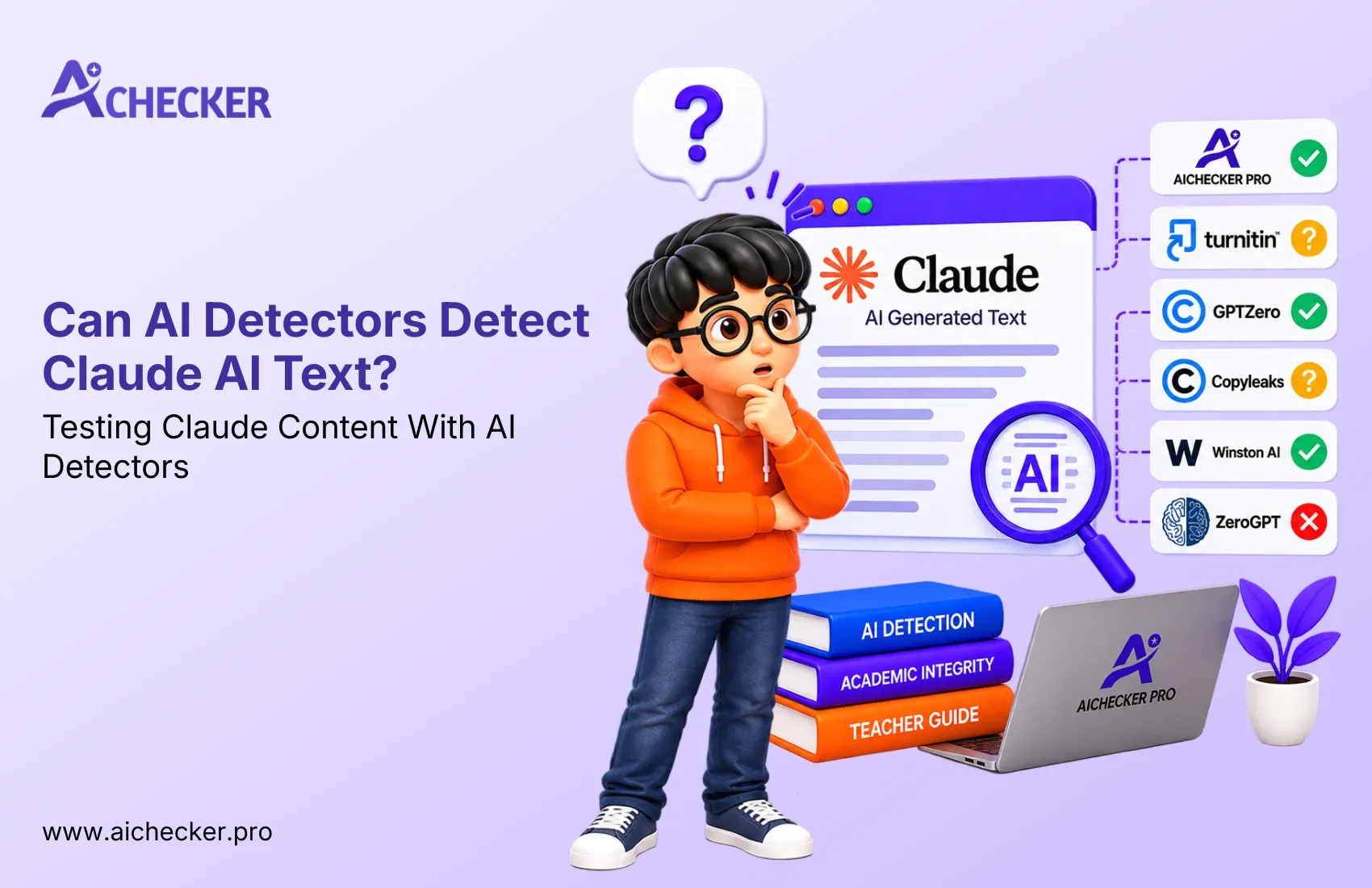
- ESL writers are frequently false-flagged, with some studies showing false positive rates as high as 61% for non-native English speakers
- Detection companies retrain their models slowly, creating a lag behind new AI releases
This means that even a very capable AI writing detector can give inconsistent results on the same text when it is run twice, on different platforms, sometimes.
ChatGPT Detector vs Human Writing: The Real Challenge
The main challenge for any ChatGPT detector is that advanced AI now writes closer to how real humans write, but in a way that's kind of hard to pin down. It kind of feels similar to natural phrasing, and it shows up as something you'd expect from a person, even when it's not, so the whole thing gets messy for detectors, sometimes.
Here is what makes detection difficult in practice:
- AI models in 2026 use 400K+ token context windows, which means their writing is more contextually coherent
- GPT-5 produces 65% fewer hallucinations than earlier versions, making outputs cleaner and less "AI-ish"
- A ChatGPT detector trained on 2023-era output may be nearly useless against GPT-5 or Claude Opus 4.5 content
The result, accuracy claims of 98-99% on marketing pages often come from these sorts of controlled benchmark tests, not really how it behaves day to day. And yeah, independent tests suggest real-world accuracy sits more like 39% to 84%, depending on the tool, or even on the actual content.
Features to Look for in an AI Checker Free Tool
Before picking a free AI checker, check these key factors:
- Multi-model detection: Does it detect GPT-5, Claude, Gemini, and LLaMA? Not just ChatGPT.
- Sentence-level highlighting: Can it show exactly which sentences are flagged?
- False positive rate: A tool that flags innocent human writing is worse than no tool at all.
- Word limit on free tier: Some tools cap free use at 500-5000 words per check.
- No signup required: The best free tools work without creating an account.
- Regular model updates: Detection tools must update frequently to catch newer AI models.
Best Free AI Detector for Students, Bloggers, and Marketers
Here are the top free AI detector tools tested and ranked in 2026:
1. AIChecker.pro
AIChecker.pro is becoming popular among bloggers, students, and SEO writers because of its fast AI detection and simple interface. The tool supports detection for ChatGPT, Claude, Gemini, and other modern AI models.
It provides detailed AI probability scoring with quick scanning results, making it useful for content verification before publishing or submission. You can read a full AIChecker.pro review and breakdown of its detection accuracy to see how it stacks up.
Best for: Bloggers, marketers, SEO writers, agencies
Pricing: Free AI checker available with premium features for advanced usage
2. GPTZero
GPTZero is one of the most recognized AI detection tools used by educators and students worldwide. It focuses heavily on academic integrity and provides sentence-level analysis with AI probability indicators.
The platform is widely used for checking essays, assignments, and research-based content. If you want a detailed side-by-side look, this GPTZero vs AIChecker.pro comparison for students covers the differences clearly.
Best for: Students, teachers, academic content checking
Pricing: Free plan available with limited monthly scans
3. QuillBot AI Detector
QuillBot AI Detector works well for writers who already use QuillBot for paraphrasing and grammar improvement. The detector analyzes content and estimates how much text may appear AI-generated.
Many bloggers and content creators use it to refine tone and improve human-like readability before publishing articles. Read the full QuillBot AI detector review to understand its strengths and limitations.
Best for: Bloggers, freelance writers, content creators
Pricing: Free version available with premium writing tools
4. Copyleaks
Copyleaks is considered one of the more advanced AI detection platforms for enterprise and educational use. It supports detection across multiple AI models and offers detailed reporting with high claimed accuracy.
Many universities and businesses use Copyleaks for plagiarism and AI content verification together. Check out this Copyleaks AI detector review for a deeper look at how it performs in real use.
Best for: Enterprises, educators, publishers
Pricing: Limited free access with paid professional plans
5. AI Humanize
AI Humanize is designed for users who want to make AI-generated content sound more natural and human-written. Along with humanizing text, it also includes AI detection features to help users evaluate content quality before publishing. The tool is commonly used by affiliate marketers, students, and SEO professionals trying to reduce robotic writing patterns.
Best for: SEO marketers, affiliate bloggers, and content optimization
Pricing: Free trial available with premium humanizer features
How Accurate Is an AI-Generated Text Detector?
No detector, even the "AI" ones, is really 100% accurate. In practice accuracy is kind of all over the place, like 39% up to 88%, depending on which tool you use, what kind of content it is, and what specific AI model is behind it.
Key accuracy facts to know:
- Vendor claims of 98-99% accuracy are based on controlled benchmarks using raw, unedited AI output
- When content is humanized or lightly edited, detection accuracy can drop to 30-65%
- Non-native English writers face a much higher rate of false positives
- Running the same text through two different AI detection tool platforms will often give different results
The honest answer: use AI detectors as a screening signal, not a final judgment.
AI Detector for Essays: Can Teachers Still Detect AI Writing?
Yeah, but it is getting kind of hard. An AI detector for essays is only as reliable as the AI model it was trained on, right? Turnitin processes more than 1.5 million papers daily, and it says it has 98% accuracy; however, independent tests show it's more like 80 to 84% in real life. They also deliberately tamp down the AI scores if it drops under 20, because their internal trials showed that those results were kinda unreliable, so yeah.
For teachers:
- Do not rely on a single AI writing detector result for integrity decisions
- Use Turnitin plus a secondary tool like Originality.ai or GPTZero
- Ask students to explain their writing process verbally when results are borderline
- Some schools now require process documentation (drafts, notes) alongside submissions
Comparing Popular AI Detection Tools and AI Checkers
| Tool | Free Plan | Estimated Accuracy | Best For | Key Highlight |
|---|---|---|---|---|
| AIChecker.pro | Yes | High accuracy for blogs & AI-generated content | Bloggers, SEO writers, marketers | Detects ChatGPT, Claude, Gemini, and other AI models with fast scanning |
| GPTZero | Yes (Limited monthly words) | ~88% | Students and educators | Strong academic-focused AI detection with sentence-level analysis |
| QuillBot AI Detector | Yes | High reliability | Writers and bloggers | Integrated with paraphrasing and grammar tools for content refinement |
| Copyleaks AI Detector | Limited free access | High enterprise-grade accuracy | Publishers, institutions, agencies | Advanced AI + plagiarism detection with multilingual support |
| AI Humanize | Yes (Trial available) | Moderate to High | SEO marketers and affiliate writers | Helps humanize AI-generated text and reduce robotic tone |
An AI generator detector like Originality.ai is kinda better for professional content teams, while the free tools work decently for solo screening, depending on what you mean by "screening" and so on.
Free AI Detector vs Paid AI Detection Tool
Free tools are nice for personal screening, honestly. Paid tools are kinda better when the stakes are high, like real high stakes, not just casual.
Free AI detector tools are usually enough when:
- You're checking your own writing before submission, just to calm down a bit
- You want a second opinion on that borderline content
- The volume is low, like a few checks per week, maybe less
Paid AI detection tool options are worth it when:
- You review hundreds of submissions (publishers, educators), and it really adds up
- False positives have consequences that you cannot afford
- You need deeper reporting, plus audit trails that you can actually reference later
If you're not sure which tier suits your needs, this free vs paid AI checker breakdown lays it out clearly for different types of users.
Tips to Avoid False Positives in AI Content Detection
False positives happen when human writing is incorrectly flagged as AI. Here is how to reduce them:
- Vary sentence length naturally in your writing
- Add personal examples and anecdotes that AI would not invent
- Use an active voice and avoid overly balanced phrasing
- Run the text through two tools before drawing conclusions
- Check for burstiness by mixing short and long sentences
- Avoid overly formal transitions like "In conclusion" or "Furthermore"
- Include specific numbers, names, or dates that ground the content
If you are an ESL writer who keeps getting flagged unfairly, try running your text through a secondary AI text checker like Scribbr before submitting to get a second perspective.
Conclusion
Getting good at using a dependable AI checker in 2026 is basically about mixing tools, not relying on just one. Use AIChecker.pro for quick, almost endless reviews, then GPTZero or Scribbr for extra careful reads when it really counts, and in every case use human judgment before you actually do anything with the outcome.
Nothing like a single AI text detector is truly perfect, the whole space keeps moving as the models get smarter, so it's worth expecting change. Begin with the free options, compare the findings across different systems, and keep in mind that false positives do happen a lot. If you also want to make your content safer before submitting, learning how to humanize AI text can be a useful extra step. In the end, you're aiming for considered judgment, not some automated verdict.
FAQs
1. What is an AI detector and how does an AI checker work?
2. Is there a free AI detector I can use without signing up?
3. How accurate is a free AI checker in 2026?
4. Can a ChatGPT detector catch content made with newer AI models?
5. What is the best AI content detector for students and essays?
6. Why does my human writing get flagged by an AI writing detector?
7. How does an AI humanizer help content pass AI detection?
8. What features should I look for in a good AI detection tool?
9. Is there a difference between a free AI detector and a paid AI detection tool?
10. How do I convert AI text to human text so it does not get flagged?

Harshil Barvaliya
SEO Executive & Content Writer at AI Checker Pro
I’m Harshil Barvaliya, an SEO Executive and Content Writer at AI Checker Pro. I focus on improving the website’s search engine visibility through effective SEO strategies, including keyword research, on-page and off-page optimization, and content development.Get Started Free
Create a free account for advanced AI detection and scan history.
Trusted by thousands worldwide.
Recent Blog's
Discover how AI-powered content creation can elevate your website's reach and engage your audience like never before. Explore the real impact of AI on crafting content that connects.