Do Scholarships Check for AI Generated Essays? Detection, Rules and Disqualification
TABLE OF CONTENTS
Do Scholarships Check for AI? The Straight Answer
Why Students Keep Asking: Do Scholarships Check for AI?
Do Scholarship Committees Check Essays for AI? How It Works
Can Scholarship Providers Detect ChatGPT?
Are AI Detector Results Reliable for Scholarship Essays?
Is Using AI in Scholarship Essays Allowed?
Can a Scholarship Application Be Rejected for AI Use?
Do All Scholarship Providers Have AI Policies?
Should Applicants Disclose AI Assistance?
How to Check Your Essay Before You Submit
Smart Ways to Handle AI Writing in Scholarship Applications
Conclusion
Get an AI summary of this post on:


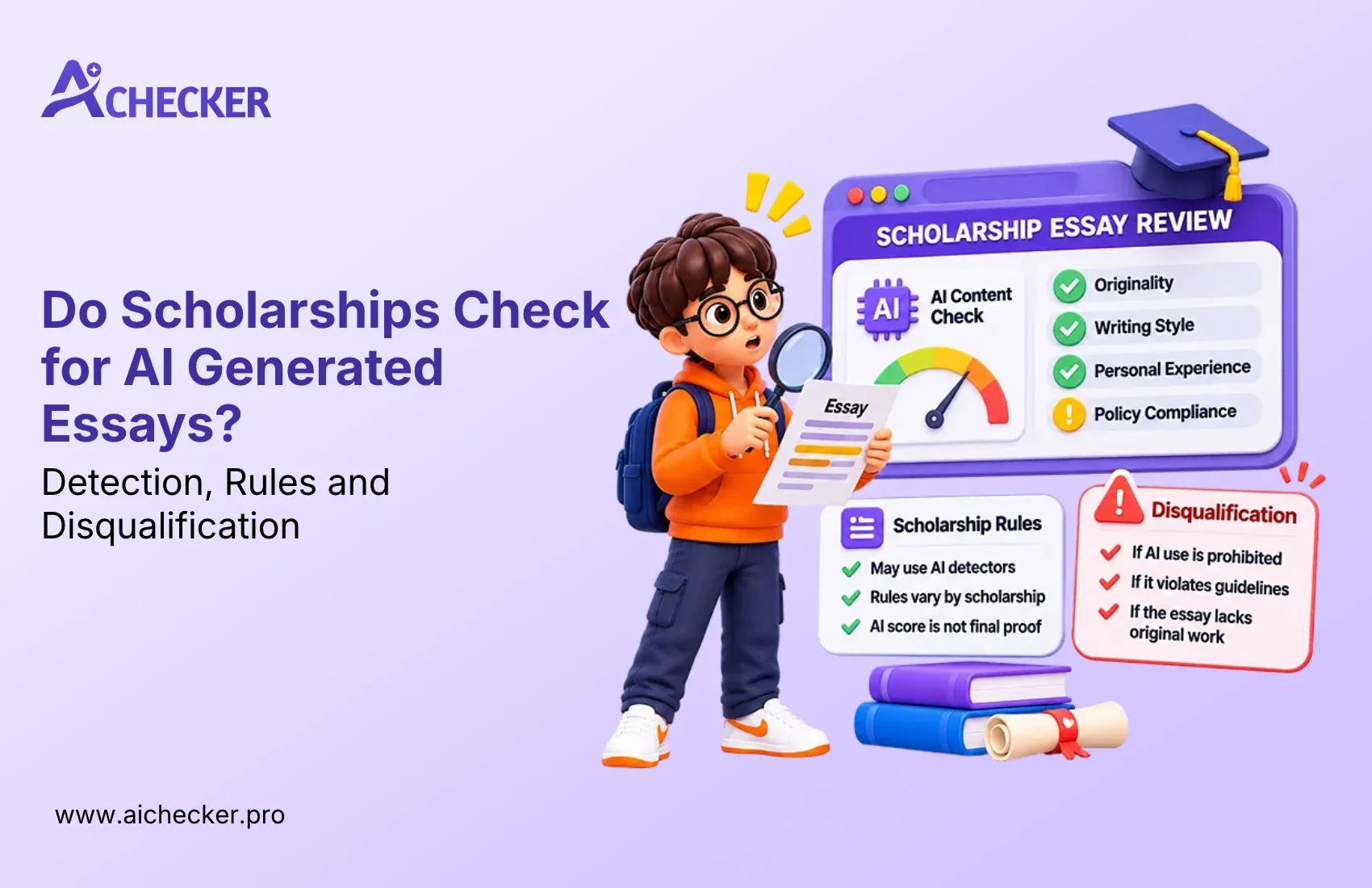
So, do scholarships check for AI in 2026? Yes, a growing number of them do, and the ones that do not check today are probably planning to soon. If you wrote your essay with ChatGPT help, or you are thinking about it, this guide is for you.
I've tested a lot of AI detectors, and honestly most of them are not reliable. Let me explain how scholarship providers handle AI, what the rules look like, and what actually works in 2026 so you can apply without panic. I wrote this guide for students, parents, and counselors who just want a straight answer on whether colleges check application essays for AI.
Do Scholarships Check for AI? The Straight Answer
Some do, and many do not, but the gap is closing fast. Let me explain this in a simple way.
Large national programs and college scholarship offices often have a small team reading thousands of essays. Many of them now run essays through a scholarship essay AI checker or ask reviewers to flag anything that feels off. Smaller local foundations usually rely on human readers only.
So when students ask me do scholarships check for AI, the honest answer is that it depends on who is reading and how much money is on the line.
Here is how the answer to do scholarships check for AI breaks down by provider:
- Big national programs: more likely to use software and detailed review
- College run scholarships: often follow the school's academic integrity rules
- Local clubs and foundations: mostly human readers who still notice generic writing
- Essay contests: strict about original work, sometimes with a signed statement
Why Students Keep Asking: Do Scholarships Check for AI?
A few years ago, nobody asked this. Then ChatGPT arrived, and many reviewers say essays started to look strangely similar. Committees noticed. Now many ask the same thing you do: do scholarships check for AI, and should we?
Fairness is the main reason. Scholarships are limited, and committees want to reward the student who did the work. When one applicant spends hours on a real story and another pastes a prompt into a chatbot, it feels unfair to everyone else. That is why do scholarships check for AI has become a common question at financial aid offices.
Do Scholarship Committees Check Essays for AI? How It Works
Picture a committee member in a US college financial aid office reading her 400th essay on a Sunday night. After a while, essays start to sound the same. Phrases like in today's fast paced world show up again and again. That is usually how AI gets noticed first, long before any software is involved.
Still, do scholarship committees check for AI with actual tools? More and more, yes. A reviewer who gets suspicious may paste a paragraph into GPTZero or another detector. Schools that already pay for Turnitin can run scholarship essays through it too, and you can read more in this Turnitin AI detector review. Private foundations usually do not have Turnitin, so they often use cheaper tools or just trust their eyes.
How do scholarship committees check essays for AI?
- Reading for voice: does the essay sound like the student's other writing?
- Software: Turnitin, GPTZero, and similar detectors
- Follow up questions: some programs interview finalists about their essay
- Consistency: does the essay match the grades, activities, and recommendation letters?
Do scholarship committees use AI detectors? Some do, especially bigger programs, but they rarely announce it. The real question behind do scholarships check for AI is not only about software. It is about whether your essay sounds like you.
Get Lifetime Access with 60% OFF
Stop paying monthly subscriptions. Enjoy unlimited AI detection and humanizer access forever with future updates included.
- One-time payment
- Unlimited access forever
- All future updates included
Can Scholarship Providers Detect ChatGPT?
Sometimes, yes. Can scholarships detect ChatGPT written essays? Software can flag patterns like very even sentence length and safe, predictable wording. Human readers catch other things, like a polished essay with no real personal details.
Here is the catch. Detection is a guess, not proof. Run the same essay through three different detectors and you will often get three different scores. That is why scholarship AI detection should never be treated as the final word, and it helps to know how AI detectors work before you trust any single score.
Newer models make this harder. Text from GPT 4, GPT 5, Gemini, and Claude sounds closer to human writing than older versions did, so detectors keep missing some AI text and wrongly flagging some human text. Students keep asking me do scholarships check for AI and then right away ask if they can get caught. Honestly, the better question is whether the essay is yours.
Are AI Detector Results Reliable for Scholarship Essays?
Not fully. AI detection in scholarship essays is far from perfect. Can AI detectors falsely flag scholarship essays? Yes, and it happens more than people think. Studies have shown that detectors can wrongly flag writing by non native English speakers. Turnitin itself says its AI score should not be the only basis for a decision.
Here is who is most at risk of a false flag:
- Students who write in a very clean, formal style
- Non native English speakers
- Writers who lean heavily on grammar tools
- Short essays, since small samples are harder to score
So even if the answer to do scholarships check for AI is yes, a flag is only a starting point. If a flag is wrong, you need proof. Keep your notes, drafts, and version history. A Google Docs history showing your essay growing over several days is strong evidence that you wrote it yourself. If it ever happens to you, this guide on what to do when you are falsely accused of using AI can help.
Is Using AI in Scholarship Essays Allowed?
It depends on the provider, and this is where most students get confused. Some programs ban AI completely. Some allow light help like brainstorming or grammar fixes. A few ask you to explain how you used it.
Are AI written scholarship essays allowed? Only if the program says so. The ChatGPT scholarship essay rules change from one scholarship to the next, so never assume. Read the instructions, the FAQ, and any terms you agree to before you submit.
Can you use ChatGPT for scholarship essays? You can if the rules allow it and the final essay is truly your story in your own voice. Using it to write the whole thing is where people get in trouble. Before you worry about do scholarships check for AI, ask whether AI is allowed at all.
Think of it like a calculator in math class. Some teachers allow it, some do not, and the syllabus tells you which. Scholarship rules work the same way, and the debate over whether using AI is cheating comes down to the same idea.
Can a Scholarship Application Be Rejected for AI Use?
Yes. Will AI generated scholarship essays get rejected? They can be. Most programs say that work that is not your own can lead to disqualification. Some also ask you to sign a statement that your essay is original. If you sign it and it is not true, that becomes a much bigger problem than a weak essay.
There can be other fallout too. If the scholarship runs through your college, the school may treat it as an academic integrity issue. Think about it: is any award worth risking your reputation with a committee that might remember your name?
That is why the answer to do scholarships check for AI matters less than whether you followed the rules.
Do All Scholarship Providers Have AI Policies?
No. Many still have nothing written down. A scholarship application AI policy is often missing from small local programs, while universities and large foundations are adding them quickly. No policy does not mean permission. Most programs already require original work, and many readers see AI written text as breaking that rule.
Do scholarship applications check for AI even without a written policy? Many reviewers do, so treat every application as if someone might look. Knowing do scholarships check for AI at one program tells you nothing about the next one. Even the Common App AI policy shows how much these rules vary from one program to another.
Should Applicants Disclose AI Assistance?
Even if do scholarships check for AI is a maybe at your program, honesty is the safest move. If the application asks, answer honestly. If it does not ask, think about how you used AI. A quick grammar check is a lot like spellcheck, and most people would not see that as a big deal. If AI shaped your ideas or wrote sentences for you, a short disclosure is safer. Being honest usually looks better than getting caught.
A simple line works: I used AI to check grammar. All ideas, stories, and wording are my own.
How to Check Your Essay Before You Submit
Here is what actually works in 2026: since the answer to do scholarships check for AI keeps changing, check your essay yourself before the committee does. Tools like AI Checker Pro help you detect AI content accurately, and a good scholarship essay AI checker shows you what a reader might flag while you still have time to fix it.
AI Checker Pro is easy to use, gives you sentence level detection so you can see exactly which lines look AI written, and includes an AI humanizer. It works with ChatGPT, GPT 4, GPT 5, Gemini, and Claude, and it is used by 100K+ users. Instead of rewriting manually, many users now rely on AI Checker Pro to fix flagged lines. I have personally seen bloggers clean their content using AI Checker Pro, and the same idea works for students who want their own voice to come through. If you want a tool built for this exact job, try an AI detector for essays.
Use it as a mirror, not a shortcut. Write your own draft first, check it, then rewrite flagged lines with real details from your life. If a line still sounds stiff, the AI humanizer can help with phrasing, but make sure the final essay is your story and follows the program's rules.
Simple checklist before you submit
Run through this list before you submit, so you never have to wonder do scholarships check for AI after the fact:
- Read the scholarship rules and any AI statement
- Write a first draft yourself, even if it is rough
- Run it through a detector and review flagged sentences
- Rewrite those lines in your own words with real details
- Save drafts and version history in case you need proof
For a step by step routine, see this guide on how to check an essay before submission.
Smart Ways to Handle **AI Writing in Scholarship Applications**
Your best protection is a real story, no matter how the question do scholarships check for AI gets answered. Add details only you know, like the name of the diner where you work on weekends or the exact moment you decided to study nursing at Ohio State. AI cannot invent that in a way that feels real.
Read your essay out loud. If you would never say a sentence in real life, change it. Ask a teacher or counselor to read it too, because they know how you write.
If you run a blog, you probably know this feeling already. Google says it cares about helpful content, not how it was made, but thin and generic text still struggles to rank. You can see how this plays out in this breakdown of whether Google detects AI content. Scholarship readers think the same way. They want something real and useful about you, not a template.
Conclusion
So, do scholarships check for AI? Many do, some do not, and the rules keep changing. Detectors are helpful but not perfect, and false flags are real. Read each program's rules, write from your real life, keep your drafts, and check your essay before you hit submit. AI writing in scholarship applications is a topic that is not going away, but honest, personal essays still win. Tools like AI Checker Pro can help you catch problems early. Take your time, trust your story, and you will be fine.
Do scholarship committees check essays for AI?
Can scholarship providers detect ChatGPT?
Is using AI in scholarship essays allowed?
Can a scholarship application be rejected for AI use?
Do all scholarship providers have AI policies?
Should applicants disclose AI assistance?
Are AI detector results reliable for scholarship essays?
Can you use ChatGPT for scholarship essays?
How do scholarship committees check essays for AI?
Can AI detectors falsely flag scholarship essays?

Harshil Barvaliya
SEO Executive & Content Writer at AI Checker Pro
I’m Harshil Barvaliya, an SEO Executive and Content Writer at AI Checker Pro. I focus on improving the website’s search engine visibility through effective SEO strategies, including keyword research, on-page and off-page optimization, and content development.Get Started Free
Create a free account for advanced AI detection and scan history.
Trusted by thousands worldwide.
Recent Blog's
Discover how AI-powered content creation can elevate your website's reach and engage your audience like never before. Explore the real impact of AI on crafting content that connects.