Common App AI Policy: What Students Should Know Before Submitting Essays
TABLE OF CONTENTS
What Is the Common App Policy on AI?
Does Common App Allow AI Generated Essays?
Can I Use AI to Edit My Common App Essay?
Does the Common App Check for AI?
Can Colleges Detect AI in Application Essays?
Is Using AI for College Essays Cheating?
What Happens If You Submit an AI Generated College Essay?
College Admissions AI Policy: School by School
AI Checker Pro vs Other Detectors: A Quick Comparison
How to Follow the Common App AI Policy Before You Submit
Conclusion
FAQs
Get an AI summary of this post on:





If you're about to hit submit on your essay, the Common App AI policy is probably keeping you up at night. Every year I get dozens of panicked phone calls from students who used ChatGPT for "just a little help" and now realize the terrifying consequences. Here's the short answer.
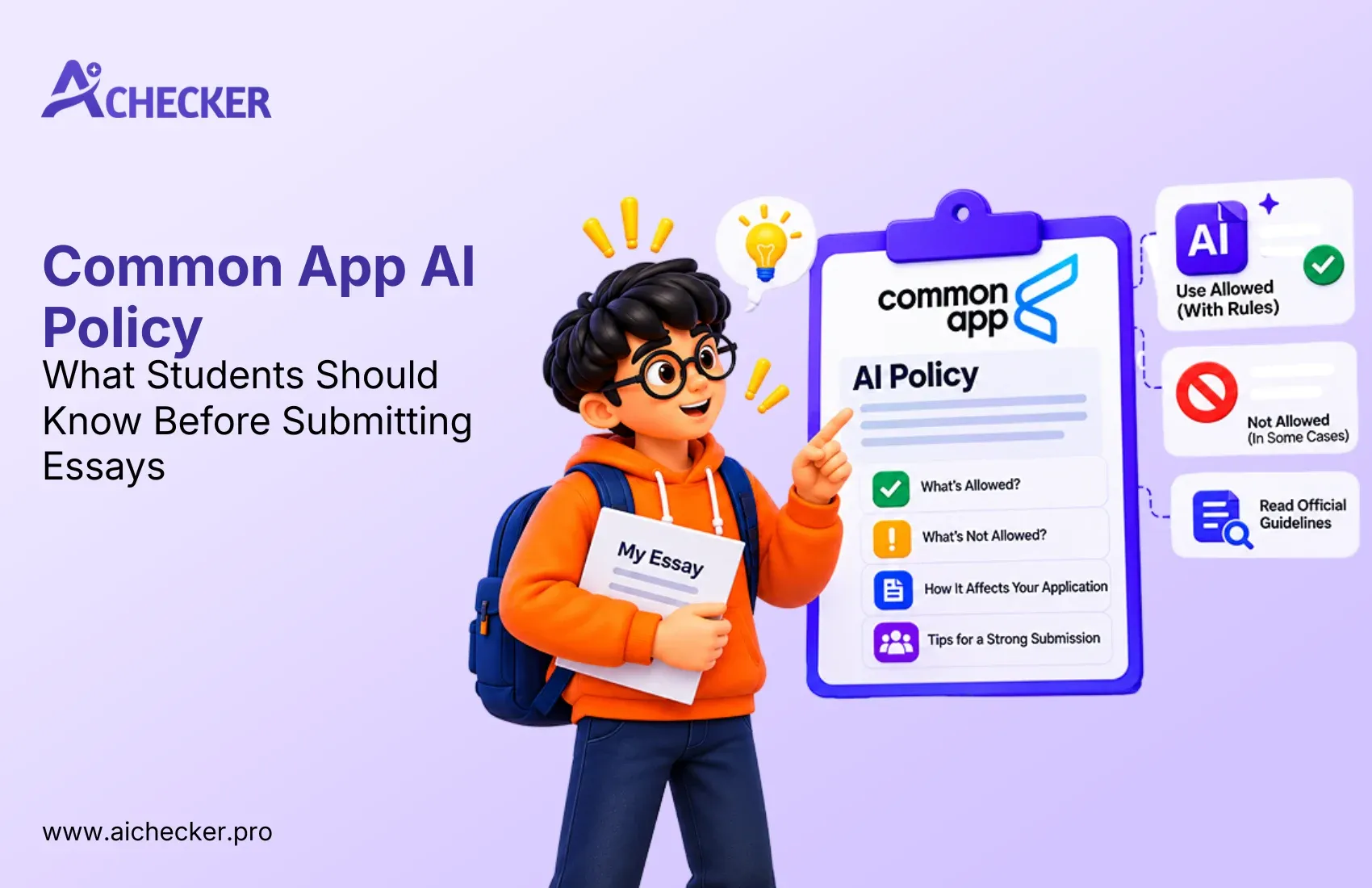
The Common App AI policy considers submitting the Main content or output of an AI tool as your own work as Dishonesty in an application.
While light use like brainstorming or grammar checking may be acceptable to some schools, the essay itself should be composed in your own words.
Let me explain what that means in more detail so you know precisely what to do and what not to do when applying in 2026.
What Is the Common App Policy on AI?
Let me start by talking about the basics. The Common App is the system used by more than 1,000 colleges to collect applications, so the Common App AI policy applies to nearly everyone. Before you submit your application materials, you sign an affirmation online that confirms that your work is your own, true, and honestly presented.
This is the Common App artificial intelligence policy.
The Common App fraud policy states that presenting the Main content or output of an AI platform as your own is fraud. This is the Common App essay AI policy in one sentence. AI cannot write your essay and then carry your name.
Here is what matters most:
- The Common App AI rules are built on honesty, not on banning every tool.
- The key idea is "Main content." Ideas, structure, stories, and sentences should come from you.
- The Common App academic integrity standard applies to every member college on your list, even schools with no separate AI page.
- Individual colleges can add stricter rules on top of the Common App baseline.
One honest note. The Common App AI policy can change, so read the current fraud policy on the Common App site before you submit.
Does Common App Allow AI Generated Essays?
Short answer: no, and their policy on this is clearly stated. If you're asking if Common App allows AI generated essays, the answer is that they consider text generated by an AI and passed off as the student's own work as fraud.
Most guidance sorts the Common App AI policy into three buckets.
Clearly not okay:
- Pasting a full AI draft into your essay box
- Asking AI to write your personal statement "based on your story," then lightly editing it
- Using AI to write activity descriptions or supplemental essays you submit as your own
Gray area (check each school):
- Asking AI to suggest a structure or outline
- Asking AI to rewrite your sentences so they sound "better"
Usually fine at many schools:
- Brainstorming topics or asking questions that help you remember a story
- Fixing spelling and basic grammar
- Getting general feedback, like "where does my essay feel unclear?"
Yale represents the school of thought that grammar assistance, spelling suggestions, and early brainstorming are not fraudulent acts. Other institutions maintain a far stricter stance on the utilization of artificial intelligence, and a few have altogether prohibited its use in any capacity.
That is why AI-generated college essays are such a precarious gamble: rules vary wildly from school to school, Common App policy serves merely as a baseline to work from, and your name is on everything you submit.

Get Lifetime Access with 60% OFF
Stop paying monthly subscriptions. Enjoy unlimited AI detection and humanizer access forever with future updates included.
- One-time payment
- Unlimited access forever
- All future updates included
Can I Use AI to Edit My Common App Essay?
This one is tougher, and it needs a more thoughtful response. Students frequently inquire if they can utilize an AI tool to edit their Common App essay and if the same applies for the Grammarly service and Common App essays.
Here is how I think about it:
- Spell check and basic grammar fixes are generally fine. Tools like Grammarly have been used for years to catch typos and punctuation mistakes.
- Rewriting features is where it gets risky. If a tool rewrites whole sentences or paragraphs for you, you are moving from editing into generating.
- Tone or style suggestions can quietly change your voice. If your essay no longer sounds like you, that is a problem for authenticity even if no rule is technically broken.
Many AI essay writing tools for college include grammar checking as well as rewriting and text generation in their combined feature sets. That is exactly where things go wrong for students, accidentally.
Disable generative features, allow only minor corrections, and make sure to keep your sentences as the base, due to the Common App's concern over who wrote what.
Plus, save your drafts. A clear paper trail of your own writing is your friend if anyone questions your work.
Does the Common App Check for AI?
Now for the part that everyone is asking about. Students ask, does Common App check for AI or does Common App use AI detectors, and the answer, based on what the public knows, is that they do not utilize any automated detection scores.
Reporting indicates that the Common App looks into cases where fraud is reported, as opposed to using algorithms to scan all essays. As such, Common App's AI policy mainly relies on reports and manual checks.
That matters because Common App AI detection is not the same thing as a college reading your essay. Here is how the process generally works:
- Admissions readers notice something odd, like an essay that sounds nothing like the rest of the application
- A school raises a concern or someone reports it
- The Common App can investigate and, if it finds fraud, take action that can be shared with the colleges on your list
I would not base a strategy on the idea that no one is looking. The Common App AI policy is not about software, and while a Common App AI detector may not be in constant use, individual colleges are free to employ their own reviewing procedures, and humans are adept at identifying generic writing.
Some schools have opted to add their own AI-related question or attestation to their supplements as well.
Can Colleges Detect AI in Application Essays?
Honestly, this is where I get a little frustrated. I have tested a lot of AI detectors, and most of them are not as reliable as they claim.
When people ask whether colleges can detect AI in application essays, the truth has two parts.
Part one: detectors are imperfect
No AI detector is 100% accurate. Tools like Turnitin, GPTZero, Originality.ai, and Copyleaks all say in their own documentation that results should be treated as a signal, not as proof. Raw, untouched AI text is easier to flag. Accuracy drops noticeably once text has been paraphrased, edited by a human, or run through a humanizer.
Part two: false positives are real
Human-written text can get flagged as AI. This happens most often with very formal writing, writing by non native English speakers, and writing that follows a rigid structure. Several major universities have scaled back how much they lean on a single detection tool for exactly this reason.
So how do colleges check for AI in essays in practice? Mostly with people:
- Comparing the essay to the rest of your application
- Looking at tone, voice, and level of specific detail
- Noticing generic phrasing and "perfect" but empty reflection
- Following up with counselors or teachers if something feels off
When I ran a few sample essays through multiple programs last month, one of the sample essays was obviously human-written but yielded different results on different programs. On one site, it marked the essay as mostly human while another flagged a couple of paragraphs as AI-generated.
This is why college essay AI detection should never be the sole criterion in determining a student's fate and why students need to run their own essays through these tools before submitting them.
None of this overrides the Common App AI policy, which is about honesty rather than detection rates.
Is Using AI for College Essays Cheating?
Students ask me if using AI for college essays is cheating almost every week. Let me be fair and clear.
If you turn in AI-written content as if it's yours, then yes, according to Common App AI policy, it is considered fraud, and the plain word for that is plagiarism. Common App AI policy, along with Common App essay plagiarism, has the same penalties since both involve presenting work that is not yours.
Using AI is not always cheating. Asking a tool to help you brainstorm or even to catch a typo is not asking it to write your story. The important thing to consider is whose ideas and words are on the page.
What Happens If You Submit an AI Generated College Essay?
Let's discuss the practical implications of the Common App AI policy because that's how consequences fit into this conversation. In other words, what are the repercussions for submitting an AI-generated college essay? The results are anything but inconsequential, unfortunately.
According to published guidance, a confirmed fraud finding can lead to:
- Rejection of your application
- Revoked admission, even after you have been accepted
- Account suspension on the platform
- Concerns being reported to other colleges on your list
Then there is the other question: will colleges reject AI-written essays even without finding it fraud? In some cases, yes, but not because of a detector.
A generic, impersonal essay will do little to help your application. Admissions officers want to see a real person. An essay that could have come from anyone is easy to dismiss.
So if your sincere essay gets flagged, keep your drafts, notes, and versions, and explain things thoroughly, without rewriting your entire piece to be favorable towards an imaginary reader.
College Admissions AI Policy: School by School
The college admissions AI policy environment is not uniform. The Common App AI policy represents a minimum standard, and individual schools build upon that. Here is a general summary, based on information made public by schools:
- Some schools, like Yale, say light help such as grammar, spelling, or topic ideas is not fraud, as long as the writing is yours.
- Some schools, like Brown, Georgetown, and BYU, take a stricter stance and limit or prohibit AI use in application writing.
- Some schools, like Caltech, ask students to disclose AI use.
- Many other schools, including large selective ones, rely on the Common App affirmation and their honor codes without a separate AI page.
The takeaway is simple. When it comes to the use of AI in college applications, you have to go by the most restrictive school's policy. If one of the schools on your list bans the use of AI in any part of the application, you have to follow that policy for every school on your list. Go through each of your targeted schools' admissions sites and review their supplemental essay instructions before you send in anything.
When it comes to the use of AI in college application essays, "no policy" does not equal "anything goes," and your Common App AI policy still applies.
AI Checker Pro vs Other Detectors: A Quick Comparison
Since the Common App AI policy concerns your writing, what tool to use is important. Here is a rough comparison based on openly available information as well as my own testing. Beware that features change constantly and should always double-check what is offered on the sites.
| Tool | Accuracy (general view) | Free Tier | Humanizer Included | Best For |
|---|---|---|---|---|
| AI Checker Pro | Sentence-level detection, works with ChatGPT, GPT -4, GPT -5, Gemini, Claude | Yes, see Pricing page | Yes | Students, bloggers, and agencies who want detection and cleanup in one place |
| Turnitin | Widely used by schools, but results are meant as a signal, not proof | No, sold to institutions | No | Teachers and universities |
| GPTZero | Popular and easy to use, can still produce false positives | Yes, limited | No | Quick checks by students and teachers |
| Originality.ai | Built mostly for publishers and SEO teams, strict on web content | No, credit-based | No | Bloggers and content agencies |
None of the tools listed above are perfect, so the best course of action is to use a plagiarism detector and then read your essay out loud, asking yourself if it sounds like you wrote it.
How to Follow the Common App AI Policy Before You Submit
The best way to follow the Common App AI policy is to make sure your essay reflects your own experiences, ideas, and writing style. Before submitting your application, follow these six steps to maintain essay authenticity and reduce the risk of misunderstandings about AI use.
Step 1: Write Your First Draft Yourself
Start with your own ideas, experiences, and personal story. Avoid asking an AI tool to write your essay for you. Your first draft should reflect your thoughts and voice.
Step 2: Save Your Drafts and Notes
Keep your outlines, personal notes, and different essay versions. Save them with dates so you can show how your essay developed if questions arise about your writing process.
Step 3: Check Your Essay for Potential AI Flags
You can use a tool like AI Checker Pro to review your essay and identify sentences that may appear machine-written. Sentence-level detection can help you find passages worth reviewing, but AI detection results are not proof that a person used AI.
Step 4: Revise Your Writing in Your Own Words
If a sentence sounds too formal or does not reflect your natural voice, rewrite it yourself. Add relevant personal details and use language that feels authentic to you. An AI humanizer may help polish your own writing, but do not use it to disguise AI-generated content or misrepresent who wrote the essay.
Step 5: Read Your Essay Out Loud
Read the entire essay at a natural pace. If a sentence sounds unnatural or unlike something you would normally say, revise it. Make sure every detail accurately reflects your experiences and perspective.
Step 6: Ask Someone You Trust to Review It
Ask a teacher, school counselor, or parent to read your essay. They can help you identify unclear sentences and check whether the essay reflects your personality and experiences. Keep the final decisions and revisions your own.
I've personally witnessed students catching overly pretentious phrasing in their own drafts by using AI Checker Pro before submitting them.
That's how it's supposed to be used. To detect, learn, and revise in your own style. More than 100K users use it to detect, and it's simple to use even if you've never tried a detector before.
Conclusion
The Common App AI policy entails a guideline that requires applicants to write essays based on their experiences, thoughts, and ideas.
The use of artificial intelligence to review one's work is allowed as long as it does not replace one's opinions. Students should store all their drafts and make sure that they revise their essays before the submission date.
The Common App AI policy also applies to those who believe that their essays were wrongly identified as AI-generated essays. Those who believe that their essays do not depict the use of AI should utilize the AI Detector and edit the identified areas that might trigger a false positive. Individuals ought to remember that the results from these AI detectors should not be considered as definite proof of AI use. As a start, one should ask, "What is my unique story?"
FAQs
What is the Common App policy on AI?
Does Common App allow AI generated essays?
Can you use ChatGPT for Common App essays?
Does Common App check for AI?
Can colleges detect AI in application essays?
Is using AI for college essays cheating?
Can I use AI to edit my Common App essay?
Can you use Grammarly on Common App essays?
Will colleges reject AI written essays?
What happens if you submit an AI generated college essay?

Harshil Barvaliya
SEO Executive & Content Writer at AI Checker Pro
I’m Harshil Barvaliya, an SEO Executive and Content Writer at AI Checker Pro. I focus on improving the website’s search engine visibility through effective SEO strategies, including keyword research, on-page and off-page optimization, and content development.Get Started Free
Create a free account for advanced AI detection and scan history.
Trusted by thousands worldwide.
Recent Blog's
Discover how AI-powered content creation can elevate your website's reach and engage your audience like never before. Explore the real impact of AI on crafting content that connects.