College Essay AI Detector: Check Your Essay Before Admissions Does (Free)
TABLE OF CONTENTS
Do Colleges Actually Use AI Detectors on Essays?
What AI Detector Do College Admissions Offices Actually Use?
How to Use a College Essay AI Checker: Step by Step
Why Your Honest Essay Might Still Get Flagged
How to Lower Your AI Score Without a Full Rewrite
What Top Colleges Actually Say About AI in Essays (2026)
Conclusion
FAQs
Get an AI summary of this post on:




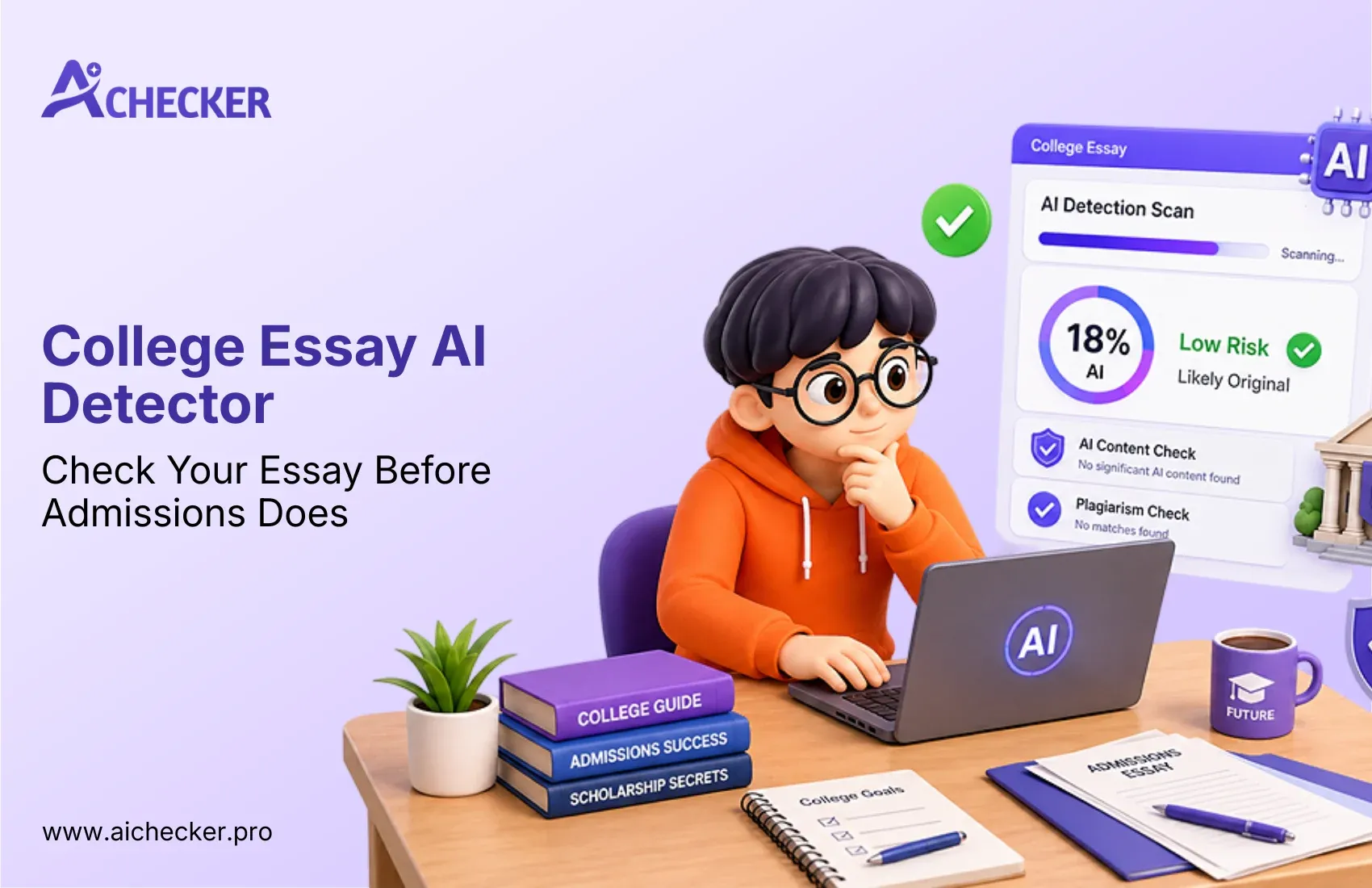
You have written your introduction paragraph several times over. You have asked your older sister to proofread your work. You have said your piece out loud to yourself at midnight. And now, just before you click 'submit,' a nagging question begins creeping into your mind: Is my essay written by AI?
Even if you have composed every line of your essay by yourself, it is a perfectly reasonable question to ask. More than 40% of universities use AI detection software to check applicants' essays, but it is not a very accurate way of assessing their academic writing. If you want to understand exactly how this process works before submitting, check out this complete breakdown of how colleges detect AI in essays.
This article will show you how to do it, what AI score to look for, what detection software the universities use, and what to do if your human essay got a high AI score.
Do Colleges Actually Use AI Detectors on Essays?
Let's answer the anxiety question first, quickly.
The Short Answer
Yes, almost 40% of four-year colleges in the US employ some form of AI detection tool on application essays.
The proportion increased dramatically from 28% in early 2023 amid the emergence of ChatGPT. This is particularly true for large-scale admissions offices that process tens of thousands of application essays.
However, here comes the critical point: there is no college that would make decisions based on an AI detection tool alone. An application marked by AI tools will require additional human assessment.
For an admissions officer, the result of such detection is simply a signal to be attentive. Nevertheless, this "signal to be attentive" is the very last thing you need for your application.
Why "No Formal Policy" Is Not the Same as "No Risk"
The 2025 Kaplan survey involving more than 200 college admission officials discovered that 68% of schools had no formal policy on the use of artificial intelligence when it comes to applications.
Here is what the 68% really means: there is room for individual judgment in the hands of each admission officer.
If an essay seems to be the product of ChatGPT, a smooth and generic essay without any errors, it will definitely be questioned, even in the case that there is no official statement regarding its use.
It is more important to note that the Common Application considers the use of such content as application fraud in any case.
For a deeper look at how colleges detect AI across different schools and systems, see our complete guide: Do Colleges Check for AI in Application Essays?
What AI Detector Do College Admissions Offices Actually Use?
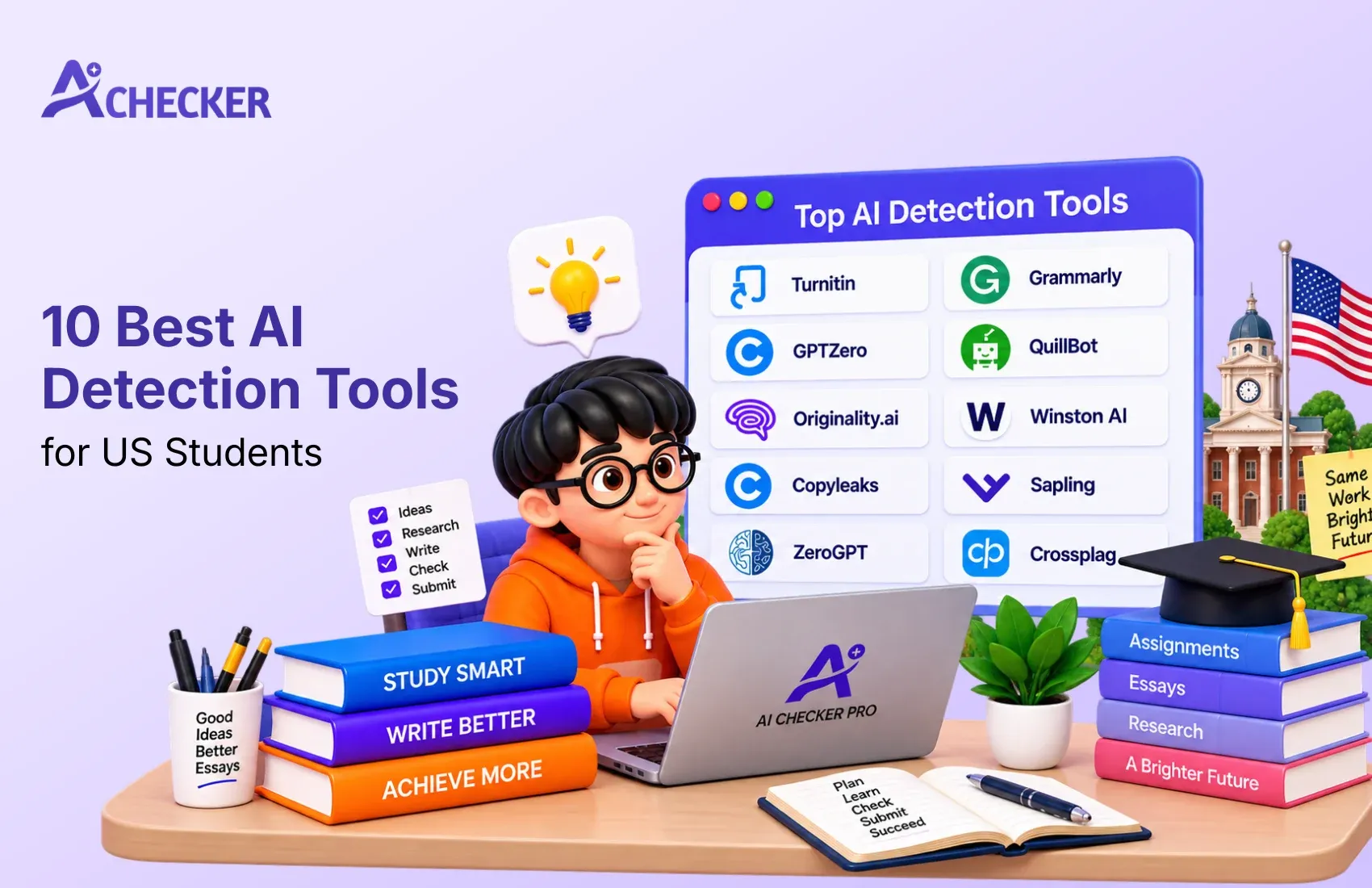
This is what is important to consider in practice, since knowing what software your college uses, you will be able to evaluate your essay according to the same criteria beforehand.
Here's what the data shows:
| AI Detection Tool | Who Uses It | Key Feature | Claimed Accuracy |
|---|---|---|---|
| Turnitin | 15,000+ institutions worldwide | Sentence-level AI Writing Indicator | ~98% on long-form text |
| GPTZero | Spot-checking by admissions staff | Perplexity + burstiness scoring | 85-92% (independent benchmarks) |
| Copyleaks | Journalism, business schools | Plagiarism + AI detection combined | Up to 99% (vendor claim) |
| Originality.ai | Publishing, some universities | SEO-focused AI detection | ~94% (vendor claim) |
Turnitin clearly dominates the market. Just the California State University system spent over $1.1 million on Turnitin in 2025.
It uses artificial intelligence to recognize patterns in the text by training it with content from ChatGPT, GPT-4, Claude, Gemini, and many other powerful AI systems. It produces findings on a sentence-by-sentence basis, instead of a simple pass/fail score. You can read a full breakdown of what AI detector Turnitin actually uses to understand how it flags content.
However, there is one major caveat: you will not be able to access the Turnitin version on the teacher's side.
That means that you won't be able to use the same software that your university utilizes. That is why running your essay through any similar third-party program is the best option.
Want the full breakdown by university? See: What AI Detectors Do Universities Use?
How to Use a College Essay AI Checker: Step by Step
This is the section most articles skip. They tell you to "use an AI checker" without explaining what that actually means in practice. Here's the full process.
Step 1: Paste Your Complete Essay
It's not enough to copy-paste just one paragraph; please copy-paste your whole essay. AI detection tools are much more accurate on 300+ word texts. The false-positive rate increases dramatically for shorter texts. An essay below 250 words will have less reliable results, but you should still see them.
Go to AI Checker Pro, paste your essay into the text box, and make sure the full text is there.
Step 2: Run the AI Detection Scan
Click Check for AI. The tool uses sophisticated AI detection algorithms to detect anomalies in your text, such as unnatural sentence structure, predictability in word choice, and lack of linguistic surprise (or perplexity, in technical terms).
The scan takes under 30 seconds.
Step 3: Read Your Sentence-Level Results
Here is where most students tend to err, as they focus on just one percentage and get worked up (or relieved) about just that one number.
Rather, focus on the analysis of each sentence. The analysis will point out those specific sentences that received high probability scores for being written by an AI. One flagged sentence is no cause for concern.
Notice any trends: are there multiple consecutive sentences flagged? Is the introduction where students tend to use more formal language?
That's where to focus your edits.
Step 4: What Score Is Actually "Safe"?
No competitor article answers this directly, so here it is:
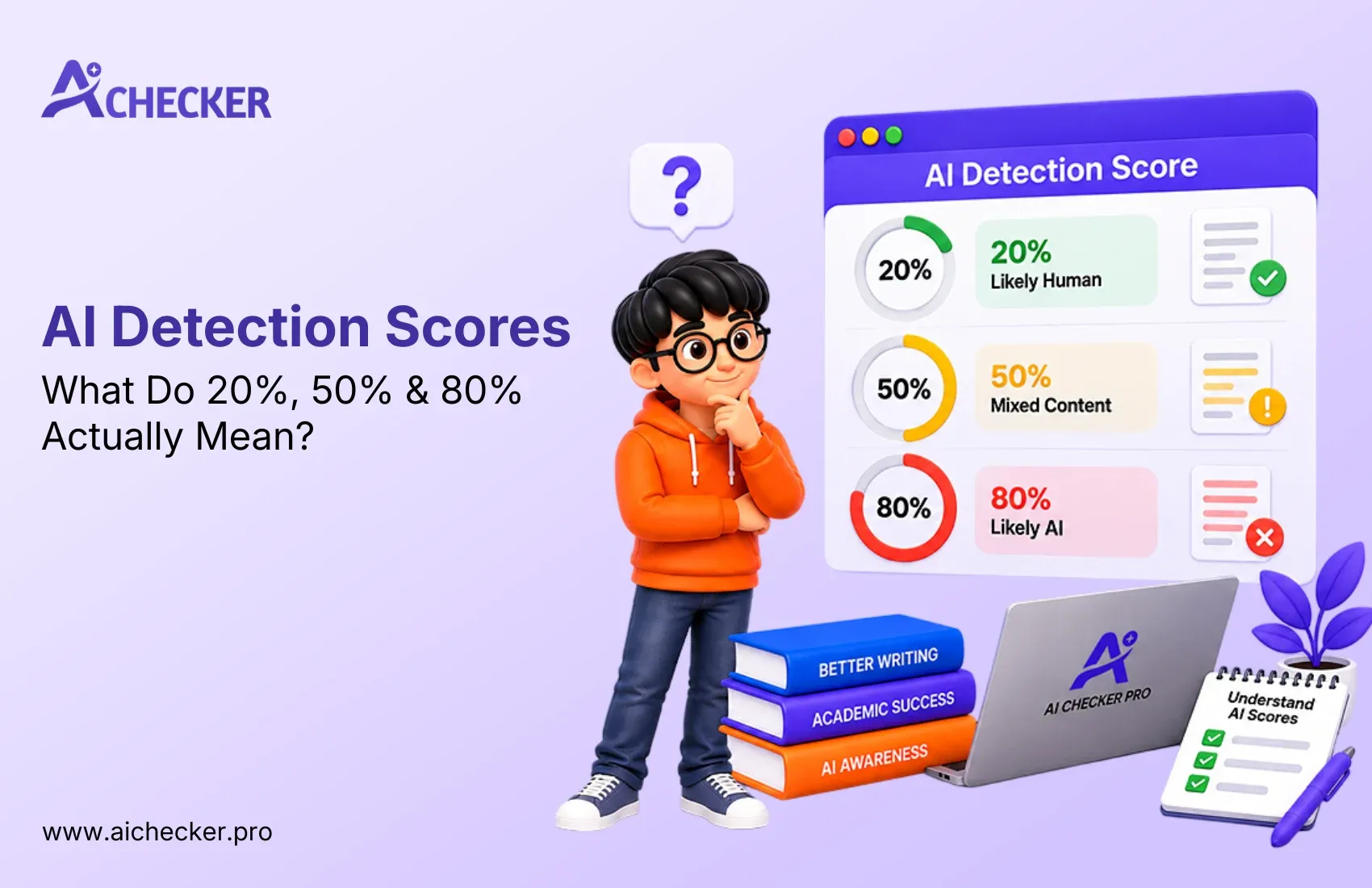
- Under 20% AI probability - You're in good shape. Submit with confidence.
- 20-40% AI probability - Review the flagged sentences. Rewrite anything that feels generic or overly formal. Re-check after edits.
- Above 40% AI probability - Your essay needs meaningful revision before submitting. Even if you wrote it yourself, the phrasing patterns are triggering detection. This doesn't mean you did anything wrong. It means the current draft needs to sound more like you.
They are not official figures from any college since no college releases such information. These are just recommendations based on how well the detection tools are able to distinguish between human-written content and AI-produced text.
Why Your Honest Essay Might Still Get Flagged
This is the part that causes the most confusion and the most unfair anxiety. AI detectors are not perfect. They never will be.
The False Positive Problem
Indeed, Turnitin's own literature on the tool admits to having around a 4% false-positive rate for sentences, which means that in a human-generated essay, one sentence out of every twenty-five would be incorrectly marked as having been written by an AI program.
The populations at highest risk for false positives:
- Non-native English speakers: Writing in a second language often produces patterns that detectors associate with AI: simpler sentence structures, more formal phrasing, consistent grammar.
- Students with formal writing styles: If you've been trained to write precisely and clearly (debate, journalism, AP classes), your writing may paradoxically score higher for AI than a student who writes loosely and conversationally.
- Students who write about universal themes: Essays about resilience, leadership, and community are the stock-in-trade of AI generators. If your genuine story happens to intersect with these themes, expect more scrutiny.
In the 2025 University of Chicago Booth working paper test of leading AI detectors using a massive corpus of human and machine-authored text, there were considerable differences in false positive rates between different detectors. Pangram showed the best performance regarding false positives, while Turnitin's rate exceeded expectations from the vendor. For a broader look at this issue, see our guide on AI detection problems and false positives.
How to Prove Your Essay Is Yours
If your essay gets flagged despite being human-written, documentation is your strongest defense:
- Write in Google Docs from day one. Revision history is automatically saved and timestamped. This is verifiable proof of an iterative writing process, something AI generation doesn't produce.
- Keep your brainstorming notes and outlines. A messy notes document that predates your final essay is compelling evidence.
- Save drafts with dates. Even screenshots of early versions help establish a human writing timeline.
If you ever find yourself having to defend your essay, the fact that you can take someone through the steps of how you drafted your essay is the strongest proof you can give.
How to Lower Your AI Score Without a Full Rewrite
If your essay comes back with a higher AI probability than you'd like, here are the most effective quick fixes:
1. Read it aloud and flag anything you wouldn't actually say. AI writing is often grammatically perfect but tonally off. If a phrase sounds like a LinkedIn post, rewrite it in your natural voice.
2. Replace general statements with specific memories. "I developed leadership skills." becomes "The night before the regional competition, I stayed until 11 p.m. writing out every teammate's individual warm-up routine on index cards." Specificity is the fastest path to a human score.
3. Vary your sentence length deliberately. Write a very short sentence. Then allow yourself to write a sentence longer than what you feel comfortable with, including a couple of clauses that show how your thoughts really flow. AI-written sentences always have a suspiciously consistent rhythm. Your sentences shouldn't.
4. If your score is still high after editing, use AI Checker Pro's AI Humanizer tool to intelligently rephrase your flagged sentences without altering your intended meaning. This is done to achieve that: not in an attempt to fool the detector, but to ensure that your original ideas shine through without interference.
What Top Colleges Actually Say About AI in Essays (2026)
Policies vary more than most students realize. Here's where major institutions currently stand:
| College / System | AI Essay Policy | Notes |
|---|---|---|
| Brown University | Full ban | AI use violates academic integrity standards |
| Georgetown University | Full ban | AI-generated content treated as application fraud |
| Cornell University | Partial, grammar/editing allowed | Essay content must originate from the student |
| Caltech | Partial grammar assistance allowed | Substance must come from the student |
| UC System (all campuses) | Nuanced approach | Limited use allowed; content must be authentic |
| Johns Hopkins | Detection tools deactivated | Opted out of Turnitin AI detection in 2024 |
| Most schools (68%) | No formal policy | Individual reviewer discretion applies |
The biggest lesson that one can learn from this table: Deactivating the AI detection software by Johns Hopkins University does not necessarily suggest that they do not care about AI essays. This is because they have found the ratio of false positives too high to justify any risk involved in tagging actual students' work.
"No policy" means no rules to cite in your defense if something goes wrong. If you are applying to a medical program, it is also worth reading about how AI detectors work on med school essays since those programs apply extra scrutiny.
Conclusion
There's nothing you can do about the particular AI software used at your college. There's nothing you can do about how harshly it is reviewed individually. There's nothing you can do about whether what you write actually sets off a pattern programmed into a computer.
But there is one thing you can do, and that is turn in an essay that you have already scanned.
Checking your college essay on an AI detector before you turn it in isn't trying to beat the system; it's getting a heads up on what admissions sees before you do. It takes 30 seconds.
It is free. And it is the one most pragmatic step to take after writing your essay.
Check Your College Essay Free at aichecker.pro
Paste your essay, see your score, fix anything that needs fixing, and submit knowing exactly how your work looks to the tools that matter.

Get Lifetime Access with 60% OFF
Stop paying every month for AI detection and humanizer tools. Get AI Checker Pro lifetime access, check your content anytime, and improve flagged text with future updates included.
- One-time payment
- AI detector and humanizer included
- All future updates included
FAQs
1. Do colleges check for AI in application essays?
2. What AI detector do college admissions use?
3. Do colleges use AI detectors for application essays even without a formal policy?
4. How do colleges check for AI in essays?
5. Can a college essay AI detector give a false positive on a human-written essay?
6. What is a safe AI score for a college essay?
7. Do colleges run essays through AI detectors for every applicant?
8. Why does my honest essay still score high on an AI checker?
9. What should I do if my college essay AI detector score is too high?
10. Which colleges ban AI use in application essays completely?

Harshil Barvaliya
SEO Executive & Content Writer at AI Checker Pro
Get Started Free
Create a free account for advanced AI detection and scan history.
Trusted by thousands worldwide.
Recent Blog's
Discover how AI-powered content creation can elevate your website's reach and engage your audience like never before. Explore the real impact of AI on crafting content that connects.