What AI Detector Do Colleges Use? Best Tools Explained
TABLE OF CONTENTS
The Short Answer
Why This Became a Question in the First Place
What AI Detectors Do Colleges Use for Applications, Specifically?
Comparison Table: Popular AI Detection Tools Used in Education
Which Colleges Actually Use AI Detectors on Applications?
How Accurate Are These Tools, Really?
What Admissions Officers Actually Look For, Beyond a Score
How to Check Your Own Essay Before You Submit It
Conclusion
FAQs
Get an AI summary of this post on:





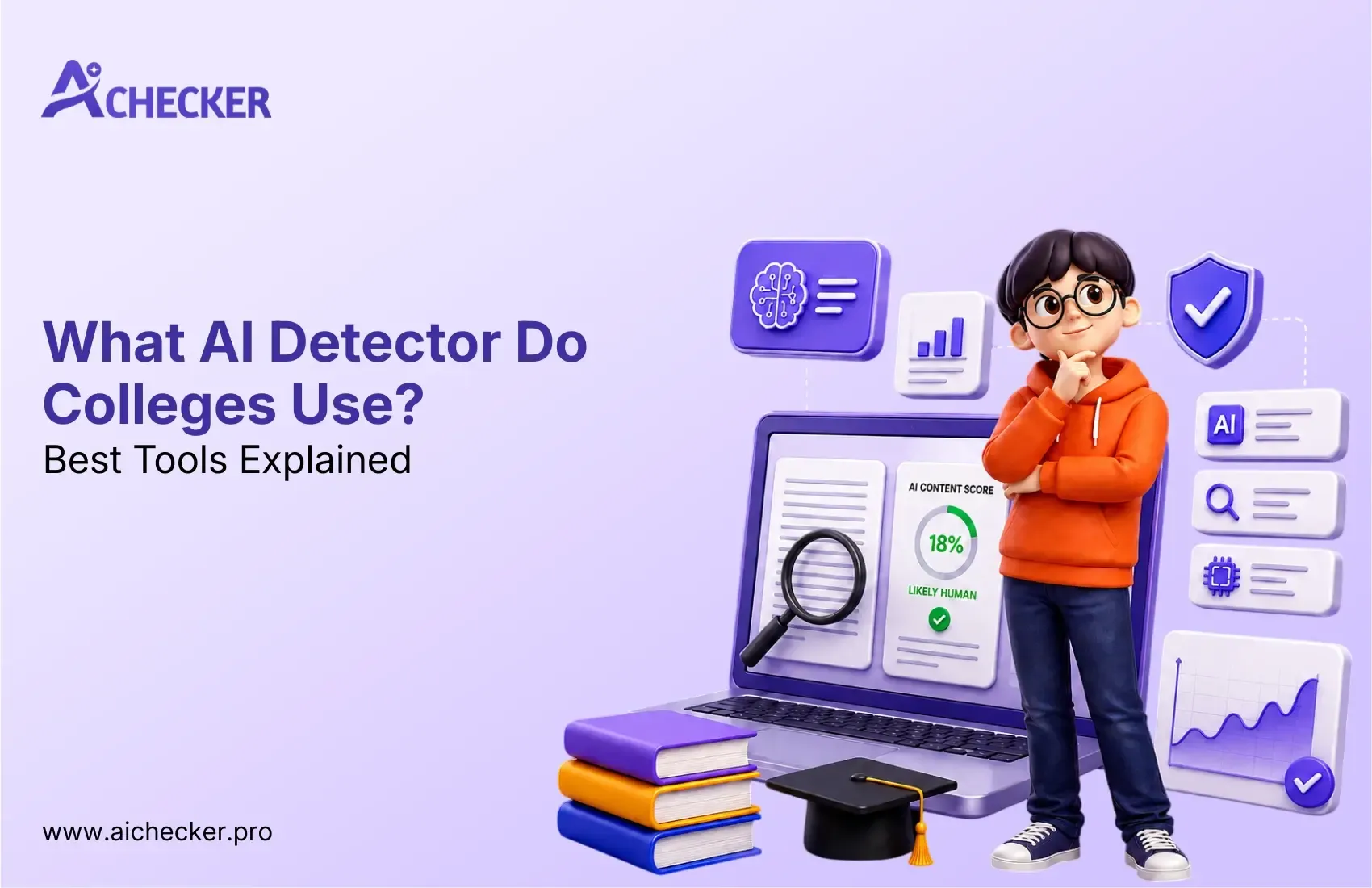
Many students applying to college ask the same question: "What AI detector do colleges use?" As generative AI tools like ChatGPT, Gemini, and Claude become more common, concerns about AI-written application essays have grown among both students and admissions offices.
One of the biggest worries students have is whether an authentic essay could be mistakenly flagged as AI-generated. Others wonder whether colleges rely on AI detection software when reviewing applications or if human admissions officers make the final decision.
After researching leading AI detection platforms, reviewing admissions policies from universities, and analyzing how AI detectors are used in education, one thing becomes clear: there is no single AI detector that every college uses. Some institutions use commercial AI detection tools, others rely primarily on human reviewers, and many combine multiple methods when evaluating submitted work.
In this guide, you'll learn which AI detectors colleges commonly use, how these tools work, how accurate they are, their limitations, and what students should know before submitting their college applications with confidence.
The Short Answer
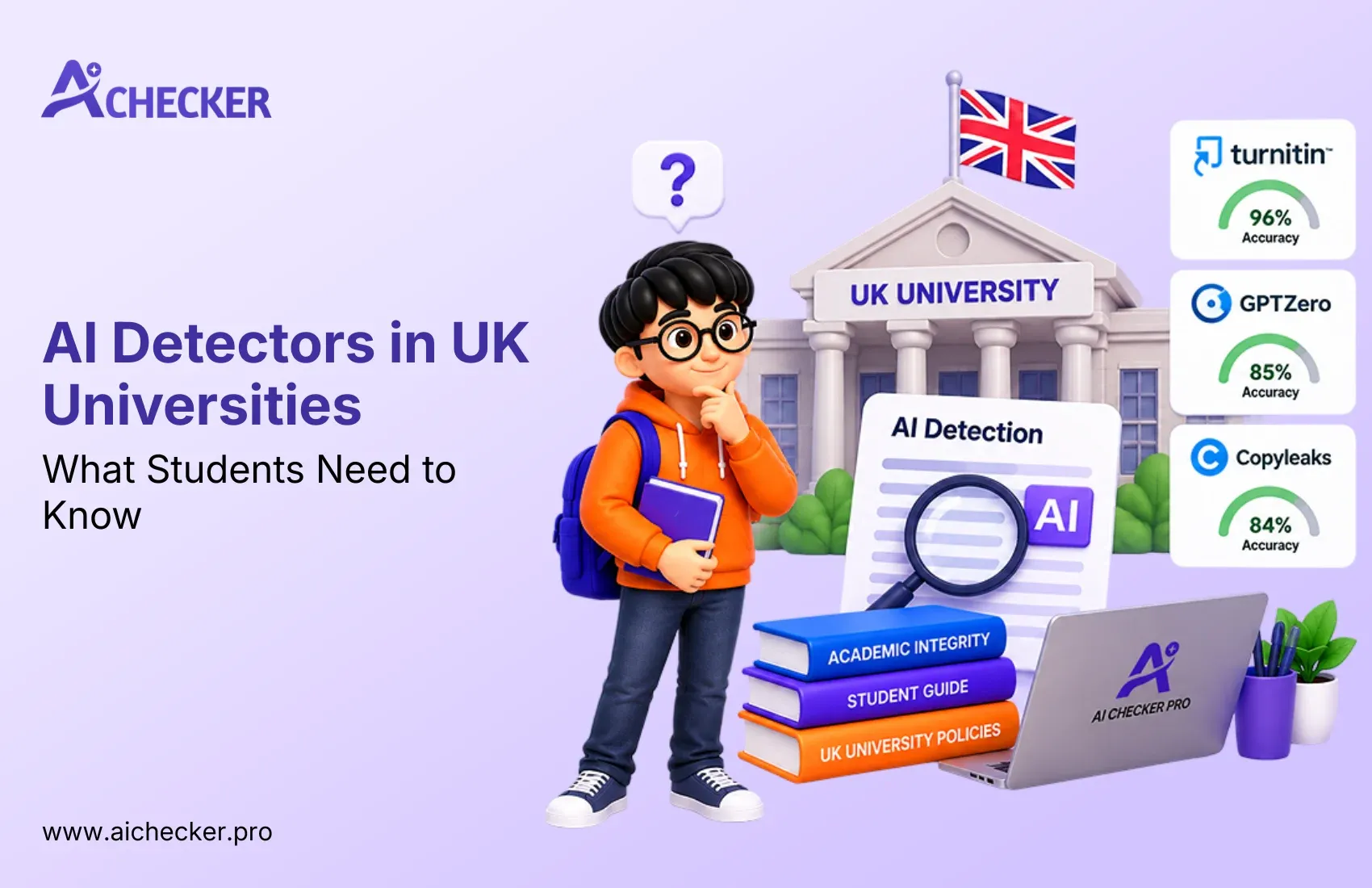
There is no universal AI detector used by all colleges or universities. Instead, institutions may use a combination of commercial AI detection tools, such as Turnitin AI Writing Detection, GPTZero, and Copyleaks, depending on their internal policies, academic integrity guidelines, and review processes.
What students should understand is that AI detection tools are rarely the sole basis for admissions decisions. In most cases, admissions officers evaluate essays for authenticity, writing quality, originality, and consistency with the applicant's overall academic profile. AI detection software, when used, is typically one factor among many rather than the final authority.
In recent years, some institutions have scaled back or discontinued the use of AI detection tools because of concerns about false positives, inconsistent results, and the limitations of current detection technology. For example, Johns Hopkins University announced that it would no longer use Turnitin's AI writing detector, while some campuses within the University of California system have also expressed caution about relying on AI detection tools for high-stakes decisions.
As AI technology continues to evolve, so do the methods colleges use to evaluate student work. Rather than relying on a single AI detector, most institutions are refining their review processes by combining human judgment, institutional policies, and, where appropriate, AI detection tools built for educators.
Get Lifetime Access with 60% OFF
Stop paying monthly subscriptions. Enjoy unlimited AI detection and humanizer access forever with future updates included.
- One-time payment
- Unlimited access forever
- All future updates included
Why This Became a Question in the First Place
Before late 2022, no one worried about this. After the release of ChatGPT, counselors across the country noticed, in the span of a single admissions cycle, a spike in essays that had the feel of something generated by a slightly too self-aware narrator.
A majority of admissions officers surveyed by Common App in mid-2023 were using the phrase in essay evaluations, and over 40% felt that AI-generated text was already a significant concern.
The worry was short-lived but real. Turnitin, the plagiarism-detection service familiar to most campuses, released an AI writing detection tool that could be turned on by instructors using the service.
Meanwhile, independent tools like GPTZero and Copyleaks, designed for enterprise and academic settings, began targeting admissions offices.
Some well-resourced universities also began evaluating AI detection tools during admissions reviews.
What AI Detectors Do Colleges Use for Applications, Specifically?
It's worth separating two very different situations, because they get lumped together constantly:
1. Classroom and coursework detection
This is the mature, widely deployed use case. If a college already uses Turnitin for plagiarism checks (and most do), the AI-writing indicator is usually just a toggle away. It's embedded in Canvas, Blackboard, and Moodle, so professors can enable the AI writing indicator for a specific assignment without asking anyone's permission.
2. Admissions application screening
This is newer, less standardized, and far less consistent. A personal statement isn't submitted through an LMS, so no built-in AI checker is waiting for it. Instead, admissions offices that want to screen essays typically have to run them manually through a tool, or they've licensed something like Copyleaks or a custom system for that specific purpose.
Because this costs money and staff time, it's mostly larger, well-funded institutions, public university systems with hundreds of thousands of applicants, or elite private schools with the budget for it that have gone this route in any organized way.
So when people ask what AI detectors do colleges use for applications, the honest breakdown looks like this:
- Turnitin AI writing indicator is the most widely licensed tool in higher ed overall, though its use specifically on admissions essays (versus enrolled-student coursework) varies a lot by school.
- GPTZero: popular with individual departments and some admissions offices because it's simple to use standalone, without LMS integration.
- Copyleaks: used by several institutions for both plagiarism and AI detection, often bundled into the same license.
- In-house or proprietary systems: a small number of large, resource-rich universities have built or commissioned their own detection layer for research and applications, though these are rarely named publicly.
Comparison Table: Popular AI Detection Tools Used in Education
| AI Detector | Best For | AI Detection | Plagiarism Check | Sentence-Level Analysis | Suitable for College Essays |
|---|---|---|---|---|---|
| AI Checker Pro | Students, admissions essay review, content verification | Advanced | - | Detailed sentence-level insights | Excellent for reviewing essays before submission |
| Turnitin AI Writing Detection | Universities and classroom assignments | Yes | Yes | Institution-facing reports | Commonly used in higher education |
| GPTZero | Students, educators, and admissions teams | Yes | No | Sentence highlighting | Good for personal statement reviews |
| Copyleaks | Educational institutions and enterprises | Yes | Yes | Detailed analysis | Suitable for academic writing |
| Originality.ai | Publishers, agencies, and SEO teams | Yes | Yes | Detailed reports | Better suited for web content than admissions essays |
| Winston AI | Educators and content publishers | Yes | No | Sentence-level detection | Useful for reviewing essay authenticity |
Which Colleges Actually Use AI Detectors on Applications?
This is precisely where, contextually, the article becomes inconsistent, where I am going to have to disagree with some of the most sensationalist headlines. Several state university systems have indeed seen a spike in spending on detection software as contracts with vendors like Turnitin.
One California university system reportedly spent more than $1 million on plagiarism detection software. However, that spending covered plagiarism detection across enrolled students rather than admissions essays. In one year alone, according to the article, that spending covered plagiarism checks over the entire student body, not just admissions essays.
By contrast, some of the most selective universities have either questioned the reliability of AI detection tools as overly harsh or simply don't have the resources to employ such expensive software.
The pattern seems to be that the more selective and better-funded institutions were much less likely to embrace automated detection and much more likely to rely on honor codes or even manual essay reading.
Detection software is much more likely to be used as a first filter by larger universities with greater applicant pools that simply have chosen not to rely heavily on AI detection because of concerns about accuracy rather than budget constraints, in order to review thousands of applications without some automation.
How Accurate Are These Tools, Really?
This is what I wish my student had known before she pulled all-nighters trying to fix an essay.
I tested a few essays myself.
Some essays were written entirely by me, and several I was allowed to use from other students.
I used several detectors, and the results varied dramatically between them.
One detector incorrectly identified a clearly human, if a bit stiffly written essay, as being AI, probably because it used common objective language and was well structured, things a good human writer would strive to accomplish.
This is part of the issue with detection problems; it looks at ratios of certain tell-tale signs (such as sentence length variation and predictability of word choice, also called perplexity) and compares them to statistical patterns commonly associated with AI-generated text.
AI-generated writing often exhibits more consistency in these metrics, but so will writing from careful human writers, or non-native English speakers who follow grammatical rules religiously, which can cause false accusations.
Even Turnitin, one of the largest, most used plagiarism detection services, warns that their AI detection score should not be used as the sole criterion for determining academic misconduct.
What Admissions Officers Actually Look For, Beyond a Score
This is what I wish my student had known before she pulled all-nighters trying to fix an essay.
I tested a few essays myself.
Some human-written but composed by me, and several I was allowed to use from other students.
I used several detectors, and the results varied dramatically between them.
One falsely accused a clearly human, if a bit stiffly written essay, of being AI, probably because it used common objective language and was well structured, things a good human writer would strive to accomplish.
- An essay that sounds noticeably more polished or "adult" than the rest of the application (activities list, short answers, recommendation letters)
- Vocabulary or sentence rhythm that shifts abruptly partway through
- Generic insights that could apply to almost any applicant, with no specific, sensory detail
- A mismatch between the essay's voice and an interview or supplemental response
This is why the safest strategy was never really about outsmarting a detector. It's about writing something so specific to your own life that no model could plausibly have generated it, a point echoed in how colleges detect AI in essays.
How to Check Your Own Essay Before You Submit It
If you want to feel confident when you hit "submit," running the essay through a reliable essay checker is an excellent way to ensure there's nothing within your paper that appears too polished, repetitive, or robotic for an authentic student's prose to be flagged by an admissions officer.
This is precisely why AI Checker Pro was created. Paste in your work and receive sentence-level analysis of which text pattern might appear artificially generated, alongside a general assessment of the likelihood your text has been generated by AI compared with typical human writing patterns.
This way, you're not given an outright pass or fail but are able to edit specific portions based on a more detailed analysis.
A few honest tips from testing this process myself:
Check early, not the night before. Give yourself time to actually rewrite flagged sections in your own voice instead of panic-editing at 11 p.m.
Include details that only you could write about. The exact smell of your grandmother's kitchen, the name of the ninth-grade teacher who called you out, the score of the game you lost, these details are what genuinely separate your writing from anything generated.
Don't over-polish your first draft. A slightly rough, honest draft often reads more human than a version you've smoothed out five times. If your writing does come out sounding too uniform, tools like an AI humanizer can help you rework specific sections back into your own natural voice.
If you used AI for brainstorming or grammar help, say so if asked. Many schools, including Yale, are explicit that grammar assistance is fine. What they're screening for is content generation, not spell-check.
Re-check after every major edit. A single round of heavy editing can shift how a detector reads your essay, for better or worse, which is why checking students' work with a free detector after each revision is worth the extra few minutes.
Conclusion
Most colleges and universities are not going to make life-changing decisions based on an AI score.
Most admissions officers are going to look at other factors besides an AI score when making a decision. Things like whether or not you were honest in your essay, your overall application, recommendation letters, interviews (if you have one), and their own judgment.
The best way to approach the college application process is to write an essay that is real, from your perspective, and based on your own experiences.
You should use your real-life and unique point of view when writing your essay. You should also be yourself when writing your essay. You may find that your essay is not as polished or pretty as an AI essay, but it is more likely to be genuine and get you into a good college.
FAQs
What AI detector do colleges use?
What AI detectors do colleges use for applications?
What AI detector do college admissions use for essays specifically?
Do colleges tell students if they use an AI detector?
Can AI detectors be wrong about a real essay?
Which colleges actually use AI detectors on applications?
Is Turnitin used for college applications too?
Does GPTZero work for personal statements?
Should I check my essay before submitting it?
Do AI detectors decide if I get accepted or rejected?

Harshil Barvaliya
SEO Executive & Content Writer at AI Checker Pro
I’m Harshil Barvaliya, an SEO Executive and Content Writer at AI Checker Pro. I focus on improving the website’s search engine visibility through effective SEO strategies, including keyword research, on-page and off-page optimization, and content development.Get Started Free
Create a free account for advanced AI detection and scan history.
Trusted by thousands worldwide.
Recent Blog's
Discover how AI-powered content creation can elevate your website's reach and engage your audience like never before. Explore the real impact of AI on crafting content that connects.