Can a Human-Written College Essay Be Flagged as AI? Here's Why
TABLE OF CONTENTS
Key Highlights
Why Do AI Detectors Flag Human Writing?
What an AI Flag Actually Means for Your Essay
AI Detector Accuracy: What the Research Actually Shows
AI Detector Wrong Results College Students Should Know About
How to Prevent False AI Flags Before Submitting
Comparing Popular AI Detectors: Turnitin, GPTZero, & AI Checker Pro
What to Do If You Get Falsely Flagged
Conclusion
Get an AI summary of this post on:




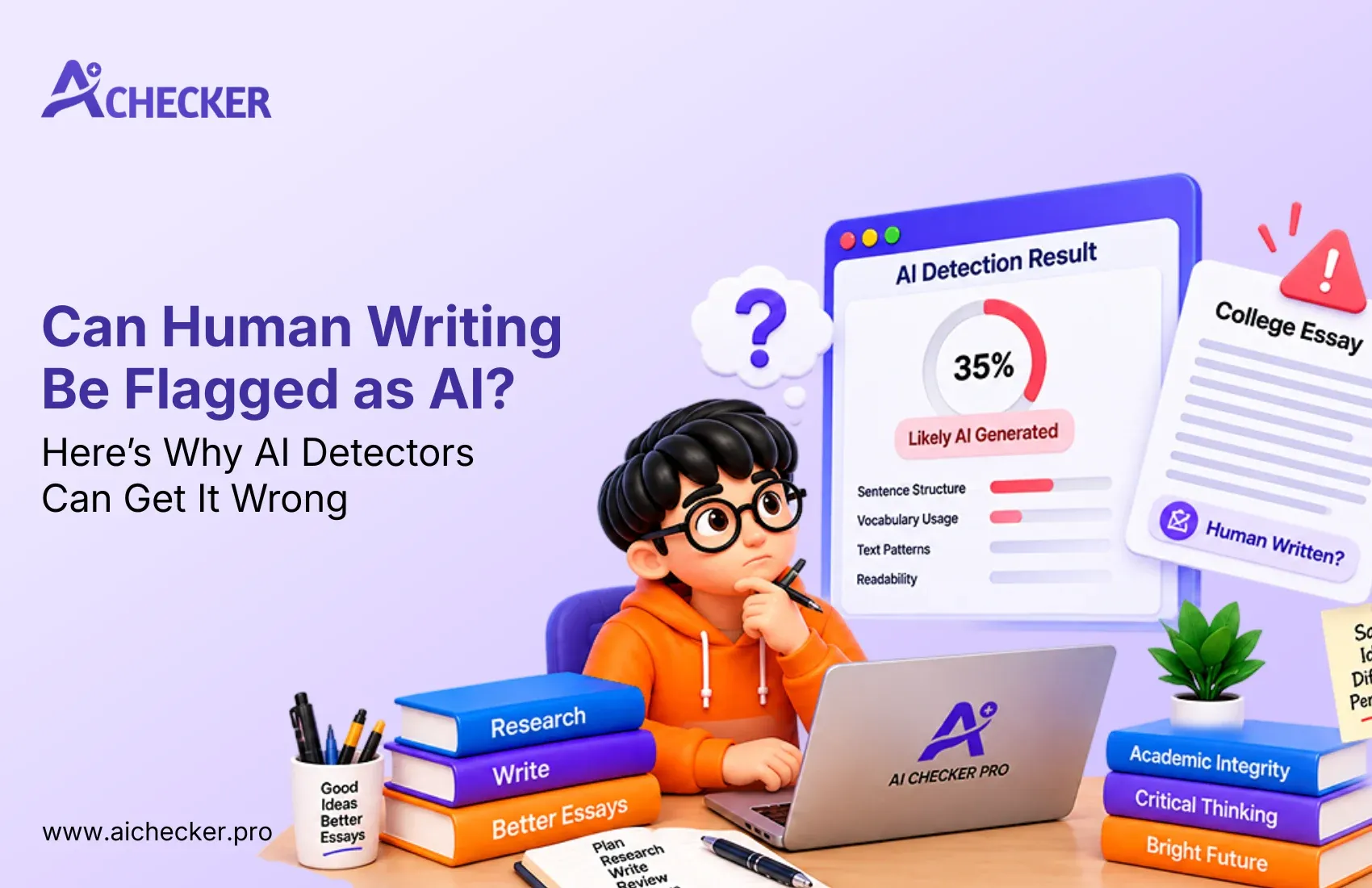
Yes, a human-written essay can be flagged by an AI detector. This can happen because some AI detection tools look for patterns such as sentence structure, word choice, and writing consistency.
If your essay gets flagged, it does not automatically mean you used AI or cheated. It simply means the detector predicted that some parts of your writing looked similar to AI-generated text, so it's worth running your draft through a reliable AI detector for essays before you submit anything. These predictions can sometimes be wrong, so the result should be reviewed along with your drafts, notes, and writing history.
Key Highlights
- No AI detector on the market is 100% accurate, including Turnitin and GPTZero
- Formal, structured, or non-native English writing gets flagged more often
- AI detection false positives are more common in short essays and heavily edited drafts
- Paraphrased or humanized AI text is much harder for detectors to catch than raw AI output
- Tools like AI Checker Pro can help you check your own writing before you submit it
I have tested various AI detectors over the past year, and I can confirm that most are not as effective as students and instructors would hope. This is a simple breakdown of what an AI detector false positive is, and why it can be so harmful to a student.
A human-written paper falsely detected by an AI detector as having been assisted by an AI is something many students fear, especially when the paper is due in a few hours.
In short, an AI detector false positive is when an AI detector (a program that detects signs of AI-assisted writing in a given text) marks a passage as AI-assisted when it is not, typically due to the passage's writing being too similar to the patterns used by AI models such as ChatGPT.

Get Lifetime Access with 60% OFF
Stop paying monthly subscriptions. Enjoy unlimited AI detection and humanizer access forever with future updates included.
- One-time payment
- Unlimited access forever
- All future updates included
Why Do AI Detectors Flag Human Writing?
It is the question I am asked the most, and the honest answer is that these tools were not made to be perfect; they were made to identify patterns.
AI detectors scan for patterns like repetitiveness and randomness. If you're curious about the mechanics behind this, it helps to understand how AI detectors work before assuming a flag means something went wrong.
Predictable sentences that use the next word with little surprise are likely to be determined to be AI-generated text. Repetitiveness is not unique to AI, however. Many human-written pieces, namely academic writing, are often repetitive, plain, or avoid pushing the boundaries of language to get the desired grade.
Here is what actually works in 2026 when you're trying to understand why AI detectors flag human writing:
- Sentence uniformity: If every sentence in your essay is roughly the same length, that reads as machine-like to most detectors.
- Overly formal tone: Students who write very formally, often because that's what they were taught in school, can score higher on AI probability.
- Non-native English patterns: This is a big one. Writers who learned English as a second language often use more standard grammar and less slang, which detectors misread as AI polish.
- Heavy editing or grammar tools: Running your essay through Grammarly or a similar tool before submitting can smooth out the natural rough edges that detectors associate with human writing.
- Short essays: Detectors need enough text to analyze. Shorter essays give less data, which increases the chance of a wrong call in either direction.
What an AI Flag Actually Means for Your Essay
If your college essay is flagged as AI, remember one important thing: an AI detector score is not proof that you used AI. It is only a prediction. Turnitin has also said that its AI detection system can sometimes make mistakes. Because of this, some universities have reduced how much they rely on a single AI detection score when reviewing student work.
I tested several essays that I knew were 100% written by humans using different AI detectors. The results were surprising. Some well-written and carefully edited essays received AI scores between 20% and 60%, even though I had written every word myself. You can read more about this pattern in our breakdown of AI Checker Pro false positives on human writing.
This can happen because AI detectors look for certain writing patterns. Clear, formal, and well-edited writing may sometimes look similar to AI-generated text.
Think about this: if a student who writes carefully and edits their work gets a higher AI score than a student with a rough and messy draft, what is the detector really measuring?
That is why an AI detector score should be treated as a signal to review the writing, not as final proof of AI use.
AI Detector Accuracy: What the Research Actually Shows
AI detector accuracy can vary depending on the tool, text length, writing style, and how much the content has been edited. In general, detectors tend to work better with long, unchanged AI-generated text. They can be less reliable with short text, heavily edited writing, or rewritten content. For a deeper look at the numbers behind these claims, see our full guide on AI detector accuracy.
Here are a few important points to keep in mind:
- Paraphrasing can affect detection: Rewriting or changing AI-generated text can make it harder for some detectors to identify AI patterns.
- Free tools may offer less detail: Many free AI detectors provide only an overall AI score, while some advanced tools offer sentence-level results and more details.
- No detector is perfect: An AI score should not be treated as final proof that a student used AI. Human review and other evidence can provide important context.
This is why AI detection wrong results are an ongoing concern. AI detectors can be useful as an initial check, but their results should be reviewed carefully rather than treated as a final verdict.
AI Detector Wrong Results College Students Should Know About
For college students, an AI detector wrong result can happen when a detector sees writing patterns that are also common in AI-generated text. The student may have written the essay themselves, but the tool can still make an incorrect prediction. This is exactly why so many campuses now recommend using a dedicated AI detector for students to double-check results before raising concerns with a professor.
Here are some common situations:
- Formal writing: A student follows a clear five-paragraph structure taught by their teacher, but the predictable format may look AI-generated.
- Strong English skills: An international student writes clear and grammatically correct English without slang or contractions. Some detectors may mistake this polished style for AI writing.
- Grammar or outline help: A student uses ChatGPT to check grammar or organize ideas but writes the actual essay themselves. The final structure may still trigger a detector.
- Heavy editing: A student rewrites and edits their essay several times. The polished final version may have fewer natural mistakes and variations, which can sometimes affect detection results.
A false positive does not automatically mean a student cheated. It means the detector predicted that some writing patterns looked similar to AI-generated text, and that prediction can be wrong.
How to Prevent False AI Flags Before Submitting
If you want to avoid false AI detection, the goal should not be to trick an AI detector. Instead, make sure your essay clearly reflects your own ideas, writing style, and work. Our guide on how to avoid AI detection in writing walks through this in more detail if you want extra reassurance before submission day.
Here are some practical steps:
Start with your own draft. Write your ideas in your own words before using any editing or writing tools. Your first draft can be imperfect. That is normal.
Add personal examples. Include experiences, class discussions, examples, and opinions that are relevant to your topic. Personal details can make your writing more clearly your own.
Use your natural writing style. You do not need to make every sentence sound perfect. Write in a way that feels natural to you while still following academic writing rules.
Review your essay before submitting it. You can use an AI detector as an additional check, but do not treat its score as proof. If something is flagged, review that section and make sure it accurately represents your own work.
Keep your writing history. Save your outlines, notes, drafts, and Google Docs version history. These records can help show how your essay developed if questions about authorship come up.
Comparing Popular AI Detectors: Turnitin, GPTZero, & AI Checker Pro
If you're comparing tools, here's a simple breakdown of how a few popular options for an AI checker for college essays stack up. For a more detailed side-by-side, check out our post on which AI detectors are actually accurate.
| Tool | Accuracy | Free Tier | Humanizer Included | Best For |
|---|---|---|---|---|
| AI Checker Pro | Great, sentence-level detail | Yes, limited free checks | Yes | Students, bloggers, agencies |
| Turnitin | Moderate, known false positive issues | No (school-provided only) | No | Institutional use in schools |
| GPTZero | Moderate to high on raw AI text | Yes, limited | No | Teachers and educators |
| Originality.ai | High on raw text, drops on edited text | No | No | Agencies and SEO teams |
No tool in this table is perfect, and that's the point. Even the most accurate detectors on the market still produce essays incorrectly flagged as AI results often enough that relying on just one score is risky, whether you're a student defending your own work or a teacher.
What to Do If You Get Falsely Flagged
If your human-written essay gets a high AI detection score and you know you wrote it yourself, do not panic. An AI detector score is not proof on its own. It's also worth knowing whether your school even factors this into admissions decisions, our article on whether colleges check for AI in application essays covers that question directly. Here are some simple steps you can take:
- Collect your work: Save your drafts, notes, outlines, and document history. These can help show how your essay was written.
- Talk to your professor: Calmly explain that you wrote the essay yourself and offer to show your drafts or writing history.
- Check your school's policy: Look for the school's rules about AI detection and ask whether there is a process for reviewing or challenging a detection result.
- Use another checker: You can compare the result with another AI detector, such as AI Checker Pro, to see which parts of your essay may have been flagged.
- Review your writing: If your work is repeatedly flagged, look at the sections being identified and make sure the wording and ideas genuinely reflect your own writing.
Most importantly, do not rely on one AI detector score as the final answer. Your drafts, notes, and writing process can provide important context when your work is questioned.
Conclusion
A human-written essay flagged as AI can be frustrating, especially when you know you wrote every word yourself. AI detectors can sometimes make mistakes because formal language, polished sentences, and common writing patterns may look similar to AI-generated text.
To reduce surprises, keep your drafts and notes, write in your natural style, and review your essay before submitting it. You can also use a tool such as AI Checker Pro to check your writing and see which parts may be flagged, giving you a chance to review them before submission.
The key is to treat an AI detection score as one signal, not final proof of authorship.
FAQs
Can a human-written essay be flagged as AI?
Why do AI detectors flag human writing?
How accurate are AI detectors?
Does Turnitin give false positives on human-written essays?
Why is my college essay flagged as AI when I wrote it myself?
What should I do if my human-written essay is flagged as AI?
Can Grammarly make my essay look AI-written?
Are non-native English speakers flagged more often by AI detectors?
Can AI detectors catch paraphrased or humanized AI text?
How can I avoid a false AI flag before submitting my essay?

Harshil Barvaliya
SEO Executive & Content Writer at AI Checker Pro
I’m Harshil Barvaliya, an SEO Executive and Content Writer at AI Checker Pro. I focus on improving the website’s search engine visibility through effective SEO strategies, including keyword research, on-page and off-page optimization, and content development.Get Started Free
Create a free account for advanced AI detection and scan history.
Trusted by thousands worldwide.
Recent Blog's
Discover how AI-powered content creation can elevate your website's reach and engage your audience like never before. Explore the real impact of AI on crafting content that connects.