Is AI in Academic Writing a Helpful Tool or a Bad Habit?
TABLE OF CONTENTS
Why AI in Academic Writing Is a Growing Debate
What Is AI in Academic Writing?
Why Students Are Using AI More Than Ever
Benefits of AI in Academic Writing
How AI Helps During the Writing Process
Drawbacks of AI in Academic Writing (A Bad Habit)
Risks of Using AI in Academic Work
How AI Can Affect Student Learning
How Students Can Use AI the Right Way
Best Practices for Responsible AI Use
Future of AI in Education
Conclusion
Frequently Asked Questions
Get an AI summary of this post on:





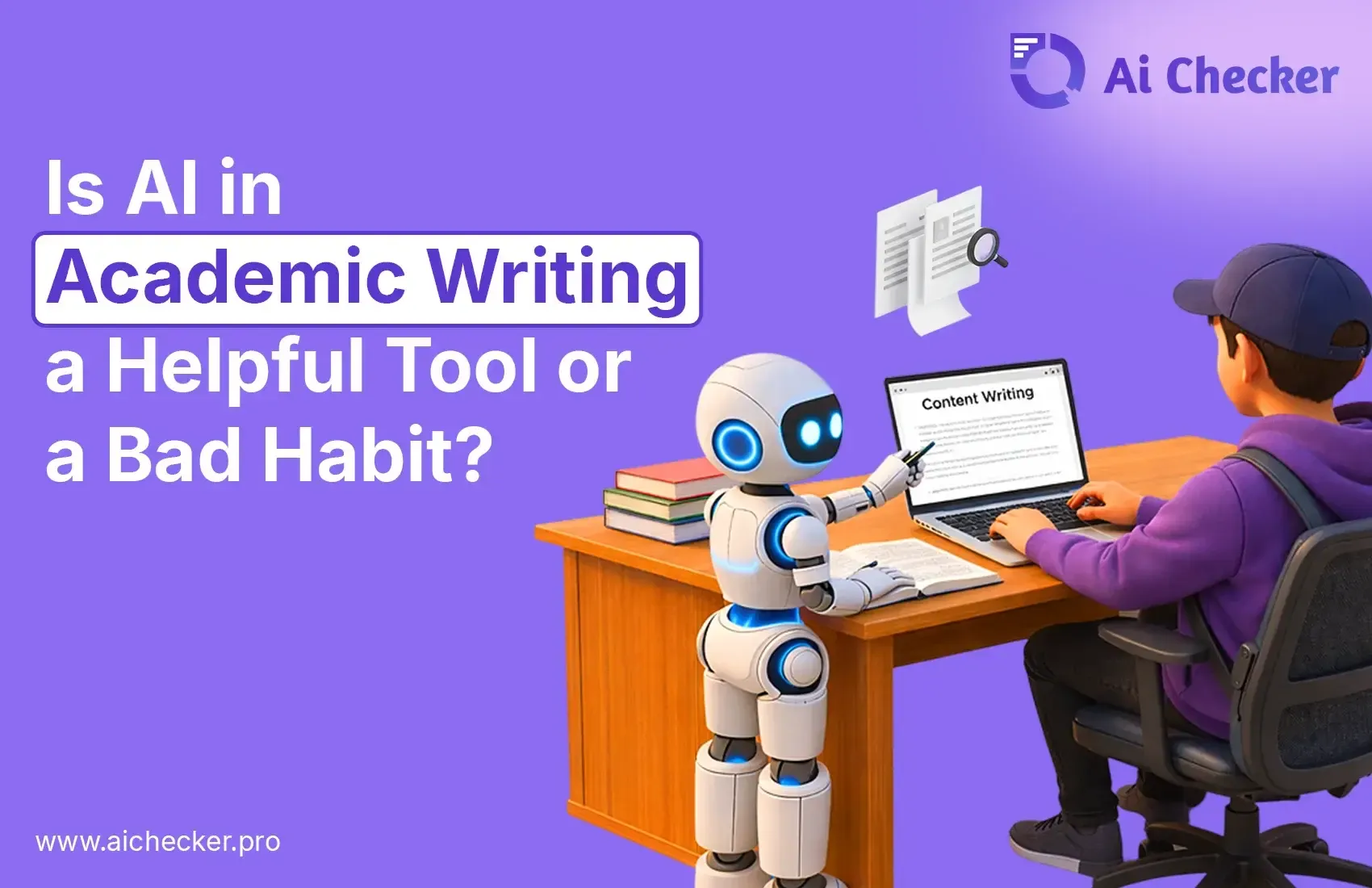
The scene shows you on Tuesday at 11 PM facing an essay deadline which requires submission at 9 AM after working for two hours on a blank screen. You launch ChatGPT to enter your subject which results in an immediate complete outline, full draft, and final conclusion. The solution appears complete because it provides essential support to users. Artificial intelligence has developed into an unnoticeable presence which now permeates educational spaces across classrooms, libraries, and student residential areas. Understanding the broader impact of this shift is why AI content detection in education has become one of the most debated topics among educators and institutions worldwide.
This article provides no straightforward yes or no response. The writer presents both perspectives for assessment through a method which enables effective dialogue.
Why AI in Academic Writing Is a Growing Debate
The primary issue scientists faced during their research had become a major problem in scholarly writing because researchers used online resources and student work without proper citation.
Plagiarism checkers became standard in schools because teachers enforced tighter rules while students developed their skills in restating information. Should educational institutions adopt AI technology in their operations? Educational institutions worldwide continue to research this matter which leads to different institutional responses.
What Is AI in Academic Writing?
AI in academic writing refers to using artificial intelligence software to help with any part of the writing process whether that's brainstorming ideas, doing research, creating drafts, fixing grammar, or improving sentence structure.
Common AI Tools Students Use
Students today have access to a surprisingly wide range of AI tools.
- ChatGPT - The most popular AI tool that enables users to ask questions, create paragraphs, and explain difficult subjects in simple language.
- Grammarly - Helps students fix grammar and improve writing style.
- AIchecker Pro - Used for paraphrasing and rewording sentences.
- Claude *- Helps with research by pulling together information from multiple sources.
- Notion AI and Google Gemini - Becoming essential tools for students in their daily academic activities.
These tools are free or cheap, easy to use, and available 24/7 - a combination that makes them extremely appealing to students who experience high levels of stress and work obligations.
Why Students Are Using AI More Than Ever
Easy Access to AI Tools
Five years ago, advanced AI tools remained exclusive to technology experts. Today, students can access advanced AI tools for free using their smartphones and internet connections. The ability to access something new leads people to alter their activities.
Pressure of Deadlines and Grades
Current students experience substantial stress from their academic requirements. Students face time constraints because they must complete assignments, study for exams, work part-time jobs, and meet social obligations. AI technology provides users with a convenient shortcut.
Need for Faster Learning
Some students use AI because they want to learn not because they want to avoid work. They use it to obtain fast comprehension of complex subjects and explore unknown topics. Learning how to write better ChatGPT prompts can help students extract more educational value from these tools rather than simply copying outputs. AI also functions as an effective learning tool for students studying in a second language, enabling them to comprehend material more effectively.
Benefits of AI in Academic Writing
AI in academic writing assists students by helping them write papers more quickly while creating better-organized academic work.
Faster Research and Idea Generation
The initial stage of academic writing consumes excessive time because writers need to determine their topic and begin their work. Students can use AI tools to generate ideas, examine various aspects of a subject, and obtain essential information. A student can use AI to narrow their focus in minutes instead of spending an hour finding a starting point.
Writing Support and Improvement
AI tools like Grammarly and ChatGPT help identify poor sentence construction, offer better word choices, and detect language mistakes. Students who want to go a step further can even learn how to humanize AI text to make their AI-assisted drafts sound more natural and authentic. This type of assistance provides important support to students who find academic writing difficult, especially those who are not native English speakers.
Personalized Learning Experience
AI produces different responses for different users. A student can say, "Explain the French Revolution like I'm 15 years old," and receive an explanation that matches their level. The typical textbook system lacks the ability to deliver this kind of customized content at any time.
Accessibility for Different Learners
Students who have dyslexia, ADHD, or other learning differences face difficulties with academic writing. AI tools enable users to create structured ideas, transform spoken language into written form, and create clear sentences decreasing the mental effort involved. AI serves as an essential tool that enables these students to progress toward their educational objectives.
How AI Helps During the Writing Process
Research Phase Support
AI assists students in research by enabling them to create quick summaries of lengthy articles, transform difficult research into simpler explanations, and suggest additional topics they may not have considered. Tools like Perplexity AI enable users to create understandable summaries by combining information from multiple sources.
Drafting and Editing Assistance
AI helps students who face difficulties with blank pages by generating first draft versions or outline documents. The student then creates their own version by building on that base. AI provides scaffolding support helping structure the work while the student fills in their own thinking.
Feedback and Revision Help
The process of revising an essay proves more difficult than writing it. AI tools can provide instant feedback on tone, clarity, structure, and grammar the kind of feedback that would typically require a professor or peer reviewer.
Drawbacks of AI in Academic Writing (A Bad Habit)
Overdependence on AI
The most common concern teachers raise is this: when students rely on AI for everything, they stop doing the hard thinking themselves.
Education needs to teach students how to perform difficult mental tasks wrestling with ideas, forming arguments, and changing their opinions halfway through the process. If AI writes the essay, who gained knowledge from the process?
Reduced Critical Thinking
Academic writing requires more than just word production. The process requires students to develop their thinking abilities. Researching a topic means evaluating different sources, challenging existing beliefs, and creating a personal viewpoint. AI skips all of that. It gives you an answer before you've had time to form the question properly.
Loss of Creativity and Originality
AI learns from pre-existing material. The system takes existing content and transforms it into new combinations. True creativity requires personal storytelling, original metaphors, and exclusive perspectives. Students who use AI to write their papers may receive a polished document but an empty work.
Risks of Using AI in Academic Work
Incorrect or Biased Information
AI tools don't always get things right. They can present incorrect facts with complete confidence a dangerous combination. A student who submits AI-generated content without fact-checking might unknowingly turn in wrong information.
AI Hallucinations
"Hallucination" refers to when an AI makes up information that sounds believable but is completely false fake research papers, invented statistics, non-existent quotes from real scholars. Understanding AI detector accuracy helps students realize that not everything an AI produces is reliable or verifiable. Students who trust AI blindly can find themselves in serious trouble.
Academic Integrity Issues
Most universities have policies against submitting AI-generated work as your own. If you're wondering do colleges really use AI detectors the answer is increasingly yes. Getting caught can mean failing a course, academic probation, or even expulsion. Beyond the rules, there's a deeper issue: submitting AI work as your own is a form of dishonesty to your institution, your professors, and yourself.
How AI Can Affect Student Learning
Short-Term Gains vs Long-Term Loss
Students who rely on AI for essay writing may achieve academic success today, but face challenges in employment interviews, public speaking, and essential writing tasks without AI assistance. The shortcuts provide immediate satisfaction yet the consequences will become apparent later.
Impact on Writing and Thinking Skills
Writing is thinking. Every time you write an essay yourself struggling through a paragraph, restructuring a weak argument, finding the right word you're strengthening your cognitive muscles. Let AI do all of that, and those muscles don't develop. Over time, students who rely heavily on AI tend to find independent writing harder, not easier.
How Students Can Use AI the Right Way
Using AI as a Support, Not a Replacement
Approach AI systems the same way you would a highly knowledgeable friend someone you can consult for research and prompt feedback. Your work needs to demonstrate your original thoughts, developed through your own intellectual process.
Improving Drafts Instead of Copying
Begin your writing process by creating your own first draft treat it as a rough version. Afterward, use AI to identify weak points, enhance clarity, and help rearrange text. AI should strengthen your work, not take it over.
Developing Personal Thinking
Before you ask AI what to write, ask yourself: What do I actually think about this topic? Write your own ideas first, then use AI to develop your concepts further. The tool reaches its full potential at that moment.
Best Practices for Responsible AI Use
Focus on Learning Process
Ask yourself: "Am I learning something from this?" If you're only copying AI output without thinking, the answer is no. Use AI as a tool that helps you grow not one that replaces growth.
Maintain Originality
Your unique voice your personal viewpoint, specific examples, and life experiences can never be replicated by artificial intelligence. Safeguard that value. Every essay is a chance to develop your voice; don't abandon it.
Verify AI-Generated Information
Always verify AI-generated content through trustworthy sources. Using the best AI detector tools can also help you understand how AI-generated your own drafts appear and whether they need more of your personal touch before submission.
Future of AI in Education
The future of artificial intelligence in education will create learning experiences that offer students personalized learning paths, flexible options, and accessible education for all learners.
Increasing Use of Artificial Intelligence Tools
AI in education will persist as a permanent element. The technology will become more integrated into student learning pathways while teachers use it for assessment and academic institutions maintain their operations. Educational institutions must now accept this technology because its adoption has reached a point of no return.
Educational Institutions Need New Learning Strategies
The process of educational transformation has already started. The question is whether students and institutions will adapt through intentional methods or through emergency measures. Those who learn to use AI as a real learning companion will achieve success.
Conclusion
The use of AI in academic writing presents both advantages and disadvantages which depend on the methods used for its implementation. Students who use AI with definite goals, honest intent, and critical thinking abilities can utilize it as an educational instrument that enhances academic performance.
AI functions as a basic instrument much like a hammer. A hammer can build a house or cause damage depending on the hands that hold it. The same is true of AI: its value depends entirely on how intentionally and responsibly you choose to use it.
Frequently Asked Questions
1. Is AI in academic writing helpful or harmful?
2. What is AI in academic writing?
3. Why are students using AI tools more today?
4. How does AI help students in writing?
5. Can AI improve learning for students?
6. What are the risks of using AI in academic work?
7. Does using AI reduce creativity?
8. Is it okay to use AI for assignments?
9. How should students use AI the right way?
10. What is the future of AI in education?

Megan Harris
Content writer at @Aichecker
Get Started Free
Create a free account for advanced AI detection and scan history.
Trusted by thousands worldwide.
Recent Blog's
Discover how AI-powered content creation can elevate your website's reach and engage your audience like never before. Explore the real impact of AI on crafting content that connects.