Will AI-Written Essays Still Get Top Grades in 2026?
TABLE OF CONTENTS
How Good Has AI Gotten at Writing Essays in 2026?
Can Professors Actually Detect AI-Written Essays?
Why Major Universities Are Backing Away from AI Detection Tools
What Happens If You Get Caught Using AI? The Real Consequences
How Smart Schools Are Actually Fighting Back in 2026
The Reality of Using AI in 2026: Where's the Line?
Should You Risk Using AI for Your Essays? An Honest Assessment
The Bigger Picture: How Education Is Changing Because of AI
What I Think Will Happen: Predictions for the Future
How to Navigate AI in Your Academic Life
What You Really Need to Know
Get an AI summary of this post on:





I am going to be straightforward with you. If by any chance you are the one reading this article, then, I can assume that you have at least considered the use of AI for writing essays. Perhaps you have even gone through this process already. Perhaps you are simply interested in the current situation across schools. Whatever the case may be, I am the one to give you the authentic scenario in 2026.
For a few years now, I have been monitoring the AI essay writing situation, and it has become very intriguing. The technology is improving all the time, schools are experimenting with different methods of detection, and nobody really knows the rules. Therefore, let us discuss the reality of the situation and its implications for you.
How Good Has AI Gotten at Writing Essays in 2026?
The most astonishing thing for me was this. AI writing software in 2026 is really something. The example I give isn't even the awkward, robotic-like sentences of some years back. Today's AI is capable of producing essays that are very natural, well-reasoned, and, finally, in many instances, can be mistaken for human writing.
What Modern AI Can Actually Do
AI technology has advanced significantly, and I have witnessed its capability in handling various tasks, from writing simple essays with five paragraphs to producing complex research papers. The latest tools such as AssignmentGPT AI can not only research deeply on various topics but also create well-organized arguments. They have a better understanding of the context, they can adopt different writing styles, and they hardly make those obvious mistakes that used to betray them.
However, the observation I made is that the quality is highly dependent on the nature of the task given to the AI. If you give it a very general prompt like "write about climate change," it will come up with a fairly good piece. But if you ask it to narrate your personal experience of visiting your grandmother's house, the AI will not be able to capture that. AI can create an illusion of being informed, but it cannot replicate the specifics of your personal life.
Where AI Writing Excels
AI manages to perform such workplace-style tasks surprisingly well that professors now adore to assign them. Such tasks include:
- Memos and formal reports in the business world
- Papers with arguments in a well-structured manner
- Summaries of research and literature reviews
- Technical writing and documentation of various kinds
This very kind of structured writing is the one that AI was made for. It's one of the main reasons that educational institutions are beginning to concern a little altogether.
Can Professors Actually Detect AI-Written Essays?
This is the point at which complications arise. Schools have started the implementation of AI detection tools in a hurry, and I must inform you that the very fewest of the results are positive.
What Detection Tools Schools Are Using
At present, a lot of universities have Copyleaks and other detection software in their arsenal. The software asserts that it can detect the machine-made text through the examination of the writing style. Detection is based on the analysis of sentence structure, vocabulary, and overall writing flow to determine the authorship of the text: human or AI.
What Tools Students Are Using
On the other hand, students can utilize tools such as:
- AssignmentGPT AI for writing an assignment and using it for studying
- Bypass AI for making AI-generated text seems more human
- Conglomeration of paraphrasing and humanization tool
Crazy as it may sound, it's turned into an arms race where the detectors are honestly losing.
The Accuracy Problem That Changes Everything
The issue that is recurring for me is the detectors which are still not so perfect. In fact, they are considerably far from being so.
I came across one study in which the detection tools were tried on TOEFL essays written by international students. The result was that more than half of the real human essays were classified as AI-generated. Just think about it for a moment, actual students who penned the essays were accused of cheating due to the mix-up of a computer program.
If you consider the different types of writers the detection tools deal with, the problem becomes even more serious. The non-native speakers are often the ones whose texts are labeled as AI-generated the most. Why is that? The reason is that their writing may be simpler and more direct therefore the AI detector mistakes it for machine writing. Such a situation is not only inaccurate but also quite unjust in reality.
The Technology Race Problem
Subsequently, there is the major problem. The advancement in the AI writing technology is the reason for the detectors becoming less effective. The release of GPT-4 made it very difficult to detect the use of AI in the case of GPT-3.5. In the case of the newest models, detection is still harder.
The students have also come to know this. Bypass AI and similar tools are specifically designed to make the text produced by AI less detectable. The tools introduce small errors, alternate the sentence patterns, and conceal writing points to make it undetectable. It is similar to a race between the police and robbers and the police are always one step behind.
Why Major Universities Are Backing Away from AI Detection Tools
Here’s a point that I found very interesting. Some important educational institutions, in fact, have given up the suggestion of AI detection tools to their faculty members. As a case in point, the University of Pittsburgh took a step back and made not to support the use of those tools throughout the campus.
Three Big Reasons Schools Are Losing Faith
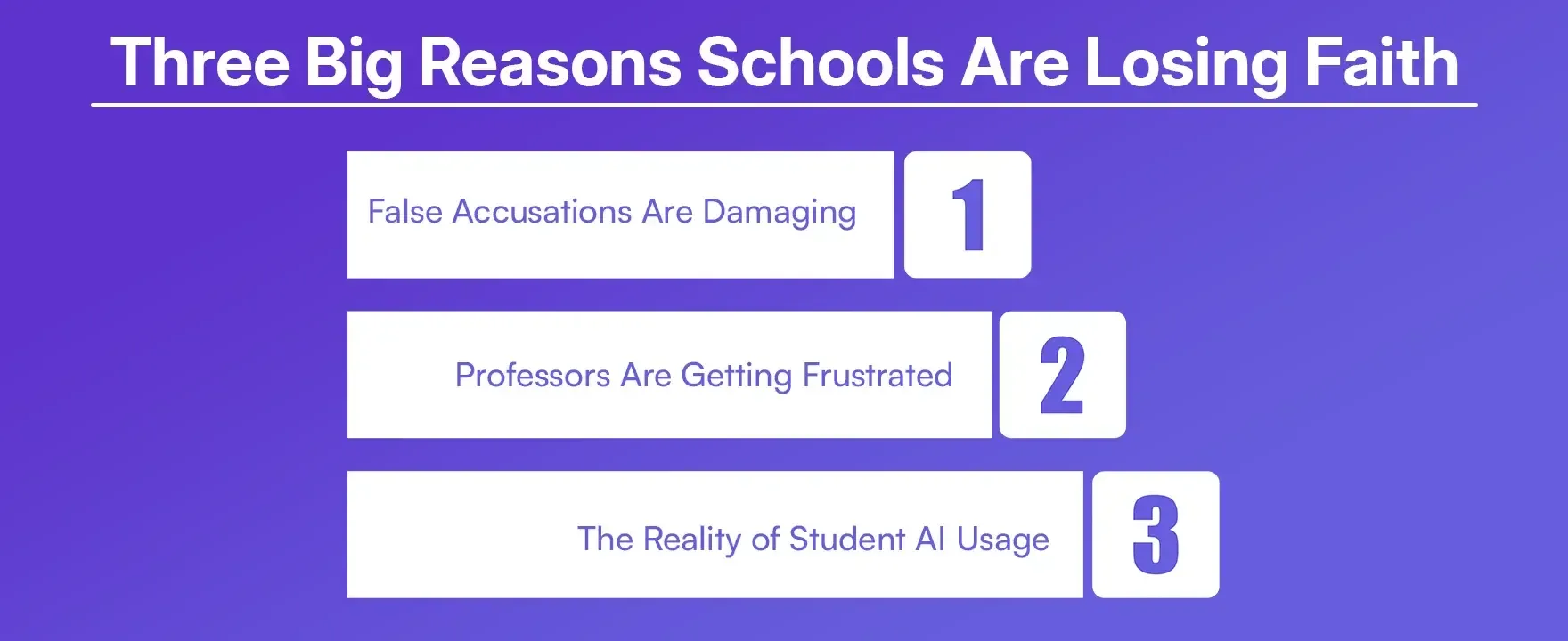
1. False Accusations Are Damaging
Envision the situation of a pupil that has invested numerous hours in composing an essay, until he gets to the professor’s office and is accused of plagiarism because a certain algorithm has misjudged it. That is certainly very hard to bear, it brings about a lot of stress, and it is utterly unfair.
2. Professors Are Getting Frustrated
I have observed that the professors are quite fed up with the whole thing concerning the false positives. They are noticing that way too many students who are not guilty of anything are getting marked. They are having to handle learners who need to demonstrate their lack of guilt. And they are coming to the conclusion that the role of investigator is not at all what they wanted when becoming teachers.
3. The Reality of Student AI Usage
Moreover, there exists another factor. It is an established fact that students have already been relying on Artificial Intelligence for homework. According to research, nearly 89% of students have somehow utilized AI tools in their schoolwork. This does not refer to a tiny minority any longer but practically all students are included. Thus, the educational institutions are beginning to understand that they should evolve with this reality instead of simply resisting it.
What Happens If You Get Caught Using AI? The Real Consequences
Let me be very specific regarding this matter. The detection tools may not be flawless, but the penalties for being discovered using AI to compose your essays are quite severe.
Academic Penalties You'll Face
In case your school finds that you have breached their academic integrity policy, then you are going to have very big problems:
- Automatic fail on the assignment (minimum consequence)
- Failing the entire course (common outcome)
- Academic probation (goes on your record)
- Suspension or expulsion (for serious or repeat violations)
- Permanent mark on your academic transcript
The Long-Term Impact on Your Future
And what is it that truly matters in the long run? All these activities are recorded in your academic record. The future professors will know it. The graduate schools will know it. Some employers may know it. You are risking not only one grade but possibly the whole of your academic and professional future.
In addition, I have witnessed the same harming effects on professor-student relationships. You may not be punished at all, but, as soon as a professor thinks you are not doing your own work, he/she will never regard you in the same way again. What about those recommendation letters you will need afterwards? Good luck with that.
How Professors Catch Students Beyond Detection Tools
Detection may not be perfect, but the professors are still learning how to identify the suspect using other means:
It is a fact that detection technology is not infallible, but through other approaches, the professors have been able to spot the cheating activities more easily.
- They have judged your writing style in the light of your earlier submissions.
- They are capable of interrogating you about your paper in real-time.
- They may demand to review your drafts and your editing history.
- They are aware that there is a sudden change in the quality of writing from poor to excellent.
- They can contrast your writing done during class with the assignments done at home.
If there is any doubt, they would simply look for other ways to investigate rather than just running it through a detector.
How Smart Schools Are Actually Fighting Back in 2026
The more intelligent schools have stopped depending on detection technology entirely. They are rather altering their methods of assignment creation and student work assessment.
Assignment Design Changes
I have witnessed professors being extraordinarily inventive in this area:
Assignments for Personal Reflection: Professors give students such topics that involve personal reflections that AI cannot imitate. How can AI describe the moment when you had to make an ethical choice in your part-time job? It can't. It wasn't around.
Association with Real Life: Instructors request students to relate the theoretical content to their own lives and experiences. Such a process produces genuine creations that are eyond AI's capabilities to copy.
Conditions of Progressive Development: They expect to receive several drafts, outlines, and revisals. This document trail is extremely difficult for AI to produce.
New Assessment Methods
There are some professors who are reviving methods that make the use of AI very clear:
- Oral presentations and debates on your written work
- Conversations during office hours when you elaborate on your essay
- Writing done in class that is in addition to the work being done at home
- Process portfolios that demonstrate the growth of your ideas
These are simple if you, the one who wrote it, comprehend it. If an AI did it, and you just turned it in, then you will have a hard time.
Clear AI Usage Policies
Moreover, I have observed an increase in the number of educational institutions that are revising their syllabi to clearly outline the policies regarding the use of AI:
- A few instructors open up their classrooms to AI for the purpose of ideas generation or checking the quality of writing
- Some of them prohibit its usage at all for designated tasks
- The vast majority ask for a statement when AI is used in ways that are allowed
- The regulations have become explicit, thus, you are informed without any doubt about what is permitted.
The Reality of Using AI in 2026: Where's the Line?
I'm not going to fake things and say that students are not \using AI writing tools. It is evident that they are doing so. However, I would like to talk about the different manners in which people are employing AI.
Acceptable AI Usage (Usually Allowed)
- Using AI as a helper and as a replacement for your own work is a world apart:
- AI could help you in learning a complex idea
- Creating an outline or thinking of ideas
- Proofreading your grammar and spelling after you have written something
- Finding a way out when you encounter writer's block
- Getting to know how to build up arguments by looking at the examples Provided.
Crossing the Line (Academic Dishonesty)
- Here is the point when you cross the line of academic dishonesty
- Submitting a paper fully written by AI as your own work
- Undisclosed assistance from AI in paragraph generation
- Plagiarizing AI text without even comprehension or alteration
- Employing AI tools where your instructor has clearly prohibited them
- Failing to give credit for using AI support when it is mandatory
Why the Difference Matters
I've had conversations with students who utilize AssignmentGPT AI and other similar tools for legitimate reasons. One of the main purposes is to enable them to continue when they don't know what to write.
Besides, they also apply it for the sake of getting examples of arguments' structure. They extensively work on improving their writing and learning by comparing with AI's output. This kind of usage, when it is accepted by your professor, could really mean a step forward in your writing skills.
The issue, however, is that some students mismanage AI and use it as a way to eliminate the whole learning process. What really concerns me about that is the fact that even if you manage to do it now, you are still not acquiring the skills you need.
Should You Risk Using AI for Your Essays? An Honest Assessment
This is the query which is posed to me the most frequently, and my reply might astonish you. I am not going to dictate you what to do. However, I am going to request you to consider your real aim, what it is that you are trying to achieve.
The Short-Term vs. Long-Term Trade-Off
If you are just going to use the minimum effort to pass school and will thus get a degree, then probably AI is going to be the best for you short term. But is it truly your goal? The first thing that I found out is that the students who eventually succeed are not those who found the easiest way out. They are the ones who actually built up proper skills and knowledge.
What You're Actually Risking
- Consider what is going to happen after graduation:
- You will be required to write emails, reports, and give presentations at work
- You will have to be able to think critically and solve problems on your own
- You will be able to get your ideas across clearly without the help of AI
- You will be in situations where your real skills will be of no use
If your four years of college have been spent with AI doing your assignments for you, you will find it extremely hard to cope with the real professional world.
The Hidden Cost: Constant Anxiety
In addition, the constant anxiety that comes with it is the hidden cost. I have noticed that students who have used AI have been living in constant fear of being found out. Their first reaction is to panic whenever a teacher asks them to come in for a chat. Similarly, they will start wondering if they are under investigation whenever there is a delay with the marking of their papers. Is it really worth that amount of stress just for avoiding some writing assignments?
The Bigger Picture: How Education Is Changing Because of AI
What is actually going on here is not just AI and essays. This technology is compelling the entire education system to undergo change. Future-oriented Educational Solutions
I have observed that progressive educators are not making AI their foe. They are realizing that AI will be a part of the world that will be presented to their students after they graduate. Therefore rather than outlawing it they are educating students on how to use it in an ethical and effective manner.
The New Educational Focus
It is not about whether you have written this yourself anymore. to "do you have this material and are able to show that you have it? That is a healthier thinking of education anyway.
Some schools are:
- Open discussion on AI capabilities and limitations.
- Digital literacy and ethical use of AI.
- Re-designing tests based on proving understanding.
What I Think Will Happen: Predictions for the Future
Having witnessed everything, I am here to present my forecast of the future direction.
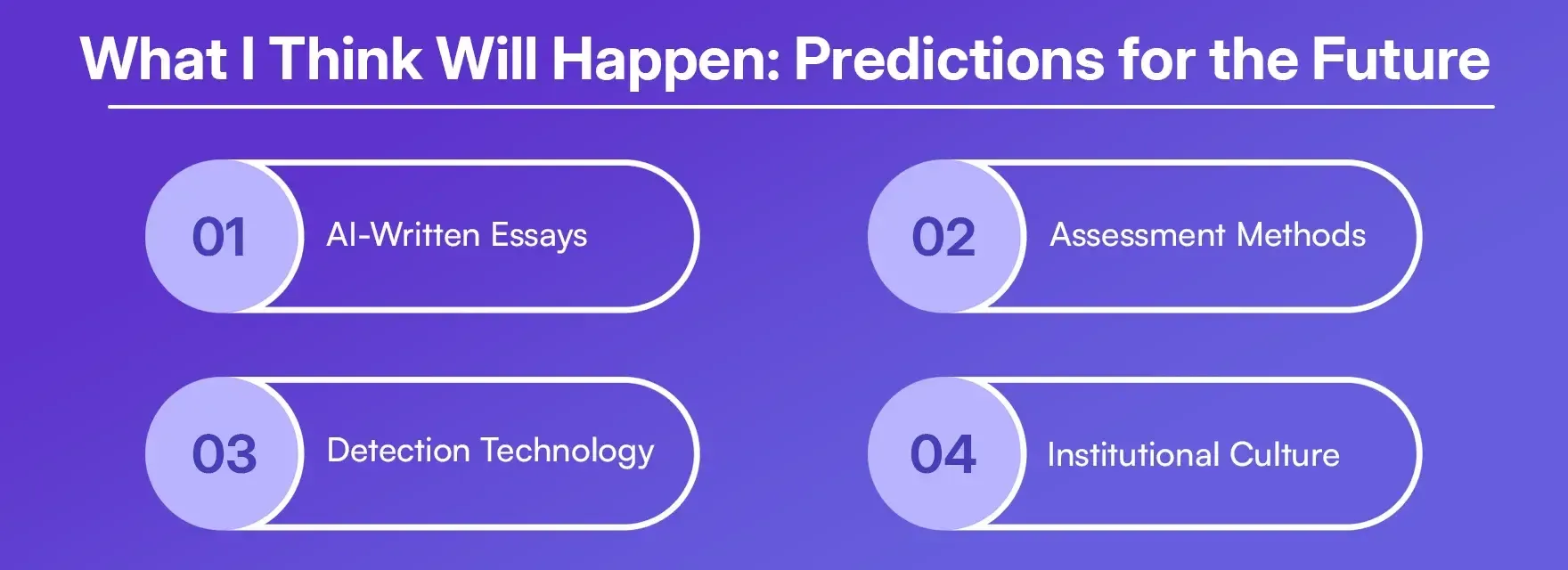
For AI-Written Essays AI-written essays may still earn good marks in 2026, but the whole process is becoming more and more uncertain, and educational value is none. There will be a gradual disappearance of essay assignments that robots can easily handle in schools.
For Assessment Methods You will see a lot more:
- Assignments tailored to your direct experience
- Exams conducted face-to-face plus verbal parts
- Attention to the process instead of just the final products
- Tasks for which AI will not be able to create genuine work at all
From Detection Technology
The technology used for detection is going to upgrade continuously, but it is unlikely that it will ever reach a point where schools can trust it completely due to the nature of false positive cases that are very serious and can't be ignored.
For Institutional Culture
In my opinion, the most important factor will be the culture of the institution. Trust-building with students along with clear and just involving AI policies will be the way to go for schools compared to those that try to catch and penalize everyone. Education is more effective when it is collaborative rather than confrontational.
How to Navigate AI in Your Academic Life
If you're thinking about using AI for your essays, here's what I recommend.
Step 1: Check Your Specific Course Syllabus
Start by checking your specific course syllabus. See what your professor's AI policy actually says. Many professors are now being explicit about what's allowed and what isn't.
Step 2: Use AI Ethically When Allowed
If AI is allowed for certain purposes, use it for those purposes and nothing more:
- Brainstorming and outlining (usually okay)
- Understanding difficult concepts (usually okay)
- Grammar and spell checking (usually okay)
- Full essay generation (usually NOT okay)
Step 3: Always Disclose AI Usage
If you use it, be honest about it. If your professor asks students to disclose AI usage, disclose it. Building a reputation for honesty is worth way more than any single grade.
Step 4: Focus on Actually Learning
Most importantly, use your time in school to actually learn. I know essays can feel pointless sometimes, but the skills they build matter. Being able to research a topic, form an argument, and communicate it clearly is valuable in almost every career. Don't cheat yourself out of developing those abilities.
What You Really Need to Know
So will AI-written essays still get top grades in 2026? Sometimes, probably yes. The technology is good enough that it can produce work that earns decent grades, especially on generic assignments.
Conclusion
Essays produced by AI will certainly develop further, but the best marks in 2026 will still require human thought, lucid concepts, and individual perception. The educators might have access to more efficient tools for detecting AI-generated works, thus students who will creatively merge AI assistance with their own comprehension will be recognized.
Ultimately, AI should be regarded as an intelligent sidekick rather than a total substitute. If you want your writing to remain secure, novel, and of top quality, then using AIchecker for fast and dependable inspections will be a good option.
FAQs
1. Will AI detectors get better in the future?
2. Can professors really tell if I used AI?
3. Is it ever okay to use AI for assignments?
4. What should I do if I'm falsely accused of using AI?
5. How can I compete with students who are using AI?

Megan Haris
Content writer at @Aichecker
I am a content writer at AI Checker, where I craft engaging, SEO-optimized content to enhance brand visibility and educate users about our AI-driven solutions. My role involves creating clear, impactful messaging across digital platforms to drive engagement and support company growth.Get Started Free
Create a free account for advanced AI detection and scan history.
Trusted by thousands worldwide.
Recent Blog's
Discover how AI-powered content creation can elevate your website's reach and engage your audience like never before. Explore the real impact of AI on crafting content that connects.