How AI Detectors Handle ChatGPT, Claude, Gemini and Other LLMs
TABLE OF CONTENTS
What Is an AI Detector, Exactly?
How AI Detection Actually Works
Why Perplexity and Burstiness Matter
How AI Detectors Handle ChatGPT Specifically
How AI Detectors Handle Claude
How AI Detectors Handle Gemini
Quick Comparison: Detection Accuracy by LLM
Why No AI Detector Is 100% Accurate
Common Mistakes Businesses Make With AI Detectors
How Businesses Should Actually Use AI Detectors
Conclusion
FAQs
Get an AI summary of this post on:





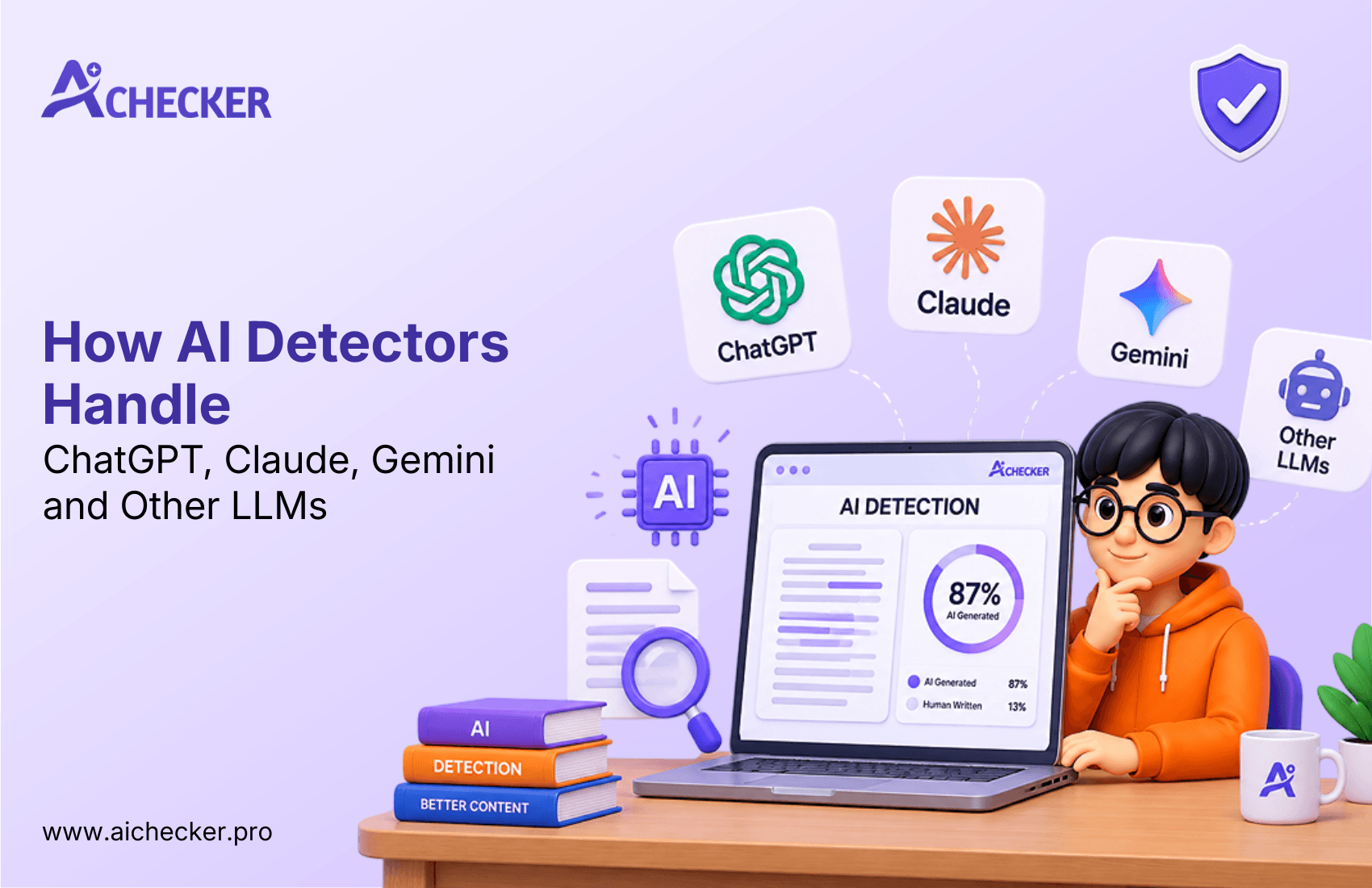
If you've ever pasted a piece of writing into an AI detector and were greeted with a confusing "68% AI" result, you're not alone. AI detectors for ChatGPT, Claude, and Gemini are everywhere, but most people don't really know how they work, or how useful they actually are.
This is a problem. Marketing teams are writing blog posts with ChatGPT, salespeople are using Gemini to write emails, and schools are trying to spot AI-generated essays. We all want to know whether an AI detector can actually tell the difference between human and AI writing.
Let's take a look at exactly how these tools work, and what their limitations are.
Short answer: they're mostly effective, but there are some important caveats.
Key Takeaway: AI detectors analyze statistical patterns in text, not meaning, to guess whether content was likely generated by an LLM like ChatGPT, Claude, or Gemini. No detector is 100% accurate, and results should always be treated as a probability, not a verdict.

Get Lifetime Access with 60% OFF
Stop paying monthly subscriptions. Enjoy unlimited AI detection and humanizer access forever with future updates included.
- One-time payment
- Unlimited access forever
- All future updates included
What Is an AI Detector, Exactly?
An AI detector is a program that evaluates a piece of text and determines the likelihood that it was produced by a large language model, based on statistical patterns of language used rather than any semantic meaning.
Think of it less as a lie detector test and more as a weather forecast.
It can tell you the probability of rain, but it can't tell you absolutely if it's going to rain or not.
Writing against datasets containing known AI-generated and human-written examples helps these tools learn what to look for. If you want a deeper breakdown of the mechanics, this guide on how AI detectors work covers it well.
They don't detect writing from ChatGPT or other AI programs per se, but they calculate an estimation based on probabilities. That's why the same paragraph can produce very different results across two AI detection tools.
How AI Detection Actually Works
AI detection involves assessing the predictability of word and phrase usage as well as sentence structure, based on statistical measures such as perplexity and burstiness, to identify patterns associated with AI-generated text.
Here's the step-by-step process most detectors follow:
- Text is broken into tokens: small chunks of words, similar to how the LLMs themselves process language.
- Perplexity is calculated: this measures how "surprised" a language model would be by the word choices. Predictable text scores low; more varied, unexpected phrasing scores higher.
- Burstiness: describes variation in sentence structure, length, and word usage across a passage. Some detection systems examine this variation because AI-generated text can sometimes show more consistent patterns than human writing.
- Pattern analysis: The detector evaluates linguistic and statistical features in the text and compares them with patterns associated with human and AI-generated writing.
- A probability score is generated: usually shown as a percentage or a "likely AI" / "likely human" label.
None of these steps involve the detector actually "reading" for meaning. That's the core limitation everyone should understand before trusting a score. For a closer look at what's happening behind the scenes, check out this piece on how AI content detectors work.
Why Perplexity and Burstiness Matter
Perplexity measures how predictable a sequence of words is to a language model. Highly predictable text tends to have lower perplexity, while less predictable wording tends to produce higher values.
Some AI detection systems use perplexity as one signal, but it cannot independently determine whether a person or an AI generated the text.
Meanwhile, humans, especially when being casual, have a much broader range of writing styles than most AI chatbots do. Some people like to write run-on sentences, while others have a habit of saying things in short, choppy phrases. Either way, this lack of strict patterns is what makes people sound "human" and not "AI-generated" to most AI detectors.
For example, one marketing team at a mid-sized SaaS company recently panicked when they realized that most of their blog posts, written partially with the help of AI, were showing up as "80% AI-generated."
For example, a human-written SaaS article may still receive a high AI score if its language is highly predictable, repetitive, or formulaic. This illustrates why detector results should be treated as signals rather than definitive proof of AI authorship, and it's a big reason why AI detector accuracy varies so much from tool to tool.
How AI Detectors Handle ChatGPT Specifically
ChatGPT is one of the most commonly evaluated LLMs, so many AI detection systems have been tested against GPT-generated text. However, detection performance can vary significantly by model version, prompt, editing level, language, and detector.
Another reason AI detectors for ChatGPT are more accurate is that ChatGPT has been publicly accessible for a more extended period than other AI chatbots.
Common tells that detectors look for in ChatGPT output:
- Predictable sentence openers ("In today's fast-paced world...")
- Balanced, symmetrical paragraph structure
- Overuse of transition words like "moreover" and "furthermore"
- A tendency toward neutral, hedged phrasing
That said, ChatGPT-4 and newer versions have gotten noticeably harder to detect than earlier GPT-3.5 outputs, especially when prompted with custom tone instructions. There's more on this in our breakdown of whether ChatGPT is detectable.
How AI Detectors Handle Claude
Claude-generated text can differ stylistically from ChatGPT output, which may affect how individual detection systems classify it. Detection performance can vary depending on the Claude model, prompt, editing, and detector methodology.
Many of us are excited about Claude's ability to write text that "sounds less robot-like" than other LLMs. However, from a deception detection perspective, that's actually a problem, since it reduces the perplexity differences between human and AI text, making them harder to distinguish. We break this down further in our Claude AI review.
Some detectors may be less effective against Claude's text because they were primarily trained on ChatGPT-like data, not Claude. This reflects a general challenge within the AI detection space, as no single solution can excel at detecting all types of AI content. The preference for ChatGPT's text over Claude's is not unique to one detection tool.
How AI Detectors Handle Gemini
Detecting Gemini-generated text can vary considerably across AI detection systems. Performance depends on the Gemini model version, the type of text being analyzed, the detector's evaluation data, and whether the content has been edited or paraphrased.
Google's Gemini models have different writing styles from ChatGPT, typically being more direct and concise, especially in the context of search results.
Because of the reduced amount of text for training detectors on Gemini, the accuracy of detectors can be more varied, with some tending to classify Gemini texts as human-written and others classifying them as AI-generated. Businesses using Gemini for content creation should be prepared for a larger variance in detector scores than those using ChatGPT.
Quick Comparison: Detection Accuracy by LLM
AI detectors may perform differently across ChatGPT, Claude, Gemini, and human-edited AI content. The results can vary based on the model, writing style, editing level, and detection method used.
| LLM / Text Type | Detection Difficulty | Key Factor | Test With |
|---|---|---|---|
| ChatGPT | Varies | Model version, prompting, and editing can affect detection | AI Checker Pro |
| Claude | Varies | Writing style and detector methodology can affect results | AI Checker Pro |
| Gemini | Varies | Model version and evaluation data can affect results | AI Checker Pro |
| Human-edited AI text | Often harder | Editing can alter detectable patterns | AI Checker Pro |
If you're evaluating tools for your team, this is also a good moment to look at AI content detector accuracy benchmarks to see how different providers stack up in independent testing.
Why No AI Detector Is 100% Accurate
No AI detector can guarantee 100% accuracy because detection relies on statistical probability, not verified authorship, and both false positives and false negatives occur regularly across every major tool.
This is the part most detector marketing pages don't emphasize enough.
Common accuracy problems include:
- False positives: human writing flagged as AI, especially formal or non-native English writing styles
- False negatives: AI writing that passes as human, especially after light editing or paraphrasing
- Inconsistency across tools: the same text can score 20% AI on one detector and 75% on another
- Model drift: as LLMs update, detectors trained on older outputs become less accurate over time
A well-known limitation: several university studies have found detectors disproportionately flag non-native English speakers' writing as AI-generated, simply because it tends to use more predictable vocabulary and sentence structure. You can read more real examples in this piece on false positives in human writing.
Expert tip: Never make a high-stakes decision (firing a freelancer, penalizing a student, rejecting content) based on a single detector score. Use it as one signal among several, not a verdict.
Common Mistakes Businesses Make With AI Detectors
Teams adopting AI detectors often run into the same avoidable problems:
- Trusting one tool exclusively: different detectors disagree constantly; cross-checking matters
- Ignoring context: a technical FAQ page will naturally score differently than a personal blog post
- Assuming a low score means "safe": paraphrased AI text can easily slip past detection
- Using detection as a punishment tool without a clear internal policy on acceptable AI use
- Not testing edited content: heavily human-edited AI drafts behave very differently than raw output
If your team is publishing AI-assisted content at scale, it's worth pairing detection with a broader workflow, including tools like an AI humanizer that can refine AI-generated drafts into more natural, human-sounding copy before publishing.
How Businesses Should Actually Use AI Detectors
Businesses should use AI detectors as a quality-control signal rather than a strict gatekeeper, combining detection scores with human review, editorial standards, and clear internal AI-usage policies.
Practical approach for SMBs and startups:
- Set an internal policy: is AI-assisted content allowed, and under what disclosure rules?
- Run content through more than one detector before flagging it as a problem.
- Focus on quality and originality, not just the AI score itself.
- Use detection results to guide editing, not to reject work outright.
- Revisit your policy periodically as LLMs and detectors both keep evolving.
For companies building content workflows around AI tools, this is also where automation helps. If you're looking to smooth out AI-assisted drafts before they go live, our blog enhancer can help design a system around your team's actual editorial standards, managing content review, drafting, and quality checks in one workflow.
Conclusion
AI detectors can be valuable tools that may help recognize patterns characteristic of ChatGPT, Claude, Gemini, or other AI language models, but they should not be considered an infallible test. The results of such tests are not always accurate, as they are based on calculations of perplexity, burstiness of texts, and other linguistic statistics, which can give both false positives and false negatives.
Moreover, as the arms race between AI developers and detectors begins, the methods of both sides will constantly change and improve, making existing software inadequate over time.
For businesses, trainers, and other users of AI-generated content, it is essential to utilize both AI detection tools and human expertise in order to filter out undesirable content. Thus, while not infallible, an AI detection score can serve as a helpful piece of information in determining the origin of a text.
FAQs
How do AI detectors know if ChatGPT wrote something?
Can AI detectors tell the difference between Claude and human writing?
Are AI detectors accurate for Gemini generated content?
What is perplexity in AI detection?
Why do two AI detectors give different results for the same text?
Can AI detectors give false positives on human writing?
Does editing AI content help it pass detection?
Is a 100% AI detection score always correct?
Should businesses rely on just one AI detector?
What's the best way to use AI detectors for content review?

Harshil Barvaliya
SEO Executive & Content Writer at AI Checker Pro
I’m Harshil Barvaliya, an SEO Executive and Content Writer at AI Checker Pro. I focus on improving the website’s search engine visibility through effective SEO strategies, including keyword research, on-page and off-page optimization, and content development.Get Started Free
Create a free account for advanced AI detection and scan history.
Trusted by thousands worldwide.
Recent Blog's
Discover how AI-powered content creation can elevate your website's reach and engage your audience like never before. Explore the real impact of AI on crafting content that connects.