Perplexity and Burstiness in AI Detection: What They Actually Mean
TABLE OF CONTENTS
Key Highlight
What Are Perplexity and Burstiness in AI Detection?
What Is Perplexity in AI Writing?
What Is Burstiness in AI Writing?
Perplexity vs. Burstiness: Key Differences
How Do AI Detectors Use Perplexity and Burstiness?
Human vs. AI Writing: Real Examples
Are Perplexity and Burstiness Reliable for AI Detection?
Why AI Detectors Can Produce False Positives
Conclusion
FAQs
Get an AI summary of this post on:





If you have ever pasted your own essay into a checker and watched it say "80% AI," you probably wondered how it decided that. The answer usually comes down to perplexity and burstiness in AI detection. These two signals sit behind many detectors, and most people misunderstand them.
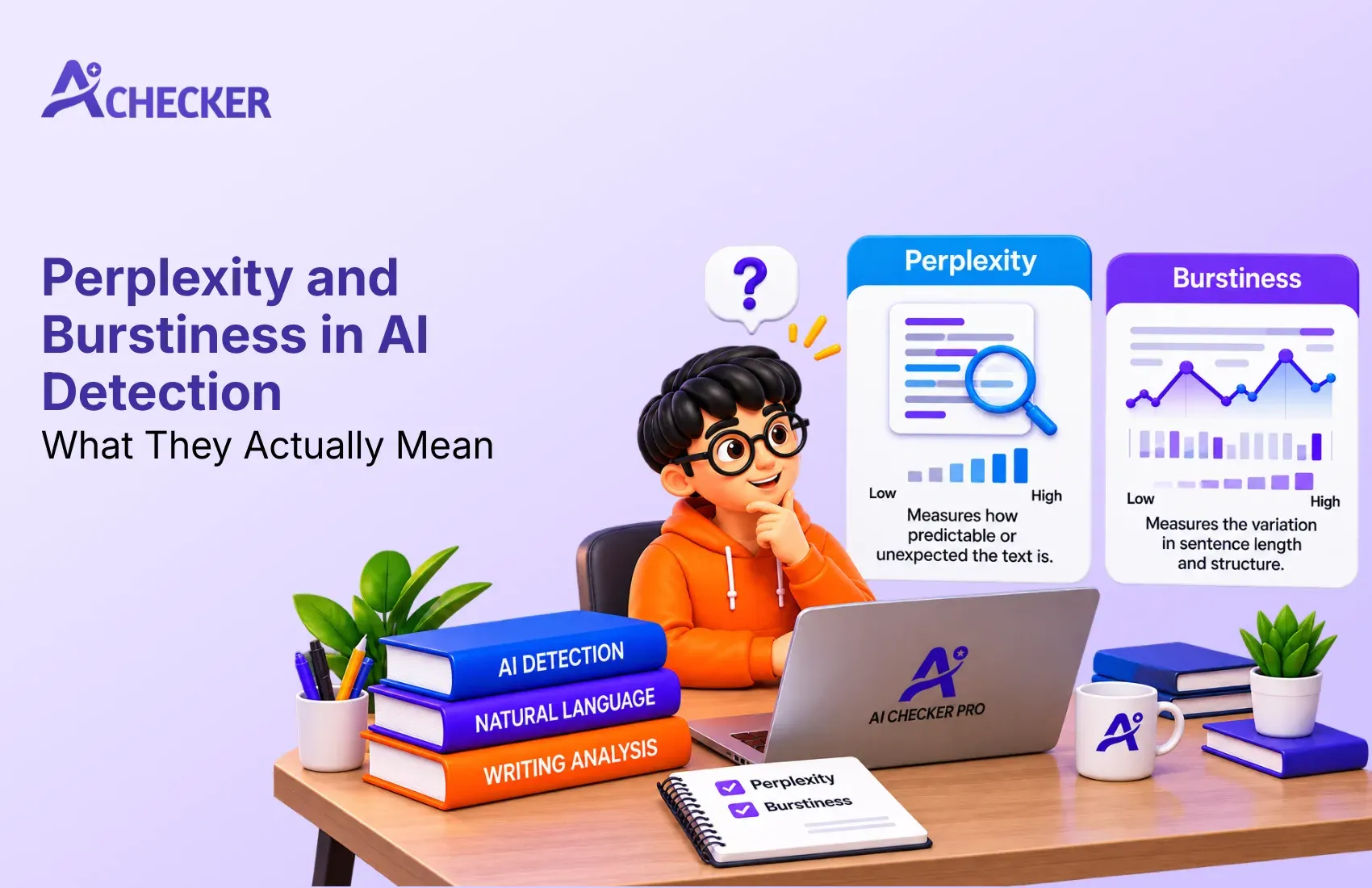
Here is the short answer. Perplexity measures how predictable your word choices are to a language model, while burstiness measures how much your sentence length and complexity vary. Low scores on both tend to look like AI. Higher, more uneven scores tend to look human, but that is only a probability, never proof.
Key Highlight
- Perplexity measures how predictable your word choices are to a language model. Lower perplexity usually means more AI-like text.
- Burstiness measures how much your sentence length and structure change from line to line. Flat, even writing scores low.
- Many detectors, including GPTZero-style tools, rely on perplexity and burstiness in AI detection as part of a bigger system.
- They are probability signals, not proof. No AI detector is 100% accurate.
- Formal writing, textbook-style essays, and non native English can score low and get falsely flagged.
- The best fix is to write with real specifics and varied rhythm, then check your draft sentence by sentence.

Get Lifetime Access with 60% OFF
Stop paying monthly subscriptions. Enjoy unlimited AI detection and humanizer access forever with future updates included.
- One-time payment
- Unlimited access forever
- All future updates included
What Are Perplexity and Burstiness in AI Detection?
Perplexity and burstiness are two statistical patterns that detectors analyze to determine human writing versus machine writing. Imagine that perplexity and burstiness are two different questions about the same text.
Perplexity asks "how surprising are each of the word choices?" while burstiness asks "how does the rhythm vary across the whole piece?" When I tested detectors on a set of student essays and blog drafts last year, the pattern was obvious.
The raw ChatGPT drafts had a consistent, even pattern from start to finish, while the human drafts varied from long run-on sentences to three-word fragments to unusual but correct word choices.
This is a big difference that can be easily picked up by an AI text detector: one that uses perplexity and burstiness to detect text. A detector does not examine the text like a professor would. It reads the pattern and then calculates the probability that a model wrote it.
Here is why perplexity and burstiness in AI detection matter to you:
- Students want to know why a genuine essay got flagged by perplexity and burstiness in AI detection.
- Teachers want to know how much weight a score deserves.
- Bloggers want to know if their drafts look robotic and how AI detectors work at a technical level.
- Businesses want content that reads as a person wrote it.
What Is Perplexity in AI Writing?
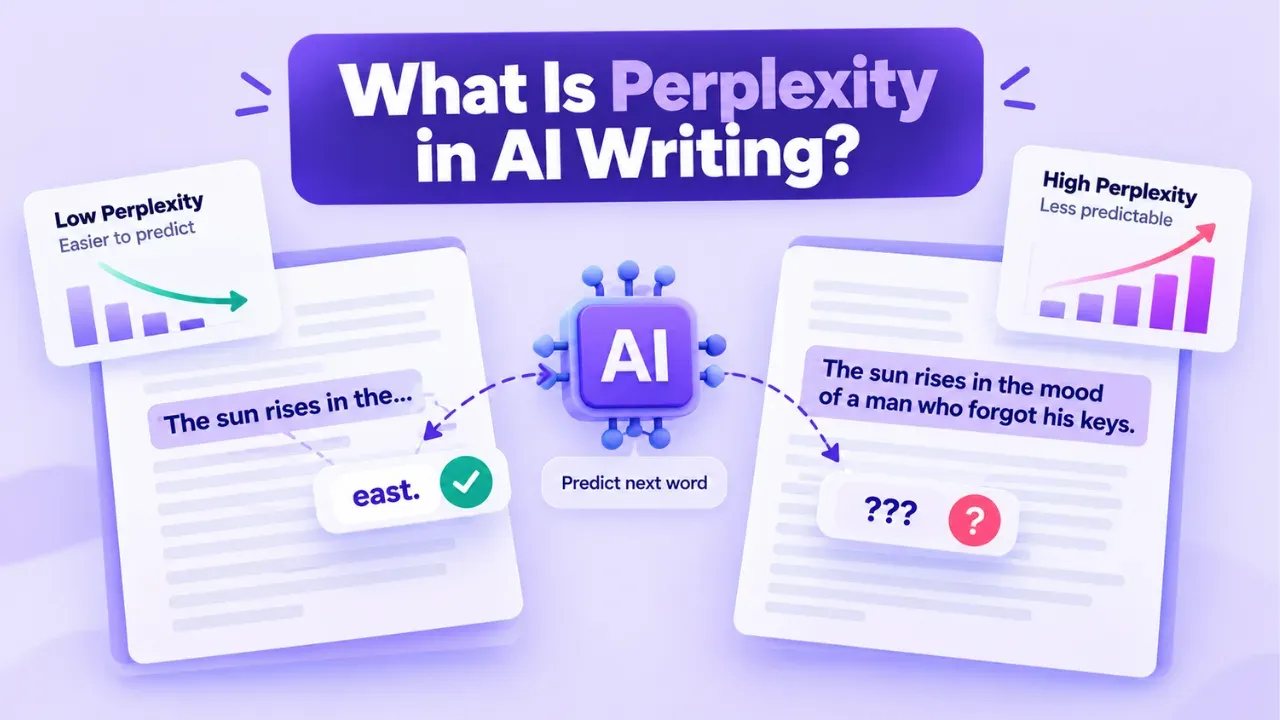
If you are wondering what perplexity is in AI, here is a simple explanation. Perplexity refers to one of the two main components, namely, perplexity and burstiness, used to detect AI-generated texts. Perplexity is a numerical value that indicates how easy it is to predict what a computer-generated text will say at any given point.
The lower the number of perplexity score, the easier it is for an algorithm to guess the following word in a sentence. On the other hand, higher levels of this indicator suggest that the text is less predictable.
A simple example
Take this sentence start: "The sun rises in the..."
Almost every model will predict "east." That is low perplexity. Now try: "The sun rises in the mood of a man who forgot his keys." No model saw that coming. That is high perplexity.
Why AI text often has low perplexity
Language models are designed to predict probable words. This is how they produce text. Therefore, a model that is writing an essay will tend to use the safest, most common, and most expected word each time. This makes it extremely easy for the second model to predict what the essay will say.
This is the basis of AI detection perplexity and the first part of perplexity and burstiness in AI detection. An AI detector uses a model to score your text, and if it is too predictable, your perplexity score in the AI detector result will be low, and your AI probability will be high.
What is a good perplexity score for human writing?
I get asked this question often, and the answer is not a simple one. There is no universal number; it depends on the model that is evaluating, the length of the text, and even what you are writing about.
Any answer someone gives you has to be at least partially guessed, since no two models will have the same thresholds.
So what's a good perplexity score for human writing? It helps to not think about it in absolute terms, because when it comes to detectors, burstiness and perplexity always depend on the model. Human writing tends to score better on average than AI text, but the ranges overlap significantly, so a technical document written by a human could score lower than an AI-generated blog post.
What Is Burstiness in AI Writing?
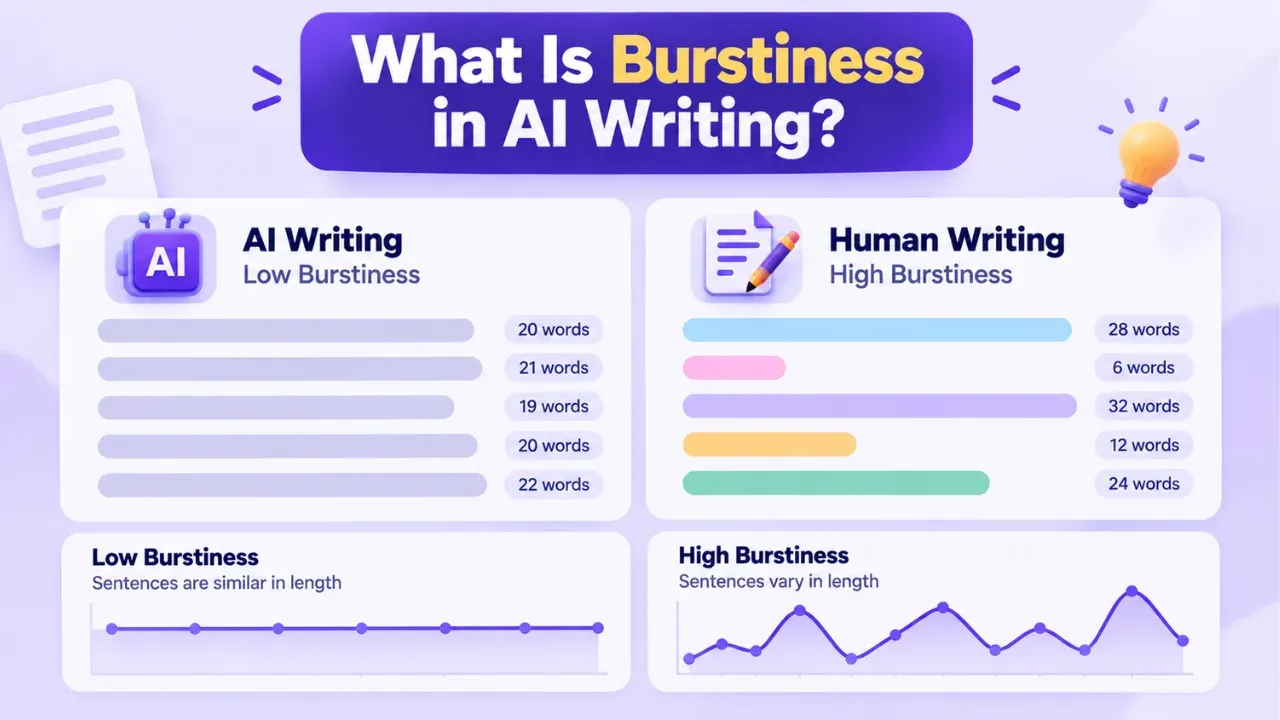
Now, the second half of perplexity and burstiness for AI detection. If you are wondering what burstiness in AI is, it describes how much your writing varies over time. Humans write in bursts. We write a long, winding sentence full of detail. Then we stop. Short one.
What high burstiness means
What is high burstiness writing? Well, it is a writing style where sentence length, structure, and word choice vary considerably. One paragraph can be super dense while the next one is straightforward. You can ask a question, make a statement, and give an example right after.
What low burstiness looks like
AI models tend to generate text in a very specific way. Most of the sentences they create are about the same length and complexity. If you were to read an original ChatGPT essay out loud, you would hear a lot of metronome-like qualities.
This is why AI detection burstiness is such an important factor. An AI detector can calculate the average amount of perplexity change between sentences, and if it is low, the burstiness score will be lower, suggesting that the text was created by a machine.
Quick check you can do yourself
Take any paragraph, and count the number of words in each sentence. If most of them are between 18-24, then your burstiness is low. Try mixing it up, and see if your reading improves.
Perplexity vs. Burstiness: Key Differences
A lot of people mix up the two halves of perplexity and burstiness in AI detection, so here is the difference between perplexity and burstiness in one place.
| Feature | Perplexity | Burstiness |
|---|---|---|
| What it measures | How predictable each word is | How much rhythm and complexity vary |
| Level | Word and phrase level | Sentence and paragraph level |
| Low score suggests | Safe, common word choices | Flat, uniform sentence patterns |
| High score suggests | Unusual, specific wording | Varied, uneven, human rhythm |
| Easy to fix by | Adding specific details and original phrasing | Mixing short and long sentences |
Here is my explanation of the concept. Perplexity refers to the complexity of the text. Burstiness is the combination of high and low range lengths of sentences.
The two can exist independently of each other. A text can use simple words but be full of sentences with different lengths. A work can have rare words but have all the sentences in it the same length.
Good detectors utilize both factors, and that is why they are so often combined in discussions of AI detection.
How Do AI Detectors Use Perplexity and Burstiness?
Let me answer how do AI detectors use perplexity and burstiness without the jargon.
- The detector splits your text into tokens, which are small chunks of words.
- A language model scores how predictable each token is.
- The detector averages those scores to get overall perplexity.
- It then checks how much those scores swing between sentences to get burstiness.
- It compares both numbers against patterns learned from human and AI samples.
- It returns a probability, such as "likely AI" or "likely human."
Where AI Checker Pro fits
Tools such as AI Checker Pro help you detect AI content accurately by analyzing your text at the sentence level rather than presenting you with a general score for the whole page.
This is important because most often, a piece of writing will not be made up solely of AI. There may be two paragraphs generated by an AI while the rest is human-written, so it is a common occurrence for perplexity and burstiness in AI text detectors to show signs of AI-generated text while most of the writing is not produced by an AI. With sentence-level detection, you know exactly where to make changes.
Moreover, it can detect text generated by ChatGPT, GPT -4, GPT 5, Gemini, Claude, and much more, and an integrated AI humanizer helps you alter the parts of the text that were identified as AI-generated, so you don't have to use multiple programs for this task.
The tool is used by 100K+ people, which demonstrates its popularity and shows that many people find value in detecting text generated by an AI at the sentence level.
How the main tools compare
Here is a general comparison of tools that use perplexity and burstiness in AI detection, based on public information and my own testing experience. Treat it as a guide, not a lab study.
| Tool | Accuracy | Free Tier | Humanizer Included | Best For |
|---|---|---|---|---|
| AI Checker Pro | Strong on raw AI text, sentence-level detail | Yes | Yes | Students, bloggers, agencies |
| Turnitin | Widely used in schools, not perfect | No direct access for individuals | No | Institutions and instructors |
| GPTZero | Popular, uses perplexity and burstiness style signals | Limited free use | No | Teachers and quick checks |
| Originality.ai | Built for publishers, strict on raw AI | Paid credits | No | SEO teams and publishers |
Notice something? Every tool in that table that leans on perplexity and burstiness in AI detection still gets less accurate on paraphrased or humanized AI content. That is true across the industry, not just one product.
Human vs. AI Writing: Real Examples
Let me show you what human vs. AI writing patterns look like. I wrote both samples on the same topic: studying for finals.
Sample A: Typical AI style
"Studying for final exams requires a consistent and structured approach. Students should create a study schedule, review class notes regularly, and practice with past exams. Additionally, getting enough sleep and maintaining a healthy diet can significantly improve overall academic performance."
Look at it. Three sentences, all about the same length. Every word is safe. The structure is list-like. This sample would likely show low perplexity and low burstiness.
Sample B: Typical human style
"I crammed for my econ final at 2 a.m. in the campus library, and honestly it did not go well. Lesson learned. Now I spread things out, even if that just means twenty minutes a day with a bad cup of coffee and my roommate quizzing me."
Now look at this one. There is a long sentence, a two-word sentence, and a long one again. The details are specific and a bit odd. A detector would likely read this as higher perplexity and higher burstiness.
Your turn
Both samples show perplexity and burstiness in AI detection playing out on the page. Which one sounds more like you? If your own writing sounds like Sample A, a detector may treat it with suspicion even if you wrote every word yourself. That brings us to the next question.
Are Perplexity and Burstiness Reliable for AI Detection?
Short answer: perplexity and burstiness in AI detection help, but it is not reliable enough to stand alone. I have tested many detectors, and honestly, most of them are not as consistent as their marketing suggests.
Here is a fair view of AI detector accuracy:
- No AI detector is 100% accurate. That includes Turnitin, GPTZero, Originality.ai, and Copyleaks.
- Detection works best on long, unedited text straight from a model.
- Accuracy drops significantly on paraphrased or humanized AI content.
- Short texts, like a 100-word discussion post, give very unstable scores.
- Newer models write with more varied rhythm, so older signals lose strength.
So how accurate are perplexity-based AI detectors? Better than a coin flip on raw AI text, much weaker on edited text, and risky for formal human writing. Several major universities have scaled back reliance on one detection tool for exactly this reason, and many instructors now treat a score as a conversation starter, not a verdict.
One more thing. Does low perplexity mean AI-generated text? No. It means the text is predictable. Plenty of human writing is predictable, especially legal memos, lab reports, and templates.
If you want to see how your own draft scores on perplexity and burstiness in AI detection, run it through the AI detector and read the sentence level results instead of just the headline number.
Why AI Detectors Can Produce False Positives
This is the part that worries students the most, and it should be given much more attention than it is. Human-written text can certainly be flagged as AI. I have seen it happen with real essays.
Who gets flagged the most
- Non native English writers. They often use simpler, more common vocabulary and safer grammar. That lowers perplexity.
- Formal and academic writers. A strict five-paragraph essay is naturally uniform.
- Technical writers. Documentation and lab reports follow set patterns.
- People using grammar tools. Heavy editing can smooth out your natural quirks.
Why it happens
Detectors are taught to rely on averages, so a low result from perplexity and burstiness in AI detection may simply be a sign of good, plain writing. If your writing accidentally falls close to the average of AI output, you seem like AI.
The tool can't know that you stayed up all night writing it. This is also where the question "can AI detectors identify human-written text" has a messy answer. Usually yes, but not every time, you see.
How to reduce your risk
Here is what actually works in 2026 when perplexity and burstiness in AI detection flags your draft:
- Add specific details only you would know, like names, places, class discussions, or personal examples.
- Vary your sentence length on purpose. Short ones help.
- Keep your drafts and version history. Google Docs history is strong proof of your process.
- Check your draft before you submit it, and rewrite the flagged sentences in your own voice.
- If you used AI for a rough draft, rework it instead of pasting it. Many users now rely on AI Checker Pro and its humanizer instead of rewriting everything by hand, which saves a lot of time.
I have personally seen bloggers clean their content this way before publishing, and their Google performance stayed healthy because the posts finally read like a person wrote them.
Want to see plans and limits? Check the pricing page.
Conclusion
Understanding perplexity and burstiness in AI detection takes a lot of the mystery out of those scary percentage scores. Perplexity tracks how predictable your words are, burstiness tracks how much your rhythm changes, and both are useful but imperfect clues. They cannot prove who wrote something.
Write with real details, vary your sentences, and keep your drafts as proof of your process. When you want a second opinion, run your text through AI Checker Pro and see exactly which sentences stand out. Then fix only those.
FAQs
What is perplexity and burstiness in AI detection?
How do AI detectors use perplexity and burstiness?
What is a good perplexity score for human writing?
What does high burstiness mean in writing?
Does low perplexity mean AI generated text?
Can AI detectors identify human written text?
How accurate are perplexity based AI detectors?
What is the difference between perplexity and burstiness?
How do I stop my human writing from being flagged as AI?
What is perplexity in AI?

Harshil Barvaliya
SEO Executive & Content Writer at AI Checker Pro
I’m Harshil Barvaliya, an SEO Executive and Content Writer at AI Checker Pro. I focus on improving the website’s search engine visibility through effective SEO strategies, including keyword research, on-page and off-page optimization, and content development.Get Started Free
Create a free account for advanced AI detection and scan history.
Trusted by thousands worldwide.
Recent Blog's
Discover how AI-powered content creation can elevate your website's reach and engage your audience like never before. Explore the real impact of AI on crafting content that connects.