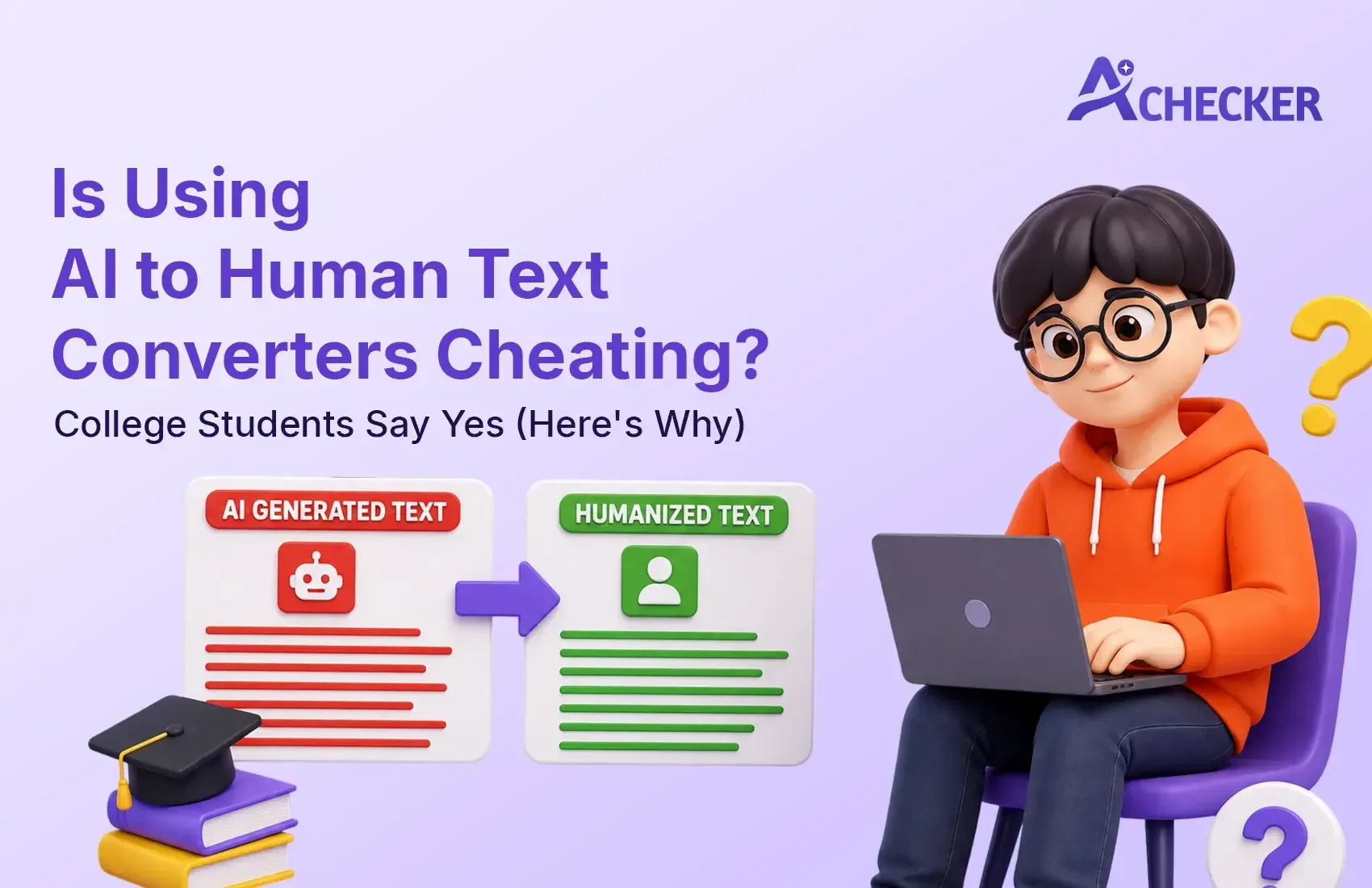
Is Using AI to Human Text Converters Cheating? College Students Say Yes (Here's Why)
TABLE OF CONTENTS
Why AI Humanizer Tools Have Become Essential in 2026
The Core Problem: What Most AI Humanizers Get Wrong
What Makes a Good AI Text Humanizer for Academic Use?
Step-by-Step: How to Convert AI Text to Human Text Properly
Best AI to Human Text Converter Tools Reviewed
Tools Worth Discovering on AIChecker.pro
Common Mistakes to Avoid
Pro Tips for Getting the Best Results
What's Next: Future of AI Text Humanization
Conclusion
FAQs
Get an AI summary of this post on:





The situation you describe exists as a common experience for more than 1000 students who attend educational institutions throughout the week. Your university detection software detects your work because you used AI for both drafting and polishing your writing.
The solution most people search for: an AI-to-human text converter. The humanizer AI tools all perform different functions. Some detectors allow users to cheat the system while maintaining their original meaning.
The other options force you to abandon your authentic speaking style. The few options that exist actually perform their intended function successfully.
This guide provides an explanation about which tools succeed and which ones fail, and how to properly operate these tools.
Why AI Humanizer Tools Have Become Essential in 2026
AI writing assistance exists in every location. People now use ChatGPT, Gemini, and Claude to create content for academic purposes, blog writing, and professional communication.
People who use AI technology need to implement AI detection systems. Universities and content platforms now use Turnitin, GPTZero, and Copyleaks as standard detection tools. The system detects AI-generated content through its ability to identify repetitive sentence patterns, its tendency to maintain a constant tone, and its use of standard transition methods.
The demand for these tools produced an entire new category, which now exists as AI humanizers. Their function involves transforming AI-generated content into text that appears to have been written by a human.
The demand exists in the world. The last 12 months have seen a major increase in searches for humanize AI text, AI to human converter, and AI remover from text.
The Core Problem: What Most AI Humanizers Get Wrong
You'd think converting AI text to human text would be straightforward. The process requires changing some words and making sentences longer or shorter, which leads to completion of the task.
It's not that simple.
Here's what actually goes wrong with weak humanizer tools:
- They paraphrase too aggressively. Your original meaning shifts or disappears.
- They introduce awkward phrasing. The output reads stranger than the AI original.
- They only fool basic detectors. Advanced tools like Turnitin's new AI writing detection still flag the content.
- They strip away your citations and structure. Academic formatting gets mangled.
- They don't preserve your argument flow. You end up with random sentences that don't connect.
For a university essay specifically, any of these problems can be worse than just submitting the original AI draft.
What Makes a Good AI Text Humanizer for Academic Use?
The benchmark needs establishment before we evaluate particular tools. The requirements for an effective academic work humanizing tool that uses AI technology need to be defined.
| Feature | Why It Matters |
|---|---|
| Semantic preservation | Keeps your argument intact |
| Tone consistency | Matches your writing voice |
| Citation-safe processing | Doesn't touch references |
| Detector bypass rate | Works against Turnitin, GPTZero, etc. |
| Readability score | Output is clean and coherent |
| Free tier availability | Accessible for students |
If a tool can't deliver on most of these, it's not worth using for serious academic submissions.
Step-by-Step: How to Convert AI Text to Human Text Properly
Whether you're using a free or paid tool, the process matters as much as the platform.
Step 1 — Clean Your Draft First
Read through your content before using AI to humanize it. Strive to remove whiffs of AI.
- Overuse of words like "delve," "multifaceted," and "comprehensive."
- Sentences that all start with the subject
- Paragraphs that are perfectly equal in length
- Bullet points where prose would flow better
This single change greatly reduces the risk of detection.
Step 2 — Choose the Right Humanization Mode
Most humanizer AI tools provide three different intensity levels, which include light, medium, and aggressive. For university essays, always use light or medium. The aggressive mode deletes too much content because it creates academic writing that becomes unrecognizable.
Step 3 — Run One Section at a Time
Do not submit your complete 3000-word paper because you should divide your work into three parts, which include the introduction, body sections, and conclusion. You should handle each part individually because this approach allows you to manage your work better while you discover mistakes at an early stage.
Step 4 — Review Every Sentence After Conversion
The matter requires your complete attention. You must examine the humanized AI text that the tool creates through a sentence-by-sentence assessment. The text should be read to you, specifically asking which questions.
- Does this still say what I meant?
- Would my professor believe I wrote this?
- Is the academic argument still clear?
Step 5 — Run the Final Draft Through a Detector
Be sure to test your output using a free AI detector before you submit your work. GPTZero provides a free version for users to access. ZeroGPT also offers a free version to its users. The procedure needs to be repeated for all paragraphs that still show flags after the first round of testing.
Best AI to Human Text Converter Tools Reviewed
Here is a sincere breakdown of certain tools out there actually being used by students and marketers.
1. AIChecker.pro
Best for: High-stakes academic submissions
AIChecker.pro enables users to identify AI-generated content from multiple sources, including ChatGPT, Claude, Gemini, and other platforms, within two seconds. The tool was designed for educators and writers, and other professionals who require quick, precise, and trustworthy detection of AI-generated content.
You can achieve instant results by pasting your text into our user-friendly interface, which provides a straightforward interface.
Pros:
- Built-in detector testing
- Multiple humanization styles
- Preserves essay structure reasonably well
Cons:
- Paid plans required for longer texts
- Can occasionally shift tone too far toward informal
Verdict: Strong option for academic use, but review every output carefully.
2. HIX Bypass
Best for: Fast bulk processing
HIX Bypass focuses on speed and detector bypass performance. The solution becomes valuable for marketing teams because developers need to handle high volumes of AI-generated content, which requires conversion into a human-readable format. You can read a full breakdown in this HIX Bypass AI review.
Pros:
- Fast processing
- API access for developers
- Good at maintaining factual content
Cons:
- Less focused on academic-specific tone
- Some outputs feel slightly generic
Verdict: Better for content marketing use cases than formal academic writing.
3. Humanize AI (humanizeai.pro)
Best for: Free-tier users and students on a budget
The AI Free Online Humanize service provides easy access to its tools. The system offers basic functionality without charging users for premium access, which makes it a preferred choice among students.
The Humanize AI system stands as one of the easiest free online humanization tools. Students prefer the system because they can access its essential functions without needing to pay for a premium subscription.
Pros:
- Genuinely free tier available
- Simple interface
- Decent output quality for shorter texts
Cons:
- Word limits on free version
- Less reliable on complex academic arguments
Verdict: Good starting point. Pair it with manual editing for best results.
4. QuillBot (Paraphrase Mode)
QuillBot, which does not advertise itself as an AI text removal tool, enables users to achieve their desired results through its paraphrase mode and fluency settings, which produce authentic sentence variations that eliminate AI detection. See how it stacks up in this QuillBot AI detector review.
Pros:
- Excellent grammar and fluency
- Trusted tool with a long track record
- Great for academic tone
Cons:
- Not designed specifically for AI detection bypass
- May not fool advanced detectors used by top universities
Verdict: Use as a second-pass polish after a dedicated humanizer tool.
5. StealthWriter
Best for: Writers who need aggressive humanization. StealthWriter provides a more sophisticated approach to rewriting to make the output unrecognizable to state-of-the-art AI detectors. Check out this StealthWriter AI detector review for a deeper look.
Pros:
- Very effective at detector bypass
- Multiple writing modes
Cons:
- Can significantly alter meaning
- Not recommended for technical academic content where precision matters
Verdict: Use only for general essays where exact phrasing isn't critical.
Tools Worth Discovering on AIChecker.pro
The platform AIChecker.pro enables users to test and compare multiple AI text converter tools through its side-by-side comparison feature. Aggregator platforms enable users to quickly see which services actually perform well in 2026 without needing to register for each individual service.
This type of tool evaluation process helps developers and SEO strategists who work with large amounts of content to save valuable time.
Through resource directories, you can access categorized lists of AI humanizer tools, detection tools, and writing assistants, which will help you find the right tool for your specific use case.
Common Mistakes to Avoid
Even with a good text humanizer tool, people still make these errors:
Mistake 1 — The complete text is impossible to be produced by the AI without human review. Rather, think of it as a first draft, not a "final" draft.
Mistake 2 — The scientific and legal academic fields demand exact word usage for their writing requirements. The process of extreme humanization replaces essential terms with incorrect word alternatives.
Mistake 3 — Many tools create citation errors through their improper citation formatting procedures. The reference system needs to be checked after processing because all references should remain unaltered since they need to remain unchanged.
Mistake 4 — Testing with weak detectors: Testing on a basic free tool and calling it safe is risky. Universities use enterprise-level detection. Test on the closest equivalent you can access. You can learn more about how colleges detect AI in essays to understand what you're up against.
Mistake 5 — Processing the whole document at once: Long documents processed in one pass often have inconsistent output quality. Section-by-section processing is always better.
Pro Tips for Getting the Best Results
Write your first draft more humanly from the start. If you're prompting AI, ask it to "write like a tired but smart second-year student," not "write a professional essay." The output starts closer to human and requires less humanization.
Vary sentence length manually before using any tool. Mix short punchy sentences with longer explanatory ones.
Add personal observations. AI never adds "When I read this paper last semester..." — small personal touches are invisible to detectors.
Use active voice. AI-generated content defaults to passive voice frequently. Rewriting key sentences to active voice reduces detection risk significantly.
Don't forget paragraph transitions. AI writing often uses clunky connectors like "Furthermore" and "In addition." Replace these with natural transitions. For more practical guidance, read these tips to avoid AI detection in writing.
What's Next: Future of AI Text Humanization
Detection tools for AI humanizers vs. humaniser tools are a cunning game.
In the next 12-18 months, expect:
- Detector tools to get smarter. Turnitin and others are training models on humanized AI text, which means today's bypass techniques will partially stop working.
- Personalization-based humanization. Future tools will analyze samples of your own writing and match your specific style, not just generic "human" patterns.
- Real-time humanization in writing tools. Expect browser extensions and document editors with built-in humanization that works as you type.
- Institutional policy shifts. Some universities are moving toward allowing AI use with disclosure rather than trying to catch it. This may reduce the cat-and-mouse dynamic over time. Learn more about the role of AI in protecting academic integrity as these policies evolve.
Conclusion
The most effective instrument becomes evident when you conduct a thorough evaluation after completing your initial usage. No AI-to-human text converter produces perfect academic essays on its own. The tools that come closest for university use are Undetectable.ai for serious submissions and Humanize AI for quick free conversions. Human evaluation remains essential for every situation.
Platforms that combine various tools enable developers and content marketers to save time while keeping up with tool developments through AIChecker.pro.
The bottom line: use humanizer AI tools as one step in your editing process, not as a shortcut that bypasses the process entirely.
FAQs
1. What is an AI to human text converter and how does it work?
2. Is using an AI to human converter considered cheating in college?
3. Can an AI detector catch humanized AI text?
4. What is the best free AI detector to use right now?
5. How does an AI checker work to detect ChatGPT content?
6. Why does AI detection matter for students and teachers?
7. Can I use AI tools for writing without getting flagged by an AI content detector?
8. What makes AIChecker.pro different from other AI detection tools?
9. Does Google penalize AI-generated content on websites?
10. How can I humanize AI text without it still sounding like AI?

Harshil Barvaliya
SEO Executive & Content Writer at AI Checker Pro
I’m Harshil Barvaliya, an SEO Executive and Content Writer at AI Checker Pro. I focus on improving the website’s search engine visibility through effective SEO strategies, including keyword research, on-page and off-page optimization, and content development.Get Started Free
Create a free account for advanced AI detection and scan history.
Trusted by thousands worldwide.
Recent Blog's
Discover how AI-powered content creation can elevate your website's reach and engage your audience like never before. Explore the real impact of AI on crafting content that connects.