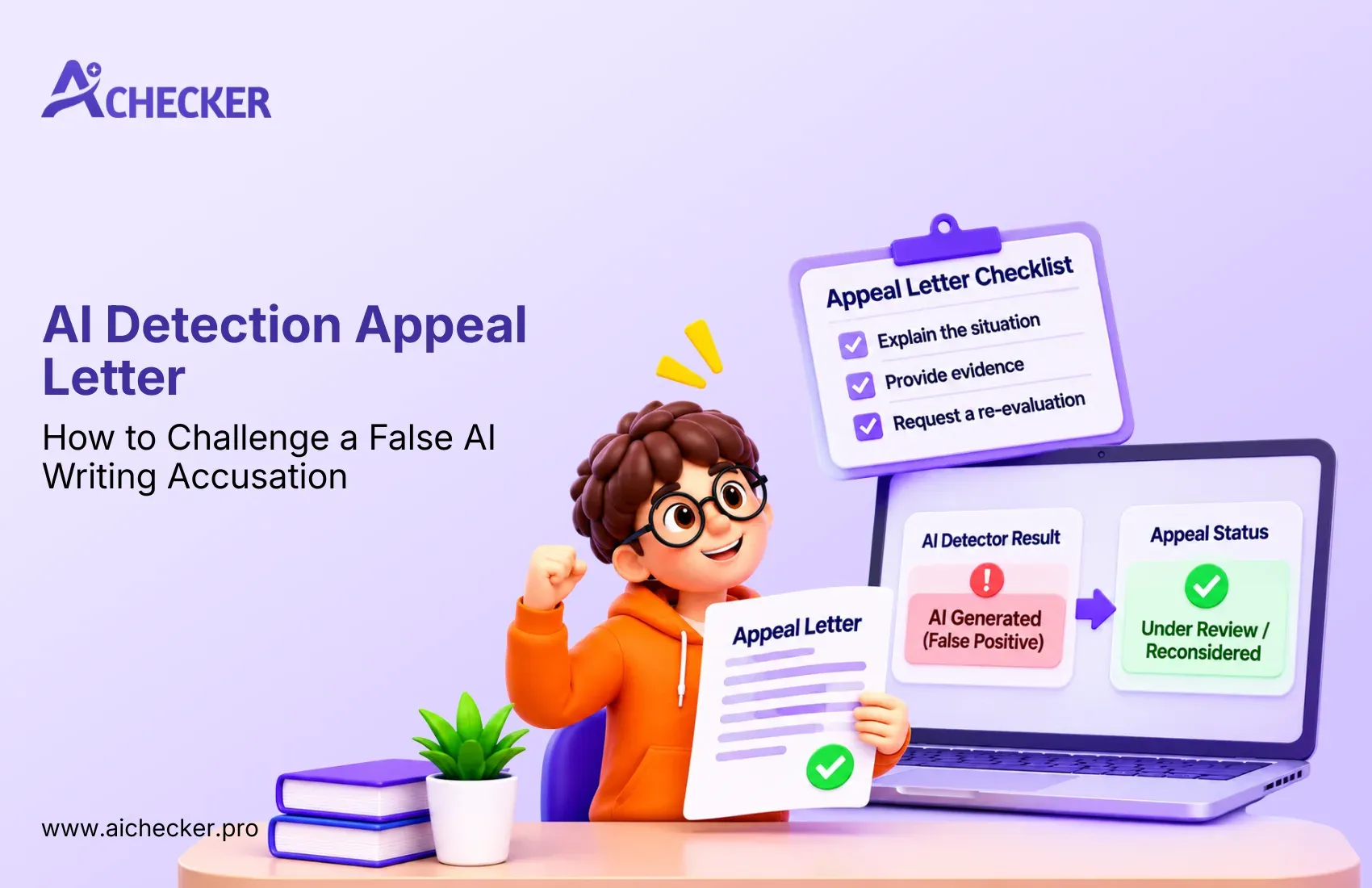
AI Detection Appeal Letter: How to Challenge a False AI Writing Accusation (2027 Guide)
TABLE OF CONTENTS
Can AI Detectors Falsely Flag Original Writing?
What Is an AI Detection Appeal Letter?
What to Do If Falsely Accused of Using AI
How to Prove Your Essay Is Human Written
What to Include in Your AI Detection Appeal Letter
AI Detection Appeal Letter Template You Can Copy
Tips to Make Your AI Detection Appeal Letter Stronger
How to Challenge an AI Detector Result Beyond the Letter
How AI Checker Pro Can Help
Conclusion
FAQs
Get an AI summary of this post on:





You open your email and see it: your professor says your essay was flagged as AI written. You wrote every word yourself, and now your grade and maybe your record are on the line. A well built AI detection appeal letter is often the first and best step you can take to fix this.
I've seen how fast these situations get stressful, and most students do not know where to begin. Let me explain this in a simple way. In this guide, you will learn what to say, what proof to attach, and how to keep your tone calm and professional. You will also get a template you can copy and adjust today.
Can AI Detectors Falsely Flag Original Writing?
Yes, they can, and it happens more than most people think. An AI detector false positive means the tool labels human writing as machine written. I've tested a lot of AI detectors, and honestly most of them are not reliable enough to be the only proof in a serious case. Turnitin and GPTZero give you a probability score, not a verdict. Even the companies behind them say the score should start a conversation, not end one.
Why does this happen? Detectors look for patterns like predictable word choice and even sentence rhythm, which is explained in more detail in this guide to perplexity and burstiness in AI detection. Some real students naturally write that way:
- Non native English speakers who learned formal phrases
- Students who write short, clean sentences
- Writers who follow a strict five paragraph format
- People who polish drafts with Grammarly
If you are facing an AI detector false accusation, remember this first. A flag is not proof. Your job is to show the real story behind your work. That is why every good AI detection appeal letter starts with facts, not feelings.
What Is an AI Detection Appeal Letter?
An AI detection appeal letter is a short, formal message where you respond to the accusation, explain how you wrote your work, and ask for a fair review. Think of it as your side of the story, backed by proof. A good AI detection appeal letter is calm, specific, and respectful. A bad one is angry, vague, and full of excuses.
Most colleges have an academic integrity process with set steps for an AI writing accusation appeal. Check your student handbook. It usually tells you who to write to, how many days you have, and what format to use. Do not skip this step. Missing a deadline can hurt you more than the accusation itself.
This is not only a student problem. A client may tell a freelance blogger that an article looks like ChatGPT and refuse to pay. The same logic applies, and you can adapt the same letter.
What to Do If Falsely Accused of Using AI
Before you type anything, slow down. I know the first reaction is panic or anger. Here is what actually works before you write your AI detection appeal letter:
- Keep every draft, note, and file.
- Do not reply while you are upset.
- Read the school policy on AI use for that class.
- Ask for the exact report, including the tool and score.
- Request a meeting if the policy allows it.
Tone matters here. Professors deal with real cheating every semester, so they start with some doubt, and it helps to understand how professors check for AI writing. A calm response helps them see you as honest.
How to Prove Your Essay Is Human Written
This is the heart of any dispute. Evidence is what makes your AI detection appeal letter believable. Gather these things:
Version history
Google Docs and Microsoft Word both save edit history, and many students wonder whether Google Docs detects AI at all. In Google Docs, open Version History and you can show hours of typing, deleting, and rewriting over several days. A pasted block of finished text looks very different. Take screenshots with the dates visible.
Notes, outlines, and sources
Handwritten notes, brainstorm lists, highlighted PDFs, and library records all help. If you saved articles in Zotero or a folder, show that too.
Older writing samples
Share past assignments from the same class. Your professor can compare voice and style. If your flagged paper looks different, explain why honestly, such as more time or a writing center visit.
An offer to explain
Offer to talk through your argument and sources out loud. If you wrote it, this is easy, and it is one of the strongest moves you can make. Also run your text through a second checker. If GPTZero says human and Turnitin says AI, that conflict shows the tools disagree.

Get Lifetime Access with 60% OFF
Stop paying monthly subscriptions. Enjoy unlimited AI detection and humanizer access forever with future updates included.
- One-time payment
- Unlimited access forever
- All future updates included
What to Include in Your AI Detection Appeal Letter
Here is how to write an appeal letter for AI detection in plain terms. A strong AI detection appeal has a clear order. Keep it to one page if you can.
- Your name, course, section, and assignment title
- A polite opening that says you are disputing the result
- A short, honest account of how you wrote the work
- A list of attached evidence
- A respectful request for a review or meeting
- Your contact details and thanks
Avoid threats, insults, and long rants. Do not call the detector garbage. Say that these tools can make errors and ask for the evidence to be reviewed. Never lie either. If you used a grammar tool or AI for brainstorming and the policy allowed it, say so plainly. Honesty protects you.
AI Detection Appeal Letter Template You Can Copy
Here is a simple AI accusation letter template. Think of it as an AI detection false positive appeal letter template that you can use as an appeal letter for AI detection in most classes. Adjust the details so it sounds like you.
Subject: Request to Review AI Detection Result for [Assignment Name]
Dear Professor [Last Name],
I am writing to respectfully dispute the AI detection result on my [assignment name] for [course and section]. I wrote this work myself, and I would like to ask for a fair review.
I started on [date] and finished on [date]. I built an outline from my class notes, read the sources in my bibliography, and wrote the draft in [Google Docs or Word]. I have attached my version history, notes, and earlier drafts so you can see how the work developed.
I understand that AI detection tools can produce a false positive, especially with formal or structured writing. I would be glad to meet and explain my argument and sources in person.
Thank you for your time. I look forward to resolving this.
Sincerely,
[Your Name]
[Student ID]
[Email]
This works as a letter to professor disputing AI detection results and as an AI detection dispute letter for other settings too. Keep your version short and personal.
Tips to Make Your AI Detection Appeal Letter Stronger
- Keep your AI detection appeal letter under one page
- Use dates, file names, and specific details
- Attach evidence instead of only claiming it
- Proofread twice, since typos hurt trust
- Send it through the official channel and keep a copy
Picture a sophomore at a large state university whose history paper gets flagged at 60 percent. She sends a one page letter, attaches two weeks of Google Docs history and her library notes, and offers to meet. A package like that is hard to ignore. A weak AI detection appeal letter has none of those details.
How to Challenge an AI Detector Result Beyond the Letter
If your first AI detection appeal gets no real answer, here is how to respond to an AI writing accusation at the next level, one step at a time:
- Ask the professor for a meeting
- Contact the department chair
- Go to the academic integrity office
- Ask whether the policy allows detector scores as sole evidence
Several universities have said publicly that detector scores alone should not decide a case, so it is fair to ask how the score was weighed. Bloggers face a different worry. Google has said it cares about helpful content, not how it was made, though mass produced low quality pages can still hurt rankings, which is covered in this piece on whether Google penalizes AI content. Your AI detection appeal letter stays the paper trail for every step.
How AI Checker Pro Can Help
Tools like AI Checker Pro help you detect AI content accurately. It is easy to use. You paste your text and get sentence level detection that shows which lines look machine written. In a dispute, that helps because you can see what a detector may react to before anyone else does. It works with text from ChatGPT, GPT 4, GPT 5, Gemini, and Claude, and it is used by 100K+ users. Run your draft through it, then use what you learn to shape your AI detection appeal letter.
Instead of rewriting manually, many users now rely on the AI humanizer included in AI Checker Pro to smooth stiff sentences in their own drafts. I have personally seen bloggers clean their content using AI Checker Pro and save hours. Use it on work you actually wrote, not to hide work you did not write. Learn more on our AI Humanizer page.
Checking your draft before you submit it can also prevent an AI plagiarism accusation in the first place, and this guide on how to check an essay before submission shows a simple way to do it.
Conclusion
Getting flagged for work you wrote yourself is stressful, but you have options. A calm, honest AI detection appeal letter backed by version history, notes, and drafts gives your professor real reasons to look again. Remember that every AI detector can produce a false positive, so a score alone is not proof. Stay respectful, follow your school's process, and keep records of everything. If you want a clearer view of how your writing reads to a detector, AI Checker Pro is a good place to start. You have more power here than you think.
FAQs
How do you write an AI detection appeal letter?
What should you include in an AI accusation appeal?
How can students challenge false AI detection results?
How do you prove your writing is human-written?
Can AI detectors falsely flag original writing?
What evidence should you provide when disputing an AI accusation?
What should you do if you are falsely accused of using AI?
How do you respond to an AI writing accusation?
How long should an AI detection appeal letter be?
Is an AI detector score enough proof of cheating?

Harshil Barvaliya
SEO Executive & Content Writer at AI Checker Pro
I’m Harshil Barvaliya, an SEO Executive and Content Writer at AI Checker Pro. I focus on improving the website’s search engine visibility through effective SEO strategies, including keyword research, on-page and off-page optimization, and content development.Get Started Free
Create a free account for advanced AI detection and scan history.
Trusted by thousands worldwide.
Recent Blog's
Discover how AI-powered content creation can elevate your website's reach and engage your audience like never before. Explore the real impact of AI on crafting content that connects.