How Do AI Detectors Work? AI Detection Algorithms Simply Explained (2027 Guide)
TABLE OF CONTENTS
How Do AI Detectors Work? The Simple Version
What Is an AI Detector Algorithm?
How Do AI Detectors Identify AI Generated Text?
What Is Perplexity in AI Detection?
What Is Burstiness in AI Detection?
Do AI Detectors Use Machine Learning?
What Features Do AI Detectors Analyze?
Can AI Detection Algorithms Detect ChatGPT?
How Accurate Are AI Detection Algorithms?
Why Do AI Detectors Produce False Positives?
Can AI Generated Text Bypass Detection Algorithms?
How Do AI Detectors Work for Students, Bloggers, and Businesses?
Where AI Checker Pro Fits In
Conclusion
FAQs
Get an AI summary of this post on:





If you have ever pasted an essay into a checker and watched a percentage pop up, you probably asked yourself, how do AI detectors work? I have tested a lot of detectors over the past couple of years, and honestly the scores can feel random. One tool says 3 percent, another says 80 percent, on the very same text.
Let me explain this in a simple way. Once you understand how do AI detectors work, the scores stop feeling like magic and start making sense. Below, I break down the math, the limits, and what you can actually do about it in 2027.
How Do AI Detectors Work? The Simple Version
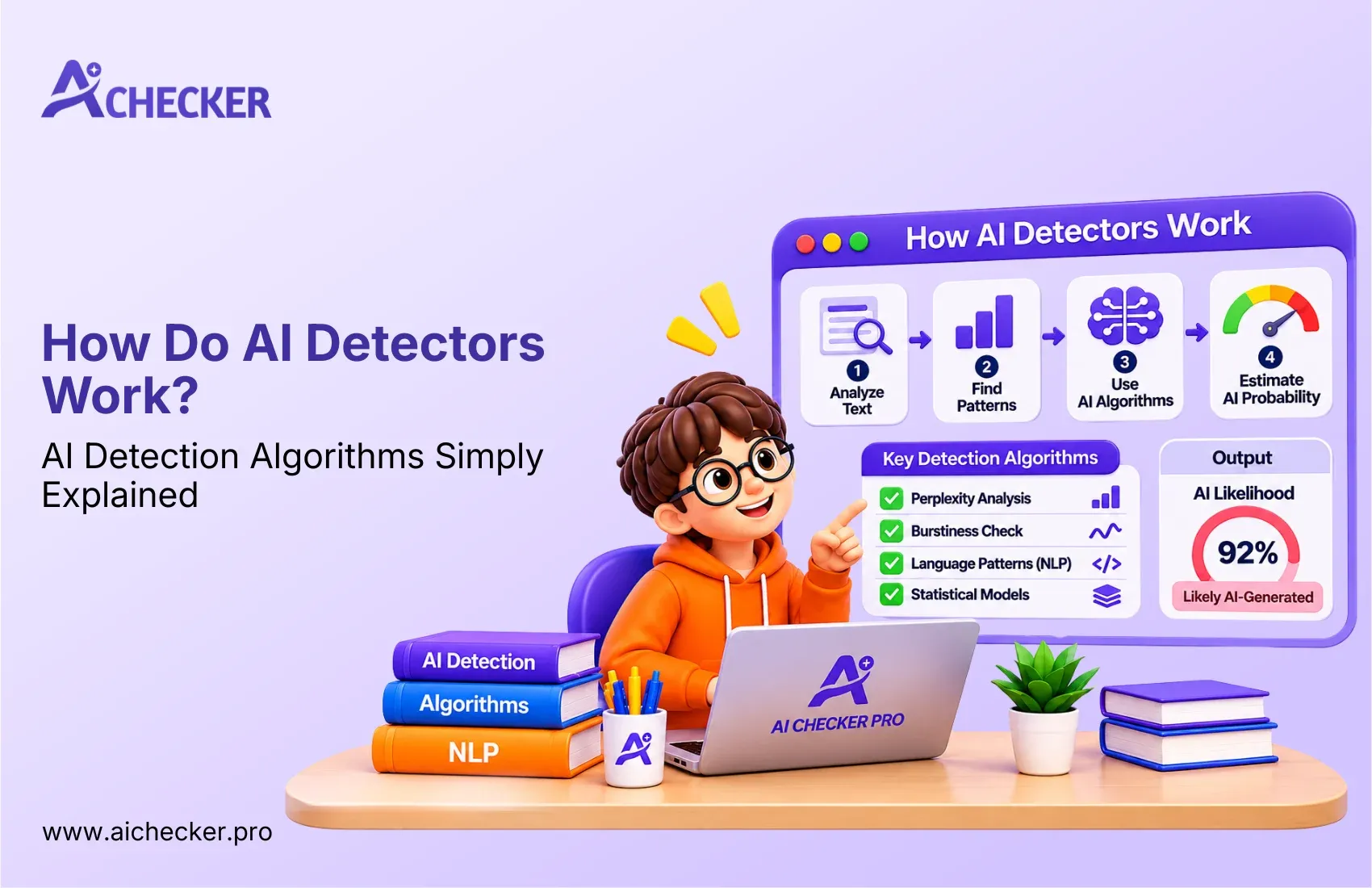
Here is the short answer. An AI detector reads your text, measures how predictable the words are, compares those patterns to examples of human and AI writing, and gives you a probability score. That is it. No detector can read your mind or see your chat history.
When I first started testing tools like GPTZero, Turnitin, and Originality, I assumed they had some secret database of ChatGPT answers. They do not. Most of them rely on AI detection technology built on statistics and training data, not on a lookup list. That is the plain answer to how do AI detectors work, and everything below builds on it.
What Is an AI Detector Algorithm?
Think of AI detector algorithms as pattern spotters. They are programs trained to notice small habits in language that humans and machines tend to show differently. A model like ChatGPT picks the most likely next word again and again. A person picks words based on mood, memory, and sometimes pure randomness.
That difference is the whole game behind how do AI detectors work. If you want to understand how AI detection works, start there.
What algorithms do AI detectors use? Two main families. The first is statistical measures like perplexity and burstiness. The second is trained classifiers that learn from labeled examples. Most modern tools mix both.
How Do AI Detectors Identify AI Generated Text?
How does an AI text detector work in the few seconds after you click the scan button? Let me walk you through it:
- The tool splits your text into small pieces called tokens, usually words or parts of words.
- A language model scores how predictable each token is.
- The tool measures patterns across sentences, like length and variety.
- A classifier compares those numbers with samples of human and AI writing.
- You get a score for the whole document and often for each sentence.
Every AI text detection algorithm follows some version of those steps, and that is the real answer to how do AI detectors work behind the scenes. This is the core of AI text classification. The detector sorts your writing into one of two buckets, human or AI, and shows how confident it is. Turnitin does this at the paragraph and sentence level, which is why you sometimes see only part of an essay highlighted.
What Is Perplexity in AI Detection?
Perplexity sounds scary, but the idea is easy. It measures how surprised a language model is by your text.
Take this sentence: "The cat sat on the mat." A model sees that coming a mile away, so the perplexity is low. Now take "The cat sat on my unpaid parking ticket." That one is a surprise, so the perplexity is high.
AI writing tends to have low perplexity because the model keeps choosing safe, likely words. Human writing usually has higher perplexity because we say odd things. This one number drives a big part of AI detection models, and it is a big piece of how do AI detectors work.
What Is Burstiness in AI Detection?
Burstiness is the second piece of how do AI detectors work, and it is all about rhythm. Humans write in bursts. We drop a long sentence with three clauses, then a short one. Like this. Then something medium again.
AI text is often smooth and even. Sentence after sentence has similar length and structure, and that flat rhythm is easy for a detector to spot. GPTZero made burstiness famous, and most modern tools now measure some version of it.
Together, these two signals are the first answer to how do AI detectors distinguish human and AI writing: AI tends to be predictable and even, while people are surprising and uneven.
Here is a quick test you can try. Read your paragraph out loud. If every sentence sounds the same, a detector will probably notice too.
Do AI Detectors Use Machine Learning?
Yes, and this is where things get more serious. Older detectors relied mostly on perplexity and burstiness. Newer ones lean on machine learning AI detection, where a model is trained on millions of examples labeled human or AI.
The training set usually includes student essays, news articles, forum posts, and text generated by ChatGPT, GPT 4, GPT 5, Gemini, and Claude. Over time, the classifier learns which word choices, sentence shapes, and transitions belong to each group. Many tools use transformer based models, the same family of technology behind the chatbots themselves.
So when people ask how do AI detectors work, the honest answer includes a trained model, not just simple math. That is also why two tools can disagree. They learned from different data.
What Features Do AI Detectors Analyze?
Beyond perplexity and burstiness, here is what AI writing detection methods usually look at:
- Word choice, like overused phrases and formal filler words
- Sentence length and structure patterns
- Repetition of ideas and transitions
- Punctuation habits and paragraph shape
- Tone that stays perfectly neutral from start to finish
- Personal details, mistakes, and quirks that machines rarely add
Notice how many of these have nothing to do with facts. Another piece of how do AI detectors work is that detectors care about style, not truth. That is why a perfectly accurate paragraph can still get flagged.
Can AI Detection Algorithms Detect ChatGPT?
Mostly yes, but not perfectly. ChatGPT has a recognizable style, and detectors have seen millions of its outputs. I tested a plain ChatGPT essay on Turnitin, GPTZero, and a few others, and the raw output was flagged almost every time.
Things changed when I edited the draft by hand. After I added personal stories, cut the generic intro, and varied my sentences, the scores dropped a lot. Same ideas, different rhythm, and a good lesson in how do AI detectors work.
Can AI Detection Algorithms Identify Every AI Model?
No. Detectors do best on models they were trained on. A newer release like GPT 5 or the latest Gemini can slip through for a while until the detector updates its training data. Open source models and lightly edited text are even harder to catch.
How Accurate Are AI Detection Algorithms?
I have tested a lot of AI detectors, and honestly most of them are not as reliable as their marketing says. Some claim 99 percent AI detection accuracy. Independent tests usually show lower numbers, especially on edited text or short samples.
Here is what affects accuracy the most when you ask how do AI detectors work in the real world:
- Length: under 150 words is hard to judge
- Editing: mixed human and AI text confuses classifiers
- Topic: technical writing often looks machine like
- Training data: older models fall behind new releases
- Writer background: non native English writers get flagged more
Turnitin has said its tool is tuned to keep false flags low, which means it can miss some AI text. Every detector makes that tradeoff. So treat any score as a clue, not a verdict.
Why Do AI Detectors Produce False Positives?
This is the part that worries students the most, and for good reason. Picture a sophomore at a state university who writes a clean, formal essay for an English class. Her sentences are tidy, her vocabulary is careful, and the detector flags 40 percent as AI. She wrote every word herself.
That happens, and it comes straight from how do AI detectors work: detectors measure predictability, not authorship. Careful writers, non native English speakers, and people who follow templates all produce low perplexity text. A 2023 Stanford study found that several detectors flagged essays by non native English writers far more often than essays by native writers.
If this happens to you, keep your drafts, notes, and version history in Google Docs. That timeline is often the best proof that you wrote the work yourself. Teachers, please remember that a detector score should start a conversation, not end one.
Can AI Generated Text Bypass Detection Algorithms?
Sometimes, yes. Paraphrasing tools, heavy editing, and adding personal voice can all lower scores. But detectors keep improving, and some now try to spot text that went through paraphrasers.
I do not recommend gaming a detector, though, and once you know how do AI detectors work, you will see why. If you are a student, your school's policy matters more than any score. If you are a blogger, Google says it rewards helpful content however it is made, but it does act on mass produced spam. What matters is whether your content is original, useful, and sounds like a real person.
How Do AI Detectors Work for Students, Bloggers, and Businesses?
Every semester I hear the same question: how do AI detectors work, and can I trust them? Knowing how AI content detectors work changes how you use them. Here is my honest take for each group:
- Students: Detectors like Turnitin look at style patterns. Keep your drafts and write in your own voice, and you will have a much easier time if a score is ever questioned.
- Teachers: Use scores as a starting point. Ask for a short chat about the paper before making any decision.
- Bloggers: Google has said it focuses on helpful content, not on who wrote it. Generic text with no real experience behind it still performs badly.
- Businesses: Your brand voice is your edge. Content that sounds like everyone else loses trust fast.
Where AI Checker Pro Fits In
I have personally seen bloggers clean their content using AI Checker Pro, so let me share how it works in practice. Tools like AI Checker Pro help you detect AI content accurately, and it does this at the sentence level. That means you can see exactly which lines sound robotic instead of getting one scary number for the whole page. Once you know how do AI detectors work, sentence level checks make a lot more sense.
Here is what people like about it:
- Easy to use
- Sentence level detection
- AI humanizer included
- Works with ChatGPT, GPT 4, GPT 5, Gemini, and Claude
- Used by 100K+ users
You paste your text, run the scan, and review the highlighted sentences. Instead of rewriting manually, many users now rely on AI Checker Pro and its built in humanizer to fix the weak spots while keeping the meaning. If you want to try that step yourself, you can use the AI humanizer.
I still recommend a final read through in your own voice. No tool replaces that.

Get Lifetime Access with 60% OFF
Stop paying monthly subscriptions. Enjoy unlimited AI detection and humanizer access forever with future updates included.
- One-time payment
- Unlimited access forever
- All future updates included
Conclusion
So, how do AI detectors work? They measure predictability and rhythm, compare your text with training data, and return a probability, not a fact. That is why AI detection accuracy varies and false positives happen. Use scores as clues, keep your drafts, and write with real experience. If you want a quick second opinion, AI Checker Pro can help you check and clean your text. Now that you know how do AI detectors work, you can decide your next step with a lot more confidence.
FAQs
What is an AI detector algorithm?
How do AI detectors analyze written text?
What is perplexity in AI detection?
What is burstiness in AI detection?
Do AI detectors use machine learning?
Can AI detection algorithms identify every AI model?
Why do AI detectors sometimes flag human written content?
Can AI generated text bypass detection algorithms?
Can AI detection algorithms detect ChatGPT?
How accurate are AI detection algorithms?

Harshil Barvaliya
SEO Executive & Content Writer at AI Checker Pro
I’m Harshil Barvaliya, an SEO Executive and Content Writer at AI Checker Pro. I focus on improving the website’s search engine visibility through effective SEO strategies, including keyword research, on-page and off-page optimization, and content development.Get Started Free
Create a free account for advanced AI detection and scan history.
Trusted by thousands worldwide.
Recent Blog's
Discover how AI-powered content creation can elevate your website's reach and engage your audience like never before. Explore the real impact of AI on crafting content that connects.