Signs of ChatGPT Writing: 15 Common Clues to Identify AI Generated Text (2027 Guide)
TABLE OF CONTENTS
Why Spotting AI Text Matters in 2027
15 Signs of ChatGPT Writing You Can Spot Fast
What Makes ChatGPT Writing Sound Unnatural?
Can You Identify ChatGPT Writing Without an AI Detector?
How Can Teachers Identify ChatGPT Written Essays?
Where ChatGPT Text Detection Tools Fit In
Conclusion
FAQs
Get an AI summary of this post on:



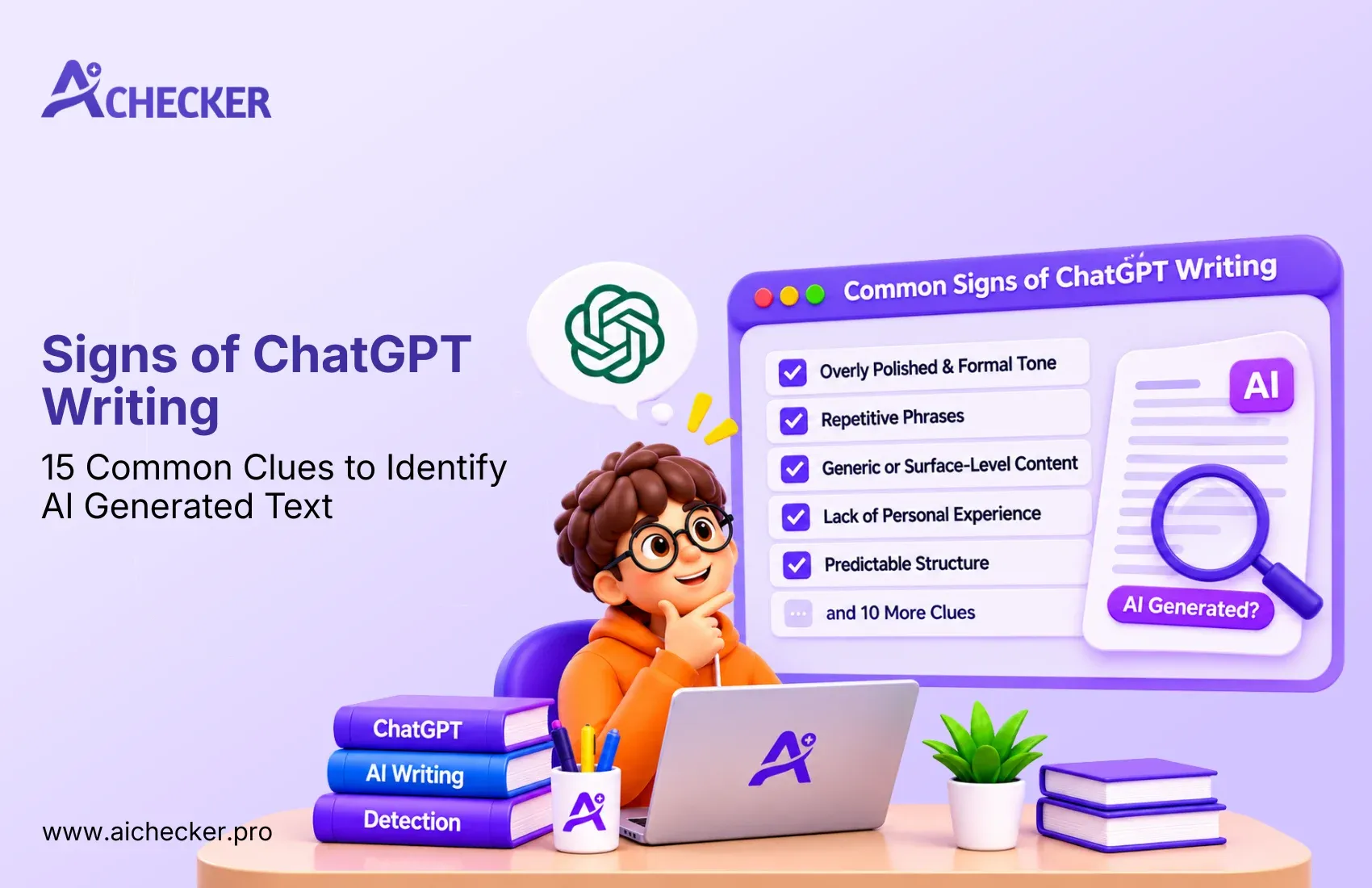
I've tested a lot of AI detectors over the past two years, and honestly most of them are not reliable on their own. That is why learning the signs of ChatGPT writing matters so much. Your own eyes and ears can catch patterns that software sometimes misses, whether you grade papers, edit blogs, or review client work. If you want a deeper walkthrough of the manual method, see this guide on how to tell if text is AI written.
In this guide, I will walk you through 15 clues I see again and again in AI text, plus a simple way to double check them. Let me explain this in a simple way: no single clue proves anything, but several together tell a clear story. Here is what actually works in 2027.
Why Spotting AI Text Matters in 2027
Students at US colleges now submit papers through Turnitin, which flags suspected AI writing. Professors run GPTZero on essays that feel off. Bloggers worry about Google's quality systems. Businesses want copy that sounds like a person wrote it. Knowing how to recognize ChatGPT writing helps every group:
- Students can fix robotic drafts before they hit submit
- Teachers can decide which essays deserve a closer look
- Bloggers can protect their rankings and reader trust
- Businesses can keep a real brand voice
Google has said it cares about helpful content, not how content was made, but generic mass produced text still performs badly. If you want to understand how that plays out, read this breakdown of whether Google penalizes AI content. Knowing the signs of ChatGPT writing helps you catch that problem early. Does your own content feel like it came from a real person?
Get Lifetime Access with 60% OFF
Stop paying monthly subscriptions. Enjoy unlimited AI detection and humanizer access forever with future updates included.
- One-time payment
- Unlimited access forever
- All future updates included
15 Signs of ChatGPT Writing You Can Spot Fast
Here are the ChatGPT writing patterns I notice most when I review essays and blog drafts. Keep in mind that one clue means very little. Look for a cluster.
1. Generic, Safe Openers
Many AI drafts start with a broad line like "In today's digital age" or "Technology has changed the world." A real writer usually jumps into a point, a story, or a number. If the first sentence could open a thousand different articles, that is a flag.
2. Transition Words in Every Paragraph
ChatGPT loves "Additionally," "However," and "In conclusion." Humans use them too, but not at the start of nearly every paragraph. Count them on a single page. If you see five or six, the text probably came from a model.
3. Favorite Buzzwords
This is one of the most common AI writing indicators. Watch for words like "tapestry," "navigate," "realm," "pivotal," "robust," and "leverage." A college freshman rarely writes "navigate the complex landscape of" in a normal essay.
4. Perfectly Even Paragraphs
Human writing is messy. Some paragraphs run long, others are one line. ChatGPT tends to produce paragraphs of nearly identical length, usually three or four sentences each. Scroll through the page and look at its shape. Does it look too neat?
5. The Rule of Three
AI loves lists of three, like "innovative, efficient, and scalable." One triple is fine. Ten triples in a 1,000 word article is a pattern, and it is one of the easiest to spot once you know about it.
6. Empty Hedging Phrases
Lines such as "It is important to note that" or "It is worth mentioning" add nothing. They are filler that makes the text sound careful without saying anything. I see these a lot in student essays pasted straight from ChatGPT.
7. No Personal Experience
This is the biggest one for me, and one of the most useful signs of ChatGPT writing. AI text rarely says "when I taught this class" or "last semester my team tested." It gives general advice with no names, places, dates, or messy details. Real experience has specifics.
8. Repetitive Sentence Structure
Check how sentences begin. If four in a row start with "This" or "The," or every sentence follows the same subject, verb, object rhythm, the writing feels flat. People vary their rhythm without thinking about it. Detection tools lean on this idea too, and you can learn more in this explainer on perplexity and burstiness in AI detection.
9. Too Balanced, No Opinion
Ask ChatGPT about a debated topic and you get both sides, politely, with no stance. A good student essay or blog post takes a position. If the writing keeps saying "there are many perspectives" and never commits, be suspicious.
10. A Tidy Summary Ending
Many AI drafts close with "In conclusion" and repeat the intro in new words. Human writers often end with a final thought, a question, or a next step. The copy and paste feel of the ending gives it away.
11. Perfect Grammar, Flat Tone
No slang, almost no typos, and very little emotion. Flawless grammar alone proves nothing, since plenty of careful writers do the same. But combined with a flat tone, it is one of the signs of AI generated writing I trust most.
12. The "Not Just X, But Y" Pattern
Sentences like "It is not just a tool, it is a game changer" show up constantly. ChatGPT also likes "whether you are a beginner or an expert." These stock structures repeat across totally unrelated topics.
13. Vague or Made Up Sources
ChatGPT can invent studies, quotes, and links that look real. Teachers at US colleges often catch this first when checking a bibliography. Search two or three citations. If the paper does not exist, you have a strong clue.
14. Formulaic Structure and Long Dashes
Bold lead ins on every bullet, headings that read like templates, and heavy use of em dashes all feel mechanical. Many readers now treat these as AI generated content signs, though some human writers love long dashes too.
15. Missing Voice and Humor
Does the writing have a personality? Real people joke, complain, and repeat favorite phrases. AI text sounds like a polite stranger. If you cannot imagine the author's voice, that matters.
What Makes ChatGPT Writing Sound Unnatural?
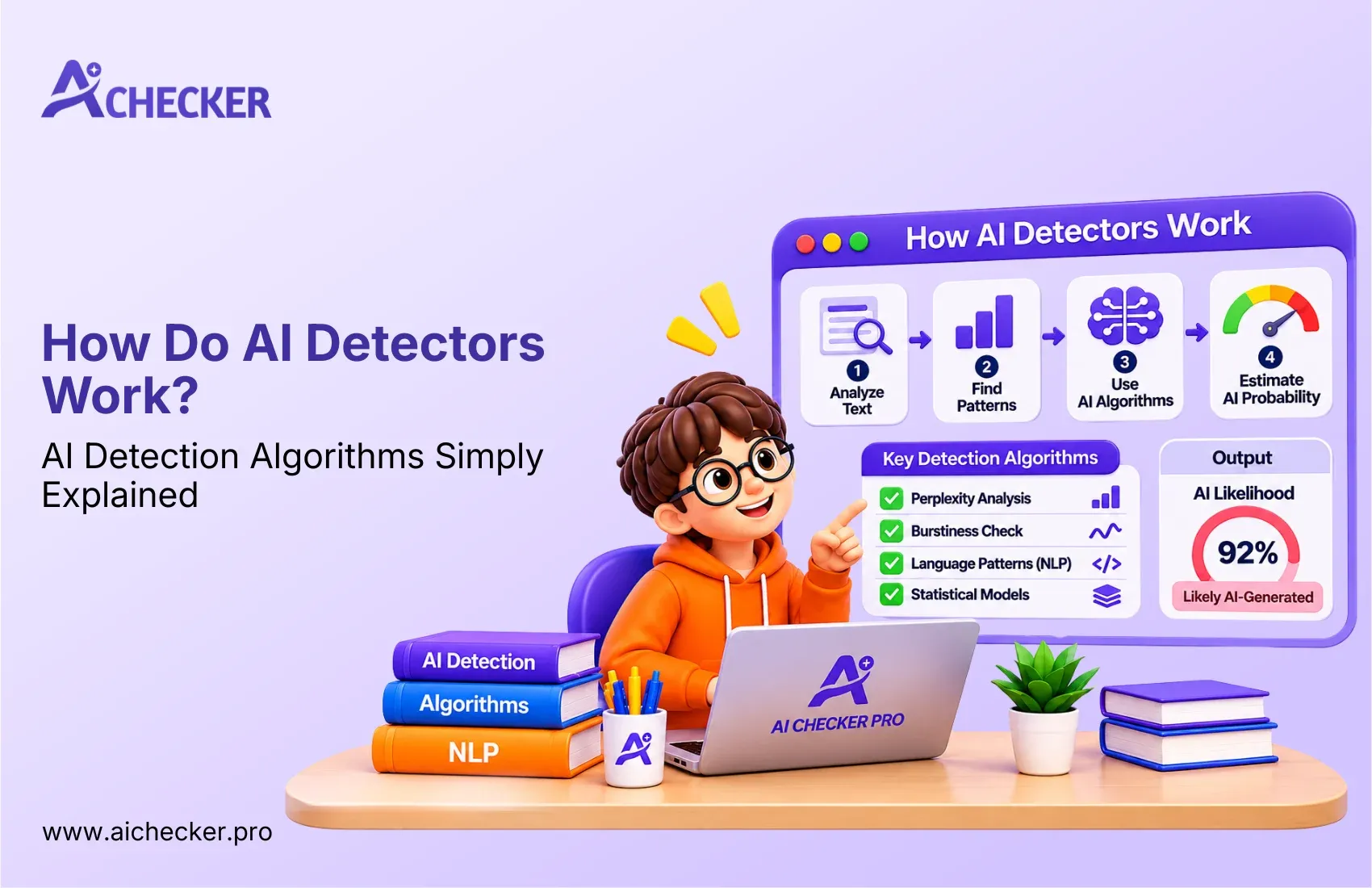
The root cause is simple. ChatGPT predicts the most likely next word, so it plays it safe. That creates smooth text with no surprises. These characteristics of AI writing include average word choices, a polite neutral tone, and ideas that stay on the surface. For a plain language look at the technology behind this, see how AI detector algorithms work, simply explained.
Real writers take risks, make odd comparisons, and sometimes break rules on purpose. Think of it like a stock photo. Nothing is wrong with it, but nothing is memorable either.
Can You Identify ChatGPT Writing Without an AI Detector?
Yes, to a point. Here is the quick routine I use before opening any tool:
- Read the text out loud and listen for stiff or repetitive rhythm
- Check two or three facts, quotes, or citations
- Compare the writing to the person's earlier work
- Ask the writer to explain a paragraph in their own words
- Look for real examples, names, and personal details
This is the most practical way to learn how to identify AI written content without paying for anything. Imagine a student who writes casual emails but turns in a paper full of polished corporate phrases. That jump is worth a conversation, not an accusation.
How Can Teachers Identify ChatGPT Written Essays?
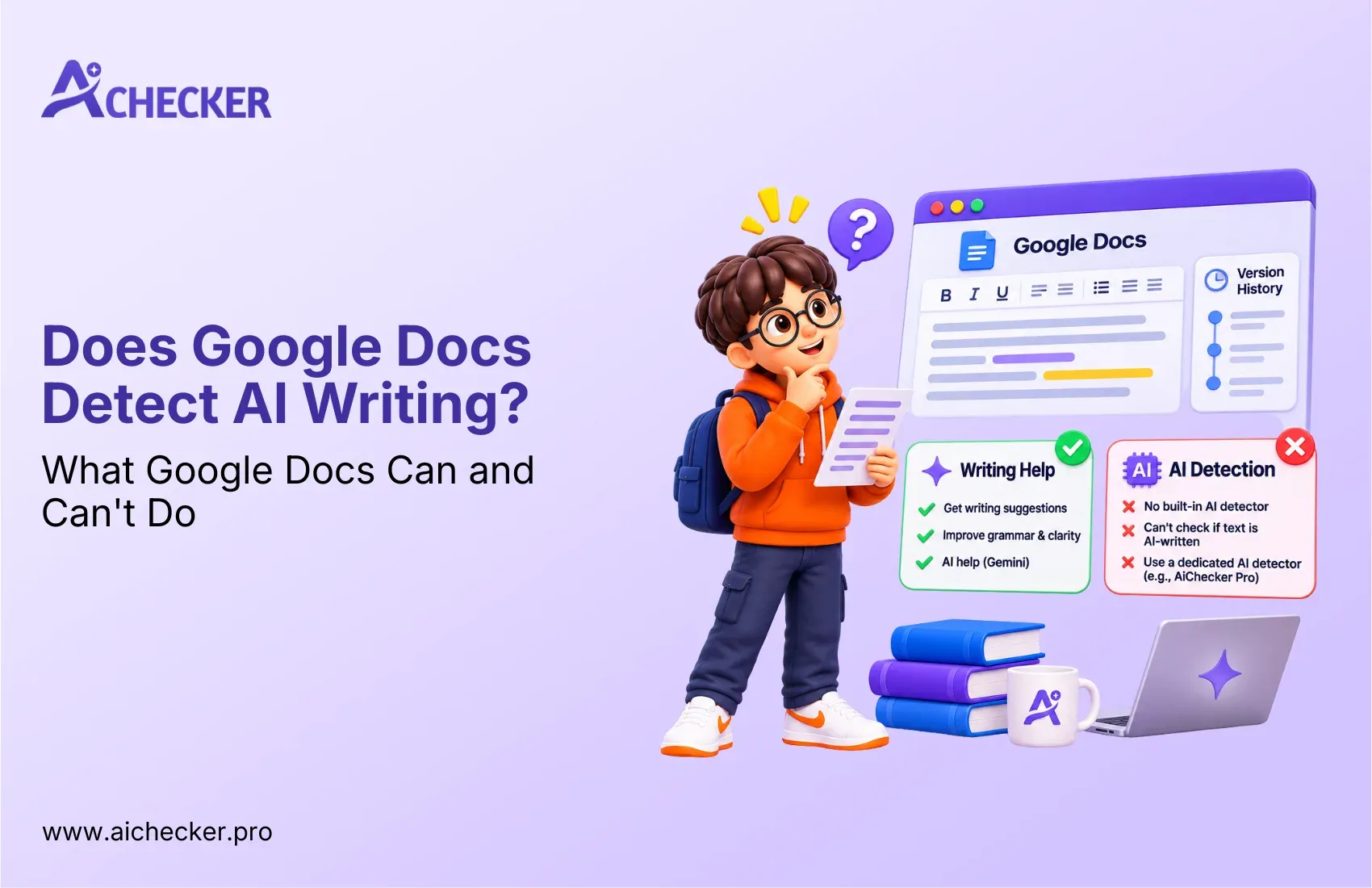
If you teach at a US college, start with process, not software. Ask for outlines, drafts, and version history in Google Docs. A student who wrote the paper can usually talk through it. Turnitin and GPTZero give a probability, not a verdict, and both can produce false positives, especially for non native English writers. Teachers who want a fuller playbook can use this AI detector guide for teachers. Treat a flag as the start of a conversation, never as the only evidence.
Where ChatGPT Text Detection Tools Fit In
Manual checks are useful, but they get slow when you review dozens of pieces. That is where ChatGPT text detection software helps. I have tried Turnitin reports, GPTZero, and several free checkers, and the results often disagree on the same text. If you want to compare options, here is a roundup of the best AI detector tools.
Tools like AI Checker Pro help you detect AI content accurately. What I like is the sentence level detection, so you see exactly which lines look machine written instead of getting one vague score. It is easy to use, works with ChatGPT, GPT 4, GPT 5, Gemini, and Claude, and is used by 100K+ users, including students, teachers, and bloggers.
Instead of rewriting manually, many users now rely on AI Checker Pro and its built in AI humanizer to smooth out robotic sections. I have personally seen bloggers clean their content using AI Checker Pro before publishing, then add their own edits on top. Bloggers in particular can start with the AI detector for bloggers.
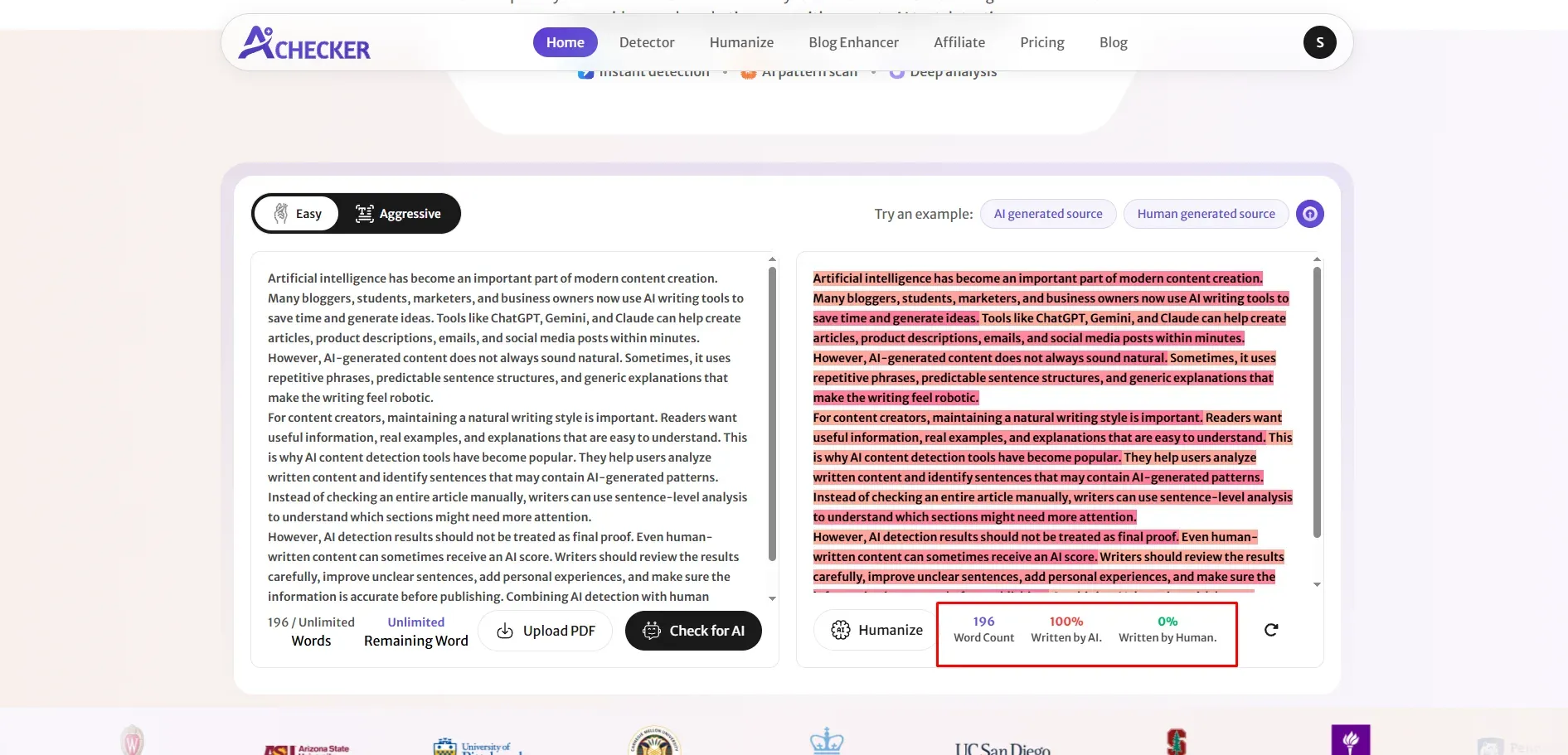
Still, no tool is perfect. Use detector results alongside the AI writing indicators from this guide, and you will make better decisions than either method gives you alone. Combining your judgment with a detector is the best way to handle the signs of ChatGPT writing in real work.
Conclusion
Spotting the signs of ChatGPT writing comes down to patterns, not guesses. Generic openers, buzzwords, even paragraphs, hedging phrases, and a missing personal voice all point toward AI text, especially when several show up together. Use your own judgment first, then add a detector like AI Checker Pro for sentence level backup. Whether you are a student, teacher, blogger, or business owner, the goal is the same: content that sounds like a real person wrote it. Which of these clues have you noticed in your own reading lately?
FAQs
What are the common signs of ChatGPT writing?
How can you tell if text was written by ChatGPT?
Does ChatGPT use repetitive phrases?
Can human-written text sound like ChatGPT?
Can AI detectors confirm ChatGPT authorship?
How reliable are writing patterns for identifying AI text?
What phrases does ChatGPT commonly use?
How can teachers identify ChatGPT-written essays?
Can you identify ChatGPT writing without an AI detector?
What makes ChatGPT writing sound unnatural?

Harshil Barvaliya
SEO Executive & Content Writer at AI Checker Pro
I’m Harshil Barvaliya, an SEO Executive and Content Writer at AI Checker Pro. I focus on improving the website’s search engine visibility through effective SEO strategies, including keyword research, on-page and off-page optimization, and content development.Get Started Free
Create a free account for advanced AI detection and scan history.
Trusted by thousands worldwide.
Recent Blog's
Discover how AI-powered content creation can elevate your website's reach and engage your audience like never before. Explore the real impact of AI on crafting content that connects.